This volume celebrates Peter Edbury's career by bringing together seventeen essays by colleagues, former students and friends which focus on three of his major research interests: the great historian of the Kingdom of Jerusalem, William of Tyre, and his Historia rerum in partibus transmarinis gestarum and its continuations; medieval Cyprus, in particular under the Lusignans; and the Military Orders in the Middle Ages. All based on original research, the contributions to this volume include new work on manuscripts, ranging from a Hospitaller rental document of the twelfth century to a seventeenth-century manuscript of Cypriot interest; studies of language and terminology in William of Tyre's chronicle and its continuations; thematic surveys; legal and commercial investigations pertaining to Cyprus; aspects of memorialization, and biographical studies. These contributions are bracketed by a foreword written by Peter Edbury's PhD supervisor, Jonathan Riley-Smith, and an appreciation of Peter's own publications by Christopher Tyerman.
1 Some New Light on the Composition Process of William of Tyre’s Historia
Benjamin Z. Kedar
In their insightful study of William of Tyre’s chronicle – which they proposed calling Historia Ierosolimitana – Peter Edbury and John Gordon Rowe maintained that William drafted a substantial part of it before he left for Rome in 1178 in order to participate in the Third Lateran Council, and that he repeatedly and extensively revised it after his return to the Kingdom of Jerusalem about two years later. They put forward the hypothesis that it was primarily William’s wish to render the Historia interesting for the prelates he had met at the Council that stimulated him to undertake the revisions.1
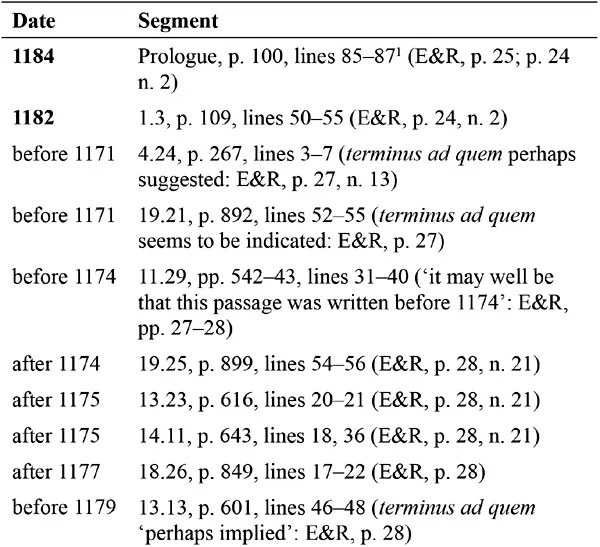
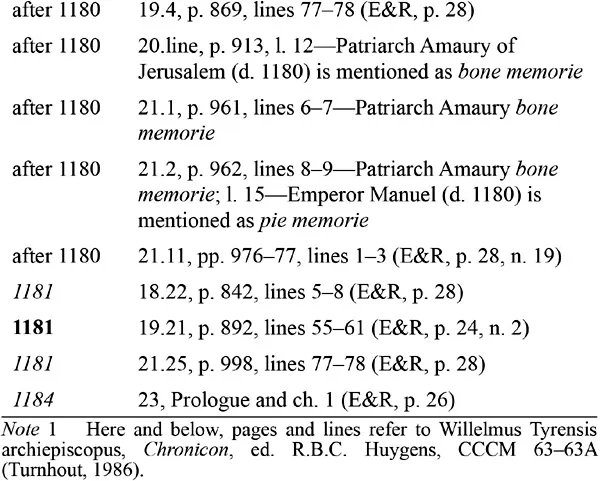
Edbury and Rowe also offered, whether in their text or in the footnotes, clues for the dating of specific segments of the chronicle. They discussed the three passages in which William explicitly spelled out the years of the Christian era in which he was writing (in the list below, these years appear in bold face) and pointed out that in all three instances the Christian date was introduced as the purported equivalent of the hijri date on which William’s history of the Muslim world ended, yet in two of them the Christian equivalent he offered was erroneous. They also dated three other passages (their dates appear below in italics) and proposed a terminus ad quem or a terminus a quo for ten further ones. To the latter we may add three passages that must have been written after 1180 (the reason in each case is spelled out below).
When these 19 segments are listed according to the order in which they appear in the Historia, the result may be seen in Table 1.1.
Thus all six accurately datable segments were written in the early 1180s: two are in the Prologue to the entire Historia and in Book 1, three in Books 18, 19 and 21, while whatever has come down to us of Book 23 must have been composed in 1184. To the list we may add Book 22, which, dealing as it does with events of the years 1180–83, must also have been written during that span of time. But while the Prologue and Book 1 contain statements that date from the 1180s, we cannot assume for that reason that these two segments were written in their entirety in the 1180s.
Table 1.1 Datable segments in William of Tyre’s Historia
The dated statements may well have been insertions that William introduced into these sections as he was revising the chronicle. The same is true for the dated passages in Books 18, 19 and 21. Indeed, in Book 19, chapter 21, lines 52–55, William apparently asserts that the Fā
imid caliphate was still in existence, which would mean that he was writing this sentence before Saladin brought an end to the Fā
imid dynasty in September 1171; but in the very next sentence (lines 55–61) he announces that he was writing in the year 1181, presented as the equivalent (correct, in this case) of 577 AH. Presumably the latter sentence was added during one of William’s revisions, while the earlier one was written more than a decade earlier. Thus the scrutiny of William’s datable segments allows for the conclusion that his chronicle contains, even near its beginning, sentences that were written in the 1180s, whereas a sentence of a late section may reflect a draft written even before 1171. In sum, the examination reveals that William worked on the Historia for a period of more than fifteen years and permits dating some segments more or less precisely; but it does not provide clues to the possible existence of different redactions of the Historia.
It is the purpose of the present essay to draw attention to what may amount to such a clue. As part of an ongoing study of the usage of the terms Ecclesia Dominici (or Sancti) Sepulchri and Ecclesia Dominice (or Sancte) Resurrectionis, I checked their occurrence in William’s chronicle. The examination revealed that throughout Book 1 William refers consistently to the edifice as the Church of the Resurrection, whether speaking of its destruction by the Caliph al-Hākim, its restoration in 1048 or the revelation Peter the Hermit had in it.2 Moreover, in his version of Urban II’s Clermont Address, he has the pope dwell on the defilement of Sancte Resurrectionis ecclesia.3 And when William returns to mention the church in his description of Jerusalem and its conquest in 1099 in Books 7 and 8, he refers to it as ecclesia Dominice Resurrectionis, Sancte Resurrectionis ecclesia or dominice passionis et resurrectionis ecclesia.4 Of course William mentions also the Lord’s Sepulchre,5 but the church is regularly named after the Resurrection.
From Book 9 onward, the two terms alternate with one another. The True Cross was found in a part of the Church of the Holy Resurrection and Godfrey allotted a quarter of Jaffa to it;6 but it was to the canons of the ecclesia Dominici Sepulchri that he assigned prebends, and it was there that he was buried, as were his successors ‘down to the present day’.7 Indeed, William subsequently reports that kings Baldwin I, Baldwin II and Fulk were buried, each in his turn, in ecclesia Dominici Sepulchri;8 he also relates that kings Baldwin III, Amaury and Baldwin IV were crowned there.9 It is impossible to detect, in this part of the chronicle, a consistent preference for either of the two terms. Thus, in Book 10 the agreement between Godfrey of Bouillon and Patriarch Daibert, made in ecclesia Dominice Resurrectionis, is mentioned; in Book 13 Patriarch Stephen claims Jaffa for the church of the Lord’s Resurrection; in Book 15 Bethany is said to have belonged to the church of the Lord’s Sepulchre; in Book 16 the ecclesia Dominici Sepulchri is hit by a thunderbolt; in Book 18 the gates of the church of the Holy Resurrection are mentioned twice; and in Book 21 the chronicle’s author himself is consecrated in the church of the Lord’s Sepulchre as archbishop of Tyre.10 The single consistency pertains to the priors, canons, chapter and cloister of the church, who are always ‘of the Lord’s Sepulchre’ or ‘of the Church of the Lord’s Sepulchre’,11 whereas the patriarch of Jerusalem presides, in 1163, over the church of the Holy Resurrection.12
However, in the single instance in Book 22 (which, as we have seen, must have been written in the early 1180s) in which the edifice is mentioned without reference to the prior and canons of its chapter, we read that King Baldwin V’s coronation took place in ecclesia Dominice Resurrectionis.13 This is hardly an accidental statement, contrasting starkly as it does with the accounts in Books 16, 19 and 21, according to which all three previous kings were crowned in ecclesia Dominici Sepulchri.14 In the rump Book 23 the edifice goes unmentioned. Thus the exclusive recourse to the term ecclesia Dominice (or Sancte) Resurrectionis in Books 1, 7 and 8, and in the description of Baldwin V’s coronation in Book 22, allows for the following hypothesis, which incorporates also the above-mentioned conclusions of Edbury and Rowe: at some point in the early 1180s William decided to apply this term systematically throughout the chronicle, but he managed to do so only for the Historia’s early part. Consequently we may consider Books 1–8 – i.e., the Historia’s section that deals with the First Crusade – as the chronicle’s second redaction; the Prologue, written in 1184, and Books 22–23 may be regarded as coeval with or belonging to it, while Books 9–21 would represent an earlier redaction, into which William introduced a number of insertions, most of them apparently in the 1180s (see Table 1). Of course there is no reason to assume that in preparing the hypothesized second redaction William was concerned only with publicizing the term ‘the Church of the Lord’s Resurrection’. It may be worthwhile to look for other characteristics distinguishing the purported second redaction from the earlier one.
But what is the significance of the term ecclesia Dominice (or Sancte) Resurrectionis, and what might have induced William to publicize it in the early 1180s?
The term made its appearance in Frankish documents in the 1130s,15 sometimes alongside the traditional ecclesia Dominici Sepulchri, but in the intitulation of Jerusalem’s patriarchs it became virtually exclusive. While the earlier patriarchs presented themselves simply as patriarchs of Jerusalem,16 Patriarch Foucher (1146–57) styled himself in his charters as ‘Patriarch of the Church of the Sacrosanct [or: the Holy] Resurrection of Christ Our God’, and on his seals as ‘Patriarch of the Church of the Holy Resurrection’.17 Foucher’s successors who resided in Frankish Jerusalem, Amaury (1157–80) and Eraclius (1180–87), used the new title both in their charters and on their seals.18 The shrine’s new name evidently attests to Oriental Christian influence. In Greek, the shrine was known as the Anastasis – that is, the Resurrection; Arabic-speaking Christians called it al-qiyāma, which means the same. Indeed, on the obverse side of the seals of patriarchs Fulcher, Amaury and Eraclius there appears the shrine’s Greek name, H ANACTACIC.19 But the new name points also to a shift in emphasis. The term ‘Holy Sepulchre’ could be understood to connote that the Tomb was sacred because it had served as the temporary abode for Christ’s body. Of course, believers knew that the burial was followed by the Resurrection, and that the empty Tomb was one of its proofs. But while the term ‘Holy Sepulchre’ does connote the Resurrection, the term ‘Resurrection’ points to it directly.20 Moreover, ‘Resurrection’ denotes Christ’s own rising as well as his raising of the dead, and the Franks came to stress both aspects: the patriarchal seals of Foucher, Amaury and Eraclius show Christ striding to the left with the cross in his left hand while with his right hand he drags upward a small crouching figure. This is the scene known as Christ’s Harrowing of Hell, which depicts Christ as rising from the underworld kingdom of the dead and rescuing Adam and others.
An urgent call to help the Frankish Kingdom, which Patriarch Amaury of Jerusalem dispatched to all Christians in 1166,21 reveals the paramount importance he ascribed to his custodianship of the site of the Resurrection. As is well known, when the popes offered the crusaders a remission of sins, they announced that they were authorized to do so by God and Saint Peter, and underscored that they were following the precedent established by Pope Urban II and his successors. Patriarch Amaury, in his call for help, offered more than did the pope of that time, Alex...
Table of contents
Cover Page
Title Page
Copyright page
Contents
Abbreviations
List of Contributors
Foreword: Peter Edbury
Preface
PART I: WILLIAM OF TYRE
PART II: CYPRUS
PART III: THE MILITARY ORDERS
PART IV: AFTERWORD
Peter Edbury’s Publications
Index
Trusted by 375,005 students
Access to over 1.5 million titles for a fair monthly price.
Study more efficiently using our study tools.
Frequently asked questions
Yes, you can cancel anytime from the Subscription tab in your account settings on the Perlego website. Your subscription will stay active until the end of your current billing period. Learn how to cancel your subscription
No, books cannot be downloaded as external files, such as PDFs, for use outside of Perlego. However, you can download books within the Perlego app for offline reading on mobile or tablet. Learn how to download books offline
We are an online textbook subscription service, where you can get access to an entire online library for less than the price of a single book per month. With over 1.5 million books across 990+ topics, we’ve got you covered! Learn about our mission
Look out for the read-aloud symbol on your next book to see if you can listen to it. The read-aloud tool reads text aloud for you, highlighting the text as it is being read. You can pause it, speed it up and slow it down. Learn more about Read Aloud
Yes! You can use the Perlego app on both iOS and Android devices to read anytime, anywhere — even offline. Perfect for commutes or when you’re on the go. Please note we cannot support devices running on iOS 13 and Android 7 or earlier. Learn more about using the app
Yes, you can access Deeds Done Beyond the Sea by Susan B. Edgington,Helen J. Nicholson in PDF and/or ePUB format, as well as other popular books in History & European Medieval History. We have over 1.5 million books available in our catalogue for you to explore.