eBook - ePub
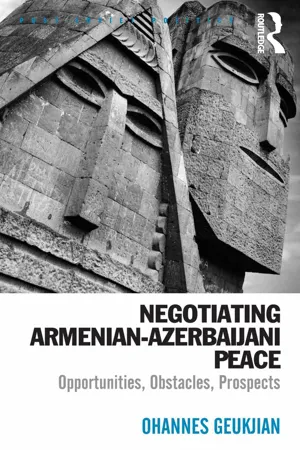
Negotiating Armenian-Azerbaijani Peace
Opportunities, Obstacles, Prospects
- 300 pages
- English
- ePUB (mobile friendly)
- Available on iOS & Android
eBook - ePub
About this book
Conflict resolution, conflict management and conflict transformations are major themes in this unique book which examines, explores and analyses the mediation attempts of the Organization for Security and Cooperation in Europe in the Nagorno-Karabakh conflict. Ohannes Geukjian shows the most striking characteristic of a protracted internal conflict such as this is its asymmetry and explains that, without meeting basic human needs like identity, recognition, security and participation, resolving any protracted social conflict is very difficult. The Armenian Azerbaijani case demonstrates how official diplomacy may not be able to solve protracted internal conflicts as, without addressing the real causes of the problematic relationship, attempts at peace making will always be sporadic and the space for mutual understanding and compromise shrink. Geukjian shows that conflict transformation has a particular salience in asymmetric conflicts such as this where the goal is to transform unjust relationships and where a high degree of polarisation between the disputants has taken root. Using the Nagorno-Karabakh case, this book focuses on the anatomy and causes of deadlock in negotiations and highlights the many difficulties in achieving a breakthrough.
Information
Chapter 1
Introduction, Approaches, Methodology and Structure
Introduction
This book seeks to provide a balanced and comprehensive analysis of the unfinished business of the Armenian-Azerbaijani negotiations over Nagorno-Karabakh (N-K). The cause of the conflict is ethno-territorial. We also categorise the conflict as identity/secession-based because it involves the relative status of Karabakh Armenians in relation to Azerbaijan. Thus, a solution must be found through a formula that meets both the Armenian demand for self-determination and Azerbaijan’s demand for territorial integrity. The most striking characteristic of the N-K internal conflict is its asymmetry. Negotiations under conditions of asymmetry have been very difficult because they are perceived by the conflict parties as zero-sum. This research applies Edward Azar’s and John Burton’s human needs theory to explain and analyse the protracted and intractable nature of the N-K conflict and to emphasise that deprivation of human needs such as security needs, identity needs and political access needs are the underlying sources of the conflict. Hatreds between the Armenians and Azerbaijanis who claimed the same land, which escalated to reciprocal atrocities, cannot be understood or managed by simply dealing with tangible issues. Equally important, without addressing these ontological needs it is very unlikely the conflict will be resolved. The peace process that started in 1992 reflects and demonstrates decades of unsuccessful Armenian-Azerbaijani negotiating habits because the negotiators have been primarily motivated by promoting and protecting their national interests. Traditional diplomacy has been used to achieve a diplomatic solution within a framework of compromise on these interests. For Azerbaijan the bottom line has been to protect the territorial integrity of the state by preventing the separatists (Karabakh Armenians) to gain international recognition. For Armenia the bottom line has been to prevent the restoration of Azerbaijani sovereignty over N-K and if possible gain de jure independence. Thus, solutions must be found through a formula that meets both the secessionist’s demands for self-determination and Azerbaijan’s demands for territorial integrity.
The struggle continues and negotiation suffers because the negotiators have failed to address the psychological elements of the conflict, such as the long-standing animosities rooted in a perceived threat to identity and survival. It is important to acknowledge that the contested issues of the conflict, such as territory, security and identity, are intimately rooted in the psychological and cultural elements sustaining the conflict. This book aims to highlight that there exists a historical pattern for failed Armenian-Azerbaijani negotiations which the mediators must break if they are genuinely to achieve progress.
Negotiating Armenian-Azerbaijani Peace presents an uninterrupted examination of the Armenian-Azerbaijani peace process since 1992. We take into account the parameters of the historical times in which the negotiations took place and the conflicting and divergent interests of the internal and external actors in the conflict. In addition to the three internal actors (Armenia, Azerbaijan and the Karabakh Leadership), the motives, views and interests of the external actors (Russia, Turkey, Iran and the US) are fully examined. The divergent viewpoints of Armenia and Azerbaijan are essential components of each party’s position of the conflict and explain how each party can perceive itself the victim and the other the aggressor. Where important we have striven to include throughout the book the rival and contrasting interpretations of these actors, thereby allowing the reader to explore alternative perspectives.
This book also examines and analyses the mediation of the Organization for Security and Cooperation in Europe (OSCE) in the N-K conflict and the peace process associated with it from 1992 to the present. Certainly, Russia, Turkey and Iran have expressed readiness to mediate the conflict in order to promote their interests in the South Caucasus region but the OSCE has been the primary forum for mediation, led by a subset of OSCE members called Minsk Group (MG), Co-Chaired by the US, France and Russia. The OSCE is another external actor in the conflict and has an interest in its outcome. The entry of the OSCE as a third party in the conflict has changed the conflict structure and has allowed a different pattern of communications enabling the MG to reflect back the messages, attitudes and behaviour of the disputants. Certainly the MG has facilitated negotiations between the conflict parties but we acknowledge that our take on the Karabakh peace process is significantly less optimistic. We do believe that Armenian-Azerbaijani peace is possible, but the two decades of negotiations have taught us to be ever more aware of the historical depth of the conflict, the immensity of the challenge facing the internal parties and the MG who would resolve it and the unpredictable actions of the spoilers whose interests are threatened whenever a negotiated agreement has come into sight.
The approaches of conflict resolution, conflict management and conflict transformation are major themes in this book. The first aim of the book is to explain that the most striking characteristic of the N-K conflict is its asymmetry. We argue that negotiations under conditions of asymmetry become very difficult, if not impossible, because the most propitious conditions for resolving conflict are difficult to obtain. As William Zartman notes, ‘a mutually hurting stalemate defines the moment as ripe for resolution’.1 However, a mutually hurting stalemate is yet to be perceived by the conflict parties. The asymmetry found in the Karabakh conflict and the negotiations is that the position of the Karabakh Leadership is totally fixed on the conflict, which involves its existence, whereas Azerbaijan, in addition to its commitment to the territorial integrity of the state, has many interests too. This situation has created the zero-sum conflict.
The second aim of this book is to explain that without meeting basic human needs, like identity, recognition, security and participation, resolving the protracted social conflict (PSC) of N-K is difficult because these human needs are ontological and biological drives for survival.2 In other words, these needs are not negotiable. Our analysis focuses on the identity group (that is, Karabakh Armenians), emphasising that it is the relationship between the identity group and the state (Azerbaijan) which is at the core of the conflict. This research promotes the idea that the Karabakh conflict cannot be resolved without redressing identity, security and recognition needs. As John Paul Lederach notes, ‘Peacebuilding must be rooted in and responsive to the experiential and subjective realities shaping people’s perspectives and needs’.3
The third aim of this book is to demonstrate that official or track one diplomacy may not solve protracted internal conflict, because without addressing the real causes of the conflict and the problematic relationship between the Armenians and Azerbaijanis, attempts at peacemaking will often be sporadic and the space of mutual understanding and compromise shrink. It is worth noting that the diplomatic approach to conflict resolution has been ill suited to address the nature of the Karabakh conflict because the conflict is characterised by deep-rooted and long-standing animosities that are reinforced by high levels of violence and experiences of atrocities. This requires the adoption of an approach that goes beyond statist diplomacy and a framework that addresses and engages the relational aspects of the peacebuilding process. We refer to many frustrated attempts to negotiate an end to the Karabakh conflict and attribute the reason to the top-level approach that has been adopted by the mediators. The negotiators have been locked into positions taken with regard the perspectives and issues in the conflict and they refused to render concessions because retreating from the publically stated goals is seen as weakness or loss of face. We write with sobering certainty that both sides will experience more frustrating attempts to end the conflict if they do not adopt an approach that concentrates on the identity groups in the conflict and acknowledge the power and potential of middle-range leaders who, if integrated properly, may provide the key to creating an infrastructure for achieving peace.
The fourth aim of this book is to highlight and explain that conflict transformation has a particular salience in asymmetric conflicts in that the goal is to transform unjust relationships and high degree of polarisation between the disputants where stereotyping and demonisation have taken root. We use conflict transformation to understand the peace process, where transformation denotes a number of necessary transitional steps like actor transformation and issue transformation. This approach implies a deep transformation in the conflict parties and their relationships and in the situation that created the conflict. So far the parties have been unable to establish a breakthrough and resolve the incompatible issues of territorial integrity and self-determination. Thus, resolving the conflict must involve a set of dynamic changes that include a de-escalation of conflict behaviour, a change in attitudes and transforming the relationships or the divergent interests that are at the core of the conflict structure. Conflict transformation also requires real changes in the disputants’ interests, goals and self-definitions. We strongly believe that a multitrack approach is necessary to resolve the conflict, relying on interventions by different actors at different levels.
Within this context, this book also examines the anatomy and causes of deadlock in the Karabakh negotiations and advances three causal hypotheses that explain the occurrence of deadlock in the negotiations and, hence, the difficulty of a compromise solution to settle the conflict. The book also offers three solution sets that will be addressed in the conclusion. We define deadlock in the Karabakh negotiations as a protracted situation of no agreement, where the Armenian and Azerbaijani sides are unable to move forward whatever they do. Obviously, both sides have inflexible positions and lack of commitment or desire to resolve the conflict. The deadlock may trigger escalation, as sporadically has been happening on the line of contact that separates the warring sides, and create a feeling that a compromise is no longer attainable. In order to better understand deadlock in the negotiations the three hypotheses are tested in the subsequent chapters of this book. The first hypothesis is Best Alternative to a Negotiated Agreement (BATNA) related, the second hypothesis is uncertainty related and the third hypothesis is ideas related. We formulate the three hypotheses as follows:
Hypothesis 1 (H1): Deadlock occurs because of superior BATNA or occurs whenever and as long as the disputants believe their alternative to compromise agreement is superior to the peace plan on offer.
Hypothesis 2 (H2): Deadlock occurs because the negotiating disputants bluff and lie.
Hypothesis 3 (H3): Deadlock occurs because fairness and justice matter.
Consequently, we describe and analyse throughout the chapters of this book the obstacles (as the title indicates) that prevented a mutually acceptable settlement of the conflict and provide evidence to explain why deadlock occurred during the different stages of the negotiations since 1992. Additionally, we also explain the role of the OSCE MG, as the main third-party mediator, and the other regional actors of Russia, Turkey and Iran in the creation and resolution of deadlock.
The South Caucasus region that comprises the states of Armenia, Azerbaijan and Georgia (see Map 1) is also highlighted in this research because it occupies a key strategic location, squeezed between the Black and Caspian Seas, Iran, Russia and Turkey. The region constitutes an important land bridge between Asia and Europe, physically linking the Caspian Sea region and Central Asia with the Black Sea and Western Europe. It is an important transport and communications corridor, particularly as a transit route for oil from the Caspian Sea to international markets. The stability of the South Caucasus is threatened by its geopolitical and geostrategic significance, as well as security challenges, including the unresolved conflicts of the breakaway regions of N-K (in Azerbaijan), South Ossetia and Abkhazia (in Georgia).4 This book explores and examines the relations between the major external actors of Russia, Turkey and Iran with the internal actors of Armenia and Azerbaijan as well as the policy of the US with regard Russia and the region as a whole. This book examines the impact of the Armenian-Russian and Azerbaijani-Turkish alliances on the Karabakh conflict and its further polarisation. Russia’s dominant role in the region is particularly emphasised to demonstrate its desire to play a leading role in resolving the conflicts and preventing US and Western penetration in the region. Russia desires to play the role of arbiter and peacekeeper in the region. Russia tends also to reduce the influence of Turkey and Iran in the region rather than encourage genuine understanding in the benefit of increased cooperation. The South Caucasus has been within Russia’s zone of geostrategic and security interests. Being a regional hegemon, Moscow tends to dominate and undermine potential regional cooperation between the three South Caucasus States which certainly weakened the chances of conflict resolution. It is unwise to ignore the regional dimension of the Karabakh conflict. Thus, this book explains that regional security arrangements, economic development and regional integration can contribute to conflict settlement and peace.
This book strongly argues that asymmetric conflicts cannot be resolved without satisfying human needs. Hence, we use the need theory because it better explains the causes of PSCs. Conceptualising conflict in general terms of needs is important, for it points to th...
Table of contents
- Cover Page
- Title Page
- Copyright Page
- Contents
- Dedication
- List of Maps and Tables
- List of Abbreviations
- 1 Introduction, Approaches, Methodology and Structure
- 2 Conceptual Framework
- 3 Peacemaking or Managing Ethnic Conflict? (1991–93)
- 4 Renewed Dynamics of International Efforts to Make Peace (1994–97)
- 5 Potential Options for Peace (1998–2000)
- 6 Bilateral Negotiations Between Armenia and Azerbaijan (2001–06)
- 7 Trying to Get a Breakthrough (2007–12)
- 8 Obstacles to Peace and Prospects for Conflict Resolution
- Conclusion
- Epilogue
- Appendices
- Bibliography
- Index
Trusted by 375,005 students
Access to over 1.5 million titles for a fair monthly price.
Study more efficiently using our study tools.
Frequently asked questions
Yes, you can cancel anytime from the Subscription tab in your account settings on the Perlego website. Your subscription will stay active until the end of your current billing period. Learn how to cancel your subscription
No, books cannot be downloaded as external files, such as PDFs, for use outside of Perlego. However, you can download books within the Perlego app for offline reading on mobile or tablet. Learn how to download books offline
Perlego offers two plans: Essential and Complete
- Essential is ideal for learners and professionals who enjoy exploring a wide range of subjects. Access the Essential Library with 800,000+ trusted titles and best-sellers across business, personal growth, and the humanities. Includes unlimited reading time and Standard Read Aloud voice.
- Complete: Perfect for advanced learners and researchers needing full, unrestricted access. Unlock 1.5M+ books across hundreds of subjects, including academic and specialized titles. The Complete Plan also includes advanced features like Premium Read Aloud and Research Assistant.
We are an online textbook subscription service, where you can get access to an entire online library for less than the price of a single book per month. With over 1.5 million books across 990+ topics, we’ve got you covered! Learn about our mission
Look out for the read-aloud symbol on your next book to see if you can listen to it. The read-aloud tool reads text aloud for you, highlighting the text as it is being read. You can pause it, speed it up and slow it down. Learn more about Read Aloud
Yes! You can use the Perlego app on both iOS and Android devices to read anytime, anywhere — even offline. Perfect for commutes or when you’re on the go.
Please note we cannot support devices running on iOS 13 and Android 7 or earlier. Learn more about using the app
Please note we cannot support devices running on iOS 13 and Android 7 or earlier. Learn more about using the app
Yes, you can access Negotiating Armenian-Azerbaijani Peace by Ohannes Geukjian in PDF and/or ePUB format, as well as other popular books in Politics & International Relations & Comparative Politics. We have over 1.5 million books available in our catalogue for you to explore.