eBook - ePub
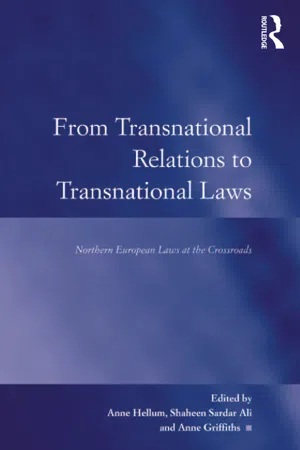
From Transnational Relations to Transnational Laws
Northern European Laws at the Crossroads
- 340 pages
- English
- ePUB (mobile friendly)
- Available on iOS & Android
eBook - ePub
From Transnational Relations to Transnational Laws
Northern European Laws at the Crossroads
About this book
This book approaches law as a process embedded in transnational personal, religious, communicative and economic relationships that mediate between international, national and local practices, norms and values. It uses the concept "living law" to describe the multiplicity of norms manifest in transnational moral, social or economic practices that transgress the territorial and legal boundaries of the nation-state. Focusing on transnational legal encounters located in family life, diasporic religious institutions and media events in countries like Norway, Sweden, Britain and Scotland, it demonstrates the multiple challenges that accelerated mobility and increased cultural and normative diversity is posing for Northern European law. For in this part of the world, as elsewhere, national law is challenged by a mixture of expanding human rights obligations and unprecedented cultural and normative pluralism enhanced by expanding global communication and market relations. As a consequence, transnationalization of law appears to create homogeneity, fragmentation and ambiguity, expanding space for some actors while silencing others. Through the lens of a variety of important contemporary subjects, the authors thus engage with the nature of power and how it is accommodated, ignored or resisted by various actors when transnational practices encounter national and local law.
PART I Family Relations, Transnational, National and Local Sites of Contestation
DOI: 10.4324/9781315583587-1
Chapter 1 Syrian Transnational Families and Family Law
DOI: 10.4324/9781315583587-2
Ilham is an elderly Syrian woman with seven children, five of whom are living abroad. Her daughter, Noura, married a French citizen in 1978 and moved with him to France where she had two children. Noura was widowed in 1988 and stayed on in France with her children. In 1981 Ilham’s oldest son, Samir, married a woman from Sweden and moved there with her from Syria. They were divorced in Sweden in 1990 and in 1995 he married a woman from Syria who settled with him in Sweden. That year Ilham’s oldest daughter, Lama, left her husband in Syria and moved with her youngest son, still a teenager, to Canada. Younis, one of Lama’s older sons, married a young Swedish woman in 1996. They met when she was visiting relatives in Syria. The young couple moved to Sweden but divorced in 1999. Younis stayed in Sweden and in 2003 married a woman from Finland. They have settled in Sweden. Lama’s oldest son got a work permit for Kuwait in 2003. There he met and married a Lebanese citizen. They still live in Kuwait. Ilham’s youngest son, Elias, married a Syrian woman in 1992 and they had their first child in 1993. Elias’s wife and child went to Canada to visit relatives in 1995 and stayed on there. In 1997 Elias was able to join his wife. Mouna, another of Ilham’s daughters, applied to immigrate to Canada and was accepted. She moved there with her family in 2006 and her youngest child was born in Canada. But her husband wanted to return to Syria and Mouna has continued to go to Canada for short visits to keep her residence permit. In 2008 Lama married a Canadian man who was born in Egypt and they are thinking of settling there later on.
Through her children and grandchildren, Ilham is connected to seven countries as well as her native Syria. She has visited all her ‘foreign’ children. Her French and Swedish grandchildren have visited Syria a number of times. Ilham herself acquired a French residence permit when she stayed with her widowed daughter. Such geographically-spread families, like Ilham’s, are not unusual in Syria or in many other parts of the world. Millions of people are now part of transnational families 1 where one, some or all its members have attachments to two or more states. They are hence bound to, or influenced by, a plurality in family law, 2 as well as policies in different states and localities with various interpretations of what constitutes a ‘normal family’. Currently there are complex and simultaneous processes of convergence and divergence of family law and policy in Europe and elsewhere. There is also an intricate relationship between the idealized family, the normative family, how people actually practise family-life and the way these influence and are influenced by different legal and policy arrangements. When many people maintain multi-local attachments through transnational links, this complexity increases.
Transnational families are not a new phenomenon. Many genealogically minded Syrians are able to trace links of kinship to people in many other countries of the region. This harks back to nomadic family histories and histories of other kinds of ‘transnational’ mobility in the periods before national borders were set up. But transnational Syrian families are also found in more recent history. In 1939, Ilham – aged thirteen at the time – was to go to Venezuela to live with some relatives who had no children. But she was suddenly married off to her second cousin. In Ilham’s Syrian mountain village, all inhabitants have relatives who migrated to South America in the early twentieth century. Some never returned, others did or were able to maintain contact with the ‘home-country’. But compared to Ilham’s childhood and youth, transnational family connections are much more intense for her own children. There is increased international mobility on the part of citizens and increased long-distance communication in most parts of the world. Ilham does not use Skype or email so her foreign children and grandchildren talk to her on the telephone but they use more modern means of communication amongst themselves.
Although transnational connections are intense in today’s world, they are also much more restricted compared to when Ilham was young. States are not always willing to let their citizens freely leave the country. Such was the case in Syria until the late 1980s. But more significant are the many restrictions and obstacles so-called ‘receiver states’ place on people wanting to go there. Freedom of movement across national borders is extremely unequally distributed in the contemporary world. Permanent residents and citizens of member states of the European Union are encouraged to increase their mobility within the union, partly as a means of enhancing European integration. But ‘outsiders’ are strongly discouraged from entry into the union. For citizens from countries in Asia and Africa, reuniting the family constitutes the legally-accepted reason, par excellence, for entry into the European Union. The importance of ‘family’ has thus in no way decreased in this age of migration 3 and migration laws and family law have in many ways become highly intertwined. People are mobile and so are laws. Law ‘operates at a global level while at the same time responding to processes of globalization’ (von Benda-Beckmann, von Benda-Beckmann and Griffiths 2005:1).
The aim of this chapter is to highlight the intersection between family law and transnational families. 4 This intersection covers large and complex phenomena that can be studied, analyzed and interpreted from many different perspectives. Issues of how citizenship is interpreted and how various national laws ‘meet’ or ‘collide’ is one important phenomenon. Another important issue is how various states handle parallel or plural jurisprudence in the field of family law. But it is crucial to underline that this intersection cannot be understood only in terms of legal principles. It is equally important to look at how people actually practise family relations across national borders. Finally, questions of gender relations and family arrangements have strong symbolic value as indicators of democracy, progress or cultural authenticity. Members of transnational families may become subject to conflicting moral interests where different groups in ‘sender’ and ‘receiver’ countries can be mobilized. There are different and legitimate ways to organize family life but there are also differences that might be difficult to accept within the framework of specific legal cultures. Family conflicts that extend across national borders may also easily turn into conflicts of morality and gender and ‘good family law’ as will be underlined below. A scrutiny of transnational families and family law may also reveal the limits of legal universalism.
In this chapter members of transnational families with strong links to Syria will be used to illustrate a few of these complex questions. 5 Syria is interesting not only because international migration plays such an important role in the lives of many citizens – both those leaving and those staying behind – but also because family law differs according to religious affiliation. 6 Members of some minority communities follow their own religious codes that make for added complications when there are transnational family conflicts. In order to analyze cases of Syrian transnational families and their concerns, I will now take a closer look at the workings of families and family law in Syria.
State and Family in Syria
The members of Ilham’s family, outlined above, have had different reasons for their moves from Syria. Some left because of marriage rather than as part of a life-long plan. Some wanted to escape family pressures or wanted more individual freedom. Some left to give their children better educational opportunities. Only one member left for mainly economic reasons although this is the most common cause among Syrian migrants. Syria is a country with enormous complexity and variation in contemporary household and family composition and citizens manage family life in many different ways. The variation is to a large extent related to rural/urban habitation, class background and ethnic or religious affiliation. Rural, poor, Sunni Muslim Syrians, for example, tend to have larger families and be more economically independent within households than urban or better-off Syrians, or minorities (Rabo 2008).
But despite the great variation in how family practice works, Syrians – like citizens in states all over the world – are fostered into particular family-regimes. First of all families are ideologically shaped and reproduced on a national level. Many researchers (for example, Kandiyoti 1991, Rabo 1996, Charrad 2001) have demonstrated the intimate link between nationalism and nation-state building in the Middle East (and elsewhere) and the fostering of a sound and stable family as the essential building block of society. This ideal – with its local, regional or ethnic/religious variations – has been successfully inculcated in the Middle East. So states have been, and are, important in constructing the ideal family as well as in ‘ordering’ such families through laws, policies and bureaucratic routines. The Syrian state, for example, can be said to practise gender equality in certain domains (Rabo 1996:163). Equality between women and men is underlined in the constitution and many policies have been set in motion to liberate women from ‘feudal and backward’ families and kin-groups in order to enhance the development of the nation. At the same time ‘family law’ and many policies continue to order men and women in an unequal way.
Managing Citizens through Family Law
The so-called Personal Status Law (qanoun al ahwaal ash-shakhsiyya) in Syria (and elsewhere in the Middle East) covers questions of marriage, divorce, parentage, custody, legal capacity, wills and inheritance. The Personal Status Law in Syria is mainly based on Hanafi jurisprudence, one of four ‘legal schools’ from the classical jurisprudence. Thus unconditional divorce is the prerogative of the husband and daughters inherit only half of their brothers’ share. Fathers have legal guardianship over children while mothers in the case of divorce may exercise ‘care-taking’ (hadane) until the children reach a specific age.
The concept of ‘personal status’ is not part of classical Islamic jurisprudence and was first used in Egypt in the 1890s by the Egyptian Minister of Justice, Muhammad Qadri Pasha (Nasir 2002:34). Through the influence of Code Napoleon, the legislators of the late Ottoman Empire started to codify ‘family issues’ which became a separate legal field, rather than part of the traditionally fluid Islamic jurisprudence. 7 Codification of family law has generally taken place in the Middle East 8 and state institutions control formal family law. 9 From the late nineteenth century onwards, family matters have thus, in general, become the concern of the worldly powers in the Middle East, just as in Europe, and intimately related to debates over modernity, development and cultural authenticity and the simultaneous ordering of citizens through censuses, health programmes, education and military service.
Table of contents
- Cover Page
- Half-Title Page
- Title Page
- Copyright Page
- Table of Contents
- List of Contributors
- Preface
- Introduction: Transnational Law in the Making
- Part I Family Relations, Transnational, National and Local Sites of Contestation
- Part II Transnational Religious Rule: Muslims in the European Diaspora
- Part III Transnational Modes of Governance: Family, Market and Media
- Part IV Transnational Media and Freedom of Expression: Human Rights Paradoxes
- Index
Trusted by 375,005 students
Access to over 1.5 million titles for a fair monthly price.
Study more efficiently using our study tools.
Frequently asked questions
Yes, you can cancel anytime from the Subscription tab in your account settings on the Perlego website. Your subscription will stay active until the end of your current billing period. Learn how to cancel your subscription
No, books cannot be downloaded as external files, such as PDFs, for use outside of Perlego. However, you can download books within the Perlego app for offline reading on mobile or tablet. Learn how to download books offline
Perlego offers two plans: Essential and Complete
- Essential is ideal for learners and professionals who enjoy exploring a wide range of subjects. Access the Essential Library with 800,000+ trusted titles and best-sellers across business, personal growth, and the humanities. Includes unlimited reading time and Standard Read Aloud voice.
- Complete: Perfect for advanced learners and researchers needing full, unrestricted access. Unlock 1.5M+ books across hundreds of subjects, including academic and specialized titles. The Complete Plan also includes advanced features like Premium Read Aloud and Research Assistant.
We are an online textbook subscription service, where you can get access to an entire online library for less than the price of a single book per month. With over 1.5 million books across 990+ topics, we’ve got you covered! Learn about our mission
Look out for the read-aloud symbol on your next book to see if you can listen to it. The read-aloud tool reads text aloud for you, highlighting the text as it is being read. You can pause it, speed it up and slow it down. Learn more about Read Aloud
Yes! You can use the Perlego app on both iOS and Android devices to read anytime, anywhere — even offline. Perfect for commutes or when you’re on the go.
Please note we cannot support devices running on iOS 13 and Android 7 or earlier. Learn more about using the app
Please note we cannot support devices running on iOS 13 and Android 7 or earlier. Learn more about using the app
Yes, you can access From Transnational Relations to Transnational Laws by Shaheen Sardar Ali,Anne Griffiths, Anne Hellum in PDF and/or ePUB format, as well as other popular books in Law & Comparative Law. We have over 1.5 million books available in our catalogue for you to explore.