eBook - ePub
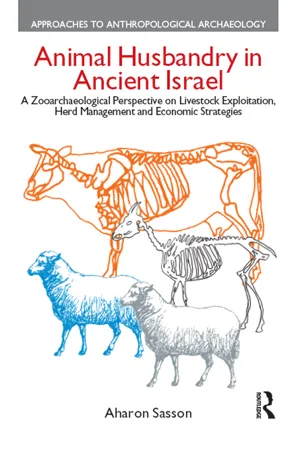
Animal Husbandry in Ancient Israel
A Zooarchaeological Perspective on Livestock Exploitation, Herd Management and Economic Strategies
- 151 pages
- English
- ePUB (mobile friendly)
- Available on iOS & Android
eBook - ePub
Animal Husbandry in Ancient Israel
A Zooarchaeological Perspective on Livestock Exploitation, Herd Management and Economic Strategies
About this book
Animals have been used to human advantage for thousands of years. 'Animal Husbandry in Ancient Israel' presents an analysis of caprines and cattle husbandry in the Southern Levantine Bronze and Iron Age. The book employs key methodological approaches - comparative analysis, taphonomy, Geographic Information System spatial analysis, and ethnographic studies - to challenge prevalent views on the Southern Levantine ancient economy. 'Animal Husbandry in Ancient Israel' argues that the key concern of nomadic, rural and urban populations was survival - the common household maintained a self-sufficient economy - rather than profit, specialization or trade. The book will be of value to all those interested in the dynamic relationship between humans and animals in ancient Israel.
Information
1 |
Introduction |
And He said unto me: ‘Son of man, can these bones live?’ And I answered: ‘O Lord GOD, Thou knowest’ (Ezekiel 37:3).
On the Zooarchaeological Perspective
The book demonstrates various methodologies to make these bones live. It is aimed at diverse crowds. While it provides an extensive data on animal husbandry in the Southern Levant for the professional zooarchaeologist, it is also aimed at the professional archaeologists and readers that are interested in the archaeology of the Bronze and Iron Age. For this reason, the book includes introductory sections that precede the zooarchaeological discussions. These sections provide to the non-zooarchaeologist brief details on zooarchaeological and taphonomic methods, the GIS methodology, models of animal husbandry and an extensive reference source on these issues.
Faunal remains are closely tied to human presence. This is particularly accurate in referring to historical periods, the time span discussed in this book. Archaeological excavations generate a high volume of animal bones. Animal bones are the second most abundant find in most archaeological excavations subsequent to stone tools or pottery shards. The reasons for their abundance are that bones are well preserved and relatively simple to collect in an archaeological dig (compared to archaeobotanical finds for instance). Even when sieving is not practiced in archaeological sites from historical periods, copious animal bones are often collected. Consequently, a broad database is compiled and it enables us to use methodological analysis and reliable inference.
Zooarchaeology, the analysis of faunal remains from archaeological sites, may be divided into two major branches, one that focuses on prehistoric periods and the other that focuses on historical periods. The primary distinction relates to the fauna utilized at these sites. Wild and pre-domesticated animals were the principle subsistence resource of prehistoric populations. In contrast, populations from historical periods whether pastoral nomads, rural or urban, founded their subsistence economy on domesticated animals, hence bone assemblages from these sites are dominated by livestock species.
The temporal focus of this book spans the early historical periods where some of the most important social evolutionary trajectories in the ancient Near East took place, from the emergence of the earliest cities during the Early Bronze Age, ca. 3000 BCE, to the rise of the first historic states during the Iron Age, ca. 1200–586 BCE.
The archaeology, history, and socio-economy of the Bronze and Iron Age in the Southern Levant has been discussed in numerous books (e.g. Levy 1998; Mazar 1992; Finkelstein and Silberman 2001; King and Stager 2001) showing that these periods are characterized by a vast sedentary population, either rural or urban, who left behind plentiful evidence including faunal remains. Ever since caprines (sheep and goats) and cattle were domesticated, they predominate most of the zooarchaeological assemblages in the Levant (Buitenhuis 1990; Hesse 1995a). Naturally, the focus of this book is the three most common livestock species of the Bronze and Iron Age: sheep (Ovis aries), goats (Capra hircus) and cattle (Bos taurus). Sheep and goats are frequently discussed as one group and will be referred as ‘caprines’.
A relatively high proportion of pig (Sus scrofa) remains may also be found on some of the Bronze and Iron Age sites (e.g. Hesse 1990; Hesse and Wapnish 1997; Rabban-Gerstel et al. 2008). Other livestock species generally represented in zooarchaeological finds from historic periods are the camel, horse and donkey (Grigson 1995). The reason for high frequency of caprines, cattle and occasionally pig bones in contrast to low frequency of beasts of burden bones (camel, donkey and horse) is related to the way these species were utilized. The first group comprises of animals consumed for food (O’Connor 2003:78) while the latter is a group of animals used as beasts of burden. As will be demonstrated below, numerous zooarchaeological reports show that animals consumed for food are found in proximity to their consumption area, namely within the inhabited site. Draught animals, on the other hand, were not consumed and were most likely dumped or buried outside the inhabited site. For this reason, the dearth of their remains should not be interpreted as reflecting their rarity. Consequently, animals consumed for food such as caprines and cattle will be discovered in high frequencies, while beasts of burden such as donkey or camel will be represented in low frequencies in the zooarchaeological assemblages. Apparently, studies of faunal remains are not always incorporated with the archaeological investigation of a site (Albarella 2001). Grigson has expressed that bluntly stating:
It is surprising that archaeologists have been so incurious about the ways in which people actually obtained their daily bread. Politics, social systems, statehood, the beginnings of urbanism, warfare, architecture and the manufacture of pottery and flint tools are all legitimate subjects for study, but none would have been possible without the provision of plant and animal food (Grigson 1995:245; see also Perry 2007).
Among zooarchaeologists, however, there is no doubt of the necessity of the zooarchaeological outlook. We may summarize the central attributes of the zooarchaeological perspective, particularly in sites from historical periods, as follows:
1. Populated sites in antiquity will normally provide us with zooarchaeological finds. The zooarchaeological evidence, as other archaeological finds, must be addressed.
2. The zooarchaeological evidence is normally rich and generates an adequate and reliable database for analysis.
3. As will be demonstrated in this book, animal bones as food waste are a substantial means for assessing human diet, social complexity and economic dynamics.
The Zooarchaeological Research of the Bronze and Iron Age in Israel: A Brief Overview
As will be discussed below, the mass of the zooarchaeological record is only one factor in the evolution of zooarchaeology into an influential research field. One would mark the 1980s as a breakthrough in the zooarchaeological research. Four significant textbooks on the study of animal bones were published in the years 1984–1987 (Grayson 1984; Klein and Cruz-Uribe 1984; Hesse and Wapnish 1985; Davis 1987a). Furthermore, four volumes of the proceedings of the International Council for Archaeozoology (ICAZ), ‘Animals and Archaeology’ were published in 1983 and 1984 (Clutton-Brock and Grigson 1983a, 1983b, 1984a, 1984b). It is worth noting that five of the authors mentioned above carried out studies of faunal remains from sites in Israel (Clutton-Brock 1979; Wapnish 1984; Hesse 1986; Grigson 1987; Davis 1988). The large number of prominent studies published in these years indicate a shift from a secondary scholarly field into an independent discipline. A second wave in the development of zooarchaeology as an influential discipline may be observed in the subsequent decade, the 1990s and early 2000s (Lyman 1994b; Reitz and Wing 1999; O’Connor 2000). In addition, in 1993 the first conference on the zooarchaeology of the ancient Near East took place (Buitenhuis and Clason 1993). The year 1995 may be considered as a benchmark in the zooarchaeological research of the Southern Levant. A group of scholars led by Øystein LaBianca published an entire volume dedicated to faunal remains as part of the archaeological investigation of Tel Hesban in Jordan (LaBianca and Driesch 1995). This was the first and only instance to date where a publication of an archaeological site included an entire volume dedicated solely to the analysis of animal bones.
The 1980s and 90s were also rich with studies establishing models of animal husbandry in historical periods. These models discuss the relative frequency of sheep, goat, swine, camel and cattle, marketing strategies of these species and exploitation strategies of their products (e.g. Davis 1980; Sherratt 1981; Wapnish 1984; Kohler 1984; Hesse 1990). Sherratt (1983) discussed the origin of secondary products (milk, wool, transportation) production. Cribb (1984) conducted a computer simulation in order to examine various kill-off (i.e. culling) strategies in caprine herds. Redding (1984) studied the sheep/goat ratio and suggested possible goals reflected by this ratio: maximizing energy (calories) and protein intake (through their products; i.e. meat and milk) or herd security. Wapnish and Hesse (1988) proposed three strategies of animal exploitation and consumption ranging between a self-sufficient economy to a producing economy. Tchernov and Horwitz (1990) examined the caprine/cattle ratio in relation to climatic regions in Israel. Zeder (1991) suggested a model of direct and indirect consumption of livestock in urban sites. Grigson (1995) studied the relative frequency of caprines and cattle and their relative contribution to meat production. One of the first models was in fact published in 1973, a decade before the major breakthrough. Payne (1973), in his pioneering work, proposed three mortality profiles of caprines; each reflects utilization of caprines for either meat, milk, or wool. Chapter 2 of this book revisits many of these models and theories.
One of the earliest zooarchaeological reports discussing sites from historical periods in Israel was published by Pier Ducos in 1968. Ducos (1968:111–21) studied three Bronze Age sites; Tel Erani (Early Bronze), Tel Nagila (Middle Bronze) and Naharia (Late Bronze). A number of zooarchaeologists followed Ducos and left their mark on the zooarchaeological study of Bronze and Iron Age sites in Israel. Simon Davis has studied the fauna from sites such as Tel Arad, Tel Qasile, Tel Qiri and Tel Yarmouth (Davis 1976, 1985, 1987b, 1988). Shlomo (Salo) Hellwing studied various sites including Tel Beer-Sheba, Izbet Sartah, Tel Kinrot, Tel Michal, Tel Dalit, Tel Aphek and Tel Shiloh (Hellwing 1984; Hellwing and Gophna 1984; Hellwing 1986, 1988–89; Hellwing and Feig 1989; Hellwing et al. 1993). Paula Wapnish and Brian Hesse who worked mainly in Israel in the 1980s and 1990s made a profound contribution to the zooarchaeological research of ancient Israel. Their work went beyond faunal remains analysis and included theories and models, which contributed to a broader understanding of animal husbandry (Wapnish and Hesse 1988; Hesse 1995b; Hesse and Wapnish 2002). Wapnish and Hesse have been involved in long-term archaeological projects such as those of Tel Miqne, Tel Dan and Tel Megiddo (Hesse 1986; Wapnish and Hesse 1991, 2000). Liora Kolska-Horwitz is probably the most prolific zooarchaeologist with numerous papers contributing to the zooarchaeological research of the Southern Levant. Horwitz has covered in her research a wide spectrum from prehistoric periods (e.g. Horwitz 2004) up to the late Islamic periods (e.g. Horwitz 1999a). She has conducted various studies of recent faunal assemblages that provide us with a better knowledge of the zooarchaeological evidence (e.g. Horwitz 1990; Horwitz and Smith 1990) as well as broad studies of animal exploitation in ancient Israel (e.g. Horwitz and Tchernov 1989; Horwitz and Milevski 2001). While seven faunal assemblages studied by Horwitz are referred in this book (Chapter 2), the list of all sites studied by her is too long to mention.
The above scholars and many others have generated a large zooarchaeological database of sites from the Bronze and Iron Age and later periods. A major portion of this database, joined with models of caprines and cattle exploitation, will be analyzed below.
What Is This Book About?
‘You are what you eat’ goes the adage, which is applicable to the interpretation of the archaeological record too. Animal bones found in archaeological sites are normally food refuse discarded by its inhabitants.
What is to be learned from food waste, particularly when it originated with three primary species: sheep, goats and cattle? This book offers four views on animal husbandry: comparative, spatial, sagittal and an ethnographic perspective. Three of these outlooks are founded on zooarchaeological evidence.
The Comparative Perspective
Chapter 2 comprises comprehensive theoretical discussion of economic strategies—a market economy and the survival subsistence strategy, pastoral-nomadism and sedentism. The comparative perspective is applied here by studying vast anthropological data from pastoral-nomads in various regions of the world as well as comparative analysis of zooarchaeological data from numerous archaeological sites in the Southern Levant. In this chapter, I show that the survival subsistence strategy rather than a market economy was prevalent throughout the Bronze and Iron Age among most households. Nomadism is evaluated here as the most successful survival subsistence strategy. The sedentary population of the Bronze and Iron Age provided us with wide-ranging zooarchaeological evidence to be studied. Three of the most common topics often discussed in zooarchaeological reports of Bronze and Iron Age sites are re-examined here: the sheep/goat and caprine/cattle ratio and strategies for the exploitation of caprines and their products. Data related to these three issues was compiled from 70 sites and strata. A comparative analysis of the data supports the model of the survival subsistence strategy presented in this book.
The Spatial Perspective
The spatial perspective provides us with a study of faunal remains from a solitary archaeological level of occupation—Stratum II at Tel Beer-Sheba, Israel.
Stratum II represents an ideal site for spatial analysis. Two-thirds of it was excavated, revealing defined architectural components of this town such as 75 houses, three principal streets, storehouses and a city wall. The spatial analysis was carried out using an innovative and computerized technology—the GIS (geographic information system). The GIS application enabled us to virtually ‘return’ all identified animal bones to the archaeological loci they were discovered at and generate a picture of the spatial distribution of faunal remains at the site. The computerized platform enabled us to address numerous multifaceted queries such as the spatial distribution of faunal remains indoors and outdoors, the spatial distribution of caprines versus cattle, sheep versus goats and the spatial distribution of hundreds of caprine astragali found at Stratum II. One of the fascinating queries addressed in Chapter 4 was whether social stratification in Stratum II can be identified through patterns in the spatial distribution of meat-rich and meat-poor skeletal elements.
The Sagittal Perspective
The sagittal perspective represents a taphonomic study of the faunal assemblage from Stratum II at Tel Beer-Sheba. Zooarchaeological finds from tel sites undergo four primary taphonomic phases starting with the phase the animals were utilized in antiquity, through the phase when their remains were discarded at the site, later through the phase these faunal remains were buried naturally during the site formation and ending at the phase when these animal bones are unearthed in an archaeological dig and studied at the zooarchaeological lab. In other words, faunal remains start as live animals consumed by the site inhabitants, shift downwards to the site’s topsoil as food refuse and shift interiorly into archaeological relic during the formation of site. Chapter 5 demonstrates a taphonomic study carried out for the first time on a faunal assemblage from a tel site, investigating the entire vertical process starting with the live animal and ending at the zooarchaeological lab. The sagittal perspective presented in Chapter 5 clearly shows that the bone assemblage of Tel Beer-Sheba was altered a number of times during this process. Thus taphonomic study should precede any socio-economic study (historic as well as prehistoric) that is based on faunal remains.
The Ethnographic Perspective
The ethnographic perspective provides us with data that cannot be obtained solely from faunal remains. In order to evaluate the contribution of caprines and cattle products (meat and milk) to the human diet, I made use of data compiled from demographic and animal censuses carried out by the British government in Palestine in the 1940s (Government of Palestine 1943, 1945). The animal census provides us with valuable data on the distribution of livestock species and their sex and age in traditional, premodern villages. This data made it possible to estimate the total amount of milk, meat, fat, protein and calories produced from caprines and cattle in each village. The analysis presented in Chapter 6 demonstrates quantitatively that the contribution of livestock products to the human diet was diminutive. Nonetheless, it is apparent caprines and cattle provided essential high-value proteins.
In sum, this book provides various outlooks on the Bronze and Iron Age animal husbandry in the Southern Levant. Although the book discusses for the most part data of sites in ancient Israel, I believe the conclusions presented here reflect a picture of animal husbandry of the whole region of the Southern Levant. The approaches taken here, GIS analysis, taphonomic investigation, comparative analysis and ethnographic study, are diverse and do not overlap each other for the most part. Nonetheless, the conclusion arising from all studies is that the economy (as reflected in animal husbandry) in ancient Israel was self-sufficient and managed conservatively. The survival subsistence strategy rather than a market economy was paramount among most parts of the Southern Levantine population.
2 | A Comparative... |
Table of contents
- Cover
- Half Title
- Title Page
- Copyright Page
- Dedication
- Table of Contents
- List of Figures
- List of Tables
- Acknowledgments
- 1 Introduction
- 2 A Comparative Perspective: The Survival Subsistence Strategy—Animal Husbandry and Economic Strategies in the Bronze and Iron Age
- 3 The Faunal Remains from Tel Beer-Sheba, Stratum II
- 4 A Spatial Perspective: Controlling Space and the Zooarchaeological Record—A GIS Spatial Analysis of Faunal Remains in Stratum II, Tel Beer-Sheba
- 5 A Sagittal Perspective: Taphonomic Study of Tel Sites—A Case Study from Tel Beer-Sheba
- 6 An Ethnographic Perspective: Animal Husbandry and Human Diet—Ethnographic Study of Premodern Villages in Mandatory Palestine
- 7 Conclusions
- References
- Index
Trusted by 375,005 students
Access to over 1.5 million titles for a fair monthly price.
Study more efficiently using our study tools.
Frequently asked questions
Yes, you can cancel anytime from the Subscription tab in your account settings on the Perlego website. Your subscription will stay active until the end of your current billing period. Learn how to cancel your subscription
No, books cannot be downloaded as external files, such as PDFs, for use outside of Perlego. However, you can download books within the Perlego app for offline reading on mobile or tablet. Learn how to download books offline
We are an online textbook subscription service, where you can get access to an entire online library for less than the price of a single book per month. With over 1.5 million books across 990+ topics, we’ve got you covered! Learn about our mission
Look out for the read-aloud symbol on your next book to see if you can listen to it. The read-aloud tool reads text aloud for you, highlighting the text as it is being read. You can pause it, speed it up and slow it down. Learn more about Read Aloud
Yes! You can use the Perlego app on both iOS and Android devices to read anytime, anywhere — even offline. Perfect for commutes or when you’re on the go.
Please note we cannot support devices running on iOS 13 and Android 7 or earlier. Learn more about using the app
Please note we cannot support devices running on iOS 13 and Android 7 or earlier. Learn more about using the app
Yes, you can access Animal Husbandry in Ancient Israel by Aharon Sasson in PDF and/or ePUB format, as well as other popular books in Social Sciences & Archaeology. We have over 1.5 million books available in our catalogue for you to explore.