eBook - ePub
Fiction and Social Reality
Literature and Narrative as Sociological Resources
- 176 pages
- English
- ePUB (mobile friendly)
- Available on iOS & Android
eBook - ePub
About this book
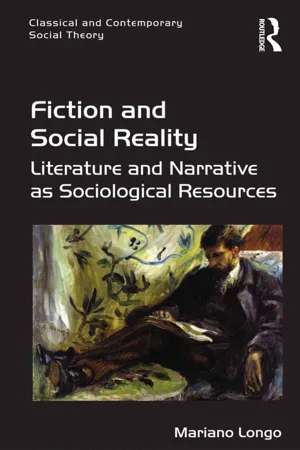
In spite of their differing rhetorics and cognitive strategies, sociology and literature are often concerned with the same objects: social relationships, action, motivation, social constraints and relationships, for example. As such, sociologists have always been fascinated with fictional literature. This book reinvigorates the debate surrounding the utility of fiction as a sociological resource, examining the distinction between the two forms of writing and exploring the views of early sociologists on the suitability of subjecting literary sources to sociological analysis. Engaging with contemporary debates in this field, the author explores the potential sociological use of literary fiction, considering the role of literature as the exemplification of sociological concepts, a non-technical confirmation of theoretical insights, and a form of empirical material used to confirm a set of theoretically oriented assumptions. A fascinating exploration of the means by which the sociological eye can be sharpened by engagement with literary sources, Fiction and Social Reality offers a set of methodological principles according to which literature can be examined sociologically. As such, it will appeal to scholars of sociology and literary studies with interests in research methods and interdisciplinary approaches to scholarly research.
Information
Chapter 1
Features and Structure of Narratives
Sketching the Character of Narratives
What is a narrative? In its most simple definition, dating back to Aristotle (Eco, 1979, p. 30), a text may be defined as a narrative when it tells a story; that is, when it deals with one or more actors and describes a process of transformation from an initial stage x to a final stage y. This minimal definition contains the fundamental feature of narrations: one or more actors and their actions are described in a temporal sequence. Thus a narrative, and that is its essential feature, has to do with changes in time. Indeed, the reference to action is, from Aristotle on, the characterizing element of narration, since it may be configured as a specific form of imitation (mimesis) of reality, e.g. the imitation of an action (Dowling, 2011, p. 1). Adopting a minimal definition of narrative is one of the possible options a scholar may take when confronted with the ubiquitousness and variety of narrations. This minimal definition is inclusive, so that the description of any process whatsoever may be intended as a narrative.1 The alternative attitude is to carefully define which features a story should possess in order to be defined as a narrative (Labov, 1997), thus excluding all those texts that, although describing processes, are not to be intended as narrations.
A minimal definition does not suffice to clarify the constitutive elements of a narrative text: in order to make the definition more rigorous, one has at least to single out the basic features of narratives. By telling a story (narrating) one is supposed to describe actors (it does not matter now whether real or fictitious) who do things. Yet, actions (things that occur which are imputable to one of the implied characters) are not the sole elements of a narrative. Following the suggestion proposed by Chatman, events are either in the mode of DO (changes consciously brought about by actors) or in the mode of HAPPEN (things which occur outside any conscious plan) (Chatman, 1978, p. 32). What is reported in a narrative, as well as the consequences of the events, is not always to be ascribed to the conscious efforts of the actors, but to a complex combination of chances, cases and plans, which makes the plot and its possible outcomes unpredictable. Even the simplest oral report of action may be intended as a narrative provided that it contains some unexpected elements: a narrative is never the sole description of the ordinary, but it deals with the introduction of the unforeseen into the taken for granted (see, for example, Labov, 1997; Van Dijk, 1975). A first connection with social sciences (sociology in particular) thus becomes evident. A narrative text consists of descriptions of actions, and action is among the constitutive elements of society. As action takes place within a physical and social environment, narratives show the interplay between individual intentions and the environment in codetermining the results of action. What is remarkable in narrative as a communication-mode is its effectiveness in combining processes and statuses. A narrative text is a hybrid, as it employs other text forms (description in particular) which accounts for the cognitive quality of narration: it tells not only what happens, but also something about the qualities of the actors and the environment in which actions take place (in Chatman’s vocabulary: existents). Even in its more elementary examples, a narrative often contextualizes actions and happenings, and in so doing it has to describe characters, milieux, the physical environment etc. The effectiveness that narratives (even in their simplest variations) show in describing reality lies in this mix of time-recounting and space- and character-description. The combination of modes of discourse as specific features of narratives accounts for their sociological relevance. A narrative (regardless of its fictionality) describes characters, their actions and their supposed motives, as well as contextual elements (fate, natural events, social opposition) which may prevent individuals from achieving their foreseen ends. This capacity to describe action in context accounts for the relevance that the reports of the social actor have for social research.
A combination of these structural elements is evident even in simple, short narratives, such as those analysed by Labov and Waletzky in their seminal work dating back to 1967. Labov and Waletzky (1967) refer to narratives defined from a specific, consciously narrow perspective. They are interested in short narratives, i.e. oral reports of personal experience in everyday conversation. The presupposition is that, in order to understand the complex structure of more articulated narratives, one has to catch the constitutive elements of oral versions of personal experiences as told by common native speakers (ibid., p. 12). The analyses by Labov and Waletzky (1967), and their later development by Labov (1997), are based on extensive empirical work consisting in the collection of thousands of oral narratives among native English speakers. The collected material gives both scholars the opportunity to detect structures, rules and functions of oral narratives, in principle compatible with narratives of other kinds (e.g. myths and folk-tales – Van Dijk, 1975, p. 276). Both papers underline two important aspects of oral narratives: the structural and the functional. As to the structural elements, an oral narrative locates events in time and space and introduces the involved actors. (Labov and Waletzky [1967, p. 32] call this function orientation). The action is set in motion by some sort of interruption in the ordinary flow of events (complication – ibid., pp. 32-3) and its prosecution is intended as a reaction to the unusual (resolution – ibid., p. 39). In order to make the passage from complication to resolution clear, a narrative needs an evaluation; that is, the explication of the narrator’s attitude towards the events as reported (ibid., p. 37). As stressed by Labov (1997) the element of complication is essential to the narrative: by breaking the ordinary, a complication makes the narrated events ‘reportable’, i.e. relevant to the audience. By elaborating upon Harvey Sacks’ (1995) analysis of turn assignment, Labov underlines how narration is one of the few cases in which the rules of taking turns in conversation do not hold, such that the narrator may keep his turn to the end of his recounting. A code clause implies a return to normal turn-taking, thus also precluding any request for further explanation related to the story.
Oral narratives as a mode of communication have two main specific functions: the referential and the evaluative (Labov and Waletzky, 1967). An oral narrative is, first of all, a way to represent events by reproducing them in their temporal sequence (ibid., p. 13). As Labov (1997) stresses, in personal narratives experiences tend to be objectively represented (they are referred more commonly to the state of fact than to inner states) and their credibility is strictly linked to their factuality. Moreover, narratives entail an implicit causal theory in relation to events, i.e. a series of causal connections, so that not only is a tale presented of what happened, but also a possible explanation of what occurred. Yet, the reproduction of events is not aseptic, as it is associated with a meaning construction process, by which events are given a specific significance for the narrator or for the actors involved. Thus, even in this everyday referential dimension, a narrative is more than the report of former experiences: it entails a process by which events, actors and actions are presented on the social scene under a specific evaluative light. The casual explanation is linked to the possibility of assigning praise or blame to the actors and to the action as reported, which implies a moral and ideological dimension of oral narratives (ibid.). Therefore a narrative, even in the minimal form of an oral report, is a process of meaning construction, which implies the presentation of the events as perceived and selected by the narrator and a casual explanation of what is reported, as well as an evaluation of actions and a presentation of the moral value of the actors involved. Narrative as a mode of discourse proves to be a prototype, playing a central role in every conversation, able to convey information within a structure organized as a sequence (a beginning, a middle and an end) (ibid.). One may notice that the structural characters of narratives as exemplified by Chatman (time and action, reference to some unusual event, description of actors and context, to which we may add causal explanation and moral evaluation) are present in nuce even in simple everyday narratives.
The work of Labov concentrates on narratives of a peculiar kind (oral speeches with a specific content) and, although his speculations achieve interesting generalizable results as to the structure and function of the oral narratives, they are conditioned by the specific empirical interests of the author. Let me go back to a more general presentation of narratives by selecting, from the enormous literature on the subject, a perspective which, by stressing the strong interconnection between action, time and narration, has a peculiar interest for the sociological investigation of the topic. The linguist Teun A. Van Dijk (1975; 1976), has tried to define the structural traits of narrative texts starting from a general, philosophically-oriented definition of action. In his essays dating back to the 1970s, Van Dijk explicitly connected action, action theory and narrative. Since narrative discourse is about action or sequences of actions in time, an appropriate linguistic definition of narrative should take into account what action is, from a general, conceptual point of view (Van Dijk, 1975, p. 273). As Van Dijk writes, “formal action description may yield insight into the abstract structures of narratives in natural language” (Van Dijk, 1976, p. 287).
Action is to be distinguished from simple doings or involuntary bodily movements, in so far as it is characterized by intentions (motivating our doings) and purposes (broader tasks within which our actions are embedded) (Van Dijk, 1975, pp. 279-80). Thus an act may be defined as what an actor intentionally performs in order to bring about a certain state of affairs under a specific purpose (ibid., p. 277). By introducing the subjective dimension of intentionality and purposefulness, philosophical action theories (and I might add sociological action theories too) show the complexity of human acts and help distinguishing them from mere behaviour. An intentional act entails not only a change in state (from stage x to stage y), it also implicates a series of internal states (wishes, wants, fears, etc.) which become relevant as soon as one moves from the actual level of empirical facts to the linguistic level of action description. Indeed, whereas ‘doings’ are connected to what actually happens, an action has to be interpreted as a specific kind of intentional activity. Moving a pen on a piece of paper, for example, is a doing, which may be interpreted as signing a contract (ibid., p. 281), but also otherwise. Thus a narrative is an action description (or, when it consists of more than one sentence, an action discourse), which takes into account intentions, desires, inner emotional states, a whole grammar of motives which may be evoked in order to explain the subjective dimension of what is done (ibid., pp. 282-3). By making reference to the subjective element in narration, one makes a further step towards the definition of the sociological relevance of the narrative discourse: as it describes not only action but also the individual motives underlining it, each narration is an attempt (naïve or sophisticated, depending on the author and the context) to understand action from the perspective of the actor (for the sociological relevance of motivated action see Wilson, 1970, p. 698).
As for oral narratives, Van Dijk intends them as structural elements of the social, with a series of functions not to be restricted to the exchange of information. A narration is a way to bring about a change in the knowledge of the hearer, although it may have additional functions. A story may be told so as to give the hearer an example of what it is sensible to imitate or to avoid, in which case a narrative converts itself into a model of experience (Van Dijk, 1975, p. 286). It may have an emotional function, when the narrator receives praise for the action performed or for his ability in telling the story. In any case, narrating appears not simply as a form of communication but also as a way by which society is reproduced. One may add that sociologically, a normal narrative (so not a simple description of events, but an everyday account of a fractured and re-established order) appears as an instrument of normalization of the unusual (Garfinkel, 1967). Hence it is a strong communicative tool by which society constantly reconstructs the sense of its normality.
Another plausible definition of narratives refers to the way events are connected together, i.e. to the coherence of the sequence in which they are ordered. Noël Carroll (2001), for example, has tried to identify narratives by concentrating on what he calls the narrative connection, i.e. the specific relation between events and states of affairs which configure a text as narrative. His analysis is explicitly directed to historical and fictional narratives, but it may also be applied to other kinds of text. According to Carroll, a narrative is an interrelation of at least two, and possibly more, events and/or states of affairs which have to be in a significant connection with one another (Carroll, 2001, p. 120). Two elements are necessary although not sufficient to qualify a text as a narrative: a unified subject and an ordered temporal sequence. An ordered temporal sequence makes for a kind of text which historians call annal; that is, the simple recording of significant events in a yearly sequence. A unified subject connected to an implicit ordered temporal sequence is a chronicle which may be better qualified as “[a] discursive representation that (temporally, but non-causally) connects at least two events in the career of a unified subject so that a reliable temporal ordering is retrievable from it (and/or from the context of enunciation)” (ibid., p. 121).
Both annals and chronicles are still not, according to Carroll, to be defined as narratives, as they lack a tight connection among events and/or states of affairs (ibid., p. 122). A structural feature is necessary in order to make the sequence of events a proper narration, which Carroll detects in some sort of casual relation (ibid.). By causal relations, a sequence of events in which the first is sufficient to determine the subsequent in a direct and necessary connection is not what is intended. Rather, Carroll refers to a looser form of causality by which an event may be intended as part of a net of cooperating factors, enabling a state of affairs to come about (ibid., p. 128).
The narrative connection, as described by Carroll, is an alternative, philosophical representation of the structural quality of narratives: a narrative is such in so far as it presents events and states of affairs which are temporally ordered, thematically coherent and which have some kind of casual interconnection. The casual relation is loose, since an event is to be considered as a necessary but not sufficient condition for another event to occur, which makes its consequences unforeseen and the plot open to the unexpected. The openness of the plot is, however, conditioned by the previous events (owing to what has already been narrated, not everything can happen,), which complies with the principle of thematic and logical coherence.
As Labov, Van Dijk and Carroll clearly show, a narrative, even in its more elementary manifestation (e.g. oral exposition of an experience) is always more than a sequential presentation of events: it entails a causal explanation of what happened as well as an evaluation of actors and actions. This shows the constructed character of narratives as such: a narrative presupposes a selection of aspects of reality from the perspective of the narrator, which makes any attempt to consider non-fictional narration as objective representation of reality, weak. Having identified the constructed character of narratives (whether fictional or non-fictional) and before turning to the definition of the specific features of literary narratives, it is necessary to summarize which elements are indispensable to viewing a text as narrative. What follows is an attempt at summarizing the fundamental features of narrations:
• Temporality: a narrative text has to do with time, in so far as it has to connect events, so even the most parsimonious attempt at defining a narrative has to take sequentiality into account.
• Action and events: the most common content in a narrative is action (Van Dijk, 1975) or at least a combination of action and unplanned events (or happenings) (Chatman, 1978, pp. 44-5).
• Connection among events: events are not only sequentially reported, they are non-randomly interconnected (Toolan, 1988, p. 7), in order to identify significant relations (for example cause and effect) among everyday happenings and actions (Bruner, 1986, p. 12)
• Consistency: the interconnected events and actions have to be linked by some principle of coherence. Stories do not simply juxtapose events and actions. Events and actions are organized within a narrative in order to make the evolution of the story in terms of change and transformation plausible (Todorov, 1977, p. 233).
• Fracture in the taken for granted: in order to be perceived as a narrative, even in its most simple structure, a text has to tell a story of broken and re-established order (Labov and Waletzky, 1967, p. 32; Van Dijk, 1975, p. 289; Toolan, 1988, p. 8) which makes the related events interesting for readers or listeners.
• Coexistence with other text-modes: although one can hardly imagine a narrative text in which nothing happens, the complexity of a narrative text depends on the fact that other communicative modes are compatible with narration (e.g. description, argumentation, evaluation). So, a narrative text is a combination of other modes of discourse, provided that the narrative mode is predominant (Franzoni, 2010, p. 596).
Two Approaches to Fiction
When we consider literary narratives, the question of their truthfulness is to be taken into account. A literary narrative may be intended as a mode of discourse with no external referents. What is told is fictional, i.e. the output of individual, artistic creation. Yet, on the one hand narratives as such, regardless of their fictional character, may be regarded as the result of a constructive and selective process, by which the representation of reality that they convey may be intended as highly artificial; on the other, if fictional narratives make sense, it is in so far as they greatly rely on socially shared knowledge. One may ask oneself: if one assumes that narratives are meaning construction processes, is a neat distinction between fictional (literary in particular) and non-fictional narratives still needed? To answer this question, one may take Walsh as a guideline, when he writes: “I want to grant full force to the claim that all narrative is artifice, and in that very restricted sense fictive, but I maintain nonetheless that fictional narrative has a coherently distinct cultural role, and that a distinct concept of fictionality is required to account for this role” (Walsh, 2007, p. 19). The task of this section is to take what Walsh calls ‘a distinct concept of fictionality’ seriously by sketching the chief features of literary narratives as compared to non-literary ones.
Is there any specific character of a text which may help us to identify it as fictional? Or should one suppose that any narrative text is such in so far as it possesses a set of well-defined (linguistic, semantic, semiotic, structural) characteristics and that the differences between the fictional and non-fictional are to be located outside the text, in some social convention connected to its actual production and fruition? Both hypotheses have been sustained in the debate about the narrative. John R. Searle (1975) is here assumed to be one of the main supporters of the second hypothesis. In his influential essay, The Logical Status of Fictional Discourse, Searle proposes a conception of fiction as a simulation of referential speech. Searle’s intention is not to distinguish between literary and non-literary texts, his leading distinction being between serious and fictional utterances, where the character of the fictional is clearly defined by opposition (what is not serious, and is hence untrue). The essay deals with the vast number of narratives which have no reference in actual events or characters (e.g. comics or jokes) (ibid., p. 319).
The question Searle poses is paradoxical: how is it possible that in fictional discourse the referential rules, attaching words to their meanings, seem to be operating and yet do not actually operate in their normal way? In other words: how is it possible to construct an apparently ordinary discourse about a simulated reality (van Ort, 1998, p. 439)? The logic underlining Searle’s argument is part of a conception of language conceived of as a realistic reproduction of reality (ibid., p. 445). Narratives are chiefly made up of a peculiar kind of illocutionary act: assertions, which is to say, acts committing the speaker to the truth. Searle compares a narrative taken from a newspaper and one reproducing a passage from a novel and shows that, whereas the first extract has to comply with the rule of truthfulness, the second clearly does not (Searle, 1975, pp. 321-4). Of course, even a newspaper article (as well as an oral narrative i...
Table of contents
- Cover Page
- Title Page
- Copyright Page
- Dedication
- Contents
- Introduction
- 1 Features and Structure of Narratives
- 2 The Cognitive Value of Fictional Narratives
- 3 Narratives and Sociology: At the Roots of a Forgotten Tradition
- 4 Writing Sociology: Social Sciences as Texts
- 5 When Sociologists Use Literary Sources
- 6 On the Sociological Use of Narratives
- Bibliography
- Index
Trusted by 375,005 students
Access to over 1.5 million titles for a fair monthly price.
Study more efficiently using our study tools.
Frequently asked questions
Yes, you can cancel anytime from the Subscription tab in your account settings on the Perlego website. Your subscription will stay active until the end of your current billing period. Learn how to cancel your subscription
No, books cannot be downloaded as external files, such as PDFs, for use outside of Perlego. However, you can download books within the Perlego app for offline reading on mobile or tablet. Learn how to download books offline
Perlego offers two plans: Essential and Complete
- Essential is ideal for learners and professionals who enjoy exploring a wide range of subjects. Access the Essential Library with 800,000+ trusted titles and best-sellers across business, personal growth, and the humanities. Includes unlimited reading time and Standard Read Aloud voice.
- Complete: Perfect for advanced learners and researchers needing full, unrestricted access. Unlock 1.5M+ books across hundreds of subjects, including academic and specialized titles. The Complete Plan also includes advanced features like Premium Read Aloud and Research Assistant.
We are an online textbook subscription service, where you can get access to an entire online library for less than the price of a single book per month. With over 1.5 million books across 990+ topics, we’ve got you covered! Learn about our mission
Look out for the read-aloud symbol on your next book to see if you can listen to it. The read-aloud tool reads text aloud for you, highlighting the text as it is being read. You can pause it, speed it up and slow it down. Learn more about Read Aloud
Yes! You can use the Perlego app on both iOS and Android devices to read anytime, anywhere — even offline. Perfect for commutes or when you’re on the go.
Please note we cannot support devices running on iOS 13 and Android 7 or earlier. Learn more about using the app
Please note we cannot support devices running on iOS 13 and Android 7 or earlier. Learn more about using the app
Yes, you can access Fiction and Social Reality by Mariano Longo in PDF and/or ePUB format, as well as other popular books in Social Sciences & Social Science Research & Methodology. We have over 1.5 million books available in our catalogue for you to explore.