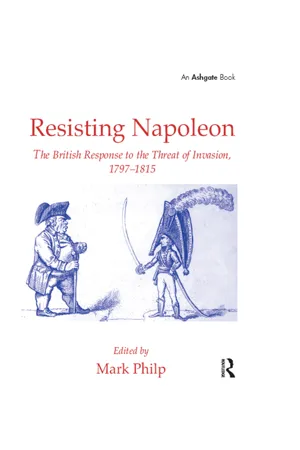
- 264 pages
- English
- ePUB (mobile friendly)
- Available on iOS & Android
eBook - ePub
About this book
The long war with Revolutionary France had a fundamental impact on British political culture. The most dramatic example of this is the mass mobilisation of the British people in response to French invasion threats throughout the last years of the century but, most spectacularly, in the period 1803-5, after the collapse of the Peace of Amiens, and the massing of an invasion fleet by Napoleon. The preparations for the threatened invasion had many dimensions including military and naval mobilization, the development of defensive earthworks and fortifications on the British Coast, the surveillance and monitoring of radicals identified with the French cause, the incitement of loyalist sentiment through caricature, newspapers, tracts and broadsides, and loyalist songs, and the construction of Napoleon as the prime enemy of British interests. Although aspects of these issues have been studied, this book is the first time that they have been brought together systematically. By bringing together historians of Britain and France to examine the dynamics of the military conflict between the two nations in this period, this book measures its impact on their domestic political cultures, and its effect on their perceptions of each other. In so doing it will encourage scholars to further examine aspects of popular mobilisation which have hitherto been largely ignored, such as the resurgence of loyalism in 1803, and to see their contributions in the light of the dual contexts of domestic political conflict and their war with each other. By allowing scholars to focus their attention on this period of heightened tension, the book contributes both new detail to our understanding of the period and a better overall understanding of the complex place which each nation came to occupy in the consciousness of the other.
Chapter 1
A Tale of Two Conflicts: Critiques of the British War Effort, 1793–1815
Viewed from a British perspective – and in the broadest terms, with the benefit of hindsight – it is hard to see the French Revolutionary and Napoleonic Wars as anything other than a brilliant success. Britain emerged from this final phase of the second Hundred Years’ struggle with France as a global hegemon, the world’s supreme naval, colonial, commercial, financial and industrial power, and of course it retained that position for most of the next century. Even viewed in the much shorter term, the Congress of Vienna brought enormous dividends to Britain: the extension and consolidation of empire through the cession of rich colonies such as Trinidad, Tobago, St Lucia, Demerara, Essequibo, the Cape, Mauritius and Ceylon; the shrinking of expansionist France back to its 1790 borders; the achievement of a balance of power that obviated (for the foreseeable future) the need for significant British intervention in Continental affairs, and the final triumph of counter-revolution through the restoration of the Bourbons in France and Spain and of the House of Orange in the new Kingdom of the Netherlands.1 After Waterloo, Britons thus had ample reason to congratulate themselves on having scored an unusually decisive victory.
The scope of that victory was scarcely conceivable before 1814, however, and any sort of peace on terms favourable to Britain was almost impossible to imagine prior to the Grand Army’s disastrous invasion of Russia in 1812. Up to that date, Britons had good reasons for perceiving the French Wars as a long series of military setbacks and domestic crises broken only by the occasional naval victory or filching of a sugar island. To begin with, the British war effort in the 1790s suffered from a lack of clearly articulated and consistent aims. Pitt memorably declared that his government sought from France ‘indemnification for the past, and security for the future’. But what did this mean in practical terms? Indemnification was most conspicuously sought in the colonial theatre, and most notably in the West Indies, which were responsible for at least a fifth of all British trade and perhaps two-fifths of all French trade prior to the war. Advocates of an aggressive colonial war, most notably Henry Dundas, thus saw the seizure of France’s sugar islands as a crippling blow to the French economy and abundant recompense for the loss of the American colonies.2
‘Security for the future’, however, obviously depended far more on checking French expansion on the Continent than it did on establishing British domination in the Caribbean. What triggered Britain’s entry into the war in 1793 was clear enough: the French invasion of the Low Countries and control of the River Scheldt.3 But the circumstances that would enable Britain to make an honourable peace were far from clear. If French aggression stemmed from revolutionary ideas, then was it even conceivable to try to make peace with the French revolutionary government? By the end of 1795, the Pitt ministry had concluded that it was, so long as reasonable terms could be secured.4 But such terms were not forthcoming from a territorially ambitious French regime that rightly felt it had the whip hand in negotiations.5 The British, moreover, gave the French no more compelling reasons to trust them than the French had given to the British. The revolutionary regimes could scarcely have interpreted the British government’s persistent efforts to aid and abet the royalist insurgents in France as an indication that Pitt and company were truly prepared to countenance a regicide peace.6
What was far clearer than British war aims in the 1790s was British failure to make sustained progress against French arms. Each one of a series of attempts to establish a meaningful British fighting presence on the Continent failed miserably. For all its formidable powers as a paymaster, moreover, the British fiscal-military state was unable to forge a lasting coalition of Continental allies. The clash of national interests prevented Austria, Prussia and Russia from acting as an effective bloc, and in any case British aid was not always forthcoming when Britain’s allies needed it most. Pitt’s government refused a loan to Austria in 1797, for example, at the very time that Napoleon was overwhelming the Austrian armies in northern Italy.7 British supremacy at sea could not overcome French supremacy on land without some sort of breakthrough on the Continent, and such a breakthrough was not forthcoming.8
Meanwhile, the chronic debate among Pitt and his colleagues as to whether they should devote the bulk of British resources to the Continental or to the colonial theatre was never resolved to anyone’s satisfaction.9 British forces in the Caribbean scored a string of victories early on, but by the end of 1795 the British West Indies were wracked by a series of slave revolts and a formidable French counter-offensive. When the government sent 35000 soldiers to the Caribbean between August 1795 and May 1796, the largest expeditionary force ever dispatched from British shores up to that point, they did so simply to prevent the total collapse of British power in that corner of the globe. Several years later, the British had saved their West Indian possessions and taken enough islands from France and Holland to serve as bargaining-chips at the negotiating table, but this limited strategic achievement was bought at a terrible price. Over half of all British soldiers (45000 out of 89000) who fought in the Caribbean between 1793 and 1801 died there, most of them from yellow fever.10
When British military success in Egypt finally enabled the Addington government to make peace on less than disastrous terms, most Britons eagerly embraced the opportunity to do so. The Napoleonic emissary sent to deliver the French ratification of the Treaty of Amiens was welcomed by a crowd that insisted on drawing his carriage through the streets of London.11 Small wonder they rejoiced, for the era of war had marked ‘a decade punctuated by crisis upon crisis’, in the apt words of Roger Wells: radical agitation and Church-and-King violence on the eve of war; the wartime struggles between a resurgent radical movement and the government culminating in the passage of the Two Acts in 1795; famine and abortive efforts to make peace in 1795–6; a series of attempted and actual invasions of Wales and Ireland, naval mutinies, financial near-collapse, and the very bloody Irish Rebellion in 1797–8, and finally, an even more serious famine accompanied by industrial recession and vociferous calls for peace in 1799–1801.12 War-weary Britons thus had very good reason to welcome the Treaty of Amiens, but they can scarcely have felt it was a good bargain. French control of the Low Countries left Britain open to the threat of invasion. France itself was now controlled by a military dictator whose dominions extended far beyond those of his royal predecessors and whose expansionist impulses were even more obvious than those of his revolutionary ones. France regained some of its lost Caribbean influence at the negotiating table, while British withdrawal from Malta and the Cape posed a possible threat to India.13
By any measure that contemporaries had ready to hand, then, the French Revolutionary War had gone very badly indeed for Britain. The first two-thirds of the Napoleonic War, while not quite so dire, were bad enough. There was a very real threat of a French invasion from 1803 to Trafalgar in October 1805, but it never became a reality. Colonial land-grabbing continued apace, and with fewer reversals than in the 1790s, so that Britain’s imperial domination had been pretty clearly established well before the end of the war. But vigorous self-defence and colonial expansion did nothing to undermine Napoleonic hegemony on the Continent, and efforts to build and preserve an effective anti-French coalition and to gain a clear advantage in the Peninsula came to grief until the last few years of the conflict. As late as 1810, the military strategist C.W. Pasley could persuasively argue that the British war effort had achieved little more than:
the annihilation of a part or all of our disposable military force; impotency in all the grand objects of warfare not connected with maritime power; disappointment in all our expeditions, whenever we have aimed at more than the attack of an island; want of confidence on the part of our allies; and a certain degree of contempt on the part of our enemies.14
Before the Grand Army’s ill-fated Russian Campaign, almost twenty years of war had brought Britons perhaps some ‘indemnification for the past’, but precious little ‘security for the future’.
Thus far, I suppose I have given comfort to the notion that there was a sameness about the French Revolutionary and Napoleonic Wars that merits our lumping them together (nominally, and, at least by implication, conceptually) as ‘the French wars’. One of the most obvious things they had in common was the futility of the British war effort in the Continental theatre, at least until the final scenes of the last act. But of course, in significant ways these were also very different wars. I wish to devote the balance of this chapter to exploring one of those differences in some detail. It has to do not so much with the growth of a British anti-war movement per se (already a familiar story), but rather with the nature of criticism of the war effort. During the French Revolutionary War, that sort of criticism was voiced almost exclusively by opponents of the war itself. While ‘loyalist’ advocates of war against the Jacobins had very good reason to deplore the inefficacy of the British war effort, they scarcely ever did so, at least not in any conspicuously public manner. In contrast, such ‘loyalist’ criticism was routine during the Napoleonic War, particularly from about 1806 to 1810, when the assault on the alleged corruption and systematic mismanagement of the war effort occasionally dominated the political agenda.
Before turning my attention to the ‘loyalist’ silence of the 1790s, it makes sense briefly to trace the opinions of the anti-war minority against whom the ‘loyalists’ were ranged. For the vociferous protests of that minority, and even more the strenuous efforts to stifle them, contributed much to a domestic political situation in which criticism of any sort was all too readily equated with disloyalty. Members of the London Corresponding Society, the Society for Constitutional Information and other radical friends of the new French Republic were of course less concerned about the means with which Britain waged war than they were about Britain’s involvement in the war against France in the first place. According to them, the French Jacobins were enlightened friends of liberty who were provoked into violence by the supporters of tyranny at home and abroad. Pitt’s government brought Britain into the war not only to restore royal despotism in France, but to use the wartime emergency as a pretext for stripping Britons of their freeborn rights. Thus Major Cartwright could declare in 1801 that this had been first and foremost a ‘war against English liberty’. ‘[D]oes not the evidence [for this characterization] accumulate upon us’, he asked,
when we look back to [the British government’s] frauds and deceptions; to their persecutions of all active patriots; to their attempt in 1794 at legal murder; to the doctrines they have proscribed, and the doctrines they have disseminated; and, in short, to their whole system?15
The North government had taken advantage of the American war to build up the influence of the Crown at the expense of the people’s representatives in the House of Commons, Christopher Wyvill added, but Pitt’s wartime government was ‘at once corrupt and tyrannical’. ‘Lord North’, he concluded, ‘left liberty nearly as he found it: but Pitt, should he drop to-morrow, would leave us a violated constitution; no freedom of the press; the bill of rights infringed; and our laws openly set at nought.’16 The war itself, radicals argued, was the mechanism by which the nefarious government ‘System’17 sought to enslave the people, through the suppression of civil liberties and, less directly, through the wartime growth in debt and taxes, which diverted the hard-earned money of the common people to the Treasury’s coffers and the bulging pockets of the government’s creditors.
The predominantly Dissenting and middle-class ‘friends of peace’ whose opinions John Cookson has so ably examined18 were likewise less concerned about the conduct of the French Revolutionary War than they were about the injustice of the war itself. While generally less inclined than their radical counterparts to explain away the excesses of French Jacobinism, they shared the radicals’ conviction that warfare was magnifying oligarchical power through the suspension of civil liberties and the imposition of grievous financial and economic burdens that hit the middling and lower sorts of people particularly hard. Strongly committed to the rational Christian principle of providential harmony, the ‘friends of peace’ believed that fighting an unjust war was a sin against God, and that war for any purpose other than self-defence was by its very nature unjust. According to them, the war itself was thoroughly corrupt, and thus it was hardly surprising that the government would use corrupt means in order to wage it.
The Foxite Whigs’ criticism of the French Revolutionary War tended to be somewhat more diverse than that of the radicals and the ‘friends of peace’, and because it came from the mouths of politicians, it tended to vary more according to shifting political circumstances.19 They shared with outdoor critics of the war the convictions that the Jacobins had been provoked into battle by despotic kings, that Pittite war-mongering was a pretext for repression at home, and that the mounting expense of the war was diverting far ...
Table of contents
- Cover
- Half Title
- Title Page
- Copyright Page
- Table of Contents
- List of Illustrations
- Acknowledgements
- List of Contributors
- Introduction: The British Response to the Threat of Invasion, 1797–1815
- 1 A Tale of Two Conflicts: Critiques of the British War Effort, 1793–1815
- 2 The Sea Fencibles, Loyalism and the Reach of the State
- 3 The Defence of Manchester and Liverpool in 1803: Conflicts of Loyalism, Patriotism and the Middle Classes
- 4 ‘An Insurrection of Loyalty’: The London Volunteer Regiments’ Response to the Invasion Threat
- 5 In Defence of Great Britain: Henry Addington, the Duke of York and Military Preparations against Invasion by Napoleonic France, 1803–1804
- 6 ‘This Soldierlike Danger’: The Trial of William Blake for Sedition
- 7 John Bull in a Dream: Fear and Fantasy in the Visual Satires of 1803
- 8 Britain and the Black Legend: The Genesis of the Anti-Napoleonic Myth
- 9 ‘The Cheap Defence of Nations’: Monuments and Propaganda
- 10 Music and Politics, 1793–1815
- 11 Anti-English Discourse among the Authorities: Myths and Realities in the Northern Départements
- 12 ‘An Inundation from Our Shores’: Travelling across the Channel around the Peace of Amiens
- Index
Trusted by 375,005 students
Access to over 1.5 million titles for a fair monthly price.
Study more efficiently using our study tools.
Frequently asked questions
Yes, you can cancel anytime from the Subscription tab in your account settings on the Perlego website. Your subscription will stay active until the end of your current billing period. Learn how to cancel your subscription
No, books cannot be downloaded as external files, such as PDFs, for use outside of Perlego. However, you can download books within the Perlego app for offline reading on mobile or tablet. Learn how to download books offline
Perlego offers two plans: Essential and Complete
- Essential is ideal for learners and professionals who enjoy exploring a wide range of subjects. Access the Essential Library with 800,000+ trusted titles and best-sellers across business, personal growth, and the humanities. Includes unlimited reading time and Standard Read Aloud voice.
- Complete: Perfect for advanced learners and researchers needing full, unrestricted access. Unlock 1.5M+ books across hundreds of subjects, including academic and specialized titles. The Complete Plan also includes advanced features like Premium Read Aloud and Research Assistant.
We are an online textbook subscription service, where you can get access to an entire online library for less than the price of a single book per month. With over 1.5 million books across 990+ topics, we’ve got you covered! Learn about our mission
Look out for the read-aloud symbol on your next book to see if you can listen to it. The read-aloud tool reads text aloud for you, highlighting the text as it is being read. You can pause it, speed it up and slow it down. Learn more about Read Aloud
Yes! You can use the Perlego app on both iOS and Android devices to read anytime, anywhere — even offline. Perfect for commutes or when you’re on the go.
Please note we cannot support devices running on iOS 13 and Android 7 or earlier. Learn more about using the app
Please note we cannot support devices running on iOS 13 and Android 7 or earlier. Learn more about using the app
Yes, you can access Resisting Napoleon by Mark Philp in PDF and/or ePUB format, as well as other popular books in History & World History. We have over 1.5 million books available in our catalogue for you to explore.