- 204 pages
- English
- ePUB (mobile friendly)
- Available on iOS & Android
eBook - ePub
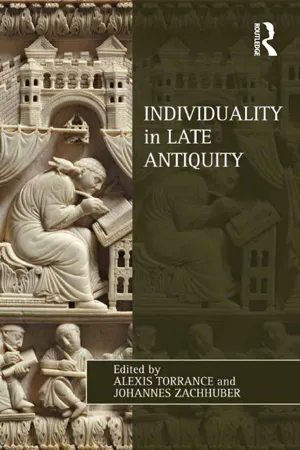
Individuality in Late Antiquity
About this book
Late antiquity is increasingly recognised as a period of important cultural transformation. One of its crucial aspects is the emergence of a new awareness of human individuality. In this book an interdisciplinary and international group of scholars documents and analyses this development. Authors assess the influence of seminal thinkers, including the Gnostics, Plotinus, and Augustine, but also of cultural and religious practices such as astrology and monasticism, as well as, more generally, the role played by intellectual disciplines such as grammar and Christian theology. Broad in both theme and scope, the volume serves as a comprehensive introduction to late antique understandings of human individuality.
Information
Chapter 1Individuality in Some Gnostic Authors, with a Few Remarks on the Interpretation of Ptolemy's Epistula ad Floram
DOI: 10.4324/9781315588414-3
Let me begin by posing a question that I believe is central for anyone seeking to understand Valentinian thought: how does myth function in their different texts? This question is in a sense far more fundamental than the ensuing problem of how to analyse the myth in different texts or different accounts and how to differentiate between schools or tendencies. Einar Thomassen, in his recent The Spiritual Seed. The Church of the Valentinians, 2 has successfully tackled the latter problem, but is mostly content to briefly label the Gnostic myth of the Valentinians as ‘a protological philosophical myth’3 and to categorise it as the third basic dimension of Valentinianism without deeper analysis of the literary and systematic function such a myth would have in a doctrinal system.4 I do not want to repeat my answer to the question on the function of the myth here, although it is somewhat obscurely concealed in a kind of Festschrift for the late Tübingen New Testament Scholar Martin Hengel's 80th birthday.5 Equally I will not deal with the central question of how myth is related to salvation history and history in general. Einar Thomassen is absolutely right to raise objections in his Spiritual Seed to common tendencies of categorising all Valentinian thought as pure myth and to establish a fundamental difference between a Valentinian myth and the salvation ‘history’ of ancient mainstream Christianity.6 My topic for this paper is an attempt to analyse a structural principle of the protological myth by comparing Valentinian and Platonic texts of the Early Roman Empire. And the key question of my analysis is the following: is there a concept of individuality in these protological myths, and if so, which entities are thought and portrayed as ‘individuals’? Approaching the argument in such a detailed manner is also necessary in order to react to a recent criticism of my interpretation of the Epistula ad Floram made by Herbert Schmid.7
_______________
1 This chapter is based on a contribution presented in September 2010 at a conference entitled ‘Individuality in Late Antiquity’ in Oxford. It was fully revised and given in Yale as the keynote lecture at the meeting of Nag Hammadi and the Gnosticism Network in May 2011. A version may be found in C. Markschies, ‘Individuality in Some Gnostic Authors: With a few remarks on the interpretation of Ptolemaeus, Epistula ad Floram’, Zeitschrift für antikes Christentum 15/3 (2011): pp. 411–30. Used with permission.
2 E. Thomassen, The Spiritual Seed. The Church of the Valentinians (Leiden-Boston, 2006). Cf. the reviews by Ph.L. Tite, Journal of Ecclesiastical History 60 (2009): pp. 55–8 and W.A. Löhr, Cristianesimo nella storia 29 (2008): pp. 614–20.
3 Thomassen, Spiritual Seed, p. 133.
4 The same can be said of J.D. Turner's, Sethian Gnosticism and the Platonic Tradition (Québec, 2001), pp. 20–23 and 457–74. Turner carefully describes Hans Jonas’ ideas on the matter and analyses some Middle Platonic myths, for example Plutarch.
5 C. Markschies, ‘Welche Funktion hat der Mythos in gnostischen Systemen? Oder: ein gescheiterter Denkversuch zum Thema “Heil und Geschichte”’, in Heil und Geschichte. Die Geschichtsbezogenheit des Heils und das Problem der Heilsgeschichte in der biblischen Tradition und in der theologischen Deutung (Tübingen, 2009), pp. 513–34.
6 Thomassen, Spiritual Seed, pp. 84–5, note 4.
7 H. Schmid, ‘Ist der Soter in der Epistula ad Floram der Demiurg?’, Zeitschrift für antikes Christentum 15 (2011): pp. 249–71. Schmid is referring to C. Markschies, ‘New Research on Ptolemaeus Gnosticus’, Zeitschrift für antikes Christentum 4 (2000): pp. 225–54.
I would like to start answering these questions by citing the so-called Grande Notice (to use the term coined by Sagnard),8 from the evidently shortened and modified Valentinian source at the beginning of Irenaeus’ Adversus haereses, which, in most manuscripts of the late fourth-century Latin translation, is entitled Narratio omnis argumenti Valentini discipulorum, ‘Tale of the complete story of the disciples of Valentinus’.9 The quotation runs as follows: ‘Thus, then, they (i.e. the Valentinians) tell us that the Aeons (or perhaps better: the eternities) were constituted equal to each other in form and sentiment’ (οὕτως τε μορφῇ καὶ γνώμῃ ἴσους κατασταθῆναι τοὺς αἰῶνας λέγουσι).
_______________
8 F.M.-M. Sagnard, La Gnose Valentinienne (Paris, 1947), pp. 31–50 and 140–232.
9 Irenaeus, Adversus Haereses 1.1.1 (SC 263.28.1–2 Rousseau and Doutreleau).
With these words, Irenaeus concludes the second paragraph of his famous account of those Gnostics who regard themselves as followers in the tradition of the Roman theologian Valentinus.10 This account, probably based on a ὑπόμνημα (or rather on some ὑπομνήματα [memoranda/notes]) which Irenaeus had at hand when writing his Exposure and Subversion of the falsely so-called Knowledge in the 80s of the second century, is in my view the earliest preserved protological myth of the Valentinians. Based on a line in the Latin translation from Late Antiquity that does not quite stand up to critical examination, Sagnard and some scholars have attributed the account to Ptolemy, a pupil of Valentinus: Et Ptolemaeus quidem ita.11 In fact, the authors of the ὑπομνήματα [memoranda], probably paraphrased by Irenaeus rather than cited (despite the one use of the formula αὐταῖς λέξεσι λέγοντες οὕτως [expressing themselves in these words]),12 were pupils of Ptolemy claiming to be pupils of Valentinus.13 Those calling themselves Οὐαλεντίνου μαθηταί [disciples of Valentinus] are in fact οἱ περὶ Πτολεμαῖον [those around Ptolemy]; one should not draw a distinction here, as Einar Thomassen has rightly pointed out.14 At times Irenaeus adheres to this conventional self-designation of his contemporary opponents, at others he uses the term ‘Valentinians’ with a different meaning, causing confusion for both ancient and modern readers. It remains uncertain whether this Ptolemy is identical to the second-century Roman teacher of the same name whose martyrdom in the capital city is mentioned by Justin with deep respect – this is one of the famous, somewhat radical hypotheses from Adolf von Harnack's so-called ‘Hypothesenschmiede’ (forge of hypotheses). But careful analysis of the preface to Book I of Irenaeus’ Adversus haereses establishes quite clearly that the Grande Notice is a work by the second generation of Roman ‘Valentinians’, based on my reconstruction of this movement's history, and if, among the first generation, one does not count the heresiarch, who gave it its name – he probably slipped away to Cyprus at some point in the second half of the century and was regarded as Heros Eponymos of the movement ever since, as he could not defend himself in person any more. Thus, in fact, his pupil Ptolemy belongs to the first generation and οἱ περὶ Πτολεμαῖον or qui sunt circa Ptolemaeum [those in Ptolemy's circle] to the second generation.15 This fits perfectly with the period of time in which Irenaeus’ great anti-heretical work was seemingly written. The Grande Notice, therefore, appears to be a reasonably contemporary text, probably dateable to the 70s of the second century.
_______________
10 Irenaeus, Adversus Haereses 1.2.6 (SC 263.46.225–6 Rousseau and Doutreleau).
11 Irenaeus, Adversus Haereses 1.8.5 (SC 263.136.189 Rousseau and Doutreleau; cf. SC 263.218) Et Ptolemaeus quidem ita; on the discussion on the philological problems, cf. Markschies, ‘New Research on Ptolemaeus Gnosticus’, pp. 249–53.
12 Irenaeus, Adversus Haereses 1.8.5 (SC 263.129.909–10); interestingly the plural is used here.
13 For more detail on this: Markschies, ‘New Research on Ptolemaeus Gnosticus’, pp. 249–51.
14 Irenaeus, Adversus Haereses 1.prol.2 (SC 263.22.35 and 263.23.44 Rousseau and Doutreleau); cf. Thomassen, Spiritual Seed, p. 11, note 6.
15 Irenaeus, Adversus Haereses 1.prol.2 (SC 263.23.44 Rousseau and Doutreleau).
But enough of introductory remarks. For what mainly concerns us here is the question of whether this specific Gnostic movement – at its stage of development in the 70s of the second century – possessed a concept of individuality in their protological myth. With reference to the quotation mentioned earlier, this seems to be the case only to a very limited degree: ‘Thus, then, they (i.e. the Valentinian Gnostics) tell us that the eternities were constituted equal to each other in form and sentiment’ (οὕτως τε μορφῇ καὶ γνώμῃ ἴσους κατασταθῆναι τοὺς αἰῶνας λέγουσι). As we remarked, the second paragraph of Valentinian cosmogony rendered by the Grande Notice concludes with this thought. Nor do the authors omit a single rhetoric device to drum, as it were, the de-individualisation of the eternities into their readers. The eternities were equalised (here we find the Greek verb ἐξισόω, which usually refers to a technical dimension of adjustment and only gains a metaphysical dimension in a Christian context16 ), they became equal to each other (ἴσος) in ‘form and character’ (μορφή καὶ γνώμη) – that is with regard to outer as well as inner dimensions. And just in case the readership had still not quite understood it, the authors of the Grande Notice made their point yet again (recalling a former catechetical Sitz im Leben of the Grande Notice):17 ‘And all (sc. male eternities) became a mind, and a word, and a human, and a Christ. Accordingly, the female aeons all became a truth, and a life, and a spirit, and a Church’. As I have written elsewhere (and thus do not want to repeat here), the ‘eternities’ mentioned earlier are clearly Christian-Gnostic ‘contrafacts’ of the Platonic ideas, which, in turn, are the thoughts of God according to common Midd...
Table of contents
- Cover Page
- Half Title Page
- Series Page
- Title Page
- Copyright Page
- Table of Contents
- List of Contributors
- Preface
- Introduction
- 1 Individuality in Some Gnostic Authors, with a Few Remarks on the Interpretation of Ptolemy’s Epistula ad Floram
- 2 Astrology and Freedom: The Case of Firmicus Maternus
- 3 Plotinus on Sensible Particulars and Individual Essences
- 4 Logico-grammatical Reflections about Individuality in Late Antiquity
- 5 Individuality and the Theological Debate about ‘Hypostasis’
- 6 Individuality and Identity-formation in Late Antique Monasticism
- 7 Individuality and the Resurrection in Some Late Antique Texts
- 8 John Philoponus on Individuality and Particularity
- 9 The Religious Constitution of Individuality: One Motif of Augustine’s Confessions in Modern Intellectual History and Theology
- Bibliography
- Index
Trusted by 375,005 students
Access to over 1.5 million titles for a fair monthly price.
Study more efficiently using our study tools.
Frequently asked questions
Yes, you can cancel anytime from the Subscription tab in your account settings on the Perlego website. Your subscription will stay active until the end of your current billing period. Learn how to cancel your subscription
No, books cannot be downloaded as external files, such as PDFs, for use outside of Perlego. However, you can download books within the Perlego app for offline reading on mobile or tablet. Learn how to download books offline
Perlego offers two plans: Essential and Complete
- Essential is ideal for learners and professionals who enjoy exploring a wide range of subjects. Access the Essential Library with 800,000+ trusted titles and best-sellers across business, personal growth, and the humanities. Includes unlimited reading time and Standard Read Aloud voice.
- Complete: Perfect for advanced learners and researchers needing full, unrestricted access. Unlock 1.5M+ books across hundreds of subjects, including academic and specialized titles. The Complete Plan also includes advanced features like Premium Read Aloud and Research Assistant.
We are an online textbook subscription service, where you can get access to an entire online library for less than the price of a single book per month. With over 1.5 million books across 990+ topics, we’ve got you covered! Learn about our mission
Look out for the read-aloud symbol on your next book to see if you can listen to it. The read-aloud tool reads text aloud for you, highlighting the text as it is being read. You can pause it, speed it up and slow it down. Learn more about Read Aloud
Yes! You can use the Perlego app on both iOS and Android devices to read anytime, anywhere — even offline. Perfect for commutes or when you’re on the go.
Please note we cannot support devices running on iOS 13 and Android 7 or earlier. Learn more about using the app
Please note we cannot support devices running on iOS 13 and Android 7 or earlier. Learn more about using the app
Yes, you can access Individuality in Late Antiquity by Alexis Torrance, Johannes Zachhuber,Alexis Torrance in PDF and/or ePUB format, as well as other popular books in Philosophie & Christentum. We have over 1.5 million books available in our catalogue for you to explore.