eBook - ePub
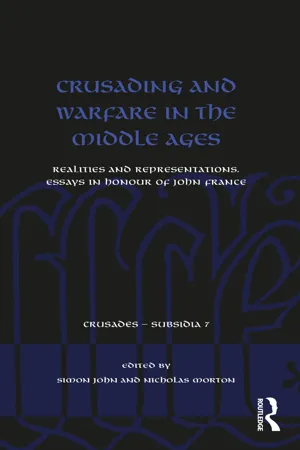
Crusading and Warfare in the Middle Ages
Realities and Representations. Essays in Honour of John France
- 258 pages
- English
- ePUB (mobile friendly)
- Available on iOS & Android
eBook - ePub
Crusading and Warfare in the Middle Ages
Realities and Representations. Essays in Honour of John France
About this book
This volume has been created by scholars from a range of disciplines who wish to show their appreciation for Professor John France and to celebrate his career and achievements. For many decades, Professor France's work has been instrumental in many of the advances made in the fields of crusader studies and medieval warfare. He has published widely on these topics including major publications such as: Victory in the East: A Military History of the First Crusade (1994) and Western Warfare in the Age of the Crusades (1999). This present volume mirrors his interests, offering studies upon both areas. The fifteen essays cover a wide variety of topics, spanning chronologically from the Carolingian period through to the early fourteenth century. Some offer new insights upon long-contested issues, such as the question of whether a new form of cavalry was created by Charles Martel and his successors or the implications of the Mongol defeat at Ayn Jalut. Others use innovative methodologies to unlock the potential of various types of source material including: manuscript illuminations depicting warfare, Templar graffiti, German crusading songs, and crusading charters. Several of the articles open up new areas of debate connected to the history of crusading. Malcolm Barber discusses why Christendom did not react decisively to the fall of Acre in 1291. Bernard Hamilton explores how the rising Frankish presence in the Eastern Mediterranean during the central medieval period reshaped Christendom's knowledge and understanding of the North African cultures they encountered. In this way, this work seeks both to advance debate in core areas whilst opening new vistas for future research.
1
Carolingian Cavalry in Battle: The Evidence Reconsidered
There is a story about early medieval warfare that was first told in the eighteenth century. It was further elaborated between the mid-nineteenth and mid-twentieth centuries, and it is still often repeated in Western civilization textbooks and sometimes in military history surveys and reference books, though specialists in medieval warfare have lately tended to dismiss it as a ‘myth’. The story goes like this:
When the Roman Empire in the West collapsed in the fifth century, the migrating peoples who crossed the Rhine frontier were warrior nations in which all free men fought, the aristocrats on horseback but the common folk on foot. The Franks, who settled in northern France and the Low Countries, were especially infantry-focused. Over time, however, cavalry came to play a larger role in their armies. This process took a great leap forward under the first Carolingian ruler, Charles Martel. For a variety of reasons, perhaps including the need to counter fast-moving Muslim raiders from Spain and (in Lynn White’s version) his recognition that the recently introduced stirrup greatly increased the effectiveness of mounted warriors engaging in shock combat,1 Charles made every effort to increase the force of armoured horsemen at his disposal, going so far as to confiscate large amounts of Church lands, which he granted out to select warriors – ‘vassals’ – in the form of estates held by precarial tenure (‘benefices’, or ‘fiefs’). The Franks were strongly averse to Roman-style taxation, and the monetary economy had much dwindled, but these estates allowed for the direct support of the soldiers, which was found to be more efficient than collecting and distributing scarce coin. Each fief generally provided revenues sufficient at least for the man holding it to sustain himself without personally engaging in farming or commerce, and to supply him with the horses, gear, and other supplies that would allow him to campaign at his own expense. This launched a ‘complete revolution in the art of war’, and amounted to the first steps towards the feudal system that structured much of medieval politics, warfare, and economics, and the chivalric ethos that infused much of medieval art, literature, song, ethics, and aristocratic culture generally.2
If it were a true story, this tale could hardly be bettered as an example of the importance of warfare and military affairs in explaining the broad sweep of general history, and hence as evidence for the profound importance of the sub-field of military history. Recently, however, Susan Reynolds has made a strong argument against the prevalence of anything much like ‘feudalism’ among the Carolingians,3 and, for a much longer period now, medieval military historians, with Bernard S. Bachrach of the University of Minnesota leading the charge, have questioned the claim that the Carolingians focused their military system on the heavy cavalry.
Indeed, Professor Bachrach does more than merely ‘question’ the idea that cavalry was the principal arm of the Carolingian military, he utterly rejects that proposition, both holistically and with respect to each component argument that might go to supporting it. ‘An entirely new state of the question must be formulated regarding the military in medieval Europe,’ he argues. ‘Knights, heavy cavalry … [and] small numbers of effectives … must be swept away as the dominant themes. Continuity from the later Roman empire through the Middle Ages is the proper focus’.4 As Bachrach’s former student Peter Burkholder writes in History Compass, ‘the main impetus to question the cavalry dominance paradigm’ is the ‘centrality of siege warfare in the Middle Ages’, which leads to the ‘necessary conclusion’ that cavalry was not the dominant arm, since, in Bachrach’s words, ‘There was no place for the warhorse in the sapper’s mine, the artilleryman’s battery, or the crossbowman’s belfry.’5
This line of argument rests on the belief that the ebb and flow of Carolingian warfare was determined by the conduct of sieges, and also on the questionable assumption that the success of individual sieges was normally determined by the tools of assault rather than by a competition over which side could keep itself fed longer6 – since in a long siege the role of cavalry in protecting or attacking foragers and supply convoys could easily be decisive. It also, at least implicitly, rests on a low assessment of the importance of cavalry in open battles. There were plenty of medieval wars resolved without an open battle taking place, it is true, but it is very difficult for an invader to conduct an effective siege-based campaign unless he is able to defeat the defenders in battle, or else deter them from initiating one. Therefore, if cavalry were generally the decisive arm in battle, superiority in cavalry would normally be a practical requirement for a successful offensive, even if the campaign consisted of a series of sieges and no battles were actually fought.7
But Bachrach and his followers minimize the importance of cavalry in open battle, as well as in siege operations.8 ‘Even in battles in the open field’, writes Steven Fanning, ‘cavalry was usually ineffective against well-trained and disciplined foot soldiers in prepared defenses’; hence aristocrats ‘usually dismounted and fought on foot throughout the Merovingian, Carolingian, and post-Carolingian periods’.9 Bryce Lyon goes even further, stating that ‘Not in a single significant battle or campaign did cavalry play a tactically decisive role.’10 Lyon seems to be echoing earlier remarks by Bachrach, who writes that ‘From the many campaigns of Charles [Martel], Pepin, and Carloman described by contemporaries and near contemporaries there is not a shred of evidence to suggest that heavily armed horsemen engaging in mounted shock combat were the decisive element of their armies’,11 and that in the next generation, in Charlemagne’s reign, ‘not a single significant battle or campaign has been cited in which the cavalry can be shown to have played the tactically decisive role’.12 Now, in these two quotations, Bachrach is actually saying more about the absence of evidence for the tactical role of mounted troops in this period than he is about cavalry’s importance or effectiveness. In most cases contemporary descriptions of Carolingian battles are extremely brief and do not allow us to draw any firm conclusions about the roles or relative importance of cavalry and infantry. Bachrach could have made the point that any theory of the social implications of the dominance of Carolingian cavalry rests on shaky foundations, because of that lack of evidence, and left it there. This would have been a valuable service to the fields of medieval and military history. But in fact he goes on to state not just that cavalry ‘cannot be shown to have played the tactically decisive role’ in any Carolingian battle, but, more positively, that ‘the decisive arm of the military forces of Charles Martel, and his sons, was not cavalry’.13 How misleading Bachrach’s logical slip can be is well illustrated by Victor Davis Hanson’s completely unsupportable claim that ‘there is not a single major Carolingian engagement in which infantrymen were not the dominant force on the battlefield’.14
In fact, a good case could be made that shock cavalry most likely was the decisive arm of the Carolingian military. But I will not make that case here, as it would require a much longer essay than this one, among other reasons because of the problems inherent in even defining what it means to be a ‘decisive arm’. I will therefore not review the evidence from the capitularies and other contemporary texts that show how much importance Charlemagne placed on recruiting, and finding fodder for, the horsemen of his army. John France has in any case already done that very well, in the course of making the point that those documents only offer circumstantial support for, not hard evidence of, a key tactical role for cavalry, since horses could have been considered of crucial importance for reasons of logistics and operational mobility even if their riders were accustomed to dismount and fight as infantry, rather than as cavalry.15 Instead, in the limited space available, this essay will focus on re-examining the few contemporary descriptions of combat that are sufficiently detailed to allow us to assess the role of cavalry per se in Carolingian battles. The earliest of these battle descriptions date to the 780s.
Frankish troops fought battles against Saxon forces in 782, twice in 783, and in 784. Although the tactical detail that has come down to us about the last of these four engagements, as is typical for Carolingian battles, amounts to less than a single sentence, it is still enough to contradict Bachrach’s assertion that ‘not a single significant battle or campaign has been cited in which the cavalry can be shown to have played the tactically decisive role’. Since the combat of 784 was described by the Annales qui dicuntur Einhardi as an equestri proelio, ‘a battle of cavalrymen’, it is hard to imagine how anyone other than cavalry can have played the decisive tactical role in it.16
Regarding the second battle of 783, fought near the River Hase, we are told only that Charlemagne led his full army to victory and killed many Saxons; no comment can be made about the respective importance of horse and foot. For the battle before that, however, we have a bit more information: we know that King Charles advanced to Detmold with ‘only a few Franks’; that the Saxons ‘prepared for battle in a plain’; and that the Franks ‘charged into them’ or ‘rushed upon them’ ‘in the usual way’ [solito more super eos inruentes], upon which the Saxons fled. The fugitives were pursued vigorously and slaughtered mercilessly so that ‘only a few escaped by flight’.17 The Frankish forces are not stated to be horsemen, but there is nonetheless good reason to presume that this was another example of a battle won by a cavalry charge, considering four things. First, that a small force sent deep into enemy territory would likely be composed entirely of mounted men, and indeed of elite, armoured cavalrymen (since such a mission would seem unduly dangerous for any type of troops that did not have an asymmetric advantage over the Saxons). That assertion is supported by the case of 782, when a detachment or scara with a very similar mission was composed entirely of cavalrymen, as we will see. Second, that men with horses who are accustomed to charge [inruere] as their ‘usual way’ of fighting18 are more likely than not to have done so on horseback, since rapid charges by infantry at the start of a battle normally create disorder and lead to defeat.19 Third, that only a force attacking on horseback is likely to pursue so effectively as to allow few enemies to escape alive, especially when the pursuers are few in number and the fugitives are on their own home ground. And fourth, that the annalist specifies the attack was made in the ‘usual way’, in between two battles, those of 782 and 784, in which we know the Franks involved fought entirely on horseback.20
As already noted, we know the later of the bracketing battles, the combat of 784, was won by Frankish cavalry because the engagement was described as a ‘cavalry battle’. The case of 782, however, is more complicated. Early in that year Charlemagne sent a force of East Franks towards the eastern frontier of his reign, apparently a small force since it was described as a scara and its target was characterized as ‘a few rebel Slavs’.21 While this contingent was en route, its leaders learned that the Saxons had rebelled. The East Franks promptly abandoned their previous mission and moved instead against the Saxons, meeting on their way with a substantial force that Charlemagne’s kinsman Theodoric had raised in the closest Frankish region. The two elements planned a pincer movement against the Saxon camp on the opposite side of the Süntal mountains, but in the event the East Frankish scara, reportedly reluctant to have the glory of the victory fall to Theodoric, attacked without waiting for his troops to move into position. ‘Therefore’, according to the Annales qui dicuntur Einhardi, ‘they decided to engage the Saxons without him. They took up their arms, and each and every one of them charged just as fast as his horse would carry him, individually straining for the greatest possible speed, towards the place outside of the Saxon camp where the Saxons were standing in a battle array – as if they were pursuing fugitives who had turned their backs and were seizing booty, rather than facing enemies standing in formation. The fighting was as bad as the approach. As soon as the battle began they were surrounded by the Saxons and slain almost to a man.’ The Frankish dead included Charlemagne’s own chamberlain, his constable, four other counts, and 20 other noblemen, along with many of their men; of the top leaders, only Charlemagne’s count of the palace escaped.22
Those who doubt the importance of cavalry in the Carolingian period see this episode as supporting their view. Bernard Bachrach, for example, writes with reference to this combat that in the ‘only real battle narrative which exists … for the times of Charles Martel, Peppin III and Charlemagne’, ‘far from the Frankish cavalry playing the decisive role, it was … decisively defeated by Saxon foot soldiers’.23 In Bachrach’s view, moreover, the descripti...
Table of contents
- Cover Page
- Title Page
- Copyright Page
- Contents
- List of Illustrations
- List of Contributors
- Preface An Appreciation of John France
- Abbreviations
- A Bibliography of John France’s Publications, 1968–2014
- 1 Carolingian Cavalry in Battle: The Evidence Reconsidered
- 2 Cultural Representations of Warfare in the High Middle Ages: The Morgan Picture Bible
- 3 A Medieval Graffito Representing a Trébuchet in an Etruscan Tomb in Corneto-Tarquinia
- 4 Encountering the Turks: The First Crusaders’ Foreknowledge of their Enemy; Some Preliminary Findings
- 5 An Early Muslim Reaction to the First Crusade?
- 6 Espionage and Military Intelligence during the First Crusade, 1095–99
- 7 Ralph of Caen as a Military Historian
- 8 ‘Martyrum collegio sociandus haberet’: Depictions of the Military Orders’ Martyrs in the Holy Land, 1187–1291
- 9 The Poet Friedrich von Hausen in the Third Crusade and the Performance of Middle High German Crusading Songs
- 10 Godfrey of Bouillon and the Swan Knight
- 11 The Preparations of Count John I of Sées for the Third Crusade
- 12 The Crusades and North-East Africa
- 13 Thoros of Armenia and the Kingdom of Jerusalem
- 14 Why Did the West Fail to Recover the Holy Land Between 1291 and 1320?
- 15 Meet the Mongols: Dealing with Mamluk Victory and Mongol Defeat in the Middle East in 1260
- Index
Trusted by 375,005 students
Access to over 1.5 million titles for a fair monthly price.
Study more efficiently using our study tools.
Frequently asked questions
Yes, you can cancel anytime from the Subscription tab in your account settings on the Perlego website. Your subscription will stay active until the end of your current billing period. Learn how to cancel your subscription
No, books cannot be downloaded as external files, such as PDFs, for use outside of Perlego. However, you can download books within the Perlego app for offline reading on mobile or tablet. Learn how to download books offline
Perlego offers two plans: Essential and Complete
- Essential is ideal for learners and professionals who enjoy exploring a wide range of subjects. Access the Essential Library with 800,000+ trusted titles and best-sellers across business, personal growth, and the humanities. Includes unlimited reading time and Standard Read Aloud voice.
- Complete: Perfect for advanced learners and researchers needing full, unrestricted access. Unlock 1.5M+ books across hundreds of subjects, including academic and specialized titles. The Complete Plan also includes advanced features like Premium Read Aloud and Research Assistant.
We are an online textbook subscription service, where you can get access to an entire online library for less than the price of a single book per month. With over 1.5 million books across 990+ topics, we’ve got you covered! Learn about our mission
Look out for the read-aloud symbol on your next book to see if you can listen to it. The read-aloud tool reads text aloud for you, highlighting the text as it is being read. You can pause it, speed it up and slow it down. Learn more about Read Aloud
Yes! You can use the Perlego app on both iOS and Android devices to read anytime, anywhere — even offline. Perfect for commutes or when you’re on the go.
Please note we cannot support devices running on iOS 13 and Android 7 or earlier. Learn more about using the app
Please note we cannot support devices running on iOS 13 and Android 7 or earlier. Learn more about using the app
Yes, you can access Crusading and Warfare in the Middle Ages by Simon John,Nicholas Morton in PDF and/or ePUB format, as well as other popular books in History & European Medieval History. We have over 1.5 million books available in our catalogue for you to explore.