This book is the third publication originating from the conference Legacy of Slavery and Indentured Labour: Past, present and future, which was organised in June 2013 by the Institute of Graduate Studies and Research (IGSR), Anton de Kom University of Suriname.
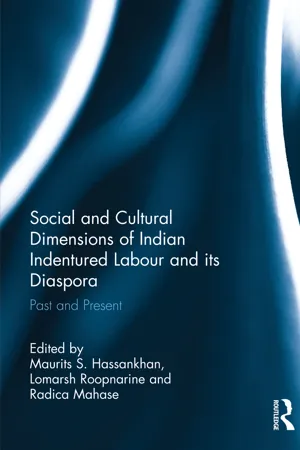
eBook - ePub
Social and Cultural Dimensions of Indian Indentured Labour and its Diaspora
Past and Present
- 374 pages
- English
- ePUB (mobile friendly)
- Available on iOS & Android
eBook - ePub
Social and Cultural Dimensions of Indian Indentured Labour and its Diaspora
Past and Present
About this book
Information
Part 1
Women, Labour and Narratives
CHAPTER 1
Plantation Patriarchy and Structural Violence: Women Workers in Sri Lanka
RACHEL KURIAN AND KUMARI JAYAWARDENA
Introduction
Plantation production in Sri Lanka was initiated in the early nineteenth century under British colonialism, with the government undertaking political and economic reforms in line with commercialization of agricultural production and thereby promoting laissez-faire capitalism. The planters, keen to lower the costs of labour, directly recruited labour from neighbouring districts of the Madras Presidency in south India. These were workers who were affected by the widespread famine and indebtedness in the region, were prepared to migrate to work on the plantations. While women formed a small proportion of the early pattern of migration, their numbers subsequently increased and, by the twentieth century, they comprised half the now-permanent workforce on the plantations. The plantation workers constituted the single largest and organized segment of the working class in the country.
The significance of plantation production to the economic development of the country has been highlighted by many academics, politicians and planners, and attention has been given to the recruitment patterns, conditions of work and life, as well as the political rights of plantation labour.1 The discussion has, on the whole, however, tended to ignore the exploitation of women workers, reflecting a male bias through subsuming their experiences within the wider category of workers.2 Using a historical and contemporary perspective, this paper analyses the social, economic and political opportunities and entitlements of women workers on the plantations in Sri Lanka and shows how these have changed over time. It deals with the role of different actors and institutions, including colonial government, the management, the trade unions and the community, in influencing these possibilities. It pays attention to the ways in which women have been constrained and supported in their struggles for upward mobility and empowerment. How were women workers incorporated into the labour regime on the plantations, and what implications did this have for their lives as workers, members of the plantation community as well as women? Did these women experience class and gender discrimination with regard to pay and benefits? How did patriarchal norms and gender biases in the prevailing social hierarchies, such as those based on class, ethnicity, caste, religion and other cultural traditions influence the capabilities, labour rights and political achievements of women workers? These are some of the questions which will be asked.
This paper argues that plantations were, by origin, patriarchal institutions characterized by a strict hierarchical order and male domination at all levels. The power of 'plantation patriarchy' extended beyond the boundaries of the unit of production, and planters exerted their influence on the state and wider society, gaining favourable concessions and legal support. Women workers on the Sri Lankan plantations were subjected to structural violence through the systematic denial and discrimination with regard to their economic, social and political rights. The argument is developed as given below.
In the case of Sri Lanka, gender prejudices and patriarchal norms stemming from colonialism, race, caste, ethnicity, religion and cultural practices were incorporated into the structure of the labour regime and the organization of life on plantations. Norms and practices promoting male domination pervaded all classes in the plantation sector, including the planters, management, recruiters and workers (including women themselves) reinforcing the traditional view that the subordination of women was justified by custom, religion and law. Under these conditions, the subordination of women was normalized ideologically and structurally; their work was exploited as 'cheap' labour; they were disadvan taged with regard to education, health and income; and they were excluded from the leadership of plantation trade unions and political parties, as well as national and local government. As a relatively isolated sector of the country, it was possible to sustain these forms of discrimination for nearly two centuries, reflecting a form of structural violence against women workers on plantations.
Plantation Patriarchy and Structural Violence
While 'patriarchy' literally means the 'rule of the father', the concept has been used to analyse norms and practices promoting male domination in structures and institutions in society (Barrett, 1980; Beechey, 1979; Bhasin, 1993; Lerner, 1986; Mies, 1986; Walby, 1990). The existence of caste and religious-based discrimination against women have led some feminists to develop the notion of 'multiple and overlapping patriarchies'. This term was initially used by Kumkum Sangari (1995: 3287) in analysing the politics of religious-based personal laws and their impact on women. Given the influence of class, race/ethnicity, caste and religion in the lives of women from the plantation community in Sri Lanka, this paper suggests that multiple patriarchies is a useful framework to understand how the different influences combined to limit women's opportunities and entitlements on the Sri Lankan plantations.
Plantations were, by origin and structure, fundamentally patriarchal institutions. The Portuguese developed the first plantations for the large-scale production of sugar in the fifteenth century with the use of slave labour and incorporated features of the prevailing patriarchal feudal household of the period.3 The early plantations maintained a strict hierarchical social order and a division of labour that was based on race and colour differences, and reflected on the fields, as well as in the segregation of living quarters and social distance (Durant et al, 1999: 11). At the highest level was the white planter (manager) supported by white staff. Lighter skinned slaves, usually the children of black slaves with either the owner or the managers were maintained as house servants. All persons in authority on the plantations (planters, overseers, recruiters, and even inspectors and other government bureaucrats) were men reflecting hegemonic masculinity at all levels. The planters were linked to the dominant class and supported by the colonial political and legal systems, as plantations were important sources of finances for the exchequer.
Women slaves, while essential labour on plantations, were subject to severe punishment (Patterson, 1967: 67) and 'harshly, physically damaging violence' (Reddock, 1985: 73). These practices of male domination were retained even after slavery was abolished. Women remained at the bottom of the plantation hierarchy and under male domination at all levels of fieldwork and within the household, with sexual exploitation and violence persisting even with indentured labour (Hyman, 1990: 14). In addition, women workers did the unpaid household chores, as well as sexually servicing the men (Shameem, 1998: 54). This overall system of controls on women workers, incorporated in the labour regime and in the organization of plantations, and supported by the wider society, could be characterized as plantation patriarchy. The latter reflected the discriminative norms and practices in colonialism, race and gender relations, as well as other cultural practices to enforce women's subordinate position in the plantation hierarchy. These 'multiple patriarchies' legitimized a gender division of labour where women workers were allocated the labour-intensive tasks on the fields and their household, and were constantly under male supervision and control. It justified women being paid lower wages while working longer hours than their male counterparts, and being largely responsible for the familial chores, including taking care of the children, the sick and the elderly. As most workers resided within the boundaries of the plantations, and interaction with 'outsiders' was relatively limited, plantation patriarchy proved to be fairly durable.
Under these circumstances, it is not surprising that women workers on plantations were exposed to different forms of gender bias and discrimination, which affected their opportunities and entitlements as women, as workers and as members of the plantation community and society. The processes and the outcomes of these disadvantages can be captured by the notion of structural violence. The most well-known author of this concept is johan Galtung, who defined structural violence as violence that is 'built into the structure and reflected in a groups' unequal power, unequal life chances and social injustice (Galtung, 1969: 171). It is reinforced through physical/direct violence and cultural violence, the latter making structural violence 'look, even feel righr (1990: 291) and 'legitimized and thus rendered acceptable in society' (Galtung, 1969: 292). According to him, 'a violent structure leaves marks not only on the human body but also on the mind and the spirit" (ibid: 294).4 Patriarchy he argued, combined 'direct, structural and cultural violence in a vicious triangle'. While 'direct violence, such as rape, intimidates and represses; structural violence institutionalizes; and cultural violence internalizes that relation, especially for the victims, the women, making the structure very durable' (Galtung, 1996: 40). At the same time, as argued by Catia Confortini, direct violence can influence both cultural and structural violence, preventing women from accessing their social, economic and political rights, thereby being 'a tool to build, perpetuate and reproduce structural violence' (Confortini, 2006: 350). Domestic violence for instance can be closely linked to wife abuse and structural violence against women, and rape need not be a deviant activity of an individual but closely related to promoting male supremacy and gender inequalities in society (ibid.: 350).
The concept of structural violence has particular relevance in analysing the experiences of women workers on the Sri Lankan plantations. It is widely acknowledged that physical violence was, since its inception in the fifteenth century, embedded in the labour relations on plantations. The physical cruelty of planters, the management and overseers on slaves, and subsequently on indentured labour and so-called 'free' labour has been well-documented (Wolf, 1959; Tinker, 1974; Breman, 1989).5 In addition, as will be discussed in the subsequent sections on Sri Lanka, plantation patriarchy in Sri Lanka was supported by gender biases in caste and religion, resulting in a form of structural violence that discriminated against their economic, social and political capabilities and denying them equal life chances for nearly two centuries.
Women Workers on Colonial Plantations in Sri Lanka
Women were part of the labour force that planters recruited from the 1830s, from the famine-prone districts of the Madras Presidency in south India. These women belonged to the lowest classes and castes in the villages and like their male counterparts suffered from chronic indebtedness and sought some form of remuneration for their survival. They migrated to work on the plantations only when the monsoons were insufficient for rice cultivation in south India, leaving them unemployed and living under precarious conditions. In the early period, they formed a migratory labour force, with approximately 56,000 men, 10,300 women and 8,000 children travelling across as plantation workers between 1843 and 1877; although the proportion of departures to arrivals was nearly 60 per cent (Kurian, 1989: 61). According to the Census of 1881, the estate population was 206,495 persons, with about 125,000 men and 82,000 women (Ferguson, 1883: 250). The workers were, as noted by Sir Emerson Tennent, the Colonial Secretary in-charge of Ceylon in 1847, caught between the dictates of plantation capitalism and debt bondage and had little choice of place of work or seasonality of employment (SLNA 3/34 Pt. I Tennent to Grey, Dispatch No. 6 (misc). 21 April 1847).
Women formed a very small proportion of the workforce during the initial stage, just 2.6 per cent of the labour force in 1843, and 27 per cent by 1866. Their conditions of travel were dismal; they were vulnerable to all kinds of dangers, including diseases, exposure to wild animals and sexual abuse. W.C. Twynam, Government Agent of Jaffna, commented on the fact that the few women accompanied the workers during the initial period of migration, indicating that the migrant workers formed '. . . miserable gangs of coolies of 1843 and 1845, with one or two women to 50 or 100 men, strangers in a strange land, ill-fed, ill-clothed, eating any garbage they came across (more however from necessity than choice. . .).'6
The planters were keen to recruit women workers and the Secretary of the Immigrant Labour Commission in 1860 asked the Agent in India to look for more labour, 'either on long or short engagements, and who, if required, would bring their wives and families with them' (SLNA, 6/2144: Dawson to Graham: 6 March 1860). The planters were motivated by economic as well as labour control advantages in recruiting women. First, women workers in south India were paid less than their male counterparts, a principle that was adopted in the recruitment of women as workers to the plantations. As such, the Commission was willing to pay relatively higher rates for 'able-bodied' men, with 'women and youths at some proportionally lower rate' (SLNA, 2/2644: Dawson to Graham: 6 March 1869). Second, women workers were viewed as more controllable and according to the Agent, women were generally 'the more steady and regular labourers' (SLNA, 6/2644: Graham to Hansbrow: 24 March 1859). Both these elements stemmed from the patriarchal norms and practices in their home regions and we...
Table of contents
- Cover
- Half Title
- Title
- Copyright
- Contents
- Introduction
- PART 1: WOMEN, LABOUR AND NARRATIVES
- PART 2: SOCIAL ISSUES AMONG HINDUSTANI IMMIGRANTS IN THE NETHERLANDS
- PART 3: RELIGION, ARTS AND IDENTITY
- PART 4: INDIAN MUSICAL TRADITIONS AND IDENTITY
- Notes on Contributors
- Index
Trusted by 375,005 students
Access to over 1.5 million titles for a fair monthly price.
Study more efficiently using our study tools.
Frequently asked questions
Yes, you can cancel anytime from the Subscription tab in your account settings on the Perlego website. Your subscription will stay active until the end of your current billing period. Learn how to cancel your subscription
No, books cannot be downloaded as external files, such as PDFs, for use outside of Perlego. However, you can download books within the Perlego app for offline reading on mobile or tablet. Learn how to download books offline
Perlego offers two plans: Essential and Complete
- Essential is ideal for learners and professionals who enjoy exploring a wide range of subjects. Access the Essential Library with 800,000+ trusted titles and best-sellers across business, personal growth, and the humanities. Includes unlimited reading time and Standard Read Aloud voice.
- Complete: Perfect for advanced learners and researchers needing full, unrestricted access. Unlock 1.5M+ books across hundreds of subjects, including academic and specialized titles. The Complete Plan also includes advanced features like Premium Read Aloud and Research Assistant.
We are an online textbook subscription service, where you can get access to an entire online library for less than the price of a single book per month. With over 1.5 million books across 990+ topics, we’ve got you covered! Learn about our mission
Look out for the read-aloud symbol on your next book to see if you can listen to it. The read-aloud tool reads text aloud for you, highlighting the text as it is being read. You can pause it, speed it up and slow it down. Learn more about Read Aloud
Yes! You can use the Perlego app on both iOS and Android devices to read anytime, anywhere — even offline. Perfect for commutes or when you’re on the go.
Please note we cannot support devices running on iOS 13 and Android 7 or earlier. Learn more about using the app
Please note we cannot support devices running on iOS 13 and Android 7 or earlier. Learn more about using the app
Yes, you can access Social and Cultural Dimensions of Indian Indentured Labour and its Diaspora by Maurits S. Hassankhan,Lomarsh Roopnarine,Radica Mahase in PDF and/or ePUB format, as well as other popular books in Social Sciences & Ethnic Studies. We have over 1.5 million books available in our catalogue for you to explore.