eBook - ePub
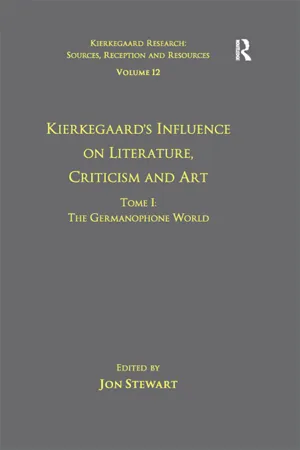
Volume 12, Tome I: Kierkegaard's Influence on Literature, Criticism and Art
The Germanophone World
- 282 pages
- English
- ePUB (mobile friendly)
- Available on iOS & Android
eBook - ePub
Volume 12, Tome I: Kierkegaard's Influence on Literature, Criticism and Art
The Germanophone World
About this book
While Kierkegaard is primarily known as a philosopher or religious thinker, his writings have also been used extensively by literary writers, critics and artists worldwide who have been attracted to his creative mixing of genres, his complex use of pseudonyms, his rhetoric and literary style, and his rich images, parables, and allegories. The goal of the present volume is to document this influence in different language groups and traditions. Tome I explores Kierkegaard's influence on literature and art in the Germanophone world. He was an important source of inspiration for German writers such as Theodor Fontane, Thomas Mann, Rainer Maria Rilke, Alfred Andersch, and Martin Walser. Kierkegaard's influence was particularly strong in Austria during the generation of modernist authors such as Rudolf Kassner, Karl Kraus, Robert Musil, and Hermann Broch. Due presumably in part to the German translations of Kierkegaard in the Austrian cultural journal Der Brenner, Kierkegaard continued to be used by later figures such as the novelist and playwright, Thomas Bernhard. His thought was also appropriated in Switzerland through the works of Max Frisch and Friedrich Dürrenmatt. The famous Czech author Franz Kafka identified personally with Kierkegaard's love story with Regine Olsen and made use of his reflections on this and other topics.
Information
Index of Persons
Abraham, 123–7, 131, 154, 197, 209, 210.
Adam, 182, 183.
Adorno, Theodor W. (1903–69), German philosopher, 4, 96, 167, 185, 186, 189.
Ahlin, Lars (1915–96), Swedish author, xii.
Alcoforado, Mariana (1640–1723), Portuguese nun, 223.
Andersch, Alfred (1914–80), German author, 1–13.
Andersen, Hans Christian (1805–75), Danish poet, novelist and writer of fairy tales, xi.
Anderson, Paul Irving, 63, 69, 72, 73.
Andreas-Salomé, Lou (1861–1937), Russian-born psychoanalyst and author, 215, 220, 228.
Arnim, Ludwig Achim von (1781–1831), German poet, xi.
Auden, W.H. (1907–73), English-born American poet, xii, 213.
Baggesen, Jens (1764–1826), Danish poet, xi.
Bakhtin, Mikhail (1895–1975), Russian writer and thinker, xiii.
Baldwin, James (1924–87), American author, xii.
Bang, Herman (1857–1912), Danish critic and journalist, 220.
Barber, Samuel (1910–81), American composer, xii.
Barlach, Ernst, 10.
Barth, Karl (1886–1968), Swiss Protestant theologian, 44, 55, 129.
Bärthold, Albert (1804–92), German Protestant pastor and theologian, 62.
Bauer, Felice, 119, 122.
Baum, Oskar, 121, 122.
Baumann, Julius, 33.
Békessy, Imre (1887–1951), Austrian-Hungarian journalist, 162–4, 167.
Benedictsson, Victoria (1850–88), Swedish author, xii.
Benjamin, Walter (1892–1940), German-Jewish philosopher and literary critic, 161.
Bergson, Henri (1859–1941), French philosopher, 105.
Bernhard, Thomas (1931–89), Austrian author, xi, 15–29.
Bernstorff, Wilhelm von, 66.
Betz, Maurice, 232.
Billeter, Fritz, 130.
Binder, Hartmut, 118.
Bjørnson, Bjørnstjerne (1832–1910), Norwegian author, xii.
Blake, William (1757–1827), English poet and artist, 143.
Blanchot, Maurice (1907–2003), French philosopher and writer, 129.
Blecher, Max (1909–38), Romanian writer, xiii.
Blei, Franz (1871–1942), Austrian-born author and translator, 98, 158.
Blicher, Steen Steensen (1782–1848), Danish author, xi.
Blixen, Karen (1885–1962), Danish author, xii.
Bloch, Ernst (1885–1977), German philosopher, 31, 238.
Bloom, Harold (b. 1930), American literary critic, xii.
Bohnenkamp, Klaus E., 143.
Boisdeffre, Pierre de, 129.
Böll, Heinric...
Table of contents
- Cover
- Half Title
- Title Page
- Copyright Page
- Table of Contents
- List of Contributors
- Preface
- Acknowledgements
- List of Abbreviations
- Alfred Andersch: Reading Søren Kierkegaard as Flight to Freedom
- Thomas Bernhard: A Grotesque Sickness unto Death
- Hermann Broch: “Nennen’s mir an Bessern”
- Friedrich Dürrenmatt: A Swiss Author Reading and Using Kierkegaard
- Theodor Fontane: A Probable Pioneer in German Kierkegaard Reception
- Max Frisch: Literary Transformations of Identity
- Theodor Haecker: The Mobilization of a Total Author
- Franz Kafka: Reading Kierkegaard
- Rudolf Kassner: A Physiognomical Appropriation
- Karl Kraus: “The Miracle of Unison”—Criticism of the Press and Experiences of Isolation
- Thomas Mann: Demons and Daemons
- Robert Musil: Kierkegaardian Themes in The Man Without Qualities
- Rainer Maria Rilke: Unsatisfied Love and the Poetry of Living
- Martin Walser: The (Un-)Certainty of Reading
- Index of Persons
- Index of Subjects
Trusted by 375,005 students
Access to over 1.5 million titles for a fair monthly price.
Study more efficiently using our study tools.
Frequently asked questions
Yes, you can cancel anytime from the Subscription tab in your account settings on the Perlego website. Your subscription will stay active until the end of your current billing period. Learn how to cancel your subscription
No, books cannot be downloaded as external files, such as PDFs, for use outside of Perlego. However, you can download books within the Perlego app for offline reading on mobile or tablet. Learn how to download books offline
Perlego offers two plans: Essential and Complete
- Essential is ideal for learners and professionals who enjoy exploring a wide range of subjects. Access the Essential Library with 800,000+ trusted titles and best-sellers across business, personal growth, and the humanities. Includes unlimited reading time and Standard Read Aloud voice.
- Complete: Perfect for advanced learners and researchers needing full, unrestricted access. Unlock 1.5M+ books across hundreds of subjects, including academic and specialized titles. The Complete Plan also includes advanced features like Premium Read Aloud and Research Assistant.
We are an online textbook subscription service, where you can get access to an entire online library for less than the price of a single book per month. With over 1.5 million books across 990+ topics, we’ve got you covered! Learn about our mission
Look out for the read-aloud symbol on your next book to see if you can listen to it. The read-aloud tool reads text aloud for you, highlighting the text as it is being read. You can pause it, speed it up and slow it down. Learn more about Read Aloud
Yes! You can use the Perlego app on both iOS and Android devices to read anytime, anywhere — even offline. Perfect for commutes or when you’re on the go.
Please note we cannot support devices running on iOS 13 and Android 7 or earlier. Learn more about using the app
Please note we cannot support devices running on iOS 13 and Android 7 or earlier. Learn more about using the app
Yes, you can access Volume 12, Tome I: Kierkegaard's Influence on Literature, Criticism and Art by Jon Stewart in PDF and/or ePUB format, as well as other popular books in Philosophie & Philosophische Kritik. We have over 1.5 million books available in our catalogue for you to explore.