eBook - ePub
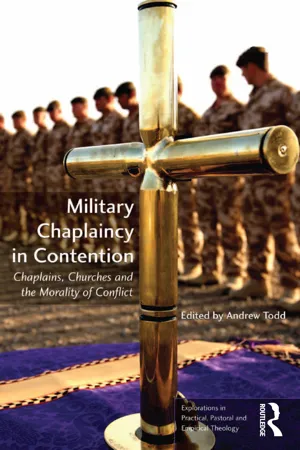
Military Chaplaincy in Contention
Chaplains, Churches and the Morality of Conflict
- 200 pages
- English
- ePUB (mobile friendly)
- Available on iOS & Android
eBook - ePub
About this book
Chaplaincy highlights the need for faith and society to re-engage with vital moral questions. Military chaplains continue to operate within the dynamic tension between faith communities, the armed services and society, offering a distinct moral presence and contribution. Drawing the reader into the world of the military chaplain, this book explores insights into the complex moral issues that arise in combat (especially in Afghanistan), and in everyday military life, These include the the increasing significance of the Law of Armed Conflict and the moral significance of drones. Through the unique chaplain's eye view of the significance of their experience for understanding the ethics of war, this book offers clearer understanding of chaplaincy in the context of the changing nature of international conflict (shaped around insurgency and non-state forces) and explores the response of faith communities to the role of the armed services. It makes the case for relocating understandings of just war within a theological framework and for a clear understanding of the relationship between the mission of chaplaincy and that of the military.
Information
Chaplaincy in Contention
Chapter 1
Chaplaincy in Contention
Introduction
This book is about the moral role of military chaplains. It offers interlocking perspectives on the nature of that role, on the challenges which it presents for chaplains, and on chaplains’ creative engagement with those challenges. In one sense, it grew out of a series of research workshops, supported by a small grant from the British Academy, and convened by the Cardiff Centre for Chaplaincy Studies, which drew together chaplains from the British Army and the RAF and academics, who were together interested in investigating the connections between military chaplaincy and the ethics of conflict. Many of the participants have contributed chapters to this book.
In another sense, the book grows out of military chaplains’ involvement in recent operations involving the British armed forces and, in particular, those located in Afghanistan. This book represents the first full discussion so far of the changing moral role of British military chaplains, in the light of their involvement in Afghanistan. Just as involvement in Afghanistan has represented a sustained operational tempo for the armed services, not known in recent decades, so military chaplains have also experienced the effects of that tempo, with frequent and recurring deployments to the theatre of operations. With their colleagues in the services, chaplains have also been in the public eye. And sometimes chaplains have had their own public profile, through their role in repatriations of those who have been killed, for example, or through media interest, such as that represented by the television programme Commando Chaplain, broadcast as part of the Channel 4 ‘Revelations’ series on 12 July 2009.
This book offers a portrayal of chaplains as very much ‘in contention’, in the sense of their being at the centre of an international conflict. But it also reflects something of the contentious nature of campaigns including Afghanistan, and investigates the way in which such contentions have reshaped military chaplaincy. The current situation places chaplaincy, as part of the armed forces, at the centre of a national debate about British involvement in Afghanistan (and previously in Iraq). In their moral and pastoral role chaplains often receive questions from military personnel that arise from their involvement in operations conducted in the public gaze, and where they become almost instantly aware of media portrayal and comment. But the chaplains’ role and involvement can itself be a public question – to what extent is a largely Christian, religious presence appropriate in this public context? What moral message is communicated by chaplaincy involvement in an international military coalition in Afghanistan, or elsewhere?
Such contentious issues sharpen other questions. Apart from a small number of civilian world faith chaplains to the military, British military chaplains are Christian, representing a variety of sending churches. Churches are, on the whole, supportive of their chaplains in the armed forces. But they may be at the same time critical of current military operations. This book explores the way in which these churches do not necessarily connect these two areas. In particular they do not always listen to the voices of chaplains on the contentious issue of the involvement of Christians in military operations, which include the authorised use of lethal force. These chaplains’ voices raise questions about the coherence of church positions, which support military chaplaincy, on the one hand; but which do not fully engage with contemporary questions of the ethics of armed conflict, on the other.
It is the contention of this book that military chaplains, with occasional exceptions, exercise a positive moral role on the international stage, including in Afghanistan. Their role is a significant public religious contribution to the debate about contemporary policy concerning the role of the military in defence and foreign policy. At the same time the book contends that the very success of that role raises sharp theological and ethical questions which need to be fully addressed by chaplains’ sending churches, as well as by chaplains themselves.
This chapter locates subsequent discussion in the chaplain’s experience of Afghanistan, before introducing the themes which emerge from that experience. Two chaplains have contributed short reflections, which explore the reality and implications of being at the sharp end of military chaplaincy in the twenty-first century.
Moral Courage
Stephen Sharkey’s narrative takes us very much to the sharp end of chaplaincy – to a Forward Operating Base in Afghanistan in the wake of the death of a soldier. In many ways this is an uncompromising account. Stephen is very clear that the moral and physical courage of a chaplain in such circumstances does not have to do with the niceties of rational debate. Rather it is the instinctive reaction of the pastor, who can do no other than be with the soldiers he serves. Nonetheless, the story does raise key questions which do need to be addressed in other contexts, including those provided by subsequent chapters of this book.
Three things stand out. First, the moral role of the chaplain is also intimately connected with the morale of the soldiers. Because the chaplain’s key role is first of all to be present, he has the capacity to respond to the human needs of the military personnel – to see their need for sleep, a listening ear or physical contact and respond accordingly. The second striking feature of the tale relates to the chaplain’s ritual, or liturgical, role. The central account of the memorial service to the dead soldier speaks volubly of the power of this act to hold the unit, despite their coming under fire. This is not only about holding their attention, but also about holding them as a community and holding their grief – through an act that is both moral and theological.
Both the first two noticeable aspects of the narrative connect, however, with the third significant feature of the account, which introduces a less comfortable concept. This is the idea that, through their pastoral, ritual and moral presence, chaplains become ‘force-multipliers’ – they contribute, whether intentionally or not, to the military effectiveness of the unit. Without Stephen’s presence and interventions, the soldiers would have been less able to cope with the continued demands of the tour of duty. This raises the vital question for chaplains, and for their sending churches, about how far both parties need to be in sympathy with the ‘mission’ of the armed forces. This is, of course, sharpened by the fact that most chaplains are commissioned and wear military uniform as part of their role.
A further question that is implicit in this narrative concerns how chaplains are educated, trained or formed. How can they be appropriately prepared to act with ‘instinctive’ moral courage in situations of crisis? What enables them to offer military personnel appropriate care, including through the medium of ritual and liturgy? And what moral formation enables them to cope with their role, whether intended, or unintended, as a ‘force multiplier’?
Stephen Sharkey’s Account
I was chaplain to a particular battalion on operations in Afghanistan. We had two companies based in Helmand District, in two Forward Operating Bases (FOBs). At around 11 a.m. one morning I was told by the Commanding Officer that we had lost a soldier, who had been killed by an Improvised Explosive Device (IED) less than an hour previously, and that the Platoon Sergeant had been seriously injured; his life was described as critical. Thankfully today he is still serving and has made an almost full recovery, a real sign of physical courage for all to see!
At the point I was told the news it was on a need to know basis, the question was asked of me, ‘Where do you think you need to be Father?’. I had the choice between heading back to Camp Bastion for the eventual repatriation or to the FOB, from where the soldier had left just a few hours previously for the last time. For me it was what I would term a ‘no brainer’, it was natural for me to want to be with those who were left behind, to be with the company who were based in the FOB, most especially with those who had been with the soldier who had died, as they faced the darkness of losing one of their comrades, friends.
The FOB was approximately six kilometers from another FOB where I had been with another company. It was a dangerous road often travelled by these soldiers, just off the route where the soldier had been killed earlier that day. To make the journey by road was an easy decision, but a risky one for all involved, it involved the usual risk of IEDs, attack by insurgents; and the fact that it was more than 45 degrees made it a very tough and dangerous journey to rendezvous with the Company and travel to their FOB.
The journey took around 13 hours. It was not without excitement as we came under fire at times and because I sat in the back of a vehicle having to avoid telling the news that the soldier had died. The boys knew, but I just could not confirm it; it was not advantageous to break the news at that time and it would not have helped matters. The news would be better broken in the safety of the FOB.
Arriving at the FOB was a relief. It was still very warm and the mood of the FOB was one of sadness, one of anger from some people. It was also a place where I witnessed for the first time the humanity of a British soldier. This was a man who would in anyone’s view be considered a giant; he was physically massive. But here in the FOB in the heat of the night and the realisation of the happenings of the day he was a broken man, he was sobbing, feeling guilt, angry but not violent. He had stood beside the dead soldier as he stepped around the side of the vehicle, as the pressure plate of the IED was activated, whether by the vehicle or by the soldier.
The moral and physical courage of a chaplain in many ways can be seen in these instances. I did not think how to act morally or with any courage, it was a natural reaction for me to travel to the FOB, to be with this company; to offer my prayer, consolation, and what I feel was most appreciated: my presence. Just being there was worth more than words would ever explain.
The heads were down, the morale was very low. It was a scene of a morose lot, and to be honest I could not blame them. But, this attitude was not healthy, I knew it and so did all of those involved and those based in the FOB. The first action I had to do was the most basic human action that we can ever do, it was to give that massive guy a hug. It was to get a grip of him and hold him and tell him not to worry, all was going to be OK; he was to relax. Then, which was I suppose an act of moral courage, I told this massive lump that he had to go to bed; I ordered him into his tent, telling him he was to shut his eyes and keep them shut until the daylight was shining through his eyelids. Thankfully he went, he lay down on his bed and he managed to get a few minutes or hours of sleep.
During the next day I wandered around talking to all in the FOB, preparing for a Memorial Service at 1800 hours, just as the sun was setting and the coolest part of the evening. We had come under some small arms fire during the day, it was sporadic, nothing too concerning.
The Memorial Service was as all such services were in Afghanistan. It was to be just a time of quiet, a period of prayer and remembrance, a show of solidarity. It was all these apart from the quiet. The quiet was broken because we came under attack by a group of insurgents. It was as though they knew we had lost one of our own and they were determined to spoil this important time of healing.
With the parade of around 150 from the battalion and attached personnel gathered around me on three sides, we started in quiet, the heat of the day was starting to reduce and the light was decreasing. The service started and the quiet reflectiveness was suddenly broken by the sound of a rocket propelled grenade landing next to one of our guard-posts. It was just at that point that all went mad, and we came under a steady stream of fire from one area outside the FOB. The gunfire could be heard as a pop in the distance but overhead the whizz of the bullets could be heard uncomfortably close. It felt as though we could almost jump up and catch the bullets.
I stared out of the side of my eye towards the Officer in Charge of the Company, and the Sergeant Major. They made no move, they did not give any signal to me and I felt happy at that point to continue on, to complete the Memorial Service. A few soldiers peeled off to assist with the Sanger under fire, firing back and suppressing the insurgent; but practically all stayed on parade. The Service continued and the most memorable point was to be during the minute’s silence, the Bugler sounded Last Post and all our soldiers stopped firing, the incoming rounds continued but we never retaliated, that is until after the minute’s silence and Reveille sounded and our Mortar Line went into action.
With the Memorial Service ended at the Blessing, everyone fled to their appropriate places to guard the FOB all round. The Memorial Service was a fitting memorial to the soldier who had died, but, from the very start of the sad events that resulted in the Memorial Service, I had to deal as a chaplain with various difficult decisions that could have had life and death implications not just for me. I don’t say this knowing that I had to ponder these decisions, but in the knowledge that they were just natural decisions that did not need to be cerebrally thought out and risk assessed, they were natural reactions and decisions that I would go as far as to say were instinctive.
Going to the FOB, I would say, did not involve any form of moral decision; it was not an act of courage, a big decision; rather it was a natural reaction and desire to be there for those who needed to be supported. It was not a response to an invitation but simply a duty to be there where and when needed. I did however think of those transferring me between the FOBs and would never have put them at risk just for me. I knew that they were needed to protect the route along which the vehicle involved in the soldier’s death would be recovered for inspection.
Within the FOB I was in some sense a free spirit. I was welcomed into the homes of the soldiers, simple tents, but they were for many months the place they would eat, sleep and drink. They were essentially home from home. Although daunting at times, with the usual ‘What can I say’, I was dropping in to speak to the soldiers, drinking coffee and just ‘being’, spending some time talking and most importantly listening. As a chaplain I would call this ‘wasting time fruitfully’, but in the light of the soldier’s death it was tinted with the fear and grief associated with the death of a mate, a fellow soldier. As most priests would recognise, sometimes silence speaks louder than words. We don’t need to have all the answers, we just need to be there; they need our presence just as much as our moral guidance.
The Memorial Service proved to be one of the most incredibly moving, and I would say at times somewhat frightening, experiences I have had ever. It was a test of nerve, in many ways, of courage. Perhaps this would even be considered moral courage, given that we were definitely determined not to allow the threat of attack to mar the memory of this soldier. It was difficult trying to assess the risk, that is the risk that at any time we could have been attacked even more ferociously, or even have experienced an attempt to overrun the FOB. There was also the risk that a stray round could hit any one of us on parade. The service has been talked about in various accounts by various people, some present and some second-hand. It was for me an example of what we are, what we do, how we show our love. The decision to go to the FOB was as I said an almost unconscious decision, by that I mean a reaction to need rather than a formulated or calculated assessment. The decision to continue the Memorial Service was slightly different. I did take into account the severity of the incident as it unfolded, and the reaction of the Company Commander and the Company Sergeant Major was pivotal to resultant completion of the service, but the ultimate decision to continue was mine. It was however not a difficult decision, but one that did prove to be a ‘force multiplier’ for that Company, as they went on to complete a successful tour of Afghanistan. If the service had stopped prematurely, even if it was completed later that night, it is said that we as a fighting force would not have been as charged and focused and so not as ‘Operationally Effective’.
The Padre and the Legal Officer
If the first chaplain’s account reveals the full potential for the chaplain’s role to have an impact on soldiers serving in Afghanistan, the second illustrates the way in which a continuing historic role is exercised in a changing context. Mark Grant-Jones’ narrative is short and to the point, and has one main focus. His account makes very clear that an increasing emphasis on legal requirements and the Law of Armed Conflict in particular may circumscribe both moral consideration of operations (at least at the tactical level) and the historic role of the chaplain. This raises a question of wide significance, for commanders and governments, as well as for the padre, of the dynamic between moral argument (including the application of...
Table of contents
- Cover Page
- Contents
- List of Contributors
- Foreword: The Right Reverend Lord Eames OM, Archbishop of Armagh 1986–2006
- Preface
- Part I Chaplaincy in Contention
- Chapter 1 Chaplaincy in Contention
- Chapter 2 Moral Soldiering and Soldiers' Morale
- Chapter 3 ‘You've Been Silent, Padre'
- Part II The Wider Context of Chaplaincy in Contention
- Chapter 4 Terrorism and Interrogation, as an Issue for Chaplains on Operations
- Chapter 5 The Robotisation of War An End to Military Virtues?
- Part III Chaplains and their Churches
- Chapter 6 The British Churches and their Chaplains Standing Back to Back and Walking in Opposite Directions
- Chapter 7 ‘O Hear Us When We Cry to Thee' Liturgy in the Current Operational Context
- Chapter 8 Just War An Ethic of Principles or a Principled Ethic?
- Chapter 9 Moral Engagements Morality, Mission and Military Chaplaincy
- Bibliography
- Index
Trusted by 375,005 students
Access to over 1.5 million titles for a fair monthly price.
Study more efficiently using our study tools.
Frequently asked questions
Yes, you can cancel anytime from the Subscription tab in your account settings on the Perlego website. Your subscription will stay active until the end of your current billing period. Learn how to cancel your subscription
No, books cannot be downloaded as external files, such as PDFs, for use outside of Perlego. However, you can download books within the Perlego app for offline reading on mobile or tablet. Learn how to download books offline
Perlego offers two plans: Essential and Complete
- Essential is ideal for learners and professionals who enjoy exploring a wide range of subjects. Access the Essential Library with 800,000+ trusted titles and best-sellers across business, personal growth, and the humanities. Includes unlimited reading time and Standard Read Aloud voice.
- Complete: Perfect for advanced learners and researchers needing full, unrestricted access. Unlock 1.5M+ books across hundreds of subjects, including academic and specialized titles. The Complete Plan also includes advanced features like Premium Read Aloud and Research Assistant.
We are an online textbook subscription service, where you can get access to an entire online library for less than the price of a single book per month. With over 1.5 million books across 990+ topics, we’ve got you covered! Learn about our mission
Look out for the read-aloud symbol on your next book to see if you can listen to it. The read-aloud tool reads text aloud for you, highlighting the text as it is being read. You can pause it, speed it up and slow it down. Learn more about Read Aloud
Yes! You can use the Perlego app on both iOS and Android devices to read anytime, anywhere — even offline. Perfect for commutes or when you’re on the go.
Please note we cannot support devices running on iOS 13 and Android 7 or earlier. Learn more about using the app
Please note we cannot support devices running on iOS 13 and Android 7 or earlier. Learn more about using the app
Yes, you can access Military Chaplaincy in Contention by Andrew Todd in PDF and/or ePUB format, as well as other popular books in Theology & Religion & Religion. We have over 1.5 million books available in our catalogue for you to explore.