eBook - ePub
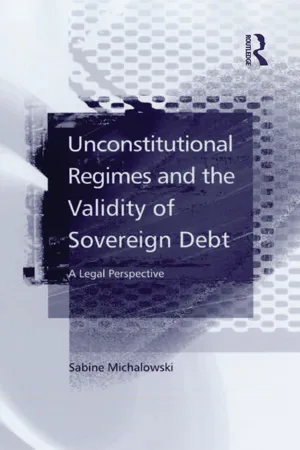
Unconstitutional Regimes and the Validity of Sovereign Debt
A Legal Perspective
- 236 pages
- English
- ePUB (mobile friendly)
- Available on iOS & Android
eBook - ePub
About this book
Sabine Michalowski's work provides a much-needed legal perspective on the topical subject of Developing World debt repayment. The volume incorporates a single debtor country, Argentina, as an example to address global questions relating to this problem. The work assesses the range of complex issues involved in the context of international as well as national law. It further examines the political pressure creditors may apply to make vulnerable countries adapt their economic and other policies in line with their wishes. These raise obvious constitutional issues for the debtor country and pose questions of whether and how the inequality of bargaining power in such situations could influence the validity of any measures taken, whether contractual or legislative. Argentina has been chosen as a case study because as a large debtor country, it represents these sorts of issues.
Chapter One Introduction1
DOI: 10.4324/9781315549378-1
In the developed world, it is easy to ignore the problem of the sovereign debt of developing countries, or to take no more than a general political interest in the issue when it is portrayed by the media at special occasions, such as the discussions of debt forgiveness in the context of G8 summits.2 In a debtor country such as Argentina, on the other hand, that is only slowly recovering from a severe economic and financial crisis at the peak of which it defaulted on its debt servicing obligations, one is confronted on a daily basis with the fundamental significance of the problem of sovereign indebtedness and its far-reaching consequences for the social, economic and financial situation and policies.
The debt problem of developing countries touches on many fundamental issues such as concepts of justice; the tension between human rights protection and financial interests; and the relationship between the Developing World and the industrialized North. It is therefore hardly surprising that debt repayment has sparked a highly emotive political and moral debate.3 From a moral perspective, it could be asked whether it can be justified that a country dedicates resources to the repayment of foreign debts while large parts of the population live below the poverty line and cannot even the fulfil their basic needs, such as food, shelter, health care etc. The moral arguments against debt repayment become even more compelling when taking into account the claim that the international creditors are partly responsible for the debt crisis. In recent years, humanitarian claims for debt relief because of the dramatic adverse impact of debt repayment on the social and economic situation of poor countries gained more and more momentum.4 From a more political perspective,5 it is often argued that the debt is unfair; odious; and that, instead of the Developing World being indebted to the North, it is the other way round, as the North owes the Developing World an ecological debt.6
Reference to legal principles and concepts is often made in order to support these moral and political claims. From a legal perspective, the Developing World debt is challenged based on principles of international law, as well as those of the domestic law of debtor nations. In this respect, it has been argued that many of the loan agreements are not valid, as they were often entered into by undemocratic regimes and were not used for the benefit of the people of the debtor nations;7 that the interest rates are usurious;8 and that the creditors are at least partly responsible for the debt crisis.9 It was further suggested that conditionalities imposed on debtor nations as a prerequisite of refinancing loans that are needed to avoid defaulting on debt repayment, in particular the requirement to implement structural adjustment programmes (SAPs), adversely affect the protection of social rights in debtor countries, and moreover undermine state sovereignty.10 However, references to the law largely consist of broad statements, mixed with strong expressions of moral and political convictions of what the law should be, and it often seems as if the law is primarily regarded as a tool that might help to achieve, and give more credence to, political and moral claims.
The international creditors, on the other hand, present the problem primarily from a formalistic legal perspective, when arguing, based on legal concepts such as the fulfilment of contractual obligations, that debts need to be repaid. Indeed, in the specific context of Argentina, the creditors adopt a seemingly objective legalistic attitude when claiming that the debts are contractual obligations that need to be honoured, regardless of the country’s economic and social situation. As James Wolfensohn explained in an interview when he was President of the World Bank: ‘everyone wants to put money into social purposes and no one more than the (World) Bank, but there needs to be a balance in terms of some responsibilities and obligations which have been undertaken’.11
It thus seems as if the legal debate of the problem of debt repayment is characterized, on the one hand, by the allegedly value neutral legalistic approach adopted by the creditors, and, on the other hand, by a moralistic and political approach to the interpretation and application of legal principles. The reality and the ideological and political visions of anti-debt campaigners, on one side, and of creditors trying to get the developing world to repay its debt, on the other, are so far removed from each other that the arguments raised on each side hardly connect. However, in order for the law to add another dimension to the anti-debt-repayment debate, and to provide a tool for rebutting the legal claims of the creditors on legal grounds, a consistent legal framework that favours the arguments against debt repayment over those advanced by the creditors of sovereign debts needs to be developed. This requires to analyse the reasons for non-payment in terms that interact with the world of the creditors, and to phrase the legal challenges in a way that makes it possible to raise them in court proceedings. Only in this way can the creditors’ reference to clear-cut legal rights be reassessed in the light of the legal objections raised by the opponents of debt repayment. And only in this way can a conclusion be drawn as to whether the law really supports the creditors’ claims as unconditionally as they want to make us believe, or whether the legal validity of their claims can be challenged successfully.
This is not to suggest that the moral arguments against debt repayment, and the efforts made by anti-debt campaigners to translate them into legal challenges on the basis of which debt repayment was and is questioned, lack significance. On the contrary, it is submitted that the work that has been carried out in this respect is extremely important, as it raises awareness of the underlying issues; demands that the law be in line with concepts of justice; demonstrates which interests it currently favours and serves; and provides useful ideas for further legal research. Indeed, while this book will focus on an academic legal analysis of some of the issues surrounding the debt crisis, the significance of political and moral considerations in the context of debt repayment cannot be ignored. As Noam Chomsky rightly claimed, while it is clear that the developing world debt exists, it is primarily an ideological question who is responsible for this debt and who owes it.12
This book is written with the intention of strengthening the arguments against debt repayment by giving them a legal basis, and it aims to challenge the logic according to which creditor claims stand above all other considerations. Recognizing the limits of what can realistically be achieved in one monograph, it will not attempt to address and analyse comprehensively all potential legal arguments according to which debt repayment might be challenged. Instead, the subject of this book is limited to providing a critical evaluation of a very specific issue where moral and legal arguments meet, which is that of the validity of loan agreements that were concluded between creditors and unconstitutional or otherwise illegitimate regimes. This issue is of particular importance, as the heavy and unsustainable debt that developing countries are asked to repay largely originates from periods when they were governed by dictatorial regimes that did not necessarily represent the interests of the people who are now expected to repay this debt. Even though central to the theme of the book, no attempt will be made to define up front and in general what is meant by a debt that is illegitimate, or a regime that is dictatorial, undemocratic, unconstitutional etc., as these definitions, as the book will show, depend on context.
From a legal perspective, to centre the analysis on the question of whether debt taken up by a dictatorial regime validly binds the people of the debtor country might at first sight seem to be focusing on the irrelevant. The issue of invalidity is, if at all, usually raised by debtor states only as a matter of political rhetoric, but not as a serious legal argument against debt repayment. Indeed, it seems as if debtor countries generally accept the binding nature of this debt and that the real issues occupying current legal debate are the legal consequences of the inability of most countries to repay the debt in full. However, it is submitted that what makes a legal analysis of the underlying issues both interesting and necessary is precisely this discrepancy between the arguments of anti-debt campaigners, which to a large extent focus on the invalidity of the debt, and the consistent practice of debtor states and the international financial community unquestioningly to accept the validity of the debt regardless of its origins. A second reason for which a focus on the validity of the original debt might be regarded as misguided is that even if an argument can be made that the original debt was affected by legal flaws, in most cases the originally questionable debts have since been restructured several times, and traded on the secondary markets, so that to challenge the validity of the original debt could be considered to be a moot point. However, it will be asserted that some of the legal arguments based on which the original debt can be regarded as invalid also affect the validity of all acts that took place in regard of this debt, including payment, trading, and restructurings.
The focus of the book on the potential invalidity of the debt means that some legal arguments that received ample academic attention in recent years and which start from the assumption that the debt is valid and seek to explore ways in which the problem of the debtor states’ inability to pay might be accommodated, will deliberately remain unaddressed. Thus, discussions such as that of sovereign insolvency;13 the legalities of unilateral debt restructurings;14 and the extent to which international law recognizes a defence of economic necessity for states,15 will not be entered into. Another issue that has recently been at the forefront of public attention, namely debt relief,16 will also not be examined in the context of this book, as debt relief is largely understood not as a legal concept, or an initiative that would benefit from legal analysis, but instead as a political and humanitarian measure.
Argentina will be used as a case study for the analysis of the legal objections to debt repayment. Not only is Argentina a country in which debt repayment is high on the political and economic agenda, but it is more importantly a country in which the issues of the country’s debt were to some extent brought into the domain of the courts. However, while the book takes Argentina as an example, it goes beyond the particular Argentinian case, in that it uses the analysis of Argentinian domestic law in order to evaluate and develop more general legal concepts. The in parts very critical analysis of Argentinian legal and constitutional practice should be understood as an outsider’s perspective on how the law could have been used in order to address the problem of the debt that was inherited b...
Table of contents
- Cover Page
- Halftitle Page
- Title Page
- Copyright Page
- Table Of Contents
- Acknowledgements
- List of Cases
- 1 Introduction
- 2 Argentina’s Debt in its Historical and Political Context
- 3 The Doctrine of Odious Debts
- 4 Redefining the Doctrine of Odious Debts
- 5 (Un)Constitutionality of Debts Taken Up by Unconstitutional Regimes
- 6 Substantive Constitutional Limits with Regard to Sovereign Debt
- 7 Impact of the Unconstitutionality of Loans on Creditor Rights
- 8 Conclusion
- Bibliography
- Index
Trusted by 375,005 students
Access to over 1.5 million titles for a fair monthly price.
Study more efficiently using our study tools.
Frequently asked questions
Yes, you can cancel anytime from the Subscription tab in your account settings on the Perlego website. Your subscription will stay active until the end of your current billing period. Learn how to cancel your subscription
No, books cannot be downloaded as external files, such as PDFs, for use outside of Perlego. However, you can download books within the Perlego app for offline reading on mobile or tablet. Learn how to download books offline
Perlego offers two plans: Essential and Complete
- Essential is ideal for learners and professionals who enjoy exploring a wide range of subjects. Access the Essential Library with 800,000+ trusted titles and best-sellers across business, personal growth, and the humanities. Includes unlimited reading time and Standard Read Aloud voice.
- Complete: Perfect for advanced learners and researchers needing full, unrestricted access. Unlock 1.5M+ books across hundreds of subjects, including academic and specialized titles. The Complete Plan also includes advanced features like Premium Read Aloud and Research Assistant.
We are an online textbook subscription service, where you can get access to an entire online library for less than the price of a single book per month. With over 1.5 million books across 990+ topics, we’ve got you covered! Learn about our mission
Look out for the read-aloud symbol on your next book to see if you can listen to it. The read-aloud tool reads text aloud for you, highlighting the text as it is being read. You can pause it, speed it up and slow it down. Learn more about Read Aloud
Yes! You can use the Perlego app on both iOS and Android devices to read anytime, anywhere — even offline. Perfect for commutes or when you’re on the go.
Please note we cannot support devices running on iOS 13 and Android 7 or earlier. Learn more about using the app
Please note we cannot support devices running on iOS 13 and Android 7 or earlier. Learn more about using the app
Yes, you can access Unconstitutional Regimes and the Validity of Sovereign Debt by Sabine Michalowski in PDF and/or ePUB format, as well as other popular books in Law & International Law. We have over 1.5 million books available in our catalogue for you to explore.