- 168 pages
- English
- ePUB (mobile friendly)
- Available on iOS & Android
eBook - ePub
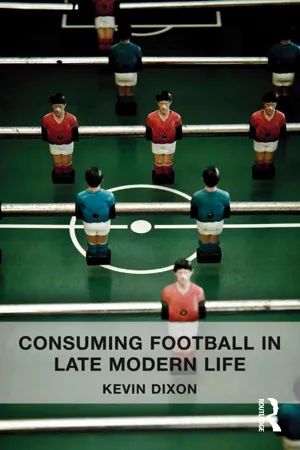
Consuming Football in Late Modern Life
About this book
Consuming Football in Late Modern Life explores the phenomenon of football (soccer) fandom as consumption in the age of late modernity. By centralising fandom within the sociology of consumption, the book examines how this phenomenon equates to a fluid series of consumption activities that are practiced in the course of everyday life. In turn, the work departs from much of the existing literature that features exceptional properties of fanatical fans, in order to emphasise the position that seemingly trivial acts of consumption can have a profound influence on the construction, maintenance and evolution of football fandom cultures. Containing up to date research findings derived from a programme of interviews with a sample of football fans, Kevin Dixon examines the social, emotional, economic and technological implications of consumption as fans participate in and respond to the demands of consumer life.
Information
Chapter 1
Introduction: Everyday Fandom as Consumption
Bill: I’m not a fanatic by any means but football is part of my daily existence. It is the clothes I wear and its part of me … lots of stuff in my house relates to Sunderland. The colour scheme, the wall paper in one room, I’ve got Sunderland cups and saucers. That sort of stuff … Early in the week I’m talking about football. I go on internet forums as well to chat about the previous match … By Wednesday, I’m looking ahead to the next match … I buy papers and watch TV shows; basically I’m always doing something related to Sunderland. Most matches, I watch on Sky (Sky television), sometimes with my mates and a shit load of food and drink. This is the highlight of my week … Winning puts a prolonged smile on my face; losing makes the week ahead tough, but yeah, the shirt, the badge and the team are a major part of my life. They will go with me to the grave. [Sunderland, aged 34]
For Bill and millions of others like him, football1 fandom practice occurs primarily through routine acts of consumption. In his contextual self appraisal of the everyday fandom experience (above), ‘Bill’ inadvertently describes how consumption infiltrates every level of practice2 to such an extent that affiliation to football is impossible without it. After all, choice of clothing; food; television shows; interior decoration; emotional labour; online activities and general sociability, are all, in the end, acts of consumption, or by-products of consumption acts. Even live televised viewing of ‘the match’ (emphasised by Bill as the highlight of his week), when scrutinised more closely comprises many other consumption acts that exist in the space between buying the television set and licence; sports channels; food; beverages; other match accompaniments; and watching/preparing for the match per-se. In other words, to practice is to consume, not only in a monetary or utilitarian sense, but it also serves to convey a way of thinking, with agents spending money, time and part of themselves on football.
Notwithstanding the logic portrayed above, the question of whether association football fans can be defined as consumers remains a contentious one within the sociological literature. Whilst it has not gone unnoticed that football has reaped the benefits of commercial enterprise (Giulianotti 1999, 2002, Horne 2006, King 1998, Manzenreiter and Horne 2004) there remains a stubborn denial that ‘real fans’ of football can be labelled as consumers at all. Instead, scholars have tended to preserve romanticised notions of fandom orthodoxy, often positioning ‘fans’ and ‘consumers’ at opposing ends of a hypothetical dichotomy that downgrades certain consumer activities (for example, buying merchandise, replica shirts, partaking in virtual communications) and celebrates forms of perceived ‘traditional loyalty’ (for example, attending football matches in person). The problem with such distinctions, of course, is that perceived traditional acts (for example, match attendance) require fans to consume in multiple ways. Most obviously, they must buy tickets and spend time and money at the stadium or in the stadium vicinity. In addition to this, it is not inconceivable to suggest that those attending the stadium may also buy merchandise and take part in other consumption activities such as watching football on television or contributing to internet discussions about football.
Consequently, value laden distinctions of this type are largely unhelpful to the sociology of football in the sense that they form rigid divisions between mythical groupings and place types of behaviour into restrictive and ultimately unrealistic categories (Crawford 2004, 2007, Dixon 2011, Gibbons and Dixon 2010). In an attempt to avoid false dichotomies of this nature and to acknowledge the fluidity of fandom practice, no such distinctions are made during the course of this book. Instead, it is argued that the terms ‘consumers’ and ‘fans’ ought to be used interchangeably given that the manner of affiliation to football must ultimately occur through acts of consumption. Accordingly then, the reader of this book is encouraged to visualise fans of football as both products and constituents of a culture in which consumption is of paramount importance.
Though this is a book about consumption, it does not solely refer to the action of economic exchange. After all, apart from consumption’s frequent and often explicit economic properties, it can be partially, if not entirely, ‘experiential’ (Watts 1999, Bourdieu 2002, Falk 2007). For the seller of course, customer consumption is a means to an end, but for the consumer, acts of consumption are much more than this. They can hold (or are attributed by the customer) intrinsic value, surpassing the economic and extending import beyond installed meanings at the point of production (Sayer 1997). This has implications for our understanding of consumer behaviour, with utilitarian and economic aspects of consumption, conceivably less significant to the consumer experience overall. Consequently, it is possible to acknowledge the presence of a ‘consumer mentality’ that is ‘orientated toward the realm of representations rather than mere need satisfaction’ (Falk 2007: 716). So, whilst experiential aspects of consumption have been used to explain the motives for and desired outcomes of economic expenditure (Veblen 1925, Bourdieu 1984, Willis 1990, McCraken 1991, Campbell 1995, Ilmonen 2004, Warde 2005, Horne 2006, Bauman 2007a, Illouz 2009), scholars now recognise the place and importance of the experiential component as a defining constituent of consumption per-se. This is typified by Warde (2005: 137) when he writes:
[consumption is] … a process whereby agents engage in appropriation and appreciation, whether for utilitarian, expressive or contemplative purposes, of goods, services, performances, information or ambience, whether purchased or not, over which the agent has some degree of discretion.
It is clear then, that scholars largely support the position that consumption can infiltrate practice at experiential as well as purely economic levels, and in relation to football fandom, I argue that fandom studies would benefit if linked more closely to wider issues of everyday life and to consumer culture more specifically. In agreement with this, Gray et al. (2007: 8) encourage researchers to acknowledge the advancing technological modes of consumption that ‘extend the prospect of engaging in fan activities’ and reflect ‘the increasing entrenchment of fan consumption in the structure of our everyday life’. Likewise, Horne (2006: 11) acknowledges the entrenchment of consumption, and consequently raises the following point. He argues that scholars of sport ought to investigate ‘the real world of consumption’ on the premise that ‘most consumption is probably mundane, routine and inconspicuous’. Hence, it is precisely because fan consumption has grown as a taken for granted aspect of late modern life that it warrants critical analysis and investigation now more than ever (Crawford 2004, Horne 2006, Gray, Sandvoss and Harrington 2007). Still, in spite of this admission from the research field, a paucity of research activity has placed ‘ordinary’ fandom practice (that is, routine experiential and material consumption) under empirical scrutiny, and subsequently fandom remains profoundly under theorised:
Although we use the term with abandon, fans and their social and cultural environment (“fandom”) are profoundly untheorised in the social sciences. We know virtually nothing about what produces fandom, what specific practices are associated with it [and] what role fans may play in social and cultural processes. (Harris 1998: 4)
Following the logic set out above, this book locates discussions of football fan cultures within the sociology of consumption in order to develop an empirically based, theoretical account of football fandom in late modern life. In doing so it contributes to the development of a critical sociology that raises the profile of everyday consumption experiences and indicates the significance of these in the construction, maintenance and evolution of football fandom cultures.
The Research Process
Before providing more details of the arguments derived from this investigation, it is useful at the outset, to briefly explain the research undertaken. In response to recent calls for empirical, rather than conceptually based work relating to football fandom (Stone 2007, Williams 2007, Gibbons and Dixon 2010) a sample of football fans were interviewed during the course of this work. Interviews were semi-structured, allowing respondents to discuss open-ended questions and aiding the researcher to explore in more depth, understandings of football fandom practice from those directly implicated (Silverman 2000, Hoffman 2007). Furthermore, in accordance with Witzel (2000), an interview guide encompassing areas of interest was used to offer a sense of continuity within and between interviews, without adhering rigidly to a strict line of questioning.
The interview guide consisted of two general principles. First, it aimed to explore the genesis of football fandom under the assumption that this would offer a central reference point from which fandom behaviour has developed for participants. This follows Weber (1968: 18) who explains that any ‘real empirical sociological investigation begins with the question: what motives determine and lead individual members … in this socialistic community to behave in such a way that the community came into being in the first place, and that it continues to exist’. In the case of football fandom, this is an under researched area that has potential to hold some crucial information, not only relating to the genesis of fandom, but it also offers a foundation from which to explore the development of fandom cultures over time (Crawford 2004). Secondly, given that a key aim of this book was to explore and explain the everyday lived experiences of football fandom; then ‘routine’ elements of fandom practice were discussed with all participants. It was decided that free-flowing, naturalistic discourse regarding the experiences of football fandom would yield contextually rich and less contrived information for subsequent analysis (Alasuutari 1995). Interviews took place over a seven month period between August 2008 and February 2009.
Recruitment Strategy and Participant Information
Participants were recruited from the North-East region of England. This region is often referred to as ‘the hotbed of football’, a tag that was first used in the 1961 Arthur Appleton book of the same name. As the title implies, football culture is thought to be particularly strong in the North East, this is in spite of the relative mediocrity of the teams representing this region (in terms of recent [last 50 years] League success). Within the North East of England there are five professional football teams at different levels of the football pyramid. In 2008-09 (the same season as data collection) those teams were positioned in the following English leagues: (Premier League) Sunderland; Newcastle United; Middlesbrough; (Football League 1) Hartlepool United; (Football League 2) Darlington – though it should be noted that at the end of season 2008-09 both Newcastle United and Middlesbrough were relegated from The Premier League into the Championship.
To obtain a body of potential participants, a University press release was launched in 2008 with a number of local media outlets responding. Media exposure afforded the researcher an opportunity to publicise the research and canvas for volunteers.3 With each exposure, contact details of the researcher were publicised and interested parties were encouraged to make contact. On acknowledgement of interest, volunteers were selected as participants for subsequent interview according to the following criteria: (1) Given that scholars Malcolm, Jones and Waddington (2000) acknowledge season ticket holders as most frequently and disproportionately used within academic literature to represent all fans; the inclusion of fandom narratives from a wider range of experiential profiles was selected. This is particularly important in the current context in order to illustrate everyday experiences of fandom within and beyond the football stadium. (2) It was deemed important not to privilege fans of top tier teams (for example, Manchester United, Chelsea, and Arsenal) over and above the majority of fans that support teams outside of this elite group. This has been a common characteristic within recent academic research where authors such as King (1998) and, additionally, Sandvoss (2003) have studied fans of a handful of top tier clubs in their domestic leagues. (3) Finally, on the recommendations of Jones (2008) I agree that it was important to be inclusive of female fans and also to take into account a range of age groups.
Sixty football fans (36 male and 24 female [aged 18-56]) were interviewed during the course of this investigation. Of those participants, thirty were current season ticket holders. The remaining thirty were not current holders of season tickets at the time of interview, although they did watch or listen to live football multiple times per-week via the media. Therefore, for the purpose of transparency within the transcript extracts and not for the purpose of systematic comparison, they are identified as: (1) Season Ticket Holders (STH); (2) Media Fans (MF), to reflect their primary mode of live football consumption at the time of the interview. It is worth emphasising that this was not an attempt to categorise fans into a simplistic dichotomy representative of fandom type. Rather, sharing the belief that fandom can be a fluid process across one’s life cycle (Crawford 2004), such labels are used solely to provide further information for the reader regarding the current (but not permanent) status of live match consumption in relation to participants.
In terms of supported teams, 51 participants were fans of one of the following 2008 English Premier League Clubs: Newcastle (N=18); Middlesbrough (N=18); Sunderland (N=12); Liverpool (N=2) and West Ham (N=1). Of the remaining participants, nine were supporters of one of the following teams: Hartlepool (N=5) and Darlington (N=4). Key characteristics of this sample are shown below.
Table 1.1 Key Characteristics of the Sample

During the course of this book evidence gathered from interview transcriptions is used verbatim (that is, changing the name of the participant, but presenting all other demographic information) to instantiate points of view, substantiate an argument or to provide support for a crucial point. Whilst the work is instantiated with individual accounts, it offers more than an individual appraisal of football fandom. Like Weber (1968: 18) suggests, it would be ‘a tremendous misunderstanding to think that individualist method should involve what is in any conceivable sense an individualistic system of values’. Rather, those patterns and regularities that are discernible through practice are the consequences of learned meanings and thus, narratives presented during the course of this book offer a thorough and accurate description of the range of opinions, experiences and reactions that were expressed throughout the research process.
Structure and Organisation of this Book
This book is divided into seven chapters inclusive of this introduction. Chapter 2 sets a historical background to the work by emphasising the point that consumption for football fans is not simply a new, late modern phenomenon. Drawing on newsprint extracts from national newspapers of the day, and the work of sport historians, this chapter illustrates the rise of football fandom as consumption. Amongst other developments it illuminates the importance of industry and the aligned trade union movement of the late nineteenth century by detailing its contribution to the genesis of consumer culture and to the development of spectator sport. Furthermore, the emergence of football cultures is discussed in relation to their capacity for representativeness, not only of team, but also of geographical localities. Those factors are considered in line with the growth and commercial potential of the practice from the early-to mid-twentieth century. In contrast, the latter part of this chapter deals with the subsequent demise of spectator football from the mid- to late-twentieth century, closely followed with brief discussions of the subsequent rebuilding and re-branding of football for the late modern period. The issues raised here are important, not only to provide context for discussions that occur in Chapters 4-7, but also to recognise the historical basis from which previous sociological theories relating to football fandom have developed.
Chapter 3 draws together past and current theoretical explanations of football fandom practice with particular reference to the much contested sociological debate that tends to situate fandom as either a direct descendent of social structure or alternatively a process that is shaped and designed by individuals. It explains how those diverse theoretical positions have ultimately served to create unrealistic theoretical dichotomies or typologies as explanations for football fandom practice and argues instead that a new theoretical perspective is warranted in order to more accurately depict the nature of fandom in the late modern period. With criticisms cast against macro and micro paradigms it is suggested that meso level theories may best solve the theoretical problems identified.
Chapter 4 is the first of three to present findings from the analysis of primary data. It begins by drawing attention to underpinning forms of experiential consumption that contribute towards the genesis of football fandom culture. This sets the scene by articulating the various means through which fandom is learned, adopted and consequently practiced. The influence of peer and kin groups are discussed with reference to (amongst other theorists) Bourdieu’s (1984) theory of practice. Trends that exist outside of this framework are explained in light of late modern life, with particular reference to Peterson’s (1992) concept of the cultural omnivore.
Chapter 5 looks beyond the consequences of engagement within football culture to il...
Table of contents
- Cover Page
- Dedication
- Title Page
- Copyright Page
- Contents
- Acknowledgements
- 1 Introduction: Everyday Fandom as Consumption
- 2 Football Fandom as Consumption: A Historical Perspective
- 3 Theorising Football Fandom as Consumption: Outlining the Need for an Alternative Approach
- 4 Learning the Game: The Consumption of Knowledge and the Construction of ‘Other’ in Late Modern Fandom
- 5 Consuming Corporate Values: Football Fandom Habitus, Disneyisation and Late Modern Life
- 6 The Routinisation of Football Consumption in Late Modern Life
- 7 Conclusion
- Bibliography
- Index
Trusted by 375,005 students
Access to over 1.5 million titles for a fair monthly price.
Study more efficiently using our study tools.
Frequently asked questions
Yes, you can cancel anytime from the Subscription tab in your account settings on the Perlego website. Your subscription will stay active until the end of your current billing period. Learn how to cancel your subscription
No, books cannot be downloaded as external files, such as PDFs, for use outside of Perlego. However, you can download books within the Perlego app for offline reading on mobile or tablet. Learn how to download books offline
Perlego offers two plans: Essential and Complete
- Essential is ideal for learners and professionals who enjoy exploring a wide range of subjects. Access the Essential Library with 800,000+ trusted titles and best-sellers across business, personal growth, and the humanities. Includes unlimited reading time and Standard Read Aloud voice.
- Complete: Perfect for advanced learners and researchers needing full, unrestricted access. Unlock 1.5M+ books across hundreds of subjects, including academic and specialized titles. The Complete Plan also includes advanced features like Premium Read Aloud and Research Assistant.
We are an online textbook subscription service, where you can get access to an entire online library for less than the price of a single book per month. With over 1.5 million books across 990+ topics, we’ve got you covered! Learn about our mission
Look out for the read-aloud symbol on your next book to see if you can listen to it. The read-aloud tool reads text aloud for you, highlighting the text as it is being read. You can pause it, speed it up and slow it down. Learn more about Read Aloud
Yes! You can use the Perlego app on both iOS and Android devices to read anytime, anywhere — even offline. Perfect for commutes or when you’re on the go.
Please note we cannot support devices running on iOS 13 and Android 7 or earlier. Learn more about using the app
Please note we cannot support devices running on iOS 13 and Android 7 or earlier. Learn more about using the app
Yes, you can access Consuming Football in Late Modern Life by Kevin Dixon in PDF and/or ePUB format, as well as other popular books in Social Sciences & Sociology. We have over 1.5 million books available in our catalogue for you to explore.