- 242 pages
- English
- ePUB (mobile friendly)
- Available on iOS & Android
eBook - ePub
About this book
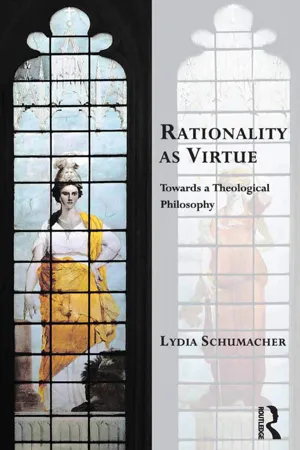
For much of the modern period, theologians and philosophers of religion have struggled with the problem of proving that it is rational to believe in God. Drawing on the thought of Thomas Aquinas, this book lays the foundation for an innovative effort to overturn the longstanding problem of proving faith's rationality, and to establish instead that rationality requires to be explained by appeals to faith. To this end, Schumacher advances the constructive argument that rationality is not only an epistemological question concerning the soundness of human thoughts, which she defines in terms of 'intellectual virtue'. Ultimately, it is an ethical question whether knowledge is used in ways that promote an individual's own flourishing and that of others. That is to say, rationality in its paradigmatic form is a matter of moral virtue, which should nonetheless entail intellectual virtue. This conclusion sets the stage for Schumacher's argument in a companion book, Theological Philosophy, which explains how Christian faith provides an exceptionally robust rationale for rationality, so construed, and is intrinsically rational in that sense.
Information
Chapter 1
Introduction to Rationality as Virtue
Throughout the modern period, philosophers have debated the question what it means to be rational. In this connection, they have investigated how ordinary beliefs are justified and inquired into the locus of ‘objectivity’ in human knowledge. According to a fairly widely established consensus, however, many distinctly modern conceptions of human rationality pose a considerable challenge when it comes to defending the rationality of faith.1
In response to this threat, theologians and philosophers of religion have tended to employ one of two main strategies for bolstering the contention that faith is rational.2 The first, defensive, approach involves responding to objections to the faith that have been presented by outsiders on any number of grounds: historical, scientific, intellectual, and even moral.3 The second approach goes on the offensive for the faith. In other words, it endeavors to give a positive account of Christian belief, which anticipates and implicitly overturns the accusations of objectors.
Although both of the two aforementioned strategies are essential to the overarching apologetic task, the persuasiveness of the defensive arguments turns on the integrity of the positive account of the faith that those arguments defend. Without that preemptive account as a basis, defensive arguments inevitably tend to address objections on the implicit assumption that the objections are legitimate, thus exposing faith to even more and more devastating critiques.
The present work will contribute to the positive dimension of the apologetic project by delineating a definition of human rationality that underlines the rationality of faith, where prevailing definitions evidently call it into doubt. As part of this effort, rationality will be described not merely as an epistemological matter to do with the soundness of human thinking. Ultimately, it will be construed as an ethical question whether knowledge is utilized in a manner that is consistent with the overarching purpose of ‘rational animals,’ which is to flourish through the exercise of individual abilities and thereby contribute to the flourishing of others. In this regard, the argument outlined here might be described as a moral argument for God’s existence, though it is in many respects distinct from and involves a good deal more than most such arguments, which is arguably essential to their sustainability.4
In ways on which I will soon elaborate, defining rationality in ethical terms, more specifically, in terms of moral virtue, provides an exceptionally effective basis for establishing the rationality of faith. For Christian faith can be shown to enact or provide a rationale for rationality, defined in these terms, such that faith is already rational—and philosophy already theological. As I will demonstrate below, it takes a full-scale re-configuration of philosophy in terms of what I call ‘pro-theology philosophy’ to obtain a definition of rationality that is both amenable to faith and intrinsically more plausible than the definitions that tend to undermine faith.
By shedding new light through such arguments on the sense in which faith is intrinsically rational, the project undertaken here aims to lay the foundation not only for defensive apologetic projects but above all for inquiries concerning what it means to live by faith and elucidate the articles of faith—proper to the fields of Christian Ethics and Systematic Theology, respectively—which proceed on the assumption that faith is rational.
Before outlining the more detailed steps of the argument, however, a brief word about sources is in order. In preparing this proposal, I have drawn considerable inspiration from numerous pre-modern thinkers, above all Thomas Aquinas. Because Aquinas for one seems to operate from a theological and philosophical perspective that does not even give rise to the problem of faith’s rationality, at least in its modern form, his work represents an especially useful resource for overcoming this problem, which urgently demands resolution today.5
Although I follow Aquinas closely on certain matters, the very fact that he operated in a context that is so far removed from our own renders it impossible or at least unprofitable simply to reiterate his thought on, say, the nature of reason or of faith. Thus, the conceptual framework outlined in this context does not entail a reformulation or even interpretation of Aquinas but a constructive effort to resolve the current question of faith’s rationality, which appropriates, sometimes quite extensively, and adapts, sometimes quite heavily, principles Aquinas articulated, insofar as these are still relevant in contemporary circumstances.6
As hinted above, my treatment of this framework falls into two distinct parts, one of which redefines rationality in ethical terms through the articulation of a ‘pro-theology philosophy,’ and another, which explains how rationality so construed gestures towards the rationality of Christian faith, such that a pro-theology philosophy turns out to be a theological philosophy.
While the present work undertakes the first part of the project, the second will be the focus of a separate work, entitled Theological Philosophy. Because the two distinct works are closely related, I will endeavor in what follows to sketch the overarching line of argument they delineate by summarizing the discussion of each book’s chapters. First, however, I will situate this argument in its intellectual context, describing some of the main approaches to asserting faith’s rationality that have been advocated in modern times.
The Intellectual Context of Theological Philosophy
Throughout the modern period, two main methods of dealing with the problem of establishing faith’s rationality have predominated, namely, rationalism and fideism. The rationalist approach, commonly espoused by proponents of natural theology, turns on several different types of attempt to establish God’s existence on grounds accessible to human beings. While cosmological arguments appeal to nature to infer the reality of a cause or creator of the world, for example, teleological arguments invoke the order of the universe and signs of intelligent design to establish God’s existence.7
In addition to these two types of argument, some, though admittedly fewer, have advocated an ontological argument for God’s existence, that is, an argument that derives proof for God from the very definition of God and thus from the mere thought of him, working from ‘reason alone’ as opposed to invoking the quasi-empirical evidence of creation or the natural order.8 By contrast to rationalism, fideism tends to trade on the assertion that faith cannot be evidenced or grounded by reason in any way but ought to be adhered to all the same.9
In recent years, many scholars have begun to recognize that neither approach to addressing the question of faith’s rationality is entirely adequate to the task. While fideism simply evades the question, for example, the natural theological proofs for God’s existence mentioned above seem ultimately to beg the question they purport to answer, or to assume what they attempt to prove. They do this by taking God’s existence as evident to the senses or self-evident to the mind, when God’s reality is clearly not evident in these ways to those who deny or disregard it. As numerous critics have noted, such proofs usually only have the power to persuade those who already believe in God.10 At very least, this suggests that they do not suffice as a main line of defensive argument for the existence of God.
That is not to say that the proofs have no place in Christian thought, however. They may indeed enrich the faith of believers or even bring unbelievers to faith, particularly when employed as tools for forming a habit of viewing the world from the perspective of belief in God. As I have argued elsewhere, this perspective checks the human tendency to ascribe absolute significance to things other than God and so transforms the thoughts and lives of believers into evidence for the difference belief in God can make when it comes to dealing with ordinary affairs.11
Though such a therapeutic or pedagogical interpretation of the theistic proofs is arguably more faithful to the intents of the early Christian and medieval writers who originally developed them, it admittedly diverges rather widely from the modern conception of the arguments, according to which theistic proofs offer direct evidence for God’s existence. In fact, it already moves in the general direction of the new approach to asserting faith’s rationality that this book contributes to developing.
In presenting a new way of conceiving faith’s rationality, however, the present work is not alone. Recently, a number of other scholars have sought to rethink the whole project of proving faith’s rationality, in some cases by going so far as to challenge the prevailing standards of rationality that pose problems for faith. For instance, proponents of Reformed Epistemology (RE)—including Nicholas Wolterstorff, William Alston, and especially Alvin Plantinga—ground their religious epistemological agenda on a preliminary reconsideration of the modern ‘evidentialist’ or ‘foundationalist’ standard of knowledge. According to this standard, knowledge claims must be backed by empirical evidence, such that cosmological and teleological proofs provide the sole means to proving the existence of God.12
In challenging this standard, Plantinga in particular argues that belief in God is ‘properly basic’, such that God is intuitively and ineluctably known, at least amongst those in whom the Holy Spirit has compensated for the effects of sin upon the will by inspiring faith.13 By construing belief in God as properly basic, Plantinga effectively reverses the question whether it is rational to believe in God. In diverse and highly sophisticated ways to which this brief description obviously cannot do full justice, therefore, he and other Reformed Epistemologists seek to render it inconceivable not to know that God exists.
Although the work of RE scholars represents an invaluable advance in the field of religious epistemology, it has met nevertheless with various forms of criticism. One of the main objections to the approach of RE thinkers is that it seems suspiciously similar to that of fideism, in that it advocates a sort of ‘groundless ground’ for belief in God, to wit, a properly basic intuition.14 Though proponents of RE have sought to exonerate their program of this charge, another has been raised, which points out that the RE agenda, if successful, still only establishes that there is something like a God, not necessarily the Christian God in whom advocates of RE actually believe.15
A similar charge could incidentally be laid before the natural theologians who advocate the other forms of proof for the existence of God mentioned above. While cosmological and teleological proofs may validly demonstrate the existence of some kind of God, they provide no basis for confirming that this God is the Christian God or that of any other religious system. Thus, the question remains how conceptually to connect theistic proofs of any kind—whether natural theological or Reformed Epistemological—with belief in, say, the Triune, Incarnate God of Christian faith, as opposed to appending the articles associated with specifically Christian belief at the end of a line of argument for God’s existence.
In order to compensate for the lack of doctrinal content inherent in theistic proofs, certain analytic philosophers with Christian persuasions have recently developed a program they call ‘analytic theology,’ which endeavors to apply the tools and methods of analytic philosophy in elucidating the coherence and rationality of theological doctrines.16 In principle, this is a commendable project to which this work and its sequel might be seen as contributing, depending on exactly how philosophy is used to illuminate the sense in which Christian doctrines are rational, and, indeed, how the terms ‘philosophy,’ ‘rationality,’ and ‘doctrine’ are even defined.
While it may eventually prove possible and indeed useful to develop an analytic theological account of every major Christian doctrine, and the nature of doctrine overall, it arguably remains the case that such accounts would bring analytic theologians no closer than analytic philosophers of religion to forging a natural and necessary connection between beliefs about the Christian God and the object of attempts to establish the rationality of theistic belief. For it would still be necessary to append arguments highlighting the intelligibility of Christian doctrines to theistic proofs in a seemingly arbitrary way in order to establish that it is the God of Christian belief whose existence is under consideration. That is not a criticism so much as an observation about the possible limits of analytic theology, and the need for a larger framework in which the connection between theistic proof and specifically Christian beliefs is integral, as it is in a theological philosophy.
In addition to the accounts already mentioned, a number of other promising approaches to resolving the question of faith’s rationality have been presented in recent years. One account, which is highly congenial to my own, is that of Denys Turner in his Faith, Reason, and the Existence of God. In this book, Turner contends that reason itself needs to be re-defined in terms that are more compatible with faith before the question of the rationality of faith can be resolved.
As Turner himself states, however, his essay only ‘clear[s] away a little of the clutter of misconception, philosophical and theological, which has for several centuries stood in the way of a more theologically positive understanding of reason.’17 In doing this, however, he effectively calls for a more comprehensive effort to re-define reason in a manner that is amenable to faith, and to address the question of the rationality of faith on that basis, thus anticipating the project I undertake here.
According to another line of argument that has been advanced in recent years—by figures as diverse as the philosopher of religion, P...
Table of contents
- Cover Page
- Title Page
- Copyright Page
- Dedication
- Contents
- Acknowledgments
- List of Abbreviations
- 1 Introduction to Rationality as Virtue
- PART I NECESSARY CONDITIONS FOR PRO-THEOLOGY PHILOSOPHY
- PART II SUFFICIENT CONDITIONS FOR PRO-THEOLOGY PHILOSOPHY
- Bibliography
- Index
Trusted by 375,005 students
Access to over 1.5 million titles for a fair monthly price.
Study more efficiently using our study tools.
Frequently asked questions
Yes, you can cancel anytime from the Subscription tab in your account settings on the Perlego website. Your subscription will stay active until the end of your current billing period. Learn how to cancel your subscription
No, books cannot be downloaded as external files, such as PDFs, for use outside of Perlego. However, you can download books within the Perlego app for offline reading on mobile or tablet. Learn how to download books offline
Perlego offers two plans: Essential and Complete
- Essential is ideal for learners and professionals who enjoy exploring a wide range of subjects. Access the Essential Library with 800,000+ trusted titles and best-sellers across business, personal growth, and the humanities. Includes unlimited reading time and Standard Read Aloud voice.
- Complete: Perfect for advanced learners and researchers needing full, unrestricted access. Unlock 1.5M+ books across hundreds of subjects, including academic and specialized titles. The Complete Plan also includes advanced features like Premium Read Aloud and Research Assistant.
We are an online textbook subscription service, where you can get access to an entire online library for less than the price of a single book per month. With over 1.5 million books across 990+ topics, we’ve got you covered! Learn about our mission
Look out for the read-aloud symbol on your next book to see if you can listen to it. The read-aloud tool reads text aloud for you, highlighting the text as it is being read. You can pause it, speed it up and slow it down. Learn more about Read Aloud
Yes! You can use the Perlego app on both iOS and Android devices to read anytime, anywhere — even offline. Perfect for commutes or when you’re on the go.
Please note we cannot support devices running on iOS 13 and Android 7 or earlier. Learn more about using the app
Please note we cannot support devices running on iOS 13 and Android 7 or earlier. Learn more about using the app
Yes, you can access Rationality as Virtue by Lydia Schumacher in PDF and/or ePUB format, as well as other popular books in Theology & Religion & Religion. We have over 1.5 million books available in our catalogue for you to explore.