eBook - ePub
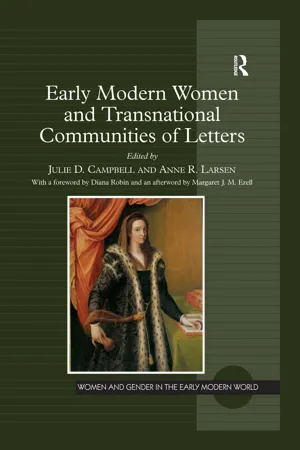
Early Modern Women and Transnational Communities of Letters
- 352 pages
- English
- ePUB (mobile friendly)
- Available on iOS & Android
eBook - ePub
Early Modern Women and Transnational Communities of Letters
About this book
An important contribution to growing scholarship on women's participation in literary cultures, this essay collection concentrates on cross-national communities of letters to offer a comparative and international approach to early modern women's writing. The essays gathered here focus on multiple literatures from several countries, ranging from Italy and France to the Low Countries and England. Individual essays investigate women in diverse social classes and life stages, ranging from siblings and mothers to nuns to celebrated writers; the collection overall is invested in crossing geographic, linguistic, political, and religious borders and exploring familial, political, and religious communities. Taken together, these essays offer fresh ways of reading early modern women's writing that consider such issues as the changing cultural geographies of the early modern world, women's bilingualism and multilingualism, and women's sense of identity mediated by local, regional, national, and transnational affiliations and conflicts.
Information
Part I
Continental Epistolary Communities
Chapter 1 Letters Make the Family: Nassau Family Correspondence at the Turn of the Seventeenth Century
Susan Broomhall
On July 10, 1584, William the Silent, after lunching at the Prinsenhof, the family's home in Delft, with his wife, sister, and several of his daughters, rose from the table. Crossing the hallway he was intercepted by the Catholic assassin, Balthasar Gérard, shot three times with a pistol, and died several hours later. Thus, as William was lamented across the Dutch Republic and wider Protestant world, the small community of the Nassau family lost its patriarch, a wife turned widow, and all but one of his children became orphans.
This essay traces the reconstruction of the Nassau family as it attempted to recover its identity as a family community, one with shared needs, and interests, and a common identity. The experiences of the Nassau family offer a chance to see how letters supported and created ideas about family, as well as how notions about these relationships could be expressed through correspondence. Moreover, the letters exchanged among siblings and relatives, including their step-mother, and step-siblings, allow us to explore how gender inflected their epistolary negotiations of relationships and discourses with their correspondents. As sons and daughters, brothers and sisters, the siblings had different opportunities to advance familial politics, or indeed to determine and debate it, and these were in part shaped by collective and individual understandings of men and women's roles within families and how these could be enacted and expressed through correspondence. This essay focuses particularly on the vital participation of women in these forums, and the impact of gender on family community making.
While many families of the era wrote letters to each other over their lifetime, few families were as widely dispersed, politically active, and religiously divided as the Nassau family. A large volume of correspondence remains between varied extended family, much of it between its female members, and provides an ideal case study to analyze the role of letters and participants in developing the "community of family." Burgeoning interest in the notion of patrimonialism in the early modern Netherlands lias typically ignored gendered dimensions of the family principles upon which this political system is founded, as Julia Adams has argued. However, even Adams focuses on the familial ideology promulgated by the patriline, although she acknowledges tensions may have been present.1 The assassination of William and the ensuing crises for his immediate family offer a view into a family where there were perhaps opportunities for more than the patriarch to define and create the identity and actions of the family. In the case of the Nassau, precisely who was the patriarch leading the family was a matter of some ambiguity, one that informed the kinds, and topics, of discussions between family members. Their letters offer an opportunity to explore early modern sibling relationships, a topic which lias received little historical attention to date, as Naomi J. Miller and Naomi Yavneh have recently argued.2 Here, I examine the epistolary negotiation of support, rivalry and authority between brothers and sisters, and between sisters, as a lived experience. This essay may provide insights into how women and subordinate men (as well as dominant men of the family) understood "family" as a unified community with shared goals, and how this notion might have been fractured or fashioned by individual experiences.
Feminist scholars have been particularly attentive to the analysis of gendered familial and individual identities. The Nassau siblings were individuals participating in varied communities in the sense that they contributed to the construction and manipulation of elite social, religious and political relations within and beyond the family. A series of new studies focusing on social aspects of politics have emphasized the importance of these cultures of networks, gossip, and intimacy as both women's particular form of political action and as means of access to the institutional structures of the political realm.3 Historians such as Sharon Kettering and Kristen B. Neuschel have argued for the expansion of sources and scope in early modern politics, in ways that accommodate the experiences and actions of women.4 Correspondence particularly lias been usefully analyzed to assess familial, gendered, and sociability networks.5 Analysing letters of the Nassau family may add to our picture of how elite women in the sixteenth and seventeenth centuries were able to participate in the wider Protestant religio-political community. Family as a principle and correspondence as a practice were instrumental to the political structures of early modern Europe, as well as important vehicles through which women could operate politically.
Recent literary scholarship reminds us that the generic and rhetorical constraints of the letter as a form must of course be kept in view during the analysis.6 Awareness of publication, and published letter-books, also provided models for appropriate expression.7 Other scholars have been attentive to the gendered constraints as well as advantages of epistolary communication.8 Indeed, the letters of Louise de Coligny, William's fourth wife, have recently been studied by Jane Couchman against the rhetorical conventions of contemporary epistolary manuals. Couchman argues that Louise was able to offer careful and sophisticated political advice to elite men about matters of French and Dutch Huguenot policy and highlights Louise's strategy of mixing the familial with the political, interspersing detailed political advice with family gossip as a way to break down barriers between her step-sons and other powerful male relatives and herself.9 Louise is a critical protagonist in the correspondence examined here because she was given practical guardianship of several of William's children, including her step-daughters Louise-Julienne, Elisabeth, Charlotte-Brabantine, and Amelia as well as her son by William, Frederick-Hemy.
From four marriages William had a total of 12 legitimate children who survived to adulthood. Philip William (1554-1618) spent much of his adult life as a hostage to the King of Spain. Upon his return, he acted as a family mediator in issues of religious conflict and inherited the title Prince of Orange after the assassination of his father in 1584. Maria (1556-1616) married the Count of Hohenlohe-Neuenstein who was an instrumental military ally in the struggles of the United Provinces. Anna (1563-1588) married her cousin, William-Louis, the Count of Nassau-Dillenberg in 1587. Maurice (1567-1625) was renowned as the military leader who continued the fight against the Spanish as stadhouder of several of the Dutch provinces. Emilia (1569-1629) married the Catholic prince, Manuel de Portugal, a union that created much religious conflict with her brother Maurice. Louise-Julienne (1576-1644) married Frederick IV, elector palatinate of the Rhine and had eight children, one of whom became King of Bohemia. Elisabeth (1577-1642) married the Duke of Bouillon, who was renowned for his military victories for the Protestant cause in France and in the United Provinces. Catherine-Belgica (1578-1648) married Philip-Louis II, Count of Hanau-Munzenberg (1576-1612). Flandrine (1579-1640) announced her desire to take the veil in 1594. In 1605, she became abbess of the prestigious French Benedictine convent of Sainte-Croix de Poitiers and maintained an amicable correspondence with her sisters in spite of their religious differences. Charlotte-Brabantine (1580-1631) married Claude, Duke of La Trémoille and Thouars. His niece married Philip William. Amelia (Emilia) Antwerpiana (1581-1657) followed her elder sister Louise-Julienne to the court at Heidelberg and married Frederick-Casimir, Count of Landsberg. Frederick-Hemy (1584-1647) was named prince of Orange, Count of Nassau, and later stadhouder of several of the provinces following the death of his half-brothers, Philip William and Maurice. In 1625 he married Amelie, daughter of John-Albert I, Count of Solms.
Even such a brief outline of the key family members indicates the significance of the relationships between the children and their parents, step-mothers, stepbrothers, and sisters, in the upbringing and life experiences of the various 12 legitimate Nassau children and their illegitimate relations. Because of the vast distances separating the siblings and their relatives, many of these relationships were sustained and created through correspondence. This was particularly so for the female members of the family, who did not travel as frequently as their brothers, especially after their marriages. Letter-writing and letter-exchange were important mechanisms by which women could continue to participate in the interests and concerns of their natal family. Letters were not only exchanged between participants but also circulated within the extended family. A courier might carry missives to a third party who would pass on the text with their own letter to the intended recipient. The ability of the transmitter to read the missive depended on the relationships of the family members concerned. For example, the young Louise-Julienne passed a letter from her step-mother Louise to her uncle, John (John VI, Count of Nassau-Dillenburg, William's younger brother) in January 1595 commenting on its content only by inference: "I send you, with this, a letter from Madame my step-mother, that she sent to me to pass to you, which I think will alert you to the marriage of my sister Isabelle [Elisabeth]."10 Flandrine's letter to her sister Charlotte-Brabantine in April 1608, on the other hand, acknowledged her opening of a transmitted letter and converted it into a hallmark of sisterly affection: "You have read the letter from Madame de Sully: I knew very well that your little fingers had opened it, but you need not have re-sealed it, dear sister, for you have all power to see them [her letters]."11 Sometimes the content of letters was paraphrased by other correspondents, and further evidence of shared epistolary exchange occurs when similar phrasing in discussion of a particular subject can be found across letters.
The Nassau men, like their sisters, exchanged letters and gifts with each other, which helped to sustain relationships. Frederick-Henry's missive to his cousin William-Louis in 1600 is indicative of the exchange of gifts, letters, and friendly banter that appeared common to their familial correspondence:
Monsieur my cousin, I thank you most humbly for the beautiful horse that you sent me. My cousin, count Ernst, is very angry that I took it and says he will chide you well in the letter he is writing.12
However, the younger generation of the Nassau family, Maurice, Frederick-Henry, and their cousin, William-Louis, saw each other more frequently, because in the late sixteenth cent...
Table of contents
- Cover
- Half Title
- Title
- Copyright
- Dedication
- Contents
- List of Illustrations
- Notes on Contributors
- Acknowledgements
- Foreword
- Introduction
- PART I: CONTINENTAL EPISTOLARY COMMUNITIES
- PART II: CROSS-CHANNEL TEXTUAL COMMUNITIES AND USES OF PRINT
- PART III: CONSTRUCTIONS OF TRANSNATIONAL LITERARY CIRCLES
- Afterword: Critical Distance
- Bibliography
- Index
Trusted by 375,005 students
Access to over 1.5 million titles for a fair monthly price.
Study more efficiently using our study tools.
Frequently asked questions
Yes, you can cancel anytime from the Subscription tab in your account settings on the Perlego website. Your subscription will stay active until the end of your current billing period. Learn how to cancel your subscription
No, books cannot be downloaded as external files, such as PDFs, for use outside of Perlego. However, you can download books within the Perlego app for offline reading on mobile or tablet. Learn how to download books offline
Perlego offers two plans: Essential and Complete
- Essential is ideal for learners and professionals who enjoy exploring a wide range of subjects. Access the Essential Library with 800,000+ trusted titles and best-sellers across business, personal growth, and the humanities. Includes unlimited reading time and Standard Read Aloud voice.
- Complete: Perfect for advanced learners and researchers needing full, unrestricted access. Unlock 1.5M+ books across hundreds of subjects, including academic and specialized titles. The Complete Plan also includes advanced features like Premium Read Aloud and Research Assistant.
We are an online textbook subscription service, where you can get access to an entire online library for less than the price of a single book per month. With over 1.5 million books across 990+ topics, we’ve got you covered! Learn about our mission
Look out for the read-aloud symbol on your next book to see if you can listen to it. The read-aloud tool reads text aloud for you, highlighting the text as it is being read. You can pause it, speed it up and slow it down. Learn more about Read Aloud
Yes! You can use the Perlego app on both iOS and Android devices to read anytime, anywhere — even offline. Perfect for commutes or when you’re on the go.
Please note we cannot support devices running on iOS 13 and Android 7 or earlier. Learn more about using the app
Please note we cannot support devices running on iOS 13 and Android 7 or earlier. Learn more about using the app
Yes, you can access Early Modern Women and Transnational Communities of Letters by Julie D. Campbell, Anne R. Larsen, Julie D. Campbell,Anne R. Larsen in PDF and/or ePUB format, as well as other popular books in Literature & Literary Criticism. We have over 1.5 million books available in our catalogue for you to explore.