eBook - ePub
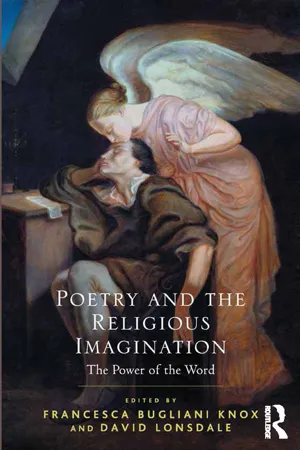
Poetry and the Religious Imagination
The Power of the Word
- 280 pages
- English
- ePUB (mobile friendly)
- Available on iOS & Android
eBook - ePub
About this book
What is the role of spiritual experience in poetry? What are the marks of a religious imagination? How close can the secular and the religious be brought together? How do poetic imagination and religious beliefs interact? Exploring such questions through the concept of the religious imagination, this book integrates interdisciplinary research in the area of poetry on the one hand, and theology, philosophy and Christian spirituality on the other. Established theologians, philosophers, literary critics and creative writers explain, by way of contemporary and historical examples, the primary role of the religious imagination in the writing as well as in the reading of poetry.
Information
Theology and Literature in Context
Chapter 1
Theology and Literature in the English-Speaking World
This chapter, a survey of the relationship between literature and theology in the Anglophone academy, is intended to some extent as a companion piece to that of Georg Langenhorst who, in the next chapter, offers a survey of the same theme in Germany. However, comparative generalizations would need to take into account the daunting complexity of Irish, North American and post-colonial literatures, which resist any narrow conception of what is English. Elisabeth Jay tacitly acknowledges the challenge when she introduces The Oxford Handbook of English Literature and Theology (2007) with a phrase from T.S. Eliot: ‘Now and in England’ (3). She and her co-editors admit that a subsequent volume would be needed to encompass the full range of geographical contexts; in the meantime, they include a chapter on James Joyce, the lone non-English representative. The present overview, unfortunately, will similarly have to confine itself to the identification of some key themes in the British and North American academies, to the exclusion of other English-language settings.
A map of the territory, however incomplete, shows quite discernible contours and even fault-lines. In a chapter entitled ‘The Rise of English’, in his book Literary Theory, Terry Eagleton asserts that ‘if one were asked to provide a single explanation for the growth of English studies in the later nineteenth century, one could do worse than reply: “the failure of religion”’ (Literary Theory 20). A steadily deepening crisis of religious belief and literacy in contemporary Britain continues to alter the shape of the dual entity which I shall henceforth refer to as ‘literature-and-theology’. In the United States, arguably, there has not been a comparable collapse of religious culture. Nevertheless, the academy has historically shown similar anxieties. We need think only of the insistence of the New Critics, from the 1930s onwards, that the individual literary work, and literature in general, have an absolute autonomy vis-à-vis non-literary judgements and influences. The various developments of, and reactions against, New Criticism have shaped the academic study of literature, including its religious dimension, in the American academy and beyond, for much of the twentieth century.
These examples demonstrate some of the nervousness that accompanies the juxtaposition of literature and theology. We are left at times with the impression of a symbiotic but uncomfortably tense proximity: a conjoined twinning, tolerated at best, but never free of suspicion and resentment. In what follows, I propose to explore four tracks. In the first section of this chapter, I sketch a map of the territory, with particular attention to the conversation as it has been emerging over the last 25 years. The contributions of three critics, Northrop Frye (1912–91), Frank Kermode (1919–2010) and George Steiner (b. 1929), illustrate the contrast between the German-speaking academy, where the conversation has been largely initiated by theologians – Georg Langenhorst’s essay discusses three of the main protagonists, Hans Urs von Balthasar, Paul Tillich and Karl-Josef Kuschel – and the English-speaking academies, where it is the literary critics who have made the most important overtures to theology, rather than the other way round.
The third track seeks to identify in the ‘English voice’ a distinctive lightness of touch which has contributed greatly to the flourishing of literature-and-theology over the past 50 years; a quality best described as the Aristotelian virtue of eutrapelia, the mean between the extremes of boorish rudeness on the one hand and frivolity on the other. I will focus here on an essay, ‘A Reading Against Shakespeare’, in which Steiner seeks to make sense of Ludwig Wittgenstein’s anguished attempts and failure to appreciate Shakespeare’s drama. My intention is to see whether the notion of eutrapelia sheds light on this perplexity.
The concluding section acknowledges the delicacy of this balance between frivolity and boorishness. The new Kulturkampf – between believers and the ‘new atheists’ – has endangered this precious conversational ideal of eutrapelia and requires the proponents of an interdisciplinary dialogue to reposition themselves again.
‘What Country, Friends, Is This?’
We begin with an attempt to chart the terrain of literature-and-theology, by identifying two chronological markers: the inaugural number of the British journal Literature and Theology (1987) and the appearance in 2007 of the Oxford Handbook of Literature and Theology. In the first of these, the editors intend not merely a return to past controversies, but ‘also a recognition of a distinctively contemporary convergence between the two disciplines’ (Jasper et al., iii). On the one hand, theologians now acknowledge the importance of narrative and figurative discourse; on the other hand, literary theorists recognize the proximity of their own hermeneutical questions to those of traditional biblical hermeneutics. In addition, metaphysical issues concerning ‘presence’ in literature seem to prompt either a distinctively theological or an anti-theological resolution. While dealing primarily with Western traditions, the new journal ‘will not be inhospitable’ to those of the East (iv). The editors assert that Literature and Theology, ‘far from dealing with matters that only overlap at the margin, will situate itself at the theoretical centre of both disciplines’ (iv).
Given this confidence, it is surprising to read David Jasper’s assessment 20 years later:
The study of literature and theology is alive and well, though it remains unsystematic and patchy. The texts of English literature and the doctrines of theology continue to enjoy creative conversations, though perhaps not much more than that, and the fundamental terms of the two fields of study remain unchanged. (Hass et al. 24)
This description is somewhat low-key. Jasper certainly anticipates change, as the institutional and cultural influence of Christianity continues to recede. He follows Eagleton, therefore, in taking the decline of religiosity as an important variable. Briefly, Eagleton argued that the decreasing effectiveness of religion as ideological control was a concern for the Victorian ruling class, anxious about the loss of a ‘social cement’ (Eagleton, Literary Theory 20) which was, for Victorian Christianity at least, a pacifying influence, fostering meekness, self-sacrifice and the contemplative inner life. A substitute was needed, Eagleton explains, and sought in literature, with ‘English’ henceforth being constructed as a discipline. Matthew Arnold proposed a scheme of cultural enrichment of the middle classes, which would empower them in turn to shape and direct the working classes, thus averting social disaffection and anarchy. Behind such a project lies the recognition that literature has the potential to inherit the immense emotional and experiential power of religion, and to carry forward its ideological task of preserving the political and economic status quo.
Variants on this theme of religion as a recognized force for ethical and social stability include Eliot and F.R. Leavis. In his 1935 essay, ‘Religion and Literature’, Eliot sought to balance the relative autonomy of literary and religious judgements; even so, his admonition that ‘literary criticism should be completed by criticism from a definite ethical and theological standpoint’ threw down a gauntlet for theorists through the subsequent 50 years (Selected Prose 97). Eliot’s championing of a European, royalist-classical Catholic tradition contrasted with Leavis’s articulation of a ‘Great Tradition’, which espoused the elemental ‘English’ energies of writers such as G.M. Hopkins and D.H. Lawrence. These involve very different cultural and existential commitments. Nevertheless, both are taken to task by Eagleton for not breaking free of Arnoldian anxieties about shoring up cultural defences against society at large, and therefore for being prescriptive and exclusivist in their canonical choices (Literary Theory 27–37).
With regard to the post-war period, Jasper lists the important dramatis personae on both sides of the Atlantic. He highlights in the United States the influence of Tillich in the 1950s and of three very different scholars in the 1960s, William F. Lynch, Nathan A. Scott Jr and Thomas Altizer (Hass et al. 19–20).1 Jasper’s survey also includes some British theologians – Austin Farrer, Martin Jarret-Kerr, John Coulson, Ulrich Simon and others – whose contribution has been comparatively overshadowed (Hass et al. 21–3); a corrective, perhaps, to the generalization mentioned above that in the English context it is critics and not theologians who have been making the overtures to dialogue.
In 2005 Terry Wright offered another typology of Anglophone literature-and-theology studies, once again identifying representative figures, in this case Nathan A. Scott Jr, George Steiner and Robert Detweiler. The shift here is from modernism/modernity to postmodernism/postmodernity. Wright follows Robert Venturi in seeing the modern as self-consciously ‘heroic and original’, whereas the postmodern is content to be ‘ugly and ordinary’ (3). Wright argues that the field of literature-and-theology in the USA and the UK was founded on modernist principles in the 1950s, Scott and Steiner being representative figures, and underwent a transformation under the pressure of postmodernity in the 1980s, a shift which is exemplified in the work of Detweiler.
It seems fair to say that the innovation of the study of literature-and-religion under Nathan Scott and others is to be understood as a reaction to the state of literature study under the influence of New Criticism. In 1961 William Empson criticized the tendency of this school to insist that ‘a poem is a private self-subsisting world’ (Wright 10; Eagleton refers to the fetishization of the poem according to this doctrine: poetry is effectively quarantined from questions of religious belief, to the detriment of the latter). Critics who refused to abide by the cordon sanitaire, such as Empson (after 1951) and C.S. Lewis, atheist and believer respectively, ran into fierce opposition for their tactlessness (Wright 10). In the United States, as recorded by Harold Bloom and others, the New Critical hegemony in Yale, where obeisance to Eliot was mandatory, constituted ‘an Anglo-Catholic nightmare’ (Wright 10). The point to note here is that the New Critics’ insistence on the disinterestedness of poetry with regard to religious or ideological commitment is hereby shown to be what existentialists decry as inauthentic bad faith. By contrast, Scott’s call for a distinctively theological and Christian approach to literature, following Tillich’s theology of culture, draws occluded religious presuppositions fully into the open, in such a way that the world of modernity could be properly and honestly engaged.
The contribution of Steiner, the other ‘modernist’, will be considered in detail below. In contrast to the modernist intensity of Scott and Steiner, Detweiler presents a more ‘laid back’ approach, interlacing profound seriousness with humour and iconoclasm, and with a deconstructive preference for the playful. This is of a piece with Detweiler’s conviction that the study of literature and religion does not in fact constitute a ‘discipline’, and we should not demand a methodological coherence which it does not warrant. Instead, its practitioners are happy to work at the ‘intersections and blurred edges of the traditional areas’ (Detweiler, Art/Literature/Religion 1). Detweiler identifies three significant aspects of the literature-and-religion conversation: the curatorial (that is, countering the widespread religious illiteracy, including ‘illiteracy’ with respect to the Bible); the hermeneutical (reading religious traditions critically); and the existential (the shaping of one’s life by means of critical choices).
Jasper, Detweiler’s British collaborator, underwent a similar experience. In their co-edited Reader in Religion and Literature (2000), Detweiler and Jasper confirm their common journey ‘from Modernism to Postmodernism’ as ‘the move from the rational and organized into the fear of chaos and disorder’ (174). This disorder, in turn, brings ‘fragmentation, deception, revelation, apocalypse, and irony’ (174–8). Jasper makes explicit the presupposition of a mutual suspicion between ‘official’ theology and the ‘suppressed’ voices of the poet and mystic, voices which are in fact no less theological (‘The Study’ 29). Despite his pessimism with regard to ‘systematic’ theology in a postmodern age, Jasper sees hope in the religious ‘return’ in Eagleton’s writing and in the attempts of some American theologians – such as David E. Klemm and William Schweiker – to advance a ‘theological humanism’ which affirms the ‘both/and’ of human flourishing and divine will. Previously Jasper had invoked the Chalcedonian formula of the human and divine natures of Christ, with literature as the ‘human’ and theology as the ‘divine’ components. Interestingly, in his 2011 essay he recognizes Chalcedon as one possible starting point (with Luther in the sixteenth century as another), but ‘with the poets we are always in the present – by the willing suspension of disbelief – in a text where we believe ourselves to be’ (Jasper, ‘Interdisciplinarity in Impossible Times’ 17).
However, as we shall see later with the three representative commentators, Frye, Kermode and Steiner, the liberating potential of chaos and indeterminacy is not something that has been universally or unequivocally welcomed. Jasper’s co-editor of the Handbook, Elisabeth Jay, notes an interest in biblical themes among British novelists in the 1980s, such as Julian Barnes, Jeanette Winterson and Sara Maitland. Barnes in particular is cited for his assertion of a forward- rather than backward-looking appraisal of myth. In his own fictional appropriations of the Jonah and Noah stories, as well as modern, ‘true-life’ versions of these archetypes, he urges that ‘myth will become reality, however sceptical we might be’ (Jay 5).
The biblical turn, Jay suggests, may imply a hunger for simpler, more defined narrative moorings, in reaction to the shapelessness and aridity of much postmodern experimentation. A generation of scholars ‘released from the bondage of the canon by a wave of critical theory, proceeded to lead their successors as students into a wilderness where texts replaced books, and hermeneutic and linguistic theories were preferred to contextual knowledge’ (6). The Exodus motif cannot but remind us of Paul Ricoeur’s dictum regarding ‘second naiveté’: ‘beyond the desert of criticism, we wish to be called again’ (The Symbolism of Evil, 351).
Three Critics: Frye, Kermode, Steiner
The editors of the new-born journal Literature and Theology identified three leading critics as particularly representative of the new conversation between literature and theology: Frye, Kermode and Steiner. This section outlines the work of each, identifying their common approach, despite the striking divergence of their respective religious commitments. The Canadian scholar Northrop Frye is noted for his book on literature and the Bible, The Great Code. A companion volume, Words with Power, appeared in 1990. These volumes proceeded from his earlier critical work, above all from An Anatomy of Criticism (1957), which demonstrates Frye’s interest in the nature of myth and narrative. Although the Anatomy is a defence of the autonomy of criticism, Frye asserted the proximity to religious concerns of the unified theory of criticism that he is espousing. He advocated a comprehensive, inductive approach which accommodated different critical methods. For such an approach to work, however, the barriers between the different methods needed to be broken down – hence the importance of archetypal or mythical criticism, which provided the appropriate, wide-angle lens. More explicitly, it was Frye’s interest in William Blake, which issued in his classic 1947 study Fearful Symmetry, and his teaching of Milton, that led him ultimately to write on the Bible’s importance for literature in The Great Code (Frye, Great Code xii).2
Frye’s significance for the present discussion may be located in the Anatomy, which comprises a ‘Polemical Introduction’ and four essays of historical (modes), ethical (symbols), archetypal (myths) and rhetorical (genres) criticism. The ‘Polemical Introduction’ sets out his objections to the critical ...
Table of contents
- Cover Page
- Half Title Page
- Title Page
- Copyright Page
- Table of Contents
- Notes on Contributors
- Preface and Acknowledgements
- Introduction
- Part I: Theology and Literature in Context
- Part II: The Religious Imagination: From Thomas Aquinas to Wallace Stevens
- Part III: Inspiration: Poetry and Poetry Reading
- Part IV: Poets and Spiritual Experience: Mystical Gestures
- Part V: Poetry, Religious Imagination and Religious Belief
- Index
Trusted by 375,005 students
Access to over 1.5 million titles for a fair monthly price.
Study more efficiently using our study tools.
Frequently asked questions
Yes, you can cancel anytime from the Subscription tab in your account settings on the Perlego website. Your subscription will stay active until the end of your current billing period. Learn how to cancel your subscription
No, books cannot be downloaded as external files, such as PDFs, for use outside of Perlego. However, you can download books within the Perlego app for offline reading on mobile or tablet. Learn how to download books offline
Perlego offers two plans: Essential and Complete
- Essential is ideal for learners and professionals who enjoy exploring a wide range of subjects. Access the Essential Library with 800,000+ trusted titles and best-sellers across business, personal growth, and the humanities. Includes unlimited reading time and Standard Read Aloud voice.
- Complete: Perfect for advanced learners and researchers needing full, unrestricted access. Unlock 1.5M+ books across hundreds of subjects, including academic and specialized titles. The Complete Plan also includes advanced features like Premium Read Aloud and Research Assistant.
We are an online textbook subscription service, where you can get access to an entire online library for less than the price of a single book per month. With over 1.5 million books across 990+ topics, we’ve got you covered! Learn about our mission
Look out for the read-aloud symbol on your next book to see if you can listen to it. The read-aloud tool reads text aloud for you, highlighting the text as it is being read. You can pause it, speed it up and slow it down. Learn more about Read Aloud
Yes! You can use the Perlego app on both iOS and Android devices to read anytime, anywhere — even offline. Perfect for commutes or when you’re on the go.
Please note we cannot support devices running on iOS 13 and Android 7 or earlier. Learn more about using the app
Please note we cannot support devices running on iOS 13 and Android 7 or earlier. Learn more about using the app
Yes, you can access Poetry and the Religious Imagination by Francesca Bugliani Knox,David Lonsdale in PDF and/or ePUB format, as well as other popular books in Theology & Religion & Poetry. We have over 1.5 million books available in our catalogue for you to explore.