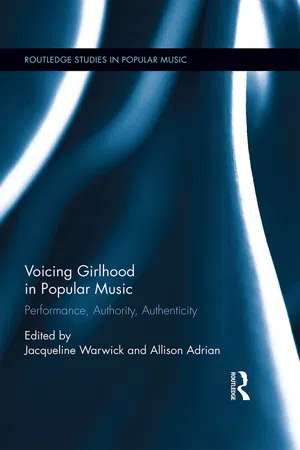
This interdisciplinary volume explores the girl's voice and the construction of girlhood in contemporary popular music, visiting girls as musicians, activists, and performers through topics that range from female vocal development during adolescence to girls' online media culture. While girls' voices are more prominent than ever in popular music culture, the specific sonic character of the young female voice is routinely denied authority. Decades old clichés of girls as frivolous, silly, and deserving of contempt prevail in mainstream popular image and sound. Nevertheless, girls find ways to raise their voices and make themselves heard. This volume explores the contemporary girl's voice to illuminate the way ideals of girlhood are historically specific, and the way adults frame and construct girlhood to both valorize and vilify girls and women. Interrogating popular music, childhood, and gender, it analyzes the history of the all-girl band from the Runaways to the present; the changing anatomy of a girl's voice throughout adolescence; girl's participatory culture via youtube and rock camps, and representations of the girl's voice in other media like audiobooks, film, and television. Essays consider girl performers like Jackie Evancho and Lorde, and all-girl bands like Sleater Kinney, The Slits and Warpaint, as well as performative 'girlishness' in the voices of female vocalists like Joni Mitchell, Beyoncé, Miley Cyrus, Taylor Swift, Kathleen Hanna, and Rebecca Black. Participating in girl studies within and beyond the field of music, this book unites scholarly perspectives from disciplines such as musicology, ethnomusicology, comparative literature, women's and gender studies, media studies, and education to investigate the importance of girls' voices in popular music, and to help unravel the complexities bound up in music and girlhood in the contemporary contexts of North America and the United Kingdom.
eBook - ePub
Voicing Girlhood in Popular Music
Performance, Authority, Authenticity
- 300 pages
- English
- ePUB (mobile friendly)
- Available on iOS & Android
eBook - ePub
Voicing Girlhood in Popular Music
Performance, Authority, Authenticity
About this book
Information
Part I
Voice and Agency
Chapter 1
Since the inception of rock culture, the easiest route in for a woman has been as a groupie, or an adjunct to male musicians. Despite this, girls and women create bands, carving out spaces of solidarity, shared power and collective authorship. This chapter explores the history of all girl rock bands, outlining how the dynamics of band formation intersect with second and third wave feminism. Analyzing interviews with musicians and fans, memoirs by female artists, and drawing from her own experiences in an all girls band, O’Brien argues that these bands exhibited feminist approaches to music making that established a solid foundation for contemporary girl bands to flourish. Chapters 2, 3, and 9 continue this discussion of the creativity, activism, and resilience of women and girls in popular music culture.
Chapter 2
While gender and musical performance are examined relatively frequently in academic discourse, little attention has been paid to women working “behind the scenes” of the music industry. Women in these particularly sex-segregated occupations have to negotiate being labeled a “girl” while they work among “the boys.” Using interviews with women inside industry, this chapter illuminates how women are positioned and position themselves to operate with respect to the gendered rhetoric of the workplace. As exhibited in Chapters 4, 5, and 10, the barriers to entry can be steep for women and girls in these musical worlds.
Chapter 3
How do pop musicians define, energize, and enable girl activism? This chapter explores the contradictory ways girl activists understand and talk about female performers who inspire them to raise their voices. Girls’ polyphonic identifications with artists remind us that there’s no one way to listen for or enact feminism in music. Girls make sense of the tensions they see and hear as pop musicians navigate mainstream success and authenticity, a topic explored in Chapter 9 as well. Girl activists develop systems of their own to evaluate performers that may conflict with critical reception (see Chapter 4), and must come to terms with ways their favorite female artists occasionally make patriarchal bargains to gain visibility (see also Chapters 9, 10, and 12).
1 I’m with the Band
Redefining Young Feminism
“It was really different to anything else I’ve been to. There were lots of younger teenage girls up front, and we were all in the mosh pit. One girl had a quote from Courtney Love on her back, and another one from Paris who started a conversation. A 17-year-old girl crashed into me and I didn’t mind. It was a really good atmosphere,” says Ilona Pope, a 15-year-old music fan who went to see Babes in Toyland play the 02 in West London as part of their reunion tour.1 She went with her mother, Beth Sather, who lived in Portland, Oregon, when the first wave of riot grrrl and grunge hit the U.S. “This wasn’t a typical nostalgia gig,” says Sather. “It was strong and active. At recent Mudhoney gigs there were signs up saying ‘No Crowdsurfing’ but Babes in Toyland are still really authentic.”2
The return of the ’90s Minneapolis female punk trio coincides with a new wave of girl bands. Many suggest that the prominence of female solo artists on the festival circuit—from Patti Smith to Florence Welch and FKA Twigs—suggests a healthy indicator of twenty-first century feminism. However, while top stars have made headlines in the last fifteen years with passionate gestures and key albums, whether it’s Bjork, PJ Harvey, or MIA, much interesting current feminist work is being done in girl bands. I would define girl bands as groups of young female musicians who share songwriting and performing duties among themselves, and present an image of collectivity. Girl bands are distinct from girl groups; the latter term refers to female vocal groups who project an image of popular teen girl culture. Mitchell and Reid-Walsh’s definition of girlhood is useful here, as one that is associated with the domesticated space of the bedroom and social practices linked to beauty, make-up, and shopping. This culture is different from the social world of boys, which is more likely to be in outside spaces and the “street corner.”
Girl groups from the Supremes and the Spice Girls to Little Mix and The Saturdays embody the “digital bedroom” space of girl culture, whereas girl bands (traditionally competing in more male environments), from The Runaways and Girlschool to Skating Polly, are more identified with the freedom and rebelliousness of boy culture. The word “girl” in this context is associated with youth and the period between late childhood and adulthood, though as Mitchell and Reid-Walsh argue, women in their 20s, 30s, and beyond enjoy and engage with the social practices of a constructed girlhood.
I would argue girl bands are a key source of feminist empowerment in popular music. Whether or not they are conscious feminists (and many want to be taken seriously as musicians, regardless of gender politics), girl bands operate like mini feminist collectives, with the emphasis on equality and the sense of a creative space that is separate from men. One of the fundamentals of second-wave feminism was this nurturing of a separate space for consciousness raising, campaigning, and building confidence. Although many young feminists are critical of the emphasis on white middle-class women in second-wave feminism, they are still inspired by their ideals of collective activism.
In their interviews with female musicians, Bayton, Reddington, and O’Brien et al. cite how women often write music in a way that is more cooperative and democratic than hierarchical. It is important not to idealize the process—tensions and competitiveness arise in female as well as male bands—but many speak of a supportive environment in making music with other women. “We wanted to have more ownership and found our own way to do it,”3 says Miki Berenyi, who teamed up with Emma Anderson in the late ’80s to form Lush. “I’d never played with other girls before. It’s a lot less about egos. Guys are ‘me, me, me,’” says Marion Andrau from indie girl band The Wharves. “Girls aren’t judging you on what you play.”4
No wonder Beyoncé likes to underline her point about female liberation by always performing with her ten-piece band the Sugar Mamas. I remember my first gig at the age of 17 with the all-girl punk band The Catholic Girls. Standing on stage in front of an expectant crowd was the scariest thing I had experienced, but we managed to perform three songs and create an impact. It was like taking a skydive; it made me fearless and it set the template for the rest of my life. In terms of confidence-building, being in a girl band at that age should be a national requirement.
The band is a crucible for female activism. In his book How Music Works, David Byrne lays out the nuts and bolts of collaborative music-making. A band should be tight, i.e., “It doesn’t mean that everyone plays exactly to the beat … it means that everyone plays together.”5 A band learns about baton-passing: “The learning, the baton-passing, happens on the bandstand—one has to play with others, to learn by watching and imitating.”6 The band is multidisciplinary, ideas are passed back and forth, and there is authorship as a group, with members working as a team. Even supreme solo artist Madonna recognizes the importance of being in a band. “Being part of a band teaches you about musicality. There’s no better way to understand about arrangements. How to create a song, how to perform,” she told Mojo. “I’m so lucky that I had all of those years playing in bands as an unknown musician, as an unknown singer, to figure out what I wanted to do and how I wanted to do it. To me, those early days were so essential to building me as an artist.”7
Last, the band creates and participates in a wider cultural network. This is evident from the early 1960s, when beat girl band Goldie & The Gingerbreads were part of the emerging rock ’n’ roll scene, touring with The Rolling Stones, The Animals, and The Yardbirds. Their first hit single in the U.K., “Can You Hear My Heartbeat,” was produced by Animals keyboardist Alan Price, who said that Margot Lewis’s organ playing was so good it made him want to go out and get drunk.8 Then in the 1980s, along with Judas Priest, Iron Maiden, and Motorhead, Girlschool was part of the New Wave of British Heavy Metal. By 2015 Girlschool was the longest-running female rock band and a major influence on young male musicians as well as all-girl bands like The Donnas and, latterly, The Kut. Apart from their work ethic, what binds the members of Girlschool together is their enduring friendship and a shared musical community. “We understand each other in the studio and on stage … we’re really good friends still, and we hang out together a lot,” said guitarist Jackie Chambers.9
So musical cohesion, friendship, and teamwork—whether it’s experienced as a short burst like The Runaways or over decades like Girlschool—are all great skills to have in learning the foundations of sisterhood, solidarity, feminine agency, and sharing power.
There are currently two strands in music and media shaping a dynamic new girl band culture. First, an expanding body of written work in the form of memoir and biography, where older female artists like Viv Albertine, Cherie Currie, Tracey Thorn, Kim Gordon, and Alice Bag are reflecting on their practice and telling their stories of the music business. This forms part of a widening critical context for a young teenage generation of girl bands like Girlpool, Baby in Vain, Trashkit, Skinny Girl Diet, The Wharves, Dolls, Chastity Belt, The Kut, and Skating Polly, who are advancing in a variety of genres and voices. Many of the current female musicians have feminist mothers who are music fans or in bands, thus building on a culture that, like women’s football, is set to rival the male canon. These feminist-raised feminists are part of a diverse, inclusive third-wave feminism that engages with queer theory and the ambiguities of women in pornography and sex work. The new wave of bands feel less limited by the perceived certainties of second-wave feminism. Baby in Vain, for example, sees no contradiction between looking pretty and playing powerful rock ’n’ roll guitar.
This chapter looks first at the contribution of the original 1970s punk and 1990s riot grrrl generation to this conversation, and the issues highlighted in popular music studies, analyzing the obstacles faced by female musicians. I will then examine how this testimony is being changed or challenged by the new generation, arguing that teenage girls are using feminist history in words and music to articulate their experience with greater confidence than ever before.
Testimony: Confessions of a Musician
In 1987 Pamela Des Barres published I’m with the Band: Confessions of a Groupie, a book about her sexual adventures in the 1960s. For decades the clearest route for women into rock ’n’ roll has been as a groupie or adjunct to a male musician. Female bands were considered a novelty and not worthy of long-term record company investment. And as Sara Cohen wrote in “Men Making a Scene” male music networks were created that actively excluded women.10
As a result of this marginalization, female musicians...
Table of contents
- Cover Page
- Half Title Page
- Series Page
- Title Page
- Copyright Page
- Dedication
- Contents
- List of Examples, Figures and Tables
- Introduction—Jacqueline Warwick and Allison Adrian
- PART I Voice and Agency
- PART II Voice and Vocality
- PART III Voice and Authenticity
- PART IV Voice and Narrative
- List of Contributors
- Index
Trusted by 375,005 students
Access to over 1.5 million titles for a fair monthly price.
Study more efficiently using our study tools.
Frequently asked questions
Yes, you can cancel anytime from the Subscription tab in your account settings on the Perlego website. Your subscription will stay active until the end of your current billing period. Learn how to cancel your subscription
No, books cannot be downloaded as external files, such as PDFs, for use outside of Perlego. However, you can download books within the Perlego app for offline reading on mobile or tablet. Learn how to download books offline
Perlego offers two plans: Essential and Complete
- Essential is ideal for learners and professionals who enjoy exploring a wide range of subjects. Access the Essential Library with 800,000+ trusted titles and best-sellers across business, personal growth, and the humanities. Includes unlimited reading time and Standard Read Aloud voice.
- Complete: Perfect for advanced learners and researchers needing full, unrestricted access. Unlock 1.5M+ books across hundreds of subjects, including academic and specialized titles. The Complete Plan also includes advanced features like Premium Read Aloud and Research Assistant.
We are an online textbook subscription service, where you can get access to an entire online library for less than the price of a single book per month. With over 1.5 million books across 990+ topics, we’ve got you covered! Learn about our mission
Look out for the read-aloud symbol on your next book to see if you can listen to it. The read-aloud tool reads text aloud for you, highlighting the text as it is being read. You can pause it, speed it up and slow it down. Learn more about Read Aloud
Yes! You can use the Perlego app on both iOS and Android devices to read anytime, anywhere — even offline. Perfect for commutes or when you’re on the go.
Please note we cannot support devices running on iOS 13 and Android 7 or earlier. Learn more about using the app
Please note we cannot support devices running on iOS 13 and Android 7 or earlier. Learn more about using the app
Yes, you can access Voicing Girlhood in Popular Music by Jacqueline Warwick, Allison Adrian, Jacqueline Warwick,Allison Adrian in PDF and/or ePUB format, as well as other popular books in Media & Performing Arts & Ethnomusicology. We have over 1.5 million books available in our catalogue for you to explore.