- 222 pages
- English
- ePUB (mobile friendly)
- Available on iOS & Android
eBook - ePub
About this book
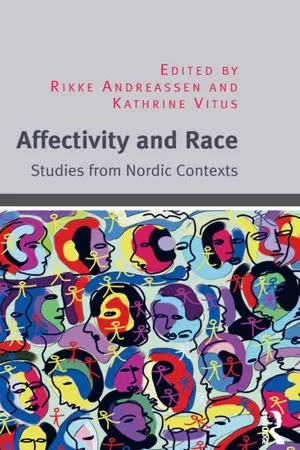
This book presents new empirical studies of social difference in the Nordic welfare states, in order to advance novel theoretical perspectives on the everyday practices and macro-politics of race and gender in multi-ethnic societies. With attention to the specific political and cultural landscapes of the Nordic countries, Affectivity and Race draws on a variety of sources, including television programmes, news media, fictional literature, interviews, ethnographic observations, teaching curricula and policy documents, to explore the ways in which ideas about affectivity and emotion afford new insights into the experience of racial difference and the unfolding of political discourses on race in various social spheres. Organised around the themes of the politicisation of race through affect, the way that race produces affect and the affective experience of race, this interdisciplinary collection sheds light on the role of feelings in the formation of subjectivities, how race and whiteness are affectively circulated in public life and the ways in which emotions contribute to regimes of inclusion and exclusion. As such it will appeal to scholars across the social sciences, with interests in sociology, anthropology, media, literary and cultural studies, race and ethnicity, and Nordic studies.
Information
How is Race Politicised Through Affects?
Chapter 1
Politics of Irony as the Emerging Sensibility of the Anti-Immigrant Debate
The past decade has witnessed hardened views towards immigration and multiculturalism in the Nordic countries. New populist parties aligned with anti-immigrant movements have gained support in all Nordic countries except Iceland. In Finland, the populist party ‘The Finns’, with an anti-immigrant agenda, became the third largest party in 2013, and currently has 39 members in the parliament of 200 representatives. The emergence of populism has shaped the political life and political practices of Finland in various ways. It has impacted on the ways in which traditional parties address their voters, the issues they engage in and the ways in which issues of immigration and multiculturalism are discussed in public. In this context, social media appears to hold a significant role as a new political arena that shapes the structures of public debates. According to recent research, the overall tone of public discussion has become more aggressive, partly due to the new forums of social media that operate in terms of anonymity and distance (Pöyhtäri et al. 2013).
This chapter explores the political online discussions of the Finnish anti-immigrant movement. My approach is informed by the work on affectivity by Wetherell (2012), Berlant (2011) and Ahmed (2004) in sketching out a particular tone or sensibility of political debates related to questions of multiculturalism and immigration that are engaged in by anti-immigrant groups. Thus, I am interested in the tone and sensibility that shape the present political debates and, moreover, the structures and practices that shape and enable this sensibility. As argued by media scholars, the post-deferential era – enhanced by a new media environment – is characterised by narrative multiplication, reflexivity and fragmentation. The chapter explores how these elements may be deployed in the politics of irony promoted by the anti-immigrant movement. The chapter focuses on three aspects of the affective practice of irony: the construction of rationality versus naïvity, the construction of shared affectivity and the move towards one-sided political communication. The time frame of the research (2007–2011) coincides with the period of expansion of the anti-immigrant movement that resulted in its victory in the 2011 general elections; thus, this study also offers insights into how the communicative space of social media operated as a base for the new political movement.
Theoretical Framework of Affect and Irony
Theorisations of affect in cultural studies point to the need to explore media and culture not only in terms of discourse and signs, but also in terms of emotion and sensation (Gregg and Seigworth 2010). However, as Margaret Wetherell (2012) points out, the recent affective turn has perhaps made too stark a distinction between affect and emotion, wherein affect is seen as autonomous and emotion is understood to be more conscious. Wetherell (2012: 60–61, 74–5) disagrees, in particular, with Nigel Thrift (2008) and Massumi (2002) on their Deleuzian understanding of affect as emergent, becoming and unattainable, and ultimately separate from consciousness and representation. As such, affect disappears or becomes an over-universalised concept that fails to describe connections with the social world. Instead, Wetherell argues for a more integrated understanding of the affect, emotion and meaning-making process that is also supported by recent research in neuroscience (see Wetherell 2012: 47–50). As Wetherell points out, ‘people swim in cultural and discursive milieus like fish in water – we are full of cultural and discursive practices’ (2012: 65). Affect is not separate from or outside of the meaning-making process, but part of it. In this chapter, I lean on Wetherell’s understanding of affect as not separate from emotion and consciousness, and something un-expressible or uncanny, but something that is intertwined and expressed in discourse; not beyond, but available for social analysis.
To understand the power of affect is to look at affect as practice and the ways in which affective practices ‘sediment in social formations’ (Wetherell 2012: 103). This becomes evident in research on distinction and social position, wherein particular affective styles become connected to social class and the boundaries of class are marked with emotions of fear, disgust or shame (Wetherell 2012: 110, Skeggs 2005). In a similar way, affective practices mark racial and gendered boundaries. Research into affective practice may also sketch out the affective canon of a particular social group or community. Likewise, shared emotions across particular social media sites or strong hateful, fearful or joyful responses to public events illustrate the collective dimensions of affective meaning making.
Wetherell warns against too fixed understandings of affective practices or patterns within a group or a community, and talks about the contextual understanding of diverse repertoires of affective practices. Contradictions and fragments that go against the grain are part of these patterns. Wetherell refers also to the famous concept by Raymond Williams (1961, 1968/1987), the ‘structures of feeling’, to describe the feel of everyday life in a particular historical period. The complex and somewhat obscure concept refers to the experiental dimension of a particular historical time period that is impossible to attain, as such, but available and articulated through art – much in the way that a historical novel mediates a specific historical conjuncture (for more on this concept, see Lehtonen 1989: 90–96, Grossberg 2010). Lauren Berlant also draws on Williams in her discussion of the genre as the locus of affective situations that ‘exemplify political and subjective formations local to particular space and time’ (Berlant 2011: 66).
Understanding affect as a pattern, structure or practice also involves the understanding of affect as shared and circulated. Work by Sara Ahmed (2004) discusses the circulation of affect in terms of affective economy, and makes important links to media texts and narratives. Ahmed argues that emotions work as a form of capital: affect collects value through its circulation. This means that particular images become influential through circulation. The affective economy operates to align signs, figures, objects and ideas (Ahmed 2004: 45). What bears significance is how when particular images and emotions become connected and ‘sticky’, particular narratives, stories and images accumulate power. They become sticky through articulation and repetition. ‘Stickiness’, in Ahmed’s words, is the ‘effect of the histories of contact between bodies, objects and signs’ (2004: 90). Ahmed connects emotions with past histories, narratives and personal experiences that come together in an affective encounter, resulting in sticky signs such as the ‘bogus asylum seeker’ circulated on online forums and in the media.
The understanding of affect as practice and structure is central to my approach in this chapter. It draws on work that discusses a particular form of the affective structures of cultural experiences. Following the work of Wetherell, Williams, Berlant and Ahmed, the task of this chapter is to take this theorisation and put it into practice – to analyse how affective practices shape the immigration and multiculturalism debate in Finland.
The key argument of this chapter is that irony is the guiding sensibility (affective practice) in anti-immigrant online discussions, as manifested in linguistic style and a general disposition. Irony is often understood to be highly rational and detached from affect; however, the ways in which irony provokes unease suggests the opposite (Hutcheon 1994: 14). As argued by Linda Hutcheon (1994: 14): ‘Irony irritates because it denies certainties, it can mock, ridicule, exclude, embarrass, humiliate’. Irony is defined as saying something, but meaning something else. Therefore, in ironic commentary, the signifier and referent are detached in a way that creates uncertainty over meaning. Irony, often used to make a sharp point, carries affective power. There is an ‘affective charge to irony that cannot be separated from its politics’ (Hutcheon 1994: 15).
Hutcheon lists a series of elements that make irony happen. These include critical edge, semantic complexity, discursive communities, intention and attribution of irony, and contextual framing. The anti-immigrant movement forms one of these discursive communities, wherein irony is used as an affective practice both to push political views further and to solidify the community. Here, I am interested not only in the grounds on which the anti-immigrant movement argues against multiculturalism and the affective dimension of these grounds, but also in the ways in which this argumentation is organised and structured.
I argue that political sensibility becomes engendered aesthetically through and within particular media practices (Berlant 2011: 65). That is not to say that media produces the tone, but rather that it shapes the practices and patterns of political engagements and, in this way, contributes to the sensibility of the present political climate, which, of course, is also shaped by and intertwined with a variety of economic and social structures and transitions within them. This sensibility could be melancholy, irony, shame, fear, lightness or flatness, for example. An obvious example of a reading of a sensibility of a particular time period is Jameson’s (1991) understanding of post-modernity as ‘waning of affect’ – a move towards surface and flatness. As Lauren Berlant points out, however, Jameson mistook the flat affect of a small elite to concern the experience of a whole society (Berlant 2011: 65). With this in mind, I underline the particularity of my reading of the politics of irony as situated in a particular discursive community, in a particular time and space, in contemporary Finland. Nonetheless, I contend that the emergence of the politics of irony is connected to and shaped by other general transformations in society and the media environment.
Therefore, I move on to introduce the political landscape of the rise of populism and the anti-immigrant movement in Finland. This is the context in which the particular affective practices of irony have been experienced and created.
The Rise of the Anti-Immigrant Movement
In Europe, the anti-immigrant sentiment mobilised within the right wing populist parties that gained political support in the 1990s, particularly in Italy, Austria and France (Vertovec and Wessendorf 2010, Mudde 2007: 1–8, Lentin and Titley 2011). The Nordic countries witnessed the rise of national populist parties with xenophobic agendas a decade later, in the 2000s. In Finland, the nationalist populist party, The Finns, gained political ground first in the local elections in 2008, then substantially in the general elections in 2011, becoming the third largest party in Finland. In Denmark, the Danish Peoples Party (Dansk Folkeparti) gained its greatest victory in the general elections in 2007, winning 13.8 per cent of the votes. In Sweden, the Sweden Demokrats (SD) won 20 seats in parliament in 2010 (5.7 per cent of the votes). Finally, in Norway, the Progress Party (FrP) became the third largest party with 16.9 per cent of the votes in the 2013 elections.
The rise of populism was closely connected with an anti-immigrant agenda and growing sentiments against multiculturalism (see Lentin and Titley 2011, Keskinen et al. 2009, Vertovec and Wessendorf 2010). The anti-immigration group within The Finns has been visible, and it has gained a foothold in the party organisation and its political agenda. In Finland altogether, nine elected representatives campaigned with an openly anti-immigration agenda in 2011. The Finnish situation, then, reflects the Nordic political landscape at large, where nationalist-populist parties have had growing support over the last decade (Horsti and Nikunen 2013).
Previous research has pointed to the relevance of Eurosceptisim, charismatic leaders and disappointment in traditional party politics in the rise of populism in Europe (Norris 2005, Mazzoleni, Stewert and Horsfield 2003). In Finland, the rise of populism is particularly connected with disappointment in the traditional parties, who are seen to have grown distant from the real problems of ordinary people. The end of the first decade of the 2000s in Finland – and elsewhere in Europe – was shaped by structural changes and a global recession that resulted in growing unemployment and the loss of industrial jobs, as production was moved elsewhere with lower production costs. Already preceding the recession, the traditional welfare state was being shaped by neoliberal politics of privatisation and competition within the public sector. These changes coincided with increased immigration from Eastern European countries, particularly Russia and Estonia, as well as – although in a lesser scale – countries from outside Europe. The 15,000 Somalians (or Somalis) comprise the largest non-European group (according to language) in Finland, followed by the group of 10,000 Iraqis. The overall scale of immigration in Finland is modest compared to that of Sweden and Norway, not to mention Germany and the UK.1
Disappointment and pessimistic views of the future have partly translated into a growing resistance towards immigration and the politics of multiculturalism. Undesired changes in society have been associated with immigration, which has operated as a scapegoat for ailing economic conditions. However, the anti-immigrant agenda is not simply an economic matter. The debates against multiculturalism reveal a deep-rooted sense of xenophobia and racism that has been silently accepted as part of the Nordic societies (Keskinen et al. 2009, Rastas 2007, 2009) and, as proposed by Lentin and Titley (2011: 16), the anti-immigrant and anti-multiculturist debates have actually provided a forum for racist views to be laundered and relegitimised. Instead of race, the (different) culture has become the problem. Yet within anti-immigrant or anti-multicultural argumentation, the notion of culture as fixed and homogenous is essentially founded on race-thinking (Lentin and Titley 2011: 16, 63). While anti-immigrant sentiments have arisen in societies in different eras in different ways, the crucial element in the success of the anti-immigrant agenda in the early 2000s was the advent of the Internet and the effective use of social media as a political arena (Horsti and Nikunen 2013).
Post-Deferential Media Environment
The digitalisation of media has allowed for new technologies of sharing, reshaping and circulating information and paved the way for new forms of political engagement. Virtual communities, discussion groups, networks and blogs in social media are seen to create new forms of participation (Couldry 2012, Jenkins 2006, Deuze 2006) that challenge the role of the traditional mass media in public and political debates.
Social media offers a space for sharing original texts, remakes and commentaries with others, either past or on the side of news forums. While the Internet has been seen to promote citizen activity and participation, it has also created spaces for hate speech, racist groups and undemocratic movements (Cammaerts 2009, Horsti and Nikunen 2013, Pöyhtäri et al. 2013). The proliferation of voices online, then, has not created a common space or arena for public debates and argumentation; rather, it has become a coexistence of multiple parallel publics and counter-publics (Papacharissi 2002, Downey and Fenton 2003). According to Zizi Papacharissi (2002), online discussions have fragmented political discourse as the virtual space has become subdivided into smaller groups; this points to Nancy Fraser’s argument of plural public spheres and the formation of alternative counter-publics (Fraser 1992).
As publics have become subdivided into various parallel groups, their relation to media seems to have become increasingly complex and reflexive (Bailey 2002, Baym 1998, Deuze 2006, Carpentier et al. 2013). The possibilities for audiences to reshape and manipulate images and create multimedia content have enhanced their understanding of the process of media production as well as their sensitivity to multiple interpretations. For example, audiences are able to recognise and trace original texts and references, as well as play with intertextual connections, memes and mashups (Bailey 2002, Sullivan 2013). In the context of humanitarian issues, Lilie Chouliaraki (2013) even suggests that reflexive style and performativity seem to have overtaken the more serious and solemn forms of political communication online.
In terms of political issues, audiences are now able to question and scrutinise the o...
Table of contents
- Cover Page
- Title Page
- Copyright Page
- Contents
- Author Biographies
- Introduction Affectivity as a Lens to Racial Formations in the Nordic Countries
- PART I How is Race Politicised Through Affects?
- PART II How Does Race Produce Affects?
- PART III How is Race Affectively Experienced?
- Index
Trusted by 375,005 students
Access to over 1.5 million titles for a fair monthly price.
Study more efficiently using our study tools.
Frequently asked questions
Yes, you can cancel anytime from the Subscription tab in your account settings on the Perlego website. Your subscription will stay active until the end of your current billing period. Learn how to cancel your subscription
No, books cannot be downloaded as external files, such as PDFs, for use outside of Perlego. However, you can download books within the Perlego app for offline reading on mobile or tablet. Learn how to download books offline
We are an online textbook subscription service, where you can get access to an entire online library for less than the price of a single book per month. With over 1.5 million books across 990+ topics, we’ve got you covered! Learn about our mission
Look out for the read-aloud symbol on your next book to see if you can listen to it. The read-aloud tool reads text aloud for you, highlighting the text as it is being read. You can pause it, speed it up and slow it down. Learn more about Read Aloud
Yes! You can use the Perlego app on both iOS and Android devices to read anytime, anywhere — even offline. Perfect for commutes or when you’re on the go.
Please note we cannot support devices running on iOS 13 and Android 7 or earlier. Learn more about using the app
Please note we cannot support devices running on iOS 13 and Android 7 or earlier. Learn more about using the app
Yes, you can access Affectivity and Race by Rikke Andreassen,Kathrine Vitus in PDF and/or ePUB format, as well as other popular books in Social Sciences & Cultural & Social Anthropology. We have over 1.5 million books available in our catalogue for you to explore.