eBook - ePub
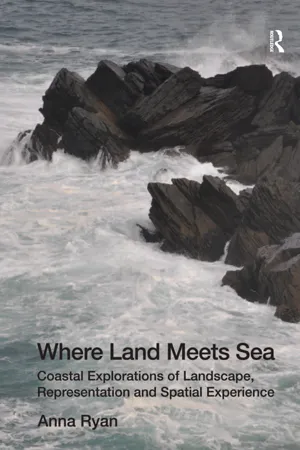
Where Land Meets Sea
Coastal Explorations of Landscape, Representation and Spatial Experience
- 300 pages
- English
- ePUB (mobile friendly)
- Available on iOS & Android
eBook - ePub
Where Land Meets Sea
Coastal Explorations of Landscape, Representation and Spatial Experience
About this book
Drawing together philosophical, empirical and academic thinking, this book focuses on generating awareness of the relationship forged between self and surroundings. It details research undertaken at two coastal sites, the South Wall in Dublin city and the Maharees peninsula in Co. Kerry, Ireland. Sixty-two participants were engaged in photography and drawing to enable this exploration of spatial experience. The participants' photographs and drawings present how spatial sensibilities can be revealed by becoming more attentive to the immediacy of bodily knowledge: our more-than-cognitive experience. Their communications resonate with the philosophers and theorists considered, including Merleau-Ponty, Edward Casey, Gilles Deleuze, Dalibor Vesely, and contemporary cultural geographers. From exploring the experienced spatiality of the meeting of land and sea, this book begins to suggest an alternative politics of the coast.
Information
1
Edge Horizon
INTRODUCTION
When sea meets land, a particular intensity of encounter is set up. The physical properties of the coast as meeting point can be wrapped up in a sense of unceasing mobility: dynamics of light, sound, presence, absence, surface, depth and texture are continually (re)worked and become apparent as alternating activities of construction, destruction and reconstruction. These movements are regular, rhythmic and constant, but are also interspersed by moments of intensity. Nothing is static. Nothing remains the same. These spatial natures of the coast thus tangibly highlight the fluidity of the world – its ongoing and ever-emergent dynamic.
People are drawn to the coast – to the paradoxical regularity of its ever-moving and elusive characteristics. This flowing mobility of the meeting of land and sea draws attention to multiple spatial sensations: as well as making the physical mobility of the world materially and visibly apparent, the coast also emphasises the flowing nature of the relationship between body and world. In this chapter I explore the spatiality of the coast as experienced: the interwoven dynamic of the physical and the social at the meeting of land and sea. I trace a journey through the material, the geometrical, the conceptual, and the historical conditions of the coast.
PART 1: EXPERIENTIAL QUALITIES OF THE MEETING OF LAND AND SEA
Indistinct boundaries of the coast
Defining an exact point when land becomes sea, or when sea gives way to land, is very difficult. Even at a vertical cliff face, both land and sea are fully involved in the movement of the other, and separation is an artificial exercise. Boundary remains notional. Acknowledging and grasping this difference, the world of mixing and intermingling, gives definition to both sides of the ‘divide’, the world of the sea and the world of the land. As land-based, western people, our descriptions often attempt to describe one of the worlds in the language and spatial realities of the other. Our general tendency is to attempt to situate the shore in a world we know and understand: the experience of land which is twice a day inundated by the sea. However, in her book The Edge of the Sea, first published in 1955, Rachel Carson embraces the in-between nature of the coast. She recognises there is a place that is different and separate to either the land or the sea, and though it is intrinsically bound up within each, she points to the fact that it is neither wholly of the sea nor wholly of the land. This world “belongs alternately to sea and land” (Carson 1999: 31).
It is interesting to consider seals as representative of this intermediate world. Richard Nairn (2005: 40) writes of how seals live in two worlds, breeding on land but spending more than half their lives in the sea. Their lives continually cross this undefined boundary. In a somewhat similar manner, the sea forms another boundary with the air. Birds and gulls traverse this boundary as part of their everyday existence. Aerial space and oceanic space are in a constant fluid cycle and changing of state through these two media. John Hay (1980: 108) describes a particular aerodynamic – how gulls carefully use the wind deflected from the waves to assist and guide their movements. These indistinct mixings of coastal bodies thus offer senses of connectivity: drawing the human into more-than-human worlds, blurring the boundaries between individual and surroundings.
Articulating the coast – the measure of edge
The challenge of articulating this blurred relationship has been taken up by the drawings, paintings, and photography of many artists. As representative of a huge body of coastal work, I have selected the paintings of two Irish artists. John Shinnors presents a series of conté drawings along the coastal estuary of the River Shannon in Limerick. In these estuary drawings, such as Figure 1.1, there is a sense of enclosure. Singly, they each form a measure of the river – the dimension of its width – and when viewed together as a whole, the series forms a measure of the expanse of the river estuary as it progresses towards its mouth and beyond to the open Atlantic. The tone used is slow and blurry and defines this shift in change or measure across to the other bank of the river. This set of paintings and drawings appears as a presentation of the particular kind of movement sensed within this broad river estuary – a movement in both dimensions, both forward and laterally. Similarly, Mary Lohan’s Shoreline series of paintings are all about a sense of movement (Figure 1.2). Mark Lawlor (2001: 34) describes that these paintings “have moved through paint, and with that pigment keep moving. It is an odd moment – you don’t know whether you are in motion or what you are looking at is in motion.” The lack of definition, the blurriness of the paintings is working to create an atmosphere. Fluidity, movement, is the central subject of the paintings. It is interesting to consider the titles Lohan has given her paintings. All include the word Shoreline and mention a particular area of shoreline. But the irony is there is no one line that dominates any other in the painting: it is all about a thickness presenting movement through, out, and beyond.
Coastal movement and time
The experience of time is integrally bound up with the physicality of the sea. The coastline exposes and conceals in regular intervals, moving across and covering like a veil, swelling up and back down, whether quietly or violently. There is ever a sense of ongoing motion. In this, a sense of time, or more precisely, the blurring of time, is a perceivable quality of the coast. Indeed, John Hay (1980: 7) suggests of the sea that: “Waiting, in fact, seems to be its essence, since it gives no answer to what it is, being a wide, surface brightness, a tidal beat, a sounding whose monumental depths are concealed, suggesting too, that we might wait for it forever and know nothing.” But in parallel to this mesmerising sense of time and motion, a relaxation due to rhythm and repetition, the impacts and dynamics of time are very apparent and are describable in the short, medium, and longer term. The cyclical fluctuations on a daily basis merge as visible seasonal differences which in turn contribute to an annual or historical dynamic. Rachel Carson (1999: 93) talks of the short term exposure of rocky coasts and pools:
Perhaps because we can visit this area only in that brief and magical hour of the tide’s turning, perhaps because of the nearness of waves breaking on rocky rims, dissolving in foam and spray, and pouring seaward again to the accompaniment of many water sounds, we are reminded always that this low-tide area is of the sea and that we are trespassers.

1.1 Estuary in February – 7, 2001. John Shinnors. Used by permission.

1.2 Stormy Winter Shoreline, Mayo I, 2001. Mary Lohan. Used by permission.
Moving beyond the daily cycles, Viney (1998b) writes of the difference in movements between seasons; how, for example, the beach is far more static in the summer. It is still and calm enough to remember the tracks of animals and the very delicate lines of fieldmice or dung beetles. Carson (1999: 240) presents the even longer rhythms of the sea: the time-frame of geology, of different shorelines, sea levels, and continents, “in which there is no finality, no ultimate and fixed reality – earth becoming fluid as the sea itself.” That there is this flux, this sense of recreation, paradoxically generates a sense of deep stability. Forging a relationship of understanding and acceptance of movement, change and time is critical in this coastal edge environment, particularly when it comes to accepting the dynamics of the coast, including processes of erosion and deposition. Carson’s (1999:3) long-term view of time emphasises this stability of mobility.
The edge of the sea is a strange and beautiful place. All through the long history of earth it has been an area of unrest where waves have broken heavily against the land, where the tides have pressed forward over the continents, receded, and then returned. For no two successive days is the shore line precisely the same. Not only do the tides advance and retreat in their eternal rhythms, but the level of the sea itself is never at rest. It rises or falls as the glaciers melt or grow, as the floor of the deep ocean basins shifts under its increasing load of sediments, or as the earth’s crust along the continental margins warps up or down in adjustment to strain and tension. Today a little more land may belong to the sea, tomorrow a little less. Always the edge of the sea remains an elusive and indefinable boundary.
The necessity and integrity of movement to the coast is sensed by John Hay (1980: 124–5) who believes the notion of beach as transition zone (i.e. a distinctive place in itself) is misleading:
It is made of land materials but it is not exactly a land boundary…The beach in its grand exposure, its instability, seems closer to the sea than land…The beach is naked, malleable, ready to move and be moved…It is a receiving ground for light…It is a power, with an expression made up of all its communicant and communicating energies, their substance and formality.
Understood in this way, the meeting point of land and sea, (whether physically manifest as a beach or as a cliff etc.) is movement. These cyclic and repetitive movements of this mobile coast generate a paradoxical experience of time, where ongoing rhythms are sensed as stable. The relationships between time and the moving coast present a significant complexity to the nature of the negotiations between individual and environment.
Texture and construction
The coast is a material experience. The changes of physical substance that occur directly at this edge create an active materiality that can be viscerally experienced. From liquid to solid, there is a progression of textures apparent in different forms, but similar in their movement. Beach can be conceived as pieces of solid matter that flow. Rocky cliff is perceived as more solid than beach, but it moves nonetheless due to erosion.
Biologists describe the textures of the coast as soft or hard. Movement, whether by water or wind, is the central characteristic of soft shores as they are formed of mobile sediments such as sand, shingle and mud that are easily eroded or changed by tidal currents. In Carson’s (1999: 129) words, “the beach has a lifeless look, as though not only uninhabited but indeed uninhabitable. In the sands almost all is hidden.” In contrast, hard rocky coasts have a firm surface and allow life to cling to it (Carson 1999: 15). But the apparent permanence of rock and the apparent instability of sand belie an implicit paradox. As Carson (1999: 128) writes,
We think of rock as a symbol of durability, yet even the hardest rock shatters and wears away when attacked by rain, frost or surf. But a grain of sand is almost indestructible. It is the ultimate product of the work of the waves – the minute, hard core of mineral that remains after years of grinding and polishing.
Thus the materialities of the coast are defined by the creative and constructive acts of movement.
The textures of the sea itself are also rich in their appearance and dynamic. The flowing nature of the sea, or its apparent surface stillness, or its whipped up meeting with the wind, generates particular atmospheres. In sheltered bays or quiet days the sea may appear like a spread-out sheet, suggesting its surface rather than its depth. It has a calm, liquidy, melty feel, where its movements happen in slow surges, rising and falling. When small breezes cross this surface, dapples and dimples and ripples and wrinkles appear, gathering themselves and then folding out as the air movement above relaxes once again. On the scale of the ocean, response or reaction to these surface appearances can be used to guide or navigate. In Passage to Juneau, Jonathan Raban (1999: 93) writes of trying to sail by the swell and the feel of the wind, concentrating on the character of the sea itself as the way to move forward.
The different textural formations of the coast are determined by the way the sea accesses, approaches, and meets the land. For example, Carson (1999) describes how some rocky coastlines were once rugged inland hills, but under the weight of a glacier, the flexible crust of the earth tilted downwards, the plains were flooded, and so the shoreline was suddenly changed. In contrast, Nairn (2005: 72) discusses how estuaries are formed from sediments eroded on more exposed coasts being carried there and deposited by the tide, as well as from sediments arriving into the estuary from the land and being deposited by the river. Similarly, the movement of substances gives rise to dune systems, for example inland machair are formed by wind-blown sand (Nairn 2005: 60). In contrast to the ‘passive’ action of deposition, coral reef is actively constructed out of its own material, being described by Carson (1999: 236) as “built”: she talks of the “sea becoming land almost before our eyes.” With the action of the fire of a volcano, liquid land combines with liquid sea, to also generate the sense of sea becoming land before our eyes. In all its formations, this link between the constructed nature of the coast and its texture is immensely apparent. At the coast, the ‘solidity’ of the land is compromised, and is forced to become mobile, forced to respond to the liquidity of the sea. A relationship of give and take is formed; a taking of substance, and a returning of substance. The land becomes fluid, broken into small pieces to work with the insistence of the water. The junction point marks a measure of change, a measure of action and re-action. As a place of meeting, the coast is a bringing together of entirely different physical substances, in different physical states thus giving rise to specific and strong sensibilities of texture and materiality.
Light at the edge of land
Light on the ocean or at the coast has a particular character. The changing dynamics of coastal light is a significant experiential aspect of the meeting point of land with sea, a physical presence that effectively dramatises and heightens all of the other action that occurs. After World War II, French philosopher Paul Virilio approached a beach and the sea for the first time ever in his life. Virilio (1994: 9–10) experienced the light as intensely part of the spatiality of the coast.
The weather was superb and the sky over the low ground was starting, minute by minute, to shine. This well-known brilliance of the atmosphere approaching the great reflector was totally new; the transparency I was so sensitive to was greater as the ocean got up closer, up to that precise moment when a line as even as a brushstroke crossed the horizon: an almost glaucous grey–green line, but one that was extending out to the limits of the horizon.
Writing of his time spent living on Inis Mór in 1968, before the advent of electricity and artificial lighting there, Andrew McNeillie (2001) presents “the falling ocean light” as alive, as an animate force. The converse of the activity of the light is the reflective capacity of the moving water of the sea, whether in it...
Table of contents
- Cover
- Half Title
- Dedication
- Title Page
- Copyright Page
- Table of Contents
- List of Illustrations
- Acknowledgements
- Introduction
- 1 Edge Horizon
- 2 Philosophies of Synthesis
- 3 Stasis and Mobility
- 4 Cois Farraige
- 5 Giving Voice
- 6 Territory
- 7 Encounter
- 8 Beyond Landscape
- Conclusion
- Bibiography
- Index
Trusted by 375,005 students
Access to over 1.5 million titles for a fair monthly price.
Study more efficiently using our study tools.
Frequently asked questions
Yes, you can cancel anytime from the Subscription tab in your account settings on the Perlego website. Your subscription will stay active until the end of your current billing period. Learn how to cancel your subscription
No, books cannot be downloaded as external files, such as PDFs, for use outside of Perlego. However, you can download books within the Perlego app for offline reading on mobile or tablet. Learn how to download books offline
Perlego offers two plans: Essential and Complete
- Essential is ideal for learners and professionals who enjoy exploring a wide range of subjects. Access the Essential Library with 800,000+ trusted titles and best-sellers across business, personal growth, and the humanities. Includes unlimited reading time and Standard Read Aloud voice.
- Complete: Perfect for advanced learners and researchers needing full, unrestricted access. Unlock 1.5M+ books across hundreds of subjects, including academic and specialized titles. The Complete Plan also includes advanced features like Premium Read Aloud and Research Assistant.
We are an online textbook subscription service, where you can get access to an entire online library for less than the price of a single book per month. With over 1.5 million books across 990+ topics, we’ve got you covered! Learn about our mission
Look out for the read-aloud symbol on your next book to see if you can listen to it. The read-aloud tool reads text aloud for you, highlighting the text as it is being read. You can pause it, speed it up and slow it down. Learn more about Read Aloud
Yes! You can use the Perlego app on both iOS and Android devices to read anytime, anywhere — even offline. Perfect for commutes or when you’re on the go.
Please note we cannot support devices running on iOS 13 and Android 7 or earlier. Learn more about using the app
Please note we cannot support devices running on iOS 13 and Android 7 or earlier. Learn more about using the app
Yes, you can access Where Land Meets Sea by Anna Ryan in PDF and/or ePUB format, as well as other popular books in Sciences physiques & Géographie. We have over 1.5 million books available in our catalogue for you to explore.