eBook - ePub
Cultural Landscapes of Post-Socialist Cities
Representation of Powers and Needs
- 224 pages
- English
- ePUB (mobile friendly)
- Available on iOS & Android
eBook - ePub
About this book
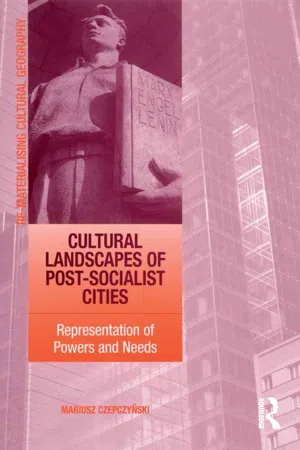
The cultural landscapes of Central European cities reflect over half a century of socialism and are marked by the Marxists' vision of a utopian landscape. Architecture, urban planning and the visual arts were considered to be powerful means of expressing the 'people's power'. However, since the velvet revolutions of 1989, this urban scenery has been radically transformed by new forces and trends, infused by the free market, democracy and liberalization. This has led to 'landscape cleansing' and 'recycling', as these former communist nations used new architectural, functional and social forms to transform their urbanscapes, their meanings and uses. Comparing case studies from different post-socialist cities, this book examines the culturally conditional variations between local powers and structures despite the similarities in the general processes and systems. It considers the contemporary cultural landscapes of these post-socialist cities as a dynamic fusion of the old communist forms and new free-market meanings, features and democratic practices, of global influences and local icons. The book assesses whether these urbanscapes clearly reflect the social, cultural and political conditions and aspirations of these transitional countries and so a critical analysis of them provides important insights.
Chapter 1 Geographical Studies of Cultural Landscape
DOI: 10.4324/9781315575315-2
The notion of landscape, especially with cultural implication, has recently come to have an expanding resonance. Its material, economic and representative values are being increasingly employed in social, economic and political spheres, as well as in everyday life. Landscape, and in particular cultural landscape, has become one of the widespread meta-words of post-modern spatial and cultural discourses, incorporating dozens of possible interpretations and areas of interest. It seems that the flexible and elastic concept of landscape meets the growing demand for holistic and synthetic interpretations in many research fields. More and more often ‘landscape’ not only denotes the traditional meaning of physical surroundings, but also refers to the ‘ensemble of material and social practices and their symbolic representation’ (Zukin 1993, 16). Cultural landscape then becomes a social product, which embodies many representations of various local and global powers, as well as everyday practices and interpretations of more or less common users. Landscape then is much more than we can see; visual features are being facilitated by their functions and additionally enhanced by their socially constructed significance. Urban scenery becomes not only buildings, spaces and places, but also ‘expressions of cultural values, social behaviour, and individual actions worked upon particular locations over a span of time’ (Meining 1979, 6).
The term ‘landscape’ can be interpreted in a number of ways, which, though not mutually exclusive, differ in emphasis. Probably the most popular, visual meaning of the term ‘landscape’ is based on morphology, and involves the examination of the visible phenomena of the studied region or place. Many authors suggest (see Naveh and Lieberman 1984) that the earliest written word meaning landscape was cited in the Book of Psalms. This word – noff in Hebrew – concerns mainly the perception of a landscape, giving importance to the visual aspect, and it seems that after three thousand years the very same and basic meaning of noff is still based on experience of the visual appearance of land.
Contemporarily, the old biblical word has been replaced by the concept of landscape, which comes from the Dutch word landschap. It was borrowed as a painters’ term during the 16th century, when Dutch artists were on the verge of becoming masters of the landscape genre. Landschap had earlier meant not much more then a ‘region, a tract of land’ but had acquired the artistic sense, which it brought over into English and other European languages, as ‘a picture depicting scenery on land’. Soon after, the art of creating desired landscapes, known as landscaping, had developed in Italy and other European countries. 19th century faced the beginning of modern sciences and methodologies, and in the end of the century the concept of landscape had been incorporated into geographical research. By the end of 20th century, landscape, without losing its prior meaning, has been incorporated into architecture and anthropology. In consequence, since the 1980s landscape began to be regarded not only as an entity existing in the physical world but as a metaphor, text, image or scene as well (see Birks et al. 2004, Robertson and Richards 2003, Dorrian and Rose 2003, Hirsch and O’Hanlon 2003, Atkins et al. 1998).
Landscapes as materialized system include verbal, visual and physical aspects of human existence and the earth’s surface, and create an arena for multi-dimensional and dynamic phenomena in the contemporary world (Cosgrove and Daniels 2004). The same time landscape interfaces various social categories like human/nature, time/space, past/future, expert/layperson and creates very broad field of multi-scale and multi-aspect discourse (Widgren 2004). Making landscape discourse more complex, some researchers (see Fægri 2004) argue, that cultural landscape can only be understood by its antithesis: untouched, unspoiled nature. But there is hardly any nature ‘untouched’ by humans, sometimes just by connotations and given meaning. It seems that technically everything on the planet has got some kind of human indication, no less than cultural significance. On the other hand, voices are being raised (see Cresswell 2004) suggesting that the term landscape should be abandoned, as being too common, too often used, as it is involved in too many explanations and interpretations. The variety of understandings and explanations of landscapes often brings misunderstanding, confusion and upheaval, which on one hand does not help to communicate and apprehend representatives of different ‘schools’ or approaches, but on the other hand can be very fertile and abundant source of interdisciplinary comprehensions.
Diversity of landscape interpretations
Complex and multi-aspect studies of landscape have recently made the term very popular and use in many disciplines, including both physical and human geography, architecture and urban studies, anthropology, social studies and ecology. The term ‘landscape’, however understood, has been frequently used not only in hundreds of scientific publications, but also in popular media and public discourse. Most of the participants of the landscape debate would agree that landscape comprises of visible features of an area of land, including physical elements such as landforms, living elements of flora and fauna, abstract elements such as lighting and weather conditions, as well as human artefacts and built environment. Landscape studies are generally based on recognition of the external world and comprise a complex and multi-aspect process, consisting of perception, but also comparison, classification, and valuation. This process often modifies and conditions our behaviour, and then our interpretation of landscape (Massey 2006).
Landscape usually refers somehow to the eye and a way of seeing, and is often understood as the outcome of a representational practice that stages its referent in relation to a viewing subject (Sennett 1990, Dorrian and Rose 2003). Landscape can be then recognized as total regional environment; a countryside; a land use; a topography or a landform; an ecosystem in which ecological relationships as realized as different types of landscape; as heritage or historical artefact; as a composite of physical components; an art form; a resource, and sometimes as energy and genre de vie. The types of contemporary landscape designations can be grouped into three main synthetic categories weighted according to the three basic attributes of landscape: form, use or significance (see Widgren 2004).
Landscape as form or artistic imagination
Landscape as form and visual aspects of a limited surface of earth is probably the most commonplace usage of the term, and comes directly from the landschap concept. The overall visual appearance of a stretch of countryside becomes a portion of land that the eye can comprehend in a single view. The visual landscape is often connected with its artistic imagination, and depicts scenery such as mountains, valleys, trees, rivers and forests. Sky is almost always included in the view, and weather usually is an element of the composition. The European artistic tradition of landscape imagination dates from the early 15th century, when landscape painting was established in Europe as an appreciation of natural beauty and part of spiritual activity. In Clark’s (1949) analysis, there were four fundamental approaches to convert a material landscape to an idea: by the acceptance of descriptive symbols, by curiosity about the facts of nature, by the creation of fantasy to allay deep-rooted fears of nature and by the belief in a Golden Age of harmony and order. Although contemporary European landscape painters like Ton Schulten, Gabriella Benevolenza and Russell Frampton all play with bold colours and cubistic forms, they always include sky, earth and line of horizon in their imagined landscapes. At the same time, the Chinese tradition of purist landscape has been based on fine ink lines on silk or paper marking the outlines of hills and trees and expressing the lightness and simplicity of Buddhism (Andrews 2000).
There are two very important components of landscape as artistic imagination that are essential for further landscape interpretations in any other discipline: a theme that must be focused on a section of land and, no less important, there must always be a certain viewing point, or an imagined standing point of the painter or interpreter. The position of the artist structuralizes the scene and brings certain order and beauty to the painting. We must then remember that every ‘objective’ landscape imagination we see, we see only through the eyes and mind of the artist or decoder, and the standing position conditions to a great extent our points of view.
The other group of landscape interpretations comes from the art of landscaping and mostly refers to the process and practice of designing and planning large scale garden establishments. Initially a skill of classical times, landscape architecture – as landscape gardening – was rediscovered in Renaissance. Since that time its scope has broadened to cover the planning and management of landscapes created by human activities, but mainly as a mélange of nature and culture in a form of deliberate garden and open areas. The object is to arrange and position the created landscape into both functionally and aesthetically satisfying parks and gardens (Andrews 2000). Horticulture or the art of landscaping gardens has dominated the meaning of the word ‘landscaping’, the contemporary understanding of which is usually a connection of external beauty and aesthetic arrangements of forms, with the utilitarian, healthy aspects of gardens and parks.
The third designation of ‘figurative’ landscape, based on its visuality, comes from architecture. In recent years, landscape has emerged as a model for urbanism, which supplants the basic architectural designs of buildings and spaces between them (Waldheim 2006). Looking for a more holistic and up to date term, many architects use ‘landscape’ to emphasize that they design much more than just a building or its surroundings, but also create the whole visual appearance of the place or space. A cityscape then becomes the urban equivalent of a natural landscape, with ‘townscape’ roughly synonymous with ‘cityscape’, though it of course implies the same difference in urban size, density, and even modernity, implicit in the difference between the words ‘city’ and ‘town’. In urban design, ‘landscape’ refers to the configuration of built forms and interstitial space. ‘Landscape architecture’ is a broader term which embraces landscape management, engineering, assessment and planning and generally requires a license and is concerned with large scale projects implemented over a long period of time and a wide geographical area (see Shannon 2006, Wolff et al. 1998).
Landscape as function or territorial complex
In natural sciences, and especially physical geographies, landscape is often understood as a geographical structure: a territorial complex consisting of soils, vegetation, hydrology, climate, as well as human settlements and communication network. The initial meaning of the word landschap as region or area has been employed in landscape ecology. Landscape or landskap, traditionally based on natural regions, can be also an administrative unit in Nordic countries, like Sweden and Norway, where landscape or cultural landscape research is habitually based on historical and regional analysis of rural settlements (see Birks et al. 2004).
Urban landscape can be of important value to the local economy and society. Landscape can be seen as a feature and function of a place, as well as a development option. The well managed and consumed landscape can enhance the quality of life, increase residential, investment and tourism attractiveness. Oscar Wilde, quoted in an office tower advertisement, said that ‘it is only shallow people who do not judge by appearance’ (Dovey 1999). When understood as a form of a function, the landscape is, in Harvey’s (1982, 233) words, ‘a geographically ordered, complex, composite commodity’ that is fixed in the space and thus circulate more freely. The fixed environment ‘functions as a vast, humanly created resource system, comprising values embedded in the physical landscape, which can be utilised for production, exchange, and consumption’. Landscape as a product can be then valued, sold, exchanged, explored, but also protected and treasured. This particular and compound resource is often employed and used in tourism and the real estate market.
More recently, landscape ecological approaches rose from growing concerns about the state of the environment. Since the 1970s in many European research centres, especially in Netherlands, the new methodology of landscape research embraced natural, ecological, cultural and social issues, and has been facilitated by the availability of new technologies, including remote sensing and GIS (Shaw and Oldfield 2007). Landscape ecology developed in Europe from historical planning in human-dominated landscapes. In North America, concepts from general ecology theory were integrated. Landscape ecology, as a term introduced by a German geographer Carl Troll in 1939, is based upon heterogeneity in space and time, and frequently included human-caused landscape changes in theory and application of concepts. Landscape ecology is focused on spatial variation in landscapes, while landscape becomes merely a scale or equivalent of the micro-region. It includes the biophysical and societal causes and consequences of landscape heterogeneity and typically deals with problems in an applied and holistic context (Forman 1995). Landscape ecology looks at how spatial structure affects organism abundance at the landscape level, as well as the behaviour and functioning of the landscape as a whole. This includes the study of the pattern, or the internal order of a landscape, on process, or the continuous operation of functions of organisms. This interdisciplinary approach to the study of the environment at a landscape scale is essentially concerned with biological territorial capacity, landscape unit, ecosphere scale, landscape ecological principles, variegation model, and standard habitat (Ingegnoli 2004). Landscape ecology theory includes the landscape stability principle, which emphasizes the importance of landscape structural heterogeneity in developing resistance to changes, recovery from disturbances, and promoting total system stability (Forman 1995). This principle is a major contribution to general ecological theories which highlight the importance of relationships among the various components of the landscape.
Landscape as a territorial unit can be also studied as land use with all the economic applications and consequences. Analysis of land use changes has included a strongly geographical approach within landscape ecology. This has lead to acceptance of the idea of multifunctional properties of landscapes. A territorial complex and its visual attractiveness can be seen as a resource and market valued commodity. The collective landscape is a public good which should be protected and enhanced by legislation and public administration. Adopted in Florence, Italy, on 20 October 2000, the European Landscape Convention aims to promote the protection, management and planning of European landscapes and to organize European co-operation on landscape issues. It is the first international treaty to be exclusively concerned with the protection, management and enhancement of European landscape. The Convention emphasizes the significance of landscape:
The landscape has an important public interest role in the cultural, ecological, environmental and social fields, and constitutes a resource favourable to economic activity and whose protection, management and planning can contribute to job creation. (The European Landscape Convention, 2000, Preamble)
Protecting existing public natural assets, societies are responsible for th...
Table of contents
- Cover Page
- Half Title Page
- Title Page
- Copyright Page
- Table of Contents
- List of Figures
- List of Boxes
- Acknowledgments
- Dedication
- Introduction
- 1 Geographical Studies of Cultural Landscape
- 2 Representations of Memories and Powers: Discursive Historical Landscapes
- 3 Landscaping Socialist Cities
- 4 Post-communist Landscape Cleansing
- 5 New Landscape Symbols of ‘New Europe’
- 6 Interpreting Landscapes in Transition
- Bibliography
- Index
Trusted by 375,005 students
Access to over 1.5 million titles for a fair monthly price.
Study more efficiently using our study tools.
Frequently asked questions
Yes, you can cancel anytime from the Subscription tab in your account settings on the Perlego website. Your subscription will stay active until the end of your current billing period. Learn how to cancel your subscription
No, books cannot be downloaded as external files, such as PDFs, for use outside of Perlego. However, you can download books within the Perlego app for offline reading on mobile or tablet. Learn how to download books offline
Perlego offers two plans: Essential and Complete
- Essential is ideal for learners and professionals who enjoy exploring a wide range of subjects. Access the Essential Library with 800,000+ trusted titles and best-sellers across business, personal growth, and the humanities. Includes unlimited reading time and Standard Read Aloud voice.
- Complete: Perfect for advanced learners and researchers needing full, unrestricted access. Unlock 1.5M+ books across hundreds of subjects, including academic and specialized titles. The Complete Plan also includes advanced features like Premium Read Aloud and Research Assistant.
We are an online textbook subscription service, where you can get access to an entire online library for less than the price of a single book per month. With over 1.5 million books across 990+ topics, we’ve got you covered! Learn about our mission
Look out for the read-aloud symbol on your next book to see if you can listen to it. The read-aloud tool reads text aloud for you, highlighting the text as it is being read. You can pause it, speed it up and slow it down. Learn more about Read Aloud
Yes! You can use the Perlego app on both iOS and Android devices to read anytime, anywhere — even offline. Perfect for commutes or when you’re on the go.
Please note we cannot support devices running on iOS 13 and Android 7 or earlier. Learn more about using the app
Please note we cannot support devices running on iOS 13 and Android 7 or earlier. Learn more about using the app
Yes, you can access Cultural Landscapes of Post-Socialist Cities by Mariusz Czepczynski in PDF and/or ePUB format, as well as other popular books in Physical Sciences & Geography. We have over 1.5 million books available in our catalogue for you to explore.