eBook - ePub
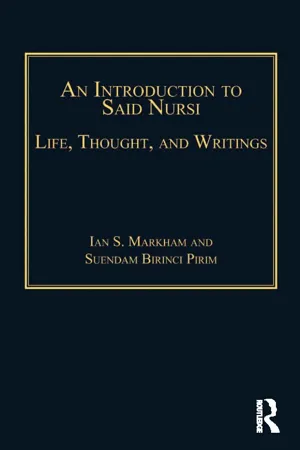
An Introduction to Said Nursi
Life, Thought, and Writings
- 206 pages
- English
- ePUB (mobile friendly)
- Available on iOS & Android
eBook - ePub
About this book
Contemporary Islamic thinkers are often studied sociologically rather than as theologians. There are many accessible introductions to Christian theologians, but very few such studies of Islamic thinkers. This book, and this series, seeks to change this situation: offering new introductions to influential Islamic thinkers and engaging, at the level of ideas, with the rich depths of contemporary Islamic theology. This book introduces to the English-speaking world the leading modern Islamic thinker Said Nursi (1878-1960) - who has some nine million followers in modern day Turkey and around the world. After an opening chapter that provides an overview of his life, the next four chapters outline the theology of Nursi on God, the Qur'an, the West and Politics. The final section provides an invaluable resource of readings from Nursi's most important writings. Providing an introduction to a major form of Islam which is committed to non-violence, dialogue and constructive relationships with the West, this is the first student textbook to introduce a contemporary Islamic theologian in a systematic way.
Information
Chapter 1
Life and Times of Said Nursi (1878–1960)
“I consider Said Nursi’s thought to be one of the foremost assemblages of important ideas among Islamic thinkers. It is not simply Nursi’s intellectualism and piety that touch the reader, but the deep human respect inherent in his ideas.”1
Known through his vibrant legacy in Turkey and in the Middle East, not much attention has been paid to Said Nursi and his ideas in the West. His name has only recently started to appear in books dedicated to modern Islamic thought and Muslim intellectuals. One major reason for the growing interest toward Nursi and his teachings in the West is due to his faith-based understanding of Islam and his insistence on keeping Islam distinct from politics. Nursi was deeply concerned with the challenges facing humanity, believers, and the Muslim ummah in particular. He had a faith-centered understanding of Islam, not a state-centered one. Consequently, he did not see the solution in establishing an Islamic state, a position advocated by many of his contemporaries. Even though he was often misunderstood in Turkey, he never lost hope or fell into despair in his loneliness, and continued to spell out what he thought to be right and beneficial for all. At times, he turned toward the future, addressing upcoming generations in his work and writings.
Having lived through one of the most significant periods in recent history, Nursi witnessed and participated in key events that affected the world. These include two World Wars, the collapse of the Ottoman Empire which gave birth to the secular Republic of Turkey, the continuing colonization of Muslim lands, the partition of the Muslim world after gaining independence through nationalist ideologies, the emergence of major ideologies such as communism and capitalism, and major movements like atheism, materialism, and anarchism. People, cultures, religion, science; in short, the entire globe was re-shaped during the years covering Nursi’s life span.
Nursi was born in 18782 in a small village called Nurs in the city of Bitlis located in southeastern Anatolia. He grew up and received his education around districts considered periphery to the Ottoman Empire. In his youth, he effectively moved to the center of the empire and became an intellect not only contributing to but shaping the agenda of Turkey. It is a remarkable life. Before proceeding toward details of his life, it will be helpful to look at his environment in order to locate Nursi in the world of his times and gain a better insight to his theology and thinking.
Anatolia during Nursi’s Early Years
The geography and political landscape of the globe in the nineteenth century was different from what it is today. Nursi was born in the lands of the Ottoman Empire, and grew into his youth through the last decades of this old domain. His environment was predominantly composed of Sunni Muslims, most of whom were ethnically Kurdish.
Established to realize a long held dream of uniting Turks under the same flag, the Ottoman Empire maintained its rule for over six centuries from 1299 to 1923. Its lands spread from Asia Minor to the Middle East, Northern Africa, and Southeastern Europe. It operated through a state system with different provinces composed of people from different religions and races. The empire was located in the center of three continents and bridged different cultures and religions. Istanbul, historically known as Constantinople, was the capital of the empire for about five centuries. The city continues to be the most dynamic metropolitan area of modern day Turkey, continuing to reflect the diversity of the nation and its population.
Even though a leading motivation for the establishment of the empire was the unification of Turks, Ottoman was known as the greatest empire of Islamic civilization. After an overwhelming majority of Turks accepted Islam starting from the eighth century on, religious fellowship was regarded as higher than any ethnic bond. The concept of ummah in Islam, referring to the community of Muslims, includes all races and ethnicities as equal creation of God announcing that the most honored in the sight of God is the most righteous (Q, 49:13).3 In light of this teaching, the Prophet of Islam stated in his last sermon that no race could be superior over the other since all humankind is created from the same couple, Adam and Eve.4
The Ottoman Empire is almost synonymous with the notion of Muslim caliphate, which is known as the dominion of the Caliph. In the Sunni tradition, this was a title given to Muslim leaders mostly concerned with political leadership and state affairs. Caliphs would be supervised by sheikh al-Islam, a leading religious scholar given the highest authority of legislation and guidance. According to Shi’a Islam, spiritual and political leadership is united in the same leader, or Imam. From the sixteenth century on, Ottoman Sultan’s received the title of Caliph as leaders of the Muslim ummah. The empire was a monarchic dynasty and the same system was applied throughout the years of caliphate.
Similar to a living organism, this great empire had its establishment, expansion, and decline periods. Its most remarkable years are regarded as the fifteenth to seventeenth centuries. In contrast to the darkness of the Western Middle Ages, arts and sciences were flourishing in the Ottoman lands. Mathematics, astronomy, geography, navigation, philosophy, mysticism, visual arts such as calligraphy, miniatures, and illumination, music and literature were among the leading fields of productivity.5 One visible legacy of Ottoman is the fascinating architecture, most notably visible in mosques and bazaars, such as the Blue Mosque and the Grand Bazaar.
The nineteenth century marked the decline and eventual downfall of the Ottoman Empire. Modernization and reform within the empire began in the first 40 years of this century. This was followed by a period called Tanzimat (1839–1876), known as a time of reorganization or reforms. Moving away from monarchy, under Meşrutiyet, Constitutional Monarchy, the establishment of a parliament restricted the Sultan’s absolute power. While people, particularly the educated, were ready and eager for this shift, a major concern was the representation of all ethnicities and religions in the parliament.
Islamic unity was the building block of the Ottoman Empire and kept it empowered until the strong force of nationalism, which was mostly advocated by the Western educated intelligentsia, confronted the empire. The nineteenth century elite were mostly educated in Paris where nationalism was a major trend. It was a period when remedies to heal the falling empire were being sought. More importantly, it was not a single dynasty or nation being affected, but a representation of the unity of Islam and its fall would give birth to many more problems. The early version of nationalism promoted by the Young Turks was Ottomanism similar to current day “American identity” claimed by the citizens of the United States. It was promoted as the ideology of the First Constitutional Era (1876–1877). However, it did not survive long as wars within the empire and around the world were waged to preserve national identities. Although Islam and Ottomanism were the strongest currents at the time, the Second Constitutional Era (1909–1922) was the period when Turkish nationalism and Turkification became trendy, leading the country toward becoming a national republic.
The early twentieth century saw the beginning of wars and the fall of the empire. Nursi witnessed all these transformations in the last phase of the Ottoman rule as an adolescent and youth during the decline, and an adult throughout the descent of the empire and Caliphate. Throughout this period, Nursi’s primary aim was preserving the integrity of Islam. Even though earlier he believed that unity could be achieved through Ottoman identity, as events moved on, he moved toward a pan-Islamic outlook. a pan-Islamic outlook. While pan-Islam would support political and social unity of all Muslim states, Nursi’s support was towards spiritual and economical unity of the Muslim world. He wrote and gave sermons about uniting features of Islam and potential dangers of nationalism, materialism, and philosophy contradicting to teachings of the Qur’an. Among the popular trends of the time, Ottomanism, nationalism, and Islamic unity, Nursi was an advocate of Islamic unity.
After World War I and the Independence War, a new secular republic was established in 1923 over the ashes of the Ottoman Empire. Its founder, Mustafa Kemal, was among the supporters of nationalism. He named the country Türkiye, the land of Turks. From the nineteenth century on, such monolithic nationalism has never been fully accepted or appreciated by the country’s ethnically diverse population. Despite the regard of the populace, nationalism has been instituted and enforced by the state since the formation of modern Turkey.
Turkey’s population still protects the richness of its ethnic diversity including Turkic, Kurd, Arab, Assyrian, Circassian, Laz, and others. The county’s 99 percent Muslim population hosts a variety of practices varying from religious movements to Sufi orders. While the country’s regime is strictly secular, a significant orthodox6 presence of religious practice continues to take place, often triggering debates and research in regards to the existence of religious communities and practices in secular systems.
Nursi’s Childhood and Early Adolescence
Going back to the late nineteenth century, the years of Nursi’s infancy, a major war broke out between Russia and the Ottoman Empire in 1877–1878, known as “The 93 War.” The empire lost its provinces in Europe and part of the Balkans and was faced with a dramatic decline in economic activity. The migration and relocation of communities from lost provinces increased economic hardship and the empire struggled to maintain stability. This was the environment that shaped Nursi’s childhood. As the fourth child born to a family of seven children, his humble home did not escape the growing problems of the empire.
Nursi’s father Mirza and mother Nuriye7 were practicing Muslims known for carefully preserving their piety. His remarkable memory, bright intelligence, and brave personality intrigued his family and village community. Nursi wanted to study and teach like his elder brother Abdullah, who was among Nursi’s first instructors.
Nursi was going to be his last name , used following the establishment of the Turkish republic, declaring his affiliation to the village of his birth. The word nur, an Arabic noun meaning light, is used in modern day Turkish. This word would come to hold great significance in Said’s life. Nursi’s village , a little hamlet of 20 houses, was Nurs, accordingly his official last name was Nursi, and his mother’s name was Nuriye, meaning woman of light. Mentioning several other instances that the word nur came across his life, Nursi notes that the Divine Name an-Nūr, The Light, was the one which provided him guidance through troubles he faced regarding understanding divine truths. He also noted that a Qur’anic verse known as ‘the nur verse’ of the chapter an-Nūr8 occupied his thought, enlightened his mind and heart the first.9 Most importantly his life’s major work was entitled the Risale-i Nur, the Treatise of Light; its followers are called Nurcu, advocates of light; and the community founded on his teachings, despite being fragmented, is known as the Nur community.
Nursi received his education in the eastern provinces of Turkey. He started his medrese,10 religious school, education when he was about ten years old, leaving his home for the first time. Nursi’s commitment to knowledge and scholarship, led him to travel to the leading medāris, plural for medrese. He continued to study with different ulemā, scholars, so that he might benefit from the different perspectives and expertise. Nursi had a remarkable capacity for learning. He managed to appreciate and understand the distinctive approach of a particular medrese, within weeks or months of staying there. His gift for learning and capacity for retaining detailed knowledge caught the attention of many. the attention of many. Following his pursuit, Nursi moved on searching new venues for learning.
One dominant feature of Nursi’s character was apparent from his early years; parrhesia, speaking candidly. He was always willing to offer his views and challenge a perceived injustice. There were occasions when he challenged older students or corrected scholars. This behavior carried into his later life; leading Nursi to defy injustices and develop a keen understanding of justice based on the Qur’an.
His travels around the medāris continued for about five years and left Nursi unsatisfied with his experience. He did not fit in the education system of the time, and was disappointed with not finding the type of quality and attentive education he sought. He turned back to his village Nurs. In despair, he saw a vision of the Prophet Muhammed (peace be upon him) in his dream. Kissing the Prophet’s hands to show his respect, Nursi asked for ilm, knowledge. The Prophet answered “Knowledge of the Qur’an will be given you on the condition you ask no questions of any of my community”.11 Filled with the spiritual empowerment of this dream, Nursi was back on track to pursue education.
Nursi was settled and content with the medrese in Bayezit, in Erzurum where he received his education from Shaykh Muhammad Celali and was given icazet, an authorization diploma, earning the title of Molla. He is reported to be fourteen or fifteen years old at the time. The form of education by then was studying with distinguished scholars until reaching a satisfactory level deserving of receiving a diploma. Under this open system of education, mollas could start their own schools, providing a for...
Table of contents
- Cover Page
- Half Title Page
- Dedication
- Title Page
- Copyright Page
- Contents
- Acknowledgements
- Introduction
- 1 Life and Times of Said Nursi (1878–1960)
- 2 The Concepts of God and the Qur'an
- 3 Said Nursi and Spirituality
- 4 Nursi's Approach to Disagreement and Pluralism
- Extracts from the Writings of Said Nursi
- Part 1 Belief
- Part 2 Prophethood
- Part 3 Life after Death and Resurrection
- Part 4 Justice and Worship
- Further Readings
- Glossary
- Index
Trusted by 375,005 students
Access to over 1.5 million titles for a fair monthly price.
Study more efficiently using our study tools.
Frequently asked questions
Yes, you can cancel anytime from the Subscription tab in your account settings on the Perlego website. Your subscription will stay active until the end of your current billing period. Learn how to cancel your subscription
No, books cannot be downloaded as external files, such as PDFs, for use outside of Perlego. However, you can download books within the Perlego app for offline reading on mobile or tablet. Learn how to download books offline
Perlego offers two plans: Essential and Complete
- Essential is ideal for learners and professionals who enjoy exploring a wide range of subjects. Access the Essential Library with 800,000+ trusted titles and best-sellers across business, personal growth, and the humanities. Includes unlimited reading time and Standard Read Aloud voice.
- Complete: Perfect for advanced learners and researchers needing full, unrestricted access. Unlock 1.5M+ books across hundreds of subjects, including academic and specialized titles. The Complete Plan also includes advanced features like Premium Read Aloud and Research Assistant.
We are an online textbook subscription service, where you can get access to an entire online library for less than the price of a single book per month. With over 1.5 million books across 990+ topics, we’ve got you covered! Learn about our mission
Look out for the read-aloud symbol on your next book to see if you can listen to it. The read-aloud tool reads text aloud for you, highlighting the text as it is being read. You can pause it, speed it up and slow it down. Learn more about Read Aloud
Yes! You can use the Perlego app on both iOS and Android devices to read anytime, anywhere — even offline. Perfect for commutes or when you’re on the go.
Please note we cannot support devices running on iOS 13 and Android 7 or earlier. Learn more about using the app
Please note we cannot support devices running on iOS 13 and Android 7 or earlier. Learn more about using the app
Yes, you can access An Introduction to Said Nursi by Ian S. Markham,Suendam Birinci Pirim in PDF and/or ePUB format, as well as other popular books in Social Sciences & Islamic Theology. We have over 1.5 million books available in our catalogue for you to explore.