- 242 pages
- English
- ePUB (mobile friendly)
- Available on iOS & Android
eBook - ePub
About this book
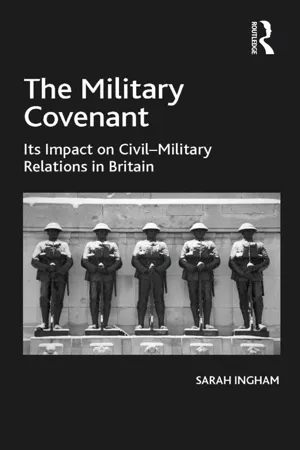
The Military Covenant states that in exchange for their military service and their willingness to make the ultimate sacrifice, soldiers should receive the nation's support. Exploring the concept's invention by the Army in the late 1990s, its migration to the civilian sphere from 2006 and its subsequent entrenchment in public policy, Ingham seeks to understand the Covenant's progress from the esoteric confines of Army doctrine to national recognition. Drawing on interviews with senior commanders, policy-makers and representatives of Forces' charities, this study highlights how the Army deployed the Military Covenant to convey the pressure on the institution caused by the concurrent combat operations in Iraq and Afghanistan. While achieving a better deal for soldiers whose sacrifice became all too apparent, the Military Covenant licensed unprecedented incursion into politics by senior commanders, enabling them to out-manoeuvre the Blair-Brown governments and to challenge the existing norms within Britain's civil-military relationship. As British Forces prepare to leave Afghanistan, this study considers the value Britain accords to military service and whether civilian society will continue to uphold its Covenant with those who have served the nation.
Trusted by 375,005 students
Access to over 1.5 million titles for a fair monthly price.
Study more efficiently using our study tools.
Information
1 The Historical Context
DOI: 10.4324/9781315555560-2
Introduction
The archaic quality of the word ‘Covenant’ is reinforced by its Biblical associations. Similarly, the term Military Covenant implies that the concept has its roots deep in the past; a compact, perhaps written on parchment with a plumed quill, familiar to the Iron Duke or Cromwell’s Ironsides. However, barely in its teens, the Covenant is an ‘invented tradition’, in which the Army itself is steeped.1 Particularly in the wake of Army reorganisations, many regimental authorities have ‘mobilized the past in the service of the present and the future’, not least to engender a sense of esprit de corps.2 Members of the five separate regular battalions of the Royal Regiment of Scotland, created in 2004, still wear distinctive coloured hackles: the so-called Government tartan adopted by the Regiment was previously worn by the Black Watch and the Argyll and Southern Highlanders. However, the tartan kilt itself – emblematic of the Scottish Highlands – was the invention of an English industrialist in the 1720s.
The Military Covenant was invented in 2000, in a background essay that provided the ‘philosophical underpinning’ to the Moral Component of Army doctrine.3Soldiering: The Military Covenant aimed to convey the truths about being a soldier today, in particular the moral responsibilities concerning the possible taking of life.4 The Covenant concept, an aspiration based on the principle of reciprocal obligation between soldier, Army and nation, was one aspect of Soldiering.5 As Hobsbawm suggests, invented traditions ‘normally attempt to establish continuity with a suitable historic past’.6 Given the importance of history and tradition to the Army as an institution, reflected by, for example, the reverence that has always been accorded to colours and trophies,7 no exploration of contemporary soldiering can be unmindful of the past. However, from 2006 and its migration from Army doctrine, the Covenant became a trope to convey the current difficulties faced by an Army war-fighting on two fronts. This study suggests that the Covenant’s successful entrenchment in the civilian sphere can in part be attributed to erroneous assumptions concerning its antiquity. The iteration of Paragraph 103, which came to be cited – in whole or in part – in Parliamentary debates, press reports, a High Court judgment, public inquiry reports and academic articles, reinforced the assertion that a centuries-old ‘unbreakable common bond’ of ‘loyalty, identity and responsibility’ had, in fact, existed. With the exception of McCartney, herself an historian, few civilians have challenged this claim.8 Indeed, two of the Covenant’s leading civilian advocates – the Royal British Legion and the Conservative Party – have emphasised its sixteenth-century roots. The co-option of the past in Army doctrine lent the Military Covenant gravitas and the patina of authenticity, just as the incorporation of the hackle and kilt in its uniform provides a reflexive ‘Scottishness’ to Royal Regiment of Scotland. Civilian society’s assumptions about the concept’s antique provenance contributed to the Covenant’s success, underlined by the legitimisation in statute of this invented tradition.
This chapter examines whether the Military Covenant simply codified an unwritten centuries-old bond between the individual soldier, Army and nation (both policy-makers and public), or whether claims concerning such a bond have been idealised or exaggerated. To this end, evidence of the historical existence of a reciprocal sense of identity, loyalty and responsibility between the Covenant’s three component actors – soldier, Army and nation – is examined. The bilateral relationships within the Covenant’s tri-lateral framework are explored; that is, between the individual soldier and the nation, the nation and the Army, the Army and the individual soldier. In addition, there will be a certain degree of synergy between the qualities of identity, loyalty and responsibility: the generation of one could stimulate the growth of another.
Today’s Army began to emerge following Charles II’s restoration in 1660. Given this chapter’s brevity, the history is selected rather than detailed; concentrating on regular rather than auxiliary forces, as well as those that came to be funded by the annual Army Estimates bill rather than those that, until 1858, were supported by the East India Company. The Army will be focused upon, rather than the regimental system, ‘the principle [sic] vehicle of the nation’s military culture’.9 Parliaments voted money to the Army, after 1689 the annual Mutiny Acts gave the Army legitimacy, while the individual soldier was subject to a body of military law. Since migration, various matters have been deemed ‘Covenant issues’ by different civilian actors: this chapter focuses primarily on those having a direct impact on soldiers’ welfare: pensions and healthcare. Remembrance is assessed in Chapter 4. Whether its claims to historical authenticity are justified, the Military Covenant provides an additional prism through which to view the civil–military relationship in the past.
The Bond of Identity
The American War of Independence (1775–83) was considered by some contemporaries in Britain to be a civil war. One writer stated the Americans had ‘the manners, habits, and ideas of Britons’; they had in common ‘the same laws, the same religion, the same constitution, the same feelings, sentiments’.10 In short, the Americans and British shared many of the civic and cultural institutions, norms and beliefs that Smith identifies as contributing to a sense of cohesive national identity.11 However, Tom Paine argued that America was entirely different, not least because of the multi-national nature of colonial society in the 1770s.12 Identity is elusive to capture, defined at its simplest as our understanding of who we are, either individually or collectively. For Muir and Wetherell, identity is a personal matter but a collective force, while ‘identifying with something always requires the exercise of individual agency’.13 Some American colonists believed they were British – itself a fairly recent construct – others did not. This mercurial aspect to identity, whether individual or collective, derives from the fact that what it tries to pin down is rarely static and it involves subjective interpretation. Depending on the identity of the audience, the identity of ‘self’ that the individual presents can be changed at will, as Goffman describes.14 Equally, a sense of collective national identity can emerge from, and be reinforced by, an ‘other’. Created de jure by the Act of Union in 1707, the British nation was, according to Colley, ‘an invention forged by war’.15
A sense of British identity and allegiance to Britain was engendered by more than a century of intermittent conflict, primarily against France, ending at Waterloo in 1815. Catholic, absolutist, then revolutionary, it was the ‘other’ just across the Channel. In addition, the spoils of the eighteenth-century wars – overseas territory – augmented British formal and informal control over increasingly large parts of the world. Between 1698 and 1815, Britain was involved in the Nine Years War, the War of Spanish Succession, the Wars of Jenkins’s Ear and Austrian Succession, the Seven Years War, the American War of Independence and then finally, the wars against Revolutionary and Napoleonic France. As Bowen observes, ‘war was a semi-permanent feature on the historical landscape’.16The British Empire – essentially a collection of far-flung territories amassed piecemeal from the sixteenth century – became a source of British identity, cohesion and pride.17 How far successive governments actively pursued or nurtured imperial expansion is a matter of historiographical debate. According to Baugh: ‘England began her career as the greatest and most prosperous colonizing power that the world had ever known without any fixed policy, in fact without any clear idea of what she and her people were doing’.18 However, by 1815, Britain had 43 colonies on five continents.19 For an ‘island nation’, the collective British outlook was, paradoxically, outward looking, not insular.
Table of contents
- Cover Page
- Half-title Page
- Title Page
- Copyright page
- Table Of Contents
- Acknowledgements
- List of Abbreviations
- Introduction
- 1 The Historical Context
- 2 The Doctrinal Context
- 3 The Contractual Context
- 4 The Military Covenant and the Nation: The Public
- 5 The Military Covenant and the Nation: Policy-Makers
- 6 The Military Covenant: The Army and the Individual Soldier
- 7 Military Covenants
- Conclusion
- Bibliography
- Index
Frequently asked questions
Yes, you can cancel anytime from the Subscription tab in your account settings on the Perlego website. Your subscription will stay active until the end of your current billing period. Learn how to cancel your subscription
No, books cannot be downloaded as external files, such as PDFs, for use outside of Perlego. However, you can download books within the Perlego app for offline reading on mobile or tablet. Learn how to download books offline
Perlego offers two plans: Essential and Complete
- Essential is ideal for learners and professionals who enjoy exploring a wide range of subjects. Access the Essential Library with 800,000+ trusted titles and best-sellers across business, personal growth, and the humanities. Includes unlimited reading time and Standard Read Aloud voice.
- Complete: Perfect for advanced learners and researchers needing full, unrestricted access. Unlock 1.5M+ books across hundreds of subjects, including academic and specialized titles. The Complete Plan also includes advanced features like Premium Read Aloud and Research Assistant.
We are an online textbook subscription service, where you can get access to an entire online library for less than the price of a single book per month. With over 1.5 million books across 990+ topics, we’ve got you covered! Learn about our mission
Look out for the read-aloud symbol on your next book to see if you can listen to it. The read-aloud tool reads text aloud for you, highlighting the text as it is being read. You can pause it, speed it up and slow it down. Learn more about Read Aloud
Yes! You can use the Perlego app on both iOS and Android devices to read anytime, anywhere — even offline. Perfect for commutes or when you’re on the go.
Please note we cannot support devices running on iOS 13 and Android 7 or earlier. Learn more about using the app
Please note we cannot support devices running on iOS 13 and Android 7 or earlier. Learn more about using the app
Yes, you can access The Military Covenant by Sarah Ingham in PDF and/or ePUB format, as well as other popular books in Technology & Engineering & Military & Maritime History. We have over 1.5 million books available in our catalogue for you to explore.