eBook - ePub
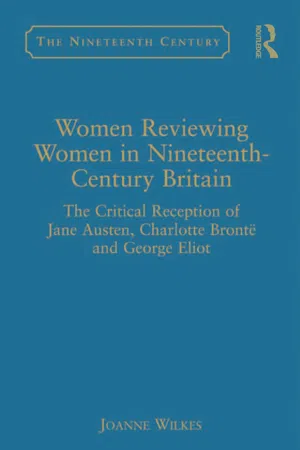
Women Reviewing Women in Nineteenth-Century Britain
The Critical Reception of Jane Austen, Charlotte Brontë and George Eliot
- 194 pages
- English
- ePUB (mobile friendly)
- Available on iOS & Android
eBook - ePub
Women Reviewing Women in Nineteenth-Century Britain
The Critical Reception of Jane Austen, Charlotte Brontë and George Eliot
About this book
Focusing particularly on the critical reception of Jane Austen, Charlotte Brontë and George Eliot, Joanne Wilkes offers in-depth examinations of reviews by eight female critics: Maria Jane Jewsbury, Sara Coleridge, Hannah Lawrance, Jane Williams, Julia Kavanagh, Anne Mozley, Margaret Oliphant and Mary Augusta Ward. What they wrote about women writers, and what their writings tell us about the critics' own sense of themselves as women writers, reveal the distinctive character of nineteenth-century women's contributions to literary history. Wilkes explores the different choices these critics, writing when women had to grapple with limiting assumptions about female intellectual capacities, made about how to disseminate their own writing. While several publishing in periodicals wrote anonymously, others published books, articles and reviews under their own names. Wilkes teases out the distinctiveness of nineteenth-century women's often ignored contributions to the critical reception of canonical women authors, and also devotes space to the pioneering efforts of Lawrance, Kavanagh and Williams to draw attention to the long tradition of female literary activity up to the nineteenth century. She draws on commentary by male critics of the period as well, to provide context for this important contribution to the recuperation of women's critical discourse in nineteenth-century Britain.
Information
Chapter 1
Introduction
By the time George Eliot’s second full-length novel, The Mill on the Floss, was being reviewed in 1860, the female identity behind the author’s male pseudonym had become common knowledge. The reviewer for the Saturday Review in April of that year recalled that Eliot’s previous novel, Adam Bede, had been ‘thought to be too good for a woman’s story’, and welcomed the disclosure of the novelist’s sex:
We may think ourselves fortunate to have a third female novelist not inferior to Miss Austen and Miss Brontë; and it so happens that there is much in the works of this new writer which reminds us of those two well-known novelists without anything like copying. George Eliot has a minuteness of painting and a certain archness of style that are quite after the manner of Miss Austen, while the wide scope of her remarks, and her delight in depicting strong and wayward feelings, show that she belongs to the generation of Currer Bell, and not to that of the quiet authoress of Emma.1
This new novelist’s work, then, evokes both the achievement of a predecessor, and that of a prominent (if now deceased) contemporary, and the reviewer goes on to explicate the resemblances. Eliot’s fiction possesses Austen’s ‘neatness of finish, a comprehensiveness of detail, and a relish for subdued comedy’. This last trait, moreover, is one where ‘[w]e seem to share with the authoress the fun of the play she is showing us’, without the story-line being broken, and the commentator declares that ‘[e]very one must remember the consummate skill with which Miss Austen manages this’.2 On the other hand, George Eliot has a dimension to her mind ‘entirely unlike that of Miss Austen, and which brings her much closer to Charlotte Brontë’. That is, ‘[s]he is full of meditation on some of the most difficult problems of life … the destinies, the possibilities, and the religious position’ of her characters. In addition, the story of the protagonist of The Mill on the Floss, Maggie Tulliver, is ‘entirely in the vein of Charlotte Brontë’, showing that Eliot ‘has thought as keenly and profoundly as the authoress of Jane Eyre on the peculiar difficulties and sorrows encountered by a girl of quick feeling and high aspirations under adverse outward circumstances’.3
This commentary on the fiction of Jane Austen and Charlotte Brontë is quite characteristic of the mid nineteenth century: it was typical to see Austen’s work as notable for neatly constructed, well-observed ‘subdued comedy’, and Charlotte Brontë’s for probing female emotional and spiritual experience. But what I would draw attention to is the incipient canon-formation here: the review sketches a history of nineteenth-century English women’s fiction as early as 1860. Although there had been few published discussions focused specifically on Jane Austen’s fiction since her death in 1817, literary historian Anne Katherine Elwood could note in 1843 ‘the popularity [her novels] have at last so generally attained’; the year after the 1860 Eliot review, too, Henry Fothergill Chorley commented in the Athenaeum that, despite the lack of impact made by Austen’s novels on their first appearance, ‘they have passed into the small library of English fiction, containing the tales which may endure so long as men and women read “story-books”’.4 Meanwhile the first novels of both Charlotte Brontë and George Eliot, Jane Eyre and Adam Bede respectively, had been both commercial and critical successes. Then after Brontë’s death in 1855, the 1857 Life of Charlotte Brontë by her friend and fellow-novelist Elizabeth Gaskell had further stimulated a fascination with the woman and her work which has really never abated. The critical and commercial history of George Eliot’s fiction over the nineteenth century was more chequered, but as the part-publication of her penultimate novel Middlemarch approached its end in October 1872, critic Richard Holt Hutton claimed that it ‘bid[ ] more than fair to be one of the great books of the world’.5 Jane Austen, Charlotte Brontë and George Eliot, for all the vagaries of reputation among women novelists over the nineteenth century – including their own – remained central to the developing canon.
As the 1860 review suggests, the three novelists were not all valued for the same qualities. Jane Austen emerges from the cluster of late eighteenth- and early nineteenth-century women writers to be praised for her fiction’s social observation, and also for its verbal economy in the age of prolix three-deckers. Charlotte Brontë’s novels grab readers from the outset with their compelling narratives, expressed in Jane Eyre and Villette through passionate and independent female narrators, and probe their characters’ inner lives. George Eliot’s fiction, psychologically penetrating like Brontë’s, renders in a vivid and detailed way British society past and present, infused with wisdom derived from wide reading and profound thinking.
None of the three novelists ventured into print initially under her own name. Jane Austen’s first published novel, Sense and Sensibility (1811), appeared as ‘by a Lady’, and subsequent novels came out as ‘by the author of’ the previous novel(s). Her identity was only disclosed after her death, with the simultaneous release of Northanger Abbey and Persuasion at the end of 1817, accompanied by her brother Henry’s ‘Biographical Notice of the Author’. By contrast, Charlotte Brontë chose the implicitly male pseudonym of ‘Currer Bell’ for Jane Eyre, and Marian Evans, the definitely masculine sobriquet of ‘George Eliot’ for her first published fiction, her series of three novellas, Scenes of Clerical Life (1858). But the identity of each author was soon revealed: Charlotte Brontë’s with the publication of her second novel, Shirley (1849), and Marian Evans’s with the appearance of The Mill on the Floss.
This is all familiar information. Equally well-known is that, in the cases of Charlotte Brontë and George Eliot, the early fictions by the then-mysterious authors generated much speculation about the identities, including the sex, of the writers, and the disclosures of the female names behind the apparently male pseudonyms inflected the reception of the later works. Nevertheless, to the extent that the striking and innovative aspects of their novels were accepted, Charlotte Brontë and George Eliot extended the boundaries of what women were considered capable of in literature.
An aspect of nineteenth-century women’s writing that has been much less studied than their fiction, however, is their practice of non-fictional writing for periodicals. With the extraordinary burgeoning of periodical writing over the century, women had the opportunity to publish on a very wide variety of subjects. An examination of the five-volume Wellesley Index to Victorian Periodicals discloses that, although women contributors were much outnumbered by men, especially in the politically and intellectually heavyweight periodicals, they did write on topics in history, biography, travel, science, theology, philosophy, art, and sometimes politics and economics; as far as fiction, poetry and drama were concerned, they published copiously in these areas, including sometimes on the Greek and Roman literature that was seldom included in a woman’s education. Other studies have brought to light women’s contributions – as both writers and editors – to a larger range of periodicals and newspapers than was covered by the Wellesley Index, including periodicals directed specifically at women and children: Margaret Beetham’s A Magazine of Her Own? Domesticity and Desire in the Woman’s Magazine 1800–1914 (1996), Barbara Onslow’s Women of the Press in Nineteenth-Century Britain (2000), and Gender and the Victorian Periodical, by Hilary Fraser, Stephanie Green and Judith Johnston (2003).
Looking at the Wellesley Index and at the studies just named puts one in awe of the extraordinary versatility and energy of so many women who wrote for periodicals. My focus here, however, is on several women who practised as literary critics, and on what they had to say about women writers – and especially about those increasingly prominent literary entities, Jane Austen, Charlotte Brontë and George Eliot. If these three novelists evidently found venturing into print as women problematic, then how far did women, working in the same environment but as literary critics, respond to these writers specifically as women novelists? Moreover, to what extent was their writing as critics affected by their own awareness of a literary context where women’s writing was often seen as different from men’s, and where a woman’s intellectual capacities for making authoritative judgments were not universally assumed? Where a novel like Adam Bede might be considered ‘too good for a woman’s story’?
There is now extensive documentation accessible about the critical reception of all three novelists, from their initial publication up to the late twentieth century. Of recent note are the ‘Critical Assessments’ series from Helm Information.6 Still very helpful, especially in their introductions, are the volumes in Routledge’s Critical Heritage series: Brian Southam’s two volumes on Jane Austen (1968, 1987), Miriam Allott’s volume on the Brontës (1974), and David R. Carroll’s volume on George Eliot (1971). There are also more analytical studies of the novelists’ reception history, such as Kathryn Sutherland’s magisterial Jane Austen’s Textual Lives: From Aeschylus to Bollywood (2005), Patsy Stoneman’s Brontë Transformations: The Cultural Dissemination of ‘Jane Eyre’ and ‘Wuthering Heights’ (1996) and, for George Eliot, J. Russell Perkin’s A Reception-History of George Eliot’s Fiction (1990). My study, however, focuses specifically on a number of women critics who were active from the 1820s through to the early years of the twentieth century, and who wrote about one or more of Jane Austen, Charlotte Brontë and George Eliot. There is one exception – Jane Williams – whose book The Literary Women of England (1861), a pioneering history of British women’s writing focused mainly on poetry, can be related illuminatingly to the women’s history produced by Hannah Lawrance, who published on Charlotte Brontë, and Julia Kavanagh, who wrote on Austen. The critics’ writings on women novelists have either not been reprinted at all, or have been reprinted only in part. In one case, that of Sara Coleridge, almost none of her commentary on women writers was written for publication, and such as was published appeared mostly posthumously.7
The first two critics covered are near-contemporaries Maria Jane Jewsbury (1800–33) and Sara Coleridge (1802–52). Jewsbury’s work has received welcome attention in recent years, notably from Monica Correa Fryckstedt, Norma Clarke, Dennis Low and Susan J. Wolfson. But Jewsbury’s crucial contribution to Jane Austen’s reception history, in producing the first article on the novelist known to be by a woman writer, has attracted little attention – not least because of its unlucky post-publication history, which is one dimension of my discussion of it here. Sara Coleridge, meanwhile, is of interest partly because she chose not to publish most of her literary criticism; much of it is scattered through her letters, only some of which were published in 1873, long after her death, by her daughter Edith Coleridge. As well as drawing on what has been published of her work, I will be dealing with some of Sara Coleridge’s unpublished letters and manuscripts. She writes on both Jane Austen and Charlotte Brontë.
The next group of critics treated are those who wrote histories of women, and/or of women’s writing. Hannah Lawrance (1795–1875) produced histories of Anglo-Saxon and medieval women, but also published a substantial review of Gaskell’s Life of Charlotte Brontë in 1857 – one that is inflected by the ideas about women’s capacities that are both evident in her histories, and expressed in an article on the most prominent woman poet of the mid nineteenth century, Elizabeth Barrett Browning. The venture of Jane Williams (1806–85) in producing in 1861 a copious history of women’s writing from the Anglo-Saxon period onwards, focusing on poetry from the period after 1700, also involved her articulating ideas about women’s literary capacities and the extent to which these differed from men’s. In the following year, Julia Kavanagh brought out English Women of Letters, which covered women novelists from Aphra Behn onwards, and included substantial discussion of Jane Austen. Kavanagh had already published well-researched studies of women: Woman in France during the Eighteenth Century (1850), Women of Christianity (1852) and French Women of Letter...
Table of contents
- Cover Page
- Dedication
- Title Page
- Copyright Page
- Contents
- General Editors’ Preface
- Acknowledgements
- 1 Introduction
- 2 Maria Jane Jewsbury and Sara Coleridge
- 3 Writing Women’s Literary History: Hannah Lawrance, Jane Williams and Julia Kavanagh
- 4 Anne Mozley
- 5 Margaret Oliphant and Mary Augusta Ward
- 6 Conclusion
- Bibliography
- Index
Trusted by 375,005 students
Access to over 1.5 million titles for a fair monthly price.
Study more efficiently using our study tools.
Frequently asked questions
Yes, you can cancel anytime from the Subscription tab in your account settings on the Perlego website. Your subscription will stay active until the end of your current billing period. Learn how to cancel your subscription
No, books cannot be downloaded as external files, such as PDFs, for use outside of Perlego. However, you can download books within the Perlego app for offline reading on mobile or tablet. Learn how to download books offline
Perlego offers two plans: Essential and Complete
- Essential is ideal for learners and professionals who enjoy exploring a wide range of subjects. Access the Essential Library with 800,000+ trusted titles and best-sellers across business, personal growth, and the humanities. Includes unlimited reading time and Standard Read Aloud voice.
- Complete: Perfect for advanced learners and researchers needing full, unrestricted access. Unlock 1.5M+ books across hundreds of subjects, including academic and specialized titles. The Complete Plan also includes advanced features like Premium Read Aloud and Research Assistant.
We are an online textbook subscription service, where you can get access to an entire online library for less than the price of a single book per month. With over 1.5 million books across 990+ topics, we’ve got you covered! Learn about our mission
Look out for the read-aloud symbol on your next book to see if you can listen to it. The read-aloud tool reads text aloud for you, highlighting the text as it is being read. You can pause it, speed it up and slow it down. Learn more about Read Aloud
Yes! You can use the Perlego app on both iOS and Android devices to read anytime, anywhere — even offline. Perfect for commutes or when you’re on the go.
Please note we cannot support devices running on iOS 13 and Android 7 or earlier. Learn more about using the app
Please note we cannot support devices running on iOS 13 and Android 7 or earlier. Learn more about using the app
Yes, you can access Women Reviewing Women in Nineteenth-Century Britain by Joanne Wilkes in PDF and/or ePUB format, as well as other popular books in Literature & Literary Criticism. We have over 1.5 million books available in our catalogue for you to explore.