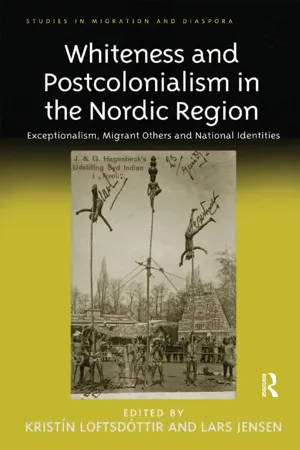
eBook - ePub
Whiteness and Postcolonialism in the Nordic Region
Exceptionalism, Migrant Others and National Identities
- 194 pages
- English
- ePUB (mobile friendly)
- Available on iOS & Android
eBook - ePub
Whiteness and Postcolonialism in the Nordic Region
Exceptionalism, Migrant Others and National Identities
About this book
This book examines the influence of imperialism and colonialism on the formation of national identities in the Nordic countries, exploring the manner in which contemporary discourses in Nordic society are rendered meaningful or obscured by references to past events and tropes related to the practices and ideologies of colonialism. Against the background of Nordic 'exceptionalism', it explores the manner in which the interwoven racial, gendered and nationalistic ideologies associated with the colonial project form part of contemporary Nordic identities. An important challenge to national identities that can become increasingly inward looking, Whiteness and Postcolonialism in the Nordic Region sheds light on the ways in which certain notions and structural inequalities, understood as residue from the colonial period, become recreated or projected onto different groups. Presenting a variety of case studies drawn from Sweden, Finland, Norway, Greenland, Denmark and Iceland, this book will be of interest to scholars across the social sciences and humanities conducting research in the fields of race and ethnicity, identity and belonging, media representations of 'the other' and colonialism and postcolonialism.
Information
Chapter 1
Colonial Discourse and Ambivalence: Norwegian Participants on the Colonial Arena in South Africa
Colonial Discourse and Ambivalence: Norwegian Participants on the Colonial Arena in South Africa
Erlend Eidsvik
Introduction
This chapter investigates the spaces of cultural ambivalence, when a group of Norwegian immigrants arrive on the colonial arena in Knysna in the Cape Colony in the latter half of the nineteenth century. Upon the establishment of a variety of business enterprises within shipping, forestry and trade, the immigrants – the Thesen family – became major economic participants in the region, and influential participants on the political scene. Since they did not belong to either of the dominant white immigrant groups – the British and the Boers – these immigrants utilized their ambivalent position to manoeuvre into new mercantile and social spaces.
Ambivalence is an essential analytical concept in colonial discourse, referring to the complex relations between colonizer and colonized (Bhabha 2004 [1994]). Here, discourse is understood as a system of statements within which the world can be known, derived from a Foucaualdian and Saidian tradition where discourse concerns how knowledge is produced and the influence of what we do, our social practice, and how knowledge and power are indivisible (Foucault 1972; Foucault 1981; Said 1994; Said 2003 [1978]). Such a system of statements is configured by dominant groups in society by enforcing knowledge, values and disciplines upon dominated groups. Thus colonial discourse can be understood to be the composite of signs and practices that organize social relations between colonizing and colonized people (Ashcroft et al. 2007: 37).
By investigating such signs and practices through perspectives of ambivalence, hybridity and liminality, inherently instrumental concepts within colonial discourse, I will argue that these migrants not only adhered to the colonial discourse, but also reconstituted and reinforced this discourse through explorations and exploitations of their own ambivalent position.
Non-Colonial Countries, Colonial Discourse and Mythmaking
The last few decades have seen an increased scholarly (self-)scrutiny on the European colonial projects and the interconnections between Europe and its colonies. In general, these contributions are anchored in an understanding that colonial discourses are shaped by the interactions between metropole and colony, rather than preshaped and projected into the colonial spaces (Said 1994; Viswanathan 1998; Chakrabarty 2000; Lester 2001; Cooper 2005).
However, studies of colonial discourse from a Nordic point of view have until recently been minuscule. Inspired by the emerging body of postcolonial scholarship, recent contributions have challenged the myth about Nordic exceptionalism and displayed examples of Nordic involvement in colonial projects (Brimnes, Ipsen et al. 2009; Keskinen, Tuori et al. 2009; Rio and Kjerland 2009; Maurer, Loftsdóttir and Jensen 2010). Nordic, or Scandinavian1 encounters on foreign territories – historically as well as contemporary – are rarely discussed in a terminology that refers to colonialism. On the contrary, the Nordic self-image and self-narrative is to a large degree constructed in stark contrast to colonial activities, denying economic exploitations and cultural oppressions (Palmberg 2009; Simonsen 2010). In the case of Norway, a narrative purporting a historical legacy devoid of colonial entanglements is recalled in the contemporary political discourse.2 This narrative inherently serves to position Norway as a neutral entity on the international arena in the construction of a self-image as a humanitarian power (Tvedt 2002; Tvedt 2003).
The semi-peripheral status of the Nordic countries compared to the metropolitan European colonial powers calls for caution when trying to juxtapose the practices on the colonial arena performed by such different countries. However, there is a point in investigating the dynamics of Norwegian migrants – in this chapter through a case study – and challenging the myth about Norwegian exceptionalism, and instead demonstrate that Norwegians took part in the construction of colonial discourse; not in colonization or in an imperial project per se, but in maintaining and constructing colonial discourse.
Collectively, the recent studies on Nordic colonial encounters display empirical heterogeneity of economic and cultural encounters in colonial enterprises, and have contributed to develop a postcolonial theoretical framework in a Nordic context that is on the verge of emerging. However, much work still remains to be done. As for example Maurer et al. (2010: 1) state, ‘Nordic postcolonialism … lacks an independent theoretical framework through which its themes and ideas can be articulated’. The recent publications mentioned above have seen analytical twists exploring the concepts of hybridity (Frello 2010), provincializing (Jensen 2010), and complicity (Vuorela 2009), to mention some recent contributions to the field.
Frello (2010) investigates the concept of hybridity through a focus on purity and transgression of purity. Departing from the biological origin of the concept, she extends its applicability by considering hybridity as a discursive resource, and analyses the relations between purity and hybridity and how they are articulated in a Danish TV series. Informed by Chakrabarty’s work Provincializing Europe (Chakrabarty 2000), Jensen explores provincializing of Scandinavia through investigations of the peripheral status of Scandinavia relative to metropolitan Europe, and examines what forms of colonial modernities might be specific to Scandinavia (Jensen 2010). Vourela departs from Spivak’s terminology and applies the concept of ‘colonial complicity’ to address how the tacit acceptance of practices is transformed into colonial complicity (Vuorela 2009: 20).
These concepts are significant contributions in the investigation and analysis of Nordic encounters on the colonial arena. Yet, the influence and impetus by the Nordic countries in colonial conquests can be considered as relatively subsidiary. The Nordic countries constitute a semi-peripheral region in a world conditioned by the imperial metropoles in their conquests of colonial territory. And as Jensen (2010: 13) remarks, the Scandinavian contribution to European thought in the colonial period is rather diminutive. However, as illustrated in these studies, encounters took place, and they had significance and consequences for the Nordic migrants, the colonizer and the colonized.
Spaces of Colonialism
Colonialism has been studied through different lenses. As Stoler and Cooper (1997: 4–5) summarize, colonialism has been approached as dominion of exploitation where European powers have extracted land, labour and produce in ways which were becoming politically impossible and economically less feasible on the domestic arena (Barratt Brown 1974). Secondly, colonies have been studied as a place beyond the inhibitions of the increasingly bourgeois cultures of Europe (Stoler 1995). Thirdly, colonies have been seen as laboratories of modernity, where Europeans could carry out experiments in social engineering on an arena without confronting resistance of the European society at home (Anderson 1995; Cooper and Stoler 1997). And fourthly, following in the tradition of Said (2003 [1978]), a scholarly focus on colonies as the other of whom Europeanness was expressed.
However, colonialism, as a system, should not be limited to colonies or colonial institutions. As an ideological and economic system, colonialism included encounters through exploration, missionary activities and trade. Considering colonialism beyond the metropoles, Scandinavian engagement in the colonial projects was part of a systematic European expansion (Ipsen and Fur 2009). And as Vuorela (2009) has pointed out, even if the Nordic nations were not the central driving forces behind colonial conquest, there are links to connect the non-empires to the knowledge production which was instrumental in promoting the colonization process, as well as direct support of the colonial projects.
This is a modest interpretation, as it is not merely knowledge and acceptance of practices on the colonial arena that are involved, but also performance of power, as some of the empirical cases presented below illuminate (Bertelsen 2009, Eidsvik 2009). Consequently, we are not merely talking of partakers and adaptors of a tacit knowledge complying with the colonial discourse, but also maintainers and developers of a colonial system by reconfiguring and reconstituting the colonial discourse through practices and performance of power.
Contact Zone, Semi-Periphery and Colonial Encounters
Colonial encounters, practices and performance of power can be thought of in relation to the concept of contact zone. This term, as conceptualized by Pratt, encompasses the social spaces, or meeting points between disparate cultures, often in highly asymmetrical relation of subordination and dominance (Pratt 1992: 4). Hence, the contact zone is the liminal space that emerges in the meeting between the colonizer and the colonized. Each encounter, or contact zone, is different and specific and should be analysed for its specific interplay.
Exploring these contact zones, the concepts of metropole and periphery (or colony) offers an idea of a spatially and power-divided relation between an imperial centre and a periphery. The metropole and the colony were connected through flows of capital, commodities, ideas and labour. Moreover, if metropole and colony – as places – always are products of wider contacts, as Massey (1995: 183) suggests, an emphasis on the nature of how power and knowledge are produced within transnational frames might reveal the interconnected historical geographies of the sites we study (Lester 2002: 30).
Yet, approaching colonialism in a Scandinavian context, the idea of metropole is hardly applicable. Politically, demographically and economically, Scandinavia was, and still is, in what can be categorized as semi-peripheral Europe. The degree of periphery is even more palpable for Norway, being in the margins of the semi-periphery during the periods of Danish and Swedish hegemonic power.3
Norway as a Colonial Nation?
Arguably, the Danish-Norwegian monarchy had colonial ambitions in the seventeenth century that sought to challenge the metropolitan powers in Europe (Jónsson 2009). The colonies in the West Indies, West Africa and India were small, yet they played an important role in the development of merchant capitalism in the eighteenth century (Fihl 2008). Norway, which is the focus here, was a Danish province from 15364 until 1814, when it was ceded to Sweden in the Treaty of Kiel as compensation for Sweden’s loss of Finnish territory to Russia. Although constitutional independence and home rule were achieved in 1814, Norway was in a personal union with the Swedish king, and complied with Swedish foreign policies until the union was dissolved in 1905 and Norway became independent.5 Being a subject of foreign rule itself, the idea of Norwegian colonial ambitions in the period prior to 1905 is somehow peculiar. However, in the period between 1814 and 1905, Norway re-entered the international arena, in particular through shipping. Concurrent with these international pursuits, the last few decades in the nineteenth century bore witness to a national awakening, which disputed foreign governance and called for full independence. On the ideological-political level, the medieval territorial expansions and occupations in the North Atlantic were brought into focus. The loss of Iceland, Greenland and the Faeroe Islands was by many seen as arrogated to Denmark in the Treaty of Kiel in 1814 without the voice of Norway being heard.6 The backdrop for a new international orientation, at least partly, was moulded in the search for an imperial legacy in the old colonial possessions.
Simultaneously, shipping boomed during the nineteenth century. In 1825, Sweden-Norway and Great Britain signed a bilateral agreement allowing vessels from the involved countries to carry cargo. This caused an increase in ...
Table of contents
- Cover
- Half Title
- Title Page
- Copyright Page
- Table of Contents
- List of Contributors
- Series Editor’s Preface
- Introduction Nordic Exceptionalism and the Nordic ‘Others’
- 1 Colonial Discourse and Ambivalence: Norwegian Participants on the Colonial Arena in South Africa
- 2 Colonialism, Racism and Exceptionalism
- 3 ‘Words That Wound’: Swedish Whiteness and Its Inability to Accommodate Minority Experiences
- 4 Belonging and the Icelandic Others: Situating Icelandic Identity in a Postcolonial Context
- 5 Transnational Influences, Gender Equality and Violence in Muslim Families
- 6 Reading History through Finnish Exceptionalism
- 7 Danishness as Whiteness in Crisis: Emerging Post-Imperial and Development Aid Anxieties
- 8 Bodies and Boundaries
- 9 Intimacy with the Danish Nation State: My Partner, the Danish State and I – A Case Study of Family Reunification Policy in Denmark
- 10 Aesthetics and Ethnicity: The Role of Boundaries in Sámi and Tornedalian Art
- Index
Trusted by 375,005 students
Access to over 1.5 million titles for a fair monthly price.
Study more efficiently using our study tools.
Frequently asked questions
Yes, you can cancel anytime from the Subscription tab in your account settings on the Perlego website. Your subscription will stay active until the end of your current billing period. Learn how to cancel your subscription
No, books cannot be downloaded as external files, such as PDFs, for use outside of Perlego. However, you can download books within the Perlego app for offline reading on mobile or tablet. Learn how to download books offline
Perlego offers two plans: Essential and Complete
- Essential is ideal for learners and professionals who enjoy exploring a wide range of subjects. Access the Essential Library with 800,000+ trusted titles and best-sellers across business, personal growth, and the humanities. Includes unlimited reading time and Standard Read Aloud voice.
- Complete: Perfect for advanced learners and researchers needing full, unrestricted access. Unlock 1.5M+ books across hundreds of subjects, including academic and specialized titles. The Complete Plan also includes advanced features like Premium Read Aloud and Research Assistant.
We are an online textbook subscription service, where you can get access to an entire online library for less than the price of a single book per month. With over 1.5 million books across 990+ topics, we’ve got you covered! Learn about our mission
Look out for the read-aloud symbol on your next book to see if you can listen to it. The read-aloud tool reads text aloud for you, highlighting the text as it is being read. You can pause it, speed it up and slow it down. Learn more about Read Aloud
Yes! You can use the Perlego app on both iOS and Android devices to read anytime, anywhere — even offline. Perfect for commutes or when you’re on the go.
Please note we cannot support devices running on iOS 13 and Android 7 or earlier. Learn more about using the app
Please note we cannot support devices running on iOS 13 and Android 7 or earlier. Learn more about using the app
Yes, you can access Whiteness and Postcolonialism in the Nordic Region by Kristín Loftsdóttir,Lars Jensen, Kristín Loftsdóttir, Lars Jensen in PDF and/or ePUB format, as well as other popular books in Social Sciences & Sociology. We have over 1.5 million books available in our catalogue for you to explore.