eBook - ePub
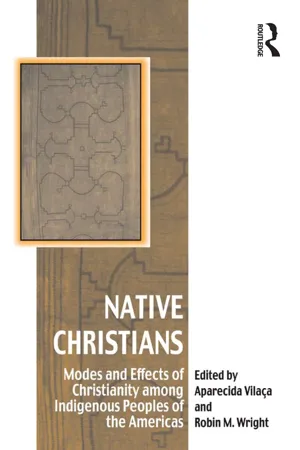
Native Christians
Modes and Effects of Christianity among Indigenous Peoples of the Americas
- 266 pages
- English
- ePUB (mobile friendly)
- Available on iOS & Android
eBook - ePub
Native Christians
Modes and Effects of Christianity among Indigenous Peoples of the Americas
About this book
Native Christians reflects on the modes and effects of Christianity among indigenous peoples of the Americas drawing on comparative analysis of ethnographic and historical cases. Christianity in this region has been part of the process of conquest and domination, through the association usually made between civilizing and converting. While Catholic missions have emphasized the 'civilizing' process, teaching the Indians the skills which they were expected to exercise within the context of a new societal model, the Protestants have centered their work on promoting a deep internal change, or 'conversion', based on the recognition of God's existence. Various ethnologists and scholars of indigenous societies have focused their interest on understanding the nature of the transformations produced by the adoption of Christianity. The contributors in this volume take native thought as the starting point, looking at the need to relativize these transformations. Each author examines different ethnographic cases throughout the Americas, both historical and contemporary, enabling the reader to understand the indigenous points of view in the processes of adoption and transformation of new practices, objects, ideas and values.
Information
Chapter 1
Towards a Comparative Study of Jesuit Missions and Indigenous Peoples in Seventeenth-Century Canada and Paraguay1
From the sixteenth century to the eighteenth, the Society of Jesus acted as Europe’s ethnographic antennae. With missions scattered across Asia, Africa and the Middle East, as well as North and South America and the Caribbean, and with an active program of correspondence and publishing, the Jesuits developed a significant body of knowledge on a variety of cultures. They approached non-western societies with the aim of changing them and, to varying degrees they did bring about change, though they never really controlled or even understood the processes at work. Be that as it may, the global scope of the Jesuit enterprise and of the archive of textual material assembled by the missionaries provides a unique opportunity to undertake comparative and intercontinental research on contact, colonization and religious transformation around the early modern world. How strange then that modern scholarship has remained, on the whole, so blinkered in its response to this documentary treasure trove, focusing their inquiries exclusively on a particular mission site, while ignoring the Jesuits’ frequent references to far-flung locations (Peruvian missionaries referring to Japan, Canadian missionaries citing Latin American experiences, amongst others).2 This chapter, not itself based on systematic comparative research in the Jesuit archives, considers the seventeenth-century Jesuit missions of Paraguay and New France. It is intended to be suggestive and to illustrate the potential value of deeper probes along these lines.
Early in the seventeenth century, Spanish Jesuits began establishing reducciónes among the Guaraní of ‘Paraguay’, while a few years later French Jesuits were at work among the Iroquoian peoples – first the Huron and later the Five Nations Iroquois – of eastern North America. Viewed from an external, ethnographic, perspective, the aboriginal peoples involved shared several common characteristics (I make this point with some discomfort, given the reductionism involved in any classification of cultures). They lived in villages composed of several multi-family houses; they practiced swidden agriculture, cultivation being the responsibility of women; men cleared fields, hunted, fished, waged war and occupied positions of community leadership. Politics and kinship were intertwined in these cultures and there was no external, coercive state structure. Beyond these schematically defined points of similarity, there were, of course, multiple divergences: for example, polygamy was a more important indicator of prestige for Guaraní than for Iroquoian men; the prophecies of charismatic shamans that moved the Guaraní to undertake great migrations had no equivalent among the Iroquoians. Still, in general terms, these peoples all fell under the broad heading of ‘semi-sedentary villagers’.
The European missionaries who confronted Guaraní and Iroquois in the seventeenth century had even more in common. Though they hailed from different nations, mainly Spain in the one case, almost exclusively France in the other, they were Jesuits and consequently they were men of virtually identical social background, education and outlook. The Jesuits active in Canada were all of European origin, whereas some South American missionaries were Creoles, raised and trained in the New World, but the Jesuit ratio studiorum ensured that they had all read more or less the same classical and Christian authors in essentially the same order. Their missionary aspirations were basically identical, with (and here I brutally simplify motives that were complex and frequently contradictory) an interior and personal component that stressed self-sacrifice and imitatio christi, and an external component that aimed at conquering territory and peoples for the true religion. One of the founders of the Jesuit missions of Paraguay, Antonio Ruiz de Montoya, entitled his account of the enterprise ‘Conquista espiritual’, implying an association between the conversion of souls and the violent seizure of territory (Montoya, 1993).3 Even though the French Jesuits came from a quarter of Europe where the militaristic traditions of the reconquista were absent, they too tended to express themselves in the language of conquest (Blackburn, 105–28). In seventeenth-century France, it was still considered proper to ‘reduce’ unbelievers and lead them to Catholicism, forcibly if necessary (Deslandres, 95). And yet, in spite of these parallels on both the native and the European side of the religious encounter, the course and the results of these two attempts at ‘spiritual conquest’ were strikingly different, and in ways that help to illuminate the general process of indigenous christianization.
Paraguay
With Montoya leading the way, the Jesuits began their mission to the Guaraní in 1609, gathering people from a vast interior region centered on the Paraguay, Uruguay and Parana Rivers into thirty reducciónes; in the eighteenth century, total population ranged between 80,000 and 120,000 (Saeger, 276). These specially constructed communities were a variation on models developed in the previous century by missionaries working in Brazil and Peru. In spite of Montoya’s attempt to present his mission as a bold confrontation with wild savages, the Guaraní of the early seventeenth century had had long, and mostly disastrous, experience with Europeans.
A small corps of Spaniards had instituted an unruly and exceptionally exploitive colonial régime centered on Asunción in the mid-sixteenth century. Far from the centres of imperial governance, they had used an unregulated version of the institution of encomienda to lay claim to the labour of Guaraní, especially the women, whom they also exploited sexually. Native population dropped precipitously through the effects of disease combined with violence and dislocation, yet the Guaraní remained sufficiently numerous to effectively submerge the handful of Europeans in their midst. Racial mixing was an accomplished fact by the seventeenth century and Guaraní the dominant language. The line dividing colonizer from colonized was exceptionally indistinct in Paraguay and yet this remained a ruthlessly exploitive colonial régime. Into this milieu, Franciscan missionaries had come in around 1580, attracting Guaraní to their reducciónes near the colonial settlements. Though the Franciscans’ objectives were benevolent, the effect of their efforts was to facilitate the more systematic subjection of natives to the heavy demands of tribute and labour service.
Benefiting from the support of the Spanish imperial state in the wake of Francisco de Alfaro’s commission of inquiry (1610–1612) into the abuses of Paraguay’s Indians (Saeger, 1999: 270), the Jesuits pursued a strategy of isolating converts from the lay colonizers in comparatively remote locations far to the east of Asunción. Unfortunately, this exposed their reducciónes to the brutal depredations of Brazilian slave-raiders from São Paulo. This led to the evacuation of several of the most vulnerable missions and to the Jesuits’ decision to sponsor a Christian Guaraní militia force equipped with Spanish arms and training. Drawing on their own warrior traditions as well as their European training, the Guaraní succeeded in defeating the Paulistas in pitched battle, reducing but never eliminating the threat that these raiders posed. The mission militias emerged in the first half of the eighteenth century as the most potent armed force in the region, assisting the Spanish crown in opposing Portuguese expansion into the area and in mastering Paraguayan revolts. When part of their territory was ceded to Portugal by the terms of the Treaty of Madrid (1750), the Guaraní of the missions mounted a bloody but unsuccessful war of resistance. The Jesuits, already hated by many in Paraguay and Brazil for their opposition to the exploitation of Indians, took much of the blame, a circumstance which helped precipitate the expulsion of the Society of Jesus, first from the Portuguese empire (1759), later from the Spanish (1767).
New France
Meanwhile, far to the north, French Jesuits were at work in Canada following their initial establishment at Quebec in 1625. Here too, they followed in the footsteps of Franciscans (of the reformed Recollet branch in this case), benefiting from the others’ experience before shouldering them out of the way (Le Clercq 1691; Axtell 1985). Their early contacts were with nomadic bands of Montagnais and Algonquins on the St Lawrence River, people who traded furs with the French and who were disposed, whether out of curiosity or friendship, to give a hearing to the religious propositions of the French priests. But their numbers were small and the Jesuits found it difficult to maintain contact with such mobile people (Greer, 2000: 20–32) and so they redirected most of their efforts to the agricultural villages of the Huron peoples, located far to the west in present-day Ontario. They were aware of their Spanish colleagues’ successes in Paraguay and chose to focus on the Hurons partly because their way of life seemed to resemble that of the Guaraní (Jetten, 1994: 15–33; Thwaites, 1896–1900, vol. 5: 33). Though the fruits of evangelizing were always somewhat disappointing, the Paraguay mission stood as an inspiring beacon of hope. Father Paul LeJeune, responding to an inquiry in 1637 as to the prospects for conversions in Canada, wrote, ‘Je responds à cela, que si celuy qui a escrit cette lettre a leu la Relation de ce qui se passe au Paraquais, qu’il a veu ce qui se fera un jour en la nouvelle France’ (Thwaites, op. cit., vol. 12: 219).
The Jesuits came to the Hurons at an earlier stage in the latter’s contact history than was the case with the Guaraní mission. In 1636, when the Huron mission had been firmly established after some interrupted early attempts, these natives were fully acquainted with European products and had forged commercial and diplomatic ties with the French, but they had not yet felt the full force of colonization. Only in 1639 were they visited by their first devastating smallpox epidemic. Because death and disease followed the Jesuits, the Hurons turned against them as dangerous sorcerers, and for a time it appeared that the whole enterprise would collapse in the face of unanimous resistance. The Jesuits held on, however, and over the course of the 1640s the Hurons were weakened by demographic decline, growing commercial dependence on the French and, above all, by defeats at the hands of their enemies, the Five Nations of the Iroquois League (Trigger, 1976: 603–788). In an atmosphere of demoralization and internal dissention, many Hurons accepted Catholic baptism and joined the pro-Jesuit faction that favored closer ties with the French. Concerted Iroquois attacks finally destroyed the Hurons as a coherent society in 1649 and a small remnant group later followed the missionaries down to Quebec where they eventually established a kind of reducción settlement near the city.
The Jesuits continued to evangelize the Algonquian bands that frequented the Canadian settlements, while the small population of lay French struggled to hold their own in conflict with the Five Nations. Only after the arrival of troops from France were they able to defeat (though not conquer) the Five Nations in 1666–67. Thereafter the way was open for the Jesuits to try to convert their former enemies. In the late 1660s and through the 1670s, a substantial number of Iroquois chose to accept baptism and migrate north to settle at two villages near Montreal; the largest of these, located on a Jesuit seigneurie, came to be known as Kahnawake. The Iroquois of Kahnawake were heavily involved in New France’s fur trade and later on they came to play a central role as French allies in the recurrent wars against the British colonies. This reducción was also the site of intense mystic-ascetic devotions on the part of a group of women converts who whipped one another, burned their flesh, and exposed their naked bodies to ice and snow. These gestures alarmed the missionaries who sensed an attempt to bypass clerical mediation and gain direct access to the spiritual power of Christianity (Greer, 2005). The Jesuit record in New France was one of limited success. Few in number (30 to 40 missionaries through most of the period), the Jesuits dealt with Indian populations that were small (compared to those of South America) and dwindling. Thus the predominant motif of their writings, especially the annual Relations des Jésuites, was of spiritual trials rather than triumphs, martyrdom rather than Christian conquest. Nevertheless, they did manage by the late seventeenth century to assemble a network of five reducciónes in the vicinity of the French settlements along the St Lawrence. The Iroquois mission of Kahnawake (near Montreal) remained the largest of these, but there was also the Huron settlement at Lorette (near Quebec), as well as Algonquian (Abenaki, Algonquin, Montagnais) missions at Odanak and Bécancour (near Trois-Rivières). (Harris, 1987, plate 47; Jetten, 1994) When we begin to compare the experience of convert Indians in the reducciónes of Canada and Paraguay, we cannot help being struck by the disparity of numbers; beyond that, however, a number of interesting divergences, as well as some similarities, can be discerned.
Comparisons
Let us begin by reviewing some of the parallels. Both the Paraguay and the New France missions were ‘frontier’ enterprises in that they took place at the edges of imperial control, in contrast to Christianizing processes that occurred in the intensively colonized heartlands of Mexico and Peru. Moreover, the natives involved in both cases had not previously been subject to an indigenous state capable of exacting tribute and commanding labour. These Indians did however have a history of prior contact with Europeans, the Guaraní much more so than the Iroquoians, and there had been some exposure to Franciscan missionaries before the Jesuits arrived on the scene. In Canada as in Paraguay, the Jesuits endeavored to isolate and protect converted natives from what they saw as a menacing secular colonial society. In the Paraguayan setting, the threats were extreme – death, enslavement or the quasi-slavery of mita originaria – whereas the French Jesuits worried about mission Iroquois being corrupted by liquor. An additional commonality lies in the military vocation of the mission Indians, though the Jesuits themselves did not act as instigators and organizers in Canada as they did in Paraguay. Still, in both these mission zones, Christian Indians acted as a crucially effective armed force of empire and enjoyed a degree of autonomy and respect as a result of that role.
Finally, it is worth noting that the Jesuits of North and South America had a common tendency to adapt to indigenous languages rather than require natives to learn a European tongue. This linguistic accommodation, the hallmark of Jesuit missions around the world, was an effective technique for attracting listeners at the initial stages of evangelization, but after the foundation of convert communities, it also contributed to the program of isolating Indians from secular European influences (less so, perhaps, in Paraguay where even the colonizers tended to be fluent in Guaraní). If language was an instrument of empire (Mignolo 1995), then both Jesuits and native Christians manifested some reservations about submitting fully to the rule of a European monarch, preferring instead to maintain a certain cultural autonomy.
For all these resemblances, the experience of Guaraní and Iroquoians under Jesuit tutelage was quite different in a number of important respects. Even when we make allowances for the sources’ rhetorical tendency to exaggerate the degree of missionary control, it is clear that the Paraguay Jesuits succeeded in reorganizing the native economy quite fundamentally and in ways that their counterparts in New France could hardly contemplate. Notwithstanding the continuation of Guaraní subsistence activities in fishing, hunting and agriculture, a great deal of effort was directed in every reducción to new, market-oriented production. Native men traveled far from their homes to tend the cattle herds on vast, Jesuit-controlled estancias. The growing and harvesting of yerba mate was an even more important source of mission revenues. The leaf of a bush that the Guaraní had long used to create a tea-like beverage, yerba mate caught on with colonizers across southern South America and the Jesuits commercialized it very successfully. Natives performed the demanding work of harvesting, processing and transporting the product. At the same time, Guaraní subsistence labour was partially transformed with the introduction of some European cultivation techniques and with men joining women in the fields, contrary to the traditional sexual division of labour.
The economic practices of Iroquoian people living at the missions on the St Lawrence also changed and adapted to the ways of the market, but much more selectively. Families concentrated more than their ancestors had on the winter hunt and their main objective was to produce beaver and other animal pelts for sale and export. Yet this participation in the Atlantic exchange economy required only the expansion of one aspect of the pre-contact yearly round of activities, not a complete transformation of the ‘traditional’ economy. Moreover, the Jesuits had little or no role in the fur economy. Indians dealt directly with French traders and they were driven to the woods by financial incentives, not by the urgings of missionaries; indeed the latter tended to disapprove of the hunt because of the way it took natives far from the mission chapel. They accepted it, rather grudgingly, as an economic necessity for their flocks, even though it escaped their control. Rather than financing the mission enterprise through the product of Indian labour, the French Jesuits had to depend on donations from abroad combined with rent from their seigneurial estates and government subsidies.
The subsistence economy of the mission Iroquois was very lightly affected by the missionaries. For generations, ...
Table of contents
- Cover Page
- Title Page
- Copyright Page
- Contents
- List of Illustrations and Maps
- Notes on Contributors
- Introduction
- 1 Towards a Comparative Study of Jesuit Missions and Indigenous Peoples in Seventeenth-Century Canada and Paraguay
- 2 Christians: A Transforming Concept in Peruvian Amazonia
- 3 ‘Before We Were All Catholics’: Changing Religion in Apiao, Southern Chile
- 4 Money, Loans and Faith: Narratives and Images of Wealth, Fertility, and Salvation in the Northern Andes
- 5 The Re-Invention of Mapuche Male Shamans as Catholic Priests: Legitimizing Indigenous Co-Gender Identities in Modern Chile
- 6 Protestant Evangelism and the Transformability of Amerindian Bodies in Northeastern Amazonia
- 7 The Skin of History: Paumari Perspectives on Conversion and Transformation
- 8 Conversion, Predation and Perspective
- 9 Shamans and Missionaries: Transitions and Transformations in the Kivalliq Coastal Area
- 10 Baniwa Art: The Baniwa Protestant Ethic and the Spirit of Sustainable Development
- 11 Divine Child and Trademark: Economy, Morality, and Cultural Sustainability of a Guaraná Project among the Sateré-Mawé, Brazil
- Afterword
- Index of Peoples
- Index of Authors
- Subject Index
Trusted by 375,005 students
Access to over 1.5 million titles for a fair monthly price.
Study more efficiently using our study tools.
Frequently asked questions
Yes, you can cancel anytime from the Subscription tab in your account settings on the Perlego website. Your subscription will stay active until the end of your current billing period. Learn how to cancel your subscription
No, books cannot be downloaded as external files, such as PDFs, for use outside of Perlego. However, you can download books within the Perlego app for offline reading on mobile or tablet. Learn how to download books offline
Perlego offers two plans: Essential and Complete
- Essential is ideal for learners and professionals who enjoy exploring a wide range of subjects. Access the Essential Library with 800,000+ trusted titles and best-sellers across business, personal growth, and the humanities. Includes unlimited reading time and Standard Read Aloud voice.
- Complete: Perfect for advanced learners and researchers needing full, unrestricted access. Unlock 1.5M+ books across hundreds of subjects, including academic and specialized titles. The Complete Plan also includes advanced features like Premium Read Aloud and Research Assistant.
We are an online textbook subscription service, where you can get access to an entire online library for less than the price of a single book per month. With over 1.5 million books across 990+ topics, we’ve got you covered! Learn about our mission
Look out for the read-aloud symbol on your next book to see if you can listen to it. The read-aloud tool reads text aloud for you, highlighting the text as it is being read. You can pause it, speed it up and slow it down. Learn more about Read Aloud
Yes! You can use the Perlego app on both iOS and Android devices to read anytime, anywhere — even offline. Perfect for commutes or when you’re on the go.
Please note we cannot support devices running on iOS 13 and Android 7 or earlier. Learn more about using the app
Please note we cannot support devices running on iOS 13 and Android 7 or earlier. Learn more about using the app
Yes, you can access Native Christians by Aparecida Vilaça, Robin M. Wright in PDF and/or ePUB format, as well as other popular books in Theology & Religion & Religion. We have over 1.5 million books available in our catalogue for you to explore.