eBook - ePub
Medieval and Renaissance Famagusta
Studies in Architecture, Art and History
- 388 pages
- English
- ePUB (mobile friendly)
- Available on iOS & Android
eBook - ePub
Medieval and Renaissance Famagusta
Studies in Architecture, Art and History
About this book
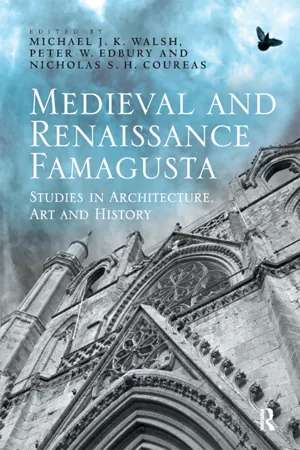
There was a time seven centuries ago when Famagusta's wealth and renown could be compared to that of Venice or Constantinople. The Cathedral of St Nicholas in the main square of Famagusta, serving as the coronation place for the Crusader Kings of Jerusalem after the fall of Acre in 1291, symbolised both the sophistication and permanence of the French society that built it. From the port radiated impressive commercial activity with the major Mediterranean trade centres, generating legendary wealth, cosmopolitanism, and hedonism, unsurpassed in the Levant. These halcyon days were not to last, however, and a 15th century observer noted that, following the Genoese occupation of the city, 'a malignant devil has become jealous of Famagusta'. When Venice inherited the city, it reconstructed the defences and had some success in revitalising the city's economy. But the end for Venetian Famagusta came in dramatic fashion in 1571, following a year long siege by the Ottomans. Three centuries of neglect followed which, combined with earthquakes, plague and flooding, left the city in ruins. The essays collected in this book represent a major contribution to the study of Medieval and Renaissance Famagusta and its surviving art and architecture and also propose a series of strategies for preserving the city's heritage in the future. They will be of particular interest to students and scholars of Gothic, Byzantine and Renaissance art and architecture, and to those of the Crusades and the Latin East, as well as the Military Orders. After an introductory chapter surveying the history of Famagusta and its position in the cultural mosaic that is the Eastern Mediterranean, the opening section provides a series of insights into the history and historiography of the city. There follow chapters on the churches and their decoration, as well as the military architecture, while the final section looks at the history of conservation efforts and assesses the work that now needs to be done.
Information
1
Camlet Manufacture, Trade in Cyprus and the Economy of Famagusta from the Thirteenth to the Late Fifteenth Century
The economic rise of Famagusta began in the 1260s with the growing settlement of refugees from the coastal cities of the Crusader or Frankish Levant conquered by the Mamluk sultans of Egypt. Famagusta’s commercial function expanded substantially after the fall of the Frankish states in 1291. The city became the main transit station for commercial exchanges between western ports on the one hand, Egypt and Syria on the other, and was inserted within the vast and complex commercial network of the Mediterranean. With varying fortunes the city maintained its function as major port in that framework from the late thirteenth century until 1489, when Venice imposed its direct rule over Cyprus.1
Famagusta’s role in trade has drawn growing attention in the last 30 years or so. On the other hand, the city’s function as manufacturing centre has been completely overlooked. The purpose of this chapter is to examine jointly these two facets of Famagusta’s economy over some two centuries by focusing upon the production and marketing of camlet, a woven fabric. Unlike other Mediterranean products, namely sugar and cotton, camlet has never been the subject of a thorough study, despite its growing diffusion from the thirteenth century onwards.2 The origin of the name and the nature of camlets are disputed. Furthermore, in the absence of precise data regarding their fibres and weave, it is impossible to identify them among extant medieval textiles. It may seem paradoxical to deal with Famagusta from the thirteenth to the late fifteenth century by focusing upon an unidentified cloth, yet two reasons warrant that approach. Though fragmentary, the evidence regarding Cypriot camlets offers precious insights into Famagusta’s economy and, more generally, into the evolution of the Cypriot economy.
‘Camlet’ appears in medieval sources under various Italian names as ‘camelotto’, ‘clamelotto’, ‘ciambelotto’, ‘zambelotto’, and the like, and their equivalents in other languages.3 There is no consensus regarding the nature of Middle Eastern and Cypriot camlets before 1500. In the late thirteenth century Marco Polo regarded the textiles woven of white camel hair in Tangut, a Chinese province north of the Great Wall, as the most beautiful and best camlets in the world.4 He must have encountered camlets in the Middle East on his way to inner Asia, at an earlier stage of his life, yet did not dwell upon their nature. A commentary to the Biblia de Alba, the Castilian translation of the Old Testament made in the first half of the fifteenth century, refers to camlets made in Syria from the hair of young goats.5 Based on these and other sources, some consider that in the period covered by this chapter Eastern Mediterranean camlets were woven of camel hair, others that Angora goat hair or mohair was used, while still others suggest that a mixture of fibres occurred.
Strangely, none of the modern authors dealing in passing with camlets has faced the challenge posed by the ‘lana da ciambellotti’ or ‘lana da fare ciambellotti’, ‘camlet wool’. The raw material from which Middle Eastern and Cypriot camlets were woven is mentioned by the fourteenth-century Francesco Balducci Pegolotti, an agent of the Florentine banking and trading company of the Bardi.6 As in ‘bambagia in lana’, ‘cotton wool’, also cited by Pegolotti, the term lana referred to fibres before spinning.7 In November 1362 the Venetian Brancha Bagnese, a resident of Famagusta, owned five small sacks of ‘lana de çambeloti’ and 60 sacks of goat hair.8 The names of the two fibre types and the distinction between them in the same inventory imply that neither ordinary sheep wool nor ordinary goat hair entered into Cypriot camlet weaves.9 It is also noteworthy that the inventory does not directly refer to camel hair, although camels were used as pack animals in Cyprus.10
The nature of Middle Eastern and Cypriot camlets in the period covered here thus remains unknown. Nor can it be clarified by evidence regarding camlets produced in the West, since the term ‘camlet’, like other textile appellations, underwent a semantic evolution and was applied over the centuries to a variety of fabrics, the fibres and texture of which varied.11 Camlet appears in some western documents as a serge woollen cloth of rather moderate quality. The tariff listing the goods taxed in Paris in the first half of the fourteenth century mentions ‘camelot de Rains’, an imitation camlet produced in Reims, among serge fabrics.12 A Parisian inventory of 1438 lists a ‘sarge vermeil de camelot’, or ‘red serge camlet’.13 It has been suggested, therefore, that originally camlet had a serge weave.14 There were also rough woollen textiles with cotton or linen warp called ‘tiretaine’, apparently in camlet weave, two pieces of which measuring 14 arm-lengths each were recorded in France in 1267.15 On the other hand, the ‘chameletts’ included among silk textiles in English royal accounts of the late fourteenth century were presumably western textiles woven of a mixture of silk and wool.16 In the fifteenth century some western camlets were entirely made of silk.17 It seems, therefore, that the nature of camlets varied from one region to the other and changed over time, the weavers mostly using fibres fairly abundant in their own region or imported raw materials.18
Despite the contradictory testimonies adduced so far, several factors point to the rank of Middle Eastern and Cypriot camlets in the hierarchy of medieval textiles. They were often listed together with silk fabrics.19 They were coupled with them in garments, as in one sewn in 1239 for Count Alphonse of Poitiers.20 Some of them were dyed with kermes, a high-quality and costly bright scarlet colourant only used otherwise for high-grade woollens and silk textiles.21 Eastern Mediterranean camlets were fairly expensive, judging by their prices and the rates of taxation applied to them, in the same range as silks.22 Finally, popes, kings, queens, and members of the nobility appear among the customers of these camlets.23 In short, these fabrics were fine and fairly prestigious textiles in the period extending from the thirteenth to the late fifteenth century.
The production of camlets in Cyprus was closely related to their manufacture in the crusader or Frankish states of the Levant, and therefore it is fitting to consider the latter first. There is good reason to believe that the weaving of these fabrics in Tripoli, attested in the thirteenth century, had begun before the crusader conquest, like the manufacture of silken, cotton and linen fabrics produced in the Frankish states.24 The production of all these textiles was largely geared to export. A black camlet from Tripoli is attested in Genoa in 1222.25 The English royal chancery recorded four black camlets from Tripoli in 1235.26 In 1241 Count Alphonse of Poitiers granted two camlets from this city to the nobleman Eustace of Neuville.27 In 1253 King Louis IX of France, who was staying in Acre, entrusted the seneschal John of Joinville to buy in Tripoli 100 pieces of cloth in various colours, which he intended to offer to the Franciscan friars of his kingdom after returning home. However, it is unclear whether the cloth was ‘camelot’ or camelin, a woollen textile of rather poor quality.28 Burchard of Mount Sion, who travelled across the Frankish Levant between 1280 and 1283, and the Arab historian Makrizi assert that 4,000 weavers, clearly an inflated figure, were engaged in the manufacturing of camlets and silk textiles in Tripoli.29 Camlets from this city are attested in northern France in the early fourteenth century.30 Twenty camlet pieces from Tripoli eaten up by worms were registered as having ‘little value’ in the inventory of King Philip V of France, compiled in 1317.31 They had apparently been stored for a long time in the royal treasury. The production of camlets in Tripoli continued under Mamluk rule, as implied by the ‘camelot de Tripe’ listed in the Parisian tariff of the first half of the fourteenth century.32 There may have been production centres other than Tripoli in the Frankish states, yet they are not documented.
By 1233 the volume of camlets exported from the Levant on Venetian ships had grown to the extent that Doge Giacomo Tiepolo included them in the list of commodities for which he fixed the freight charges to Venice. Camlets appear in the same context in the Venetian maritime statutes of 1255.33 Acre was a major market for camlets, as for other textiles. In 1239 Emperor Frederick II ordered the purchase of woollens, linen or cotton buckram, silk fabrics known as sendals, as well as camlets in Acre.34 In 1266, at the time of his death in that city, Count Eudes of Nevers owned several camlet garments, some black ones lined with red sendal, others blue lined with black sendal, and another lined with green sendal. The two camlet pieces sold after his death fetched 16 bezants, a fairly large sum. He had clearly purchased the camlet fabrics in Acre, like the ‘tartar’ silks in his possession.35 Pegolotti refers to the sale of camlets in the section of his trade manual covering Acre in the pre-1291 period.36 A Pisan trade manual compiled in 1278 mentions the sale of ‘giamelotti d’Assira’ by weight in Laiazzo, the main port of the Armenian kingdom of Cilicia. The reference is presumably to Syria.37 ‘Biauz camelos de Surie’, ‘pretty Syrian camlets’, are coupled with various silk fabrics from Acre and Almeria (Spain) as luxuries in Escanor, a French Arthurian romance composed around 1280.38 By 1290 the Genoese were importing to Egypt camlets, the origin of which is not stated.39 In addition to Tripoli, one may envisage pieces shipped from Laiazzo and others woven in Cyprus. Syrian camlets were registered in the papal treasury in 1331 and 1332, yet we do not know since when they were kept there.40
It has been suggested that the earliest testimony regarding Cypriot camlets appears in an Arabic book attributed to Nizam al-Mulk, who served two Seljuk rulers, Alp Arslan and Malik, from 1059 to 1091.41 According to this work, presents sent from Byzantium to one of the Seljuk rulers included some ‘suf-i-Qubrusi’, or ‘Cypriot suf’.42 However, the alleged equivalence of ‘suf’ and ‘camlet’ before the sixteenth century has not been convincingly proven, although ‘suf’ was later used in Asia Minor and Armenia for camlet.43 Moreover, there is no evidence suggesting that Cyprus manufactured camlets before the thirteenth century. We may safely assume that their production was introduced into the island from the Frankish states of the Levant. A number of Arabic-speaking Oriental Christians or ‘Syrians’ settled in Cyprus in response to the appeal of Guy of Lusignan, shortly after the establishment of his rule over the island in 1192. Others were included among the refugees from the Levantine mainland reaching Cyprus in the course of the thirteenth century.44 There were clearly camlet weavers among them, although we do not know when they arrived in the island. In any event, they are attested from the 1290s onwards, both in Nicosia and Famagusta.
The destruction and depopulation caused by the Ma...
Table of contents
- Cover
- Half Title
- Title Page
- Copyright Page
- Dedication
- Table of Contents
- List of Figures
- List of Plates
- List of Tables
- Notes on Contributors
- Foreword by Philippe Roux de Lusignan
- Preface by Nicola Coldstream
- Acknowledgements
- Introduction – Famagusta: An Imperilled Cultural Mosaic in the Eastern Mediterranean
- Part I: History and Historiography
- Part II: Art and Architecture
- Part III: Conservation
- Appendix I: Address delivered by Michael J. K. Walsh in Paris, 4 April 2008
- Appendix II: Press Release
- Appendix III: Chronology of Venetian Administration, for Dating the Coats of Arms of Famagusta
- Appendix IV: Armenian Manuscript Colophons from Famagusta and Cyprus
- Appendix V: Typed Notes by M[onica] Bardswell, February 1937 from Conway Library, Courtauld Institute
- Bibliography
- Index
Trusted by 375,005 students
Access to over 1.5 million titles for a fair monthly price.
Study more efficiently using our study tools.
Frequently asked questions
Yes, you can cancel anytime from the Subscription tab in your account settings on the Perlego website. Your subscription will stay active until the end of your current billing period. Learn how to cancel your subscription
No, books cannot be downloaded as external files, such as PDFs, for use outside of Perlego. However, you can download books within the Perlego app for offline reading on mobile or tablet. Learn how to download books offline
Perlego offers two plans: Essential and Complete
- Essential is ideal for learners and professionals who enjoy exploring a wide range of subjects. Access the Essential Library with 800,000+ trusted titles and best-sellers across business, personal growth, and the humanities. Includes unlimited reading time and Standard Read Aloud voice.
- Complete: Perfect for advanced learners and researchers needing full, unrestricted access. Unlock 1.5M+ books across hundreds of subjects, including academic and specialized titles. The Complete Plan also includes advanced features like Premium Read Aloud and Research Assistant.
We are an online textbook subscription service, where you can get access to an entire online library for less than the price of a single book per month. With over 1.5 million books across 990+ topics, we’ve got you covered! Learn about our mission
Look out for the read-aloud symbol on your next book to see if you can listen to it. The read-aloud tool reads text aloud for you, highlighting the text as it is being read. You can pause it, speed it up and slow it down. Learn more about Read Aloud
Yes! You can use the Perlego app on both iOS and Android devices to read anytime, anywhere — even offline. Perfect for commutes or when you’re on the go.
Please note we cannot support devices running on iOS 13 and Android 7 or earlier. Learn more about using the app
Please note we cannot support devices running on iOS 13 and Android 7 or earlier. Learn more about using the app
Yes, you can access Medieval and Renaissance Famagusta by Michael J. K. Walsh, Peter W. Edbury, Nicholas S.H. Coureas, Michael J. K. Walsh,Peter W. Edbury,Nicholas S.H. Coureas in PDF and/or ePUB format, as well as other popular books in Art & History of Renaissance Art. We have over 1.5 million books available in our catalogue for you to explore.