eBook - ePub
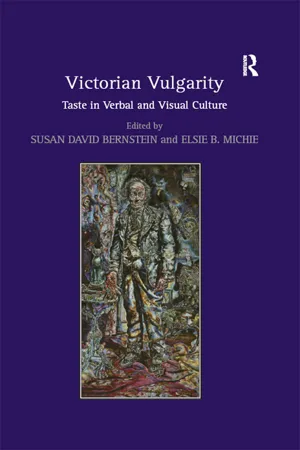
Victorian Vulgarity
Taste in Verbal and Visual Culture
- 272 pages
- English
- ePUB (mobile friendly)
- Available on iOS & Android
eBook - ePub
About this book
Originally describing language use and class position, vulgarity became, over the course of the nineteenth century, a word with wider social implications. Variously associated with behavior, the possession of wealth, different races, sexuality and gender, the objects displayed in homes, and ways of thinking and feeling, vulgarity suggested matters of style, taste, and comportment. This collection examines the diverse ramifications of vulgarity in the four areas where it was most discussed in the nineteenth century: language use, changing social spaces, the emerging middle classes, and visual art. Exploring the dynamics of the term as revealed in dictionaries and grammars; Mayhew's London Labour and the London Poor; fiction by Dickens, Eliot, Gissing, and Trollope; essays, journalism, art, and art reviews, the contributors bring their formidable analytical skills to bear on this enticing and divisive concept. Taken together, these essays urge readers to consider the implications of vulgarity's troubled history for today's writers, critics, and artists.
Information
PART I
VULGAR WORDS
Chapter 1
The Vulgarity of Elegance: Social Mobility, Middle-Class Diction, and the Victorian Novel
The problem facing the young heiress Cecilia Halkett late in George Meredith’s novel, Beauchamp’s Career (1875), is a familiar one. In an emotionally fraught and socially awkward situation, what kind of language best preserves the feelings and dignity of all concerned, while still conveying the truth? Common, familiar words feel too blunt. More formal and elevated language provides an emotional buffer, but sounds stilted and artificial. Caught between these unacceptable alternatives, Cecilia hesitates as she seeks the right words with which to discourage a marriage proposal she knows is coming but which she cannot accept, because she has just agreed to marry a less attractive and eligible man she does not love. She has a hard time bringing herself to utter the direct, bald, “commonplace” statement “I am engaged,” but rejects the synonyms that present themselves: betrothed, affianced, and plighted. Her problem, as Meredith sums it up, is this: “Between the vulgarity of romantic language, and the baldness of commonplace, it seemed to her that our English gives us no choice; that we cannot be dignified in simplicity” (448).
What’s surprising about this analysis is that the vulgarity Cecilia wishes to avoid lies not in “the baldness of commonplace,” where we might expect her to locate it, but rather, in the “romantic” words “betrothed, affianced, plighted…pretty words as they are.” Yet this counter-intuitive association of the vulgar with the elevated is the most striking feature of cultivated Victorians’ attitudes toward language, and indeed toward vulgarity more generally. Nor was the nineteenth-century yoking of the vulgar to the elevated solely a matter of language: Meredith’s pairing of vulgarity with “romantic,” and his contrasting of it with the commonplace, has literary-historical implications to which I shall return later in this essay. My main project is to explore the way vulgarity, as marker of inferior social status, ignorance, and bad taste, was being constructed by Victorian speakers, writers, and commentators upon language, within a variety of discourses, each possessing a different kind of cultural legitimacy.
I wish to make clear that I am not using the word vulgarity in what I must call its vulgar sense: what concerns me here is not obscenity, profanity, or some combination of these. The vulgarity in question is any exercise of language, oral or written, that is stigmatized because it marks its user as a member of an inferior social class – inferior, that is, to the person making the judgment. To put it differently, those accused of uttering or writing vulgarisms are perceived to lack what Pierre Bourdieu called “cultural capital,” that accumulation of knowledge and savoir faire acquired through slow inculcation, which identifies those who have it as members of the dominant social group, and mystifies domination as the result of intrinsic merit rather than social privilege.1 An awareness of different sociolects was not new to the nineteenth century, but increasing rates of literacy, together with expanded opportunities for upward social mobility, raised the stakes. These forces resulted in the codification of linguistic practice that Henry C. Wyld, an early twentieth-century linguist, called the Received Standard, a magisterial phrase whose passive construction conceals important questions of agency and social privilege.2 There is an extensive literature about the development and imposition of this standard in pronunciation and grammar, as well as of a longer history of standardization in English (see Crowley, Milroy and Milroy, Mugglestone, Williams), which it is not my intention to review; nor will I explore Alan S.C. Ross’s influential account of “U” or upper-class and non-U expressions, colloquialisms, and slang – that is, linguistic markers of prestige that lie outside the official and institutional canons of correctness.3 Rather I wish to focus instead on a more subtle effect of the forces that brought these phenomena into being: the increasingly fine calibration by which judgments about linguistic vulgarism were made by those in a position to make them, especially with regard to middle-class speech and writing. One effect is that it is sometimes difficult for the contemporary reader to grasp exactly why a mode of expression might have seemed vulgar to some nineteenth-century ears; and yet the reasons are not really arbitrary. That does not mean that there are inherent superiorities and inferiorities, but rather that there is a cultural logic to the distinctions that were made, even if this logic contains contradictions and was not universally embraced.
The subtleties of the vulgar/refined divide in nineteenth-century linguistic practice, both in England and among the self-consciously genteel in America, were affected by two forces working at cross purposes. These were the efforts of the upwardly mobile to distinguish themselves from the class fractions immediately beneath them in the social hierarchy, and the counter-reactions of those above them who sought in turn to distinguish themselves from people perceived as social climbers or arrivistes. As new opportunities for acquiring wealth had begun to focus attention on the social gulf between wealth and inherited rank, or to put it another way, between economic and cultural capital, those who hoped to rise socially began to seek prescriptive advice. They found ready, if ambivalent, assistance from the upper class in a discourse intended to shore up their confidence. This discourse is the etiquette book, with its emphasis not on the moral aspects of conduct, but on social forms.4
A striking feature of the etiquette book is that it often dispenses prescriptive advice about language – about grammar, pronunciation, and diction – as well as about the forms of politeness. It thus operates alongside the more properly philological work of grammar books and lexicography that flourished in the eighteenth century, particularly the last two decades, and that continued to be produced and circulated throughout the nineteenth (Görlach 1). This is hardly surprising, for an expanding middle class sought to adopt the sociolect of the upper class. In the previous generation this sociolect had achieved a high degree of standardization, becoming more narrowly identified with the upper-class London speech. The rural gentry who spent the social season in London and were educated at Oxbridge (and the feeder public schools) gradually adopted this speech, partly in response to the concerns about language change expressed in the eighteenth century by Johnson, Swift, and others. In the process, provincial words and pronunciations formerly regarded as correct and even refined, depending on the status of the speaker, became déclassé (Mugglestone 17–30).
Thus the widespread anxiety experienced by many English people over the way they speak their native language first became a common feature of English social life, as Raymond Williams observed, during the nineteenth century (239, 246–9). Among middle-class speakers this anxiety, or more accurately a tendency to be, as Williams put it, “anxiously correct” (246), was also a feature of nineteenth-century American life. Not surprisingly, books offering prescriptive advice about language were popular on both sides of the Atlantic. For example Charles William Day’s Hints on Etiquette and the Usages of Society, attributed to Αγάγος (“guide” or “leader”), devotes considerable attention to language; it was published in England not long after the first Reform Act, and reprinted in the U.S. as late as 1894.5 By the 1860s prescriptive advice about language spilled outside the etiquette book proper and became a popular discourse of its own. Rather than teaching grammar systematically, these books sought to inculcate good usage, in part by isolating “vulgarisms.” Probably the best known is Henry Alford’s A Plea for the Queen’s English (1864), which quickly went into numerous English and American printings and editions.6 His project is less explicitly class-conscious than the American Vulgarisms and Other Errors of Speech (1869), by Richard Meade Bache, or the English book Society Small Talk, Or What to Say and When to Say It (1879), which instructs the inexperienced and tongue-tied in how to make conversation at dinner parties and other social outings, and which devotes an entire chapter to “Vulgarisms of Speech.” Significantly, despite Alford’s complaint (dropped in the third and subsequent editions) that Americans are responsible for the deterioration of the language, all of these books agree in general terms about the debasement of the language through a preference among the commercial classes, including journalists, for elevated language over the simple and direct.
Traffic in books about language flowed eastward as well as westward – though sometimes for amusement as much as edification. A little book with the playfully stern title Don’t, written for socially anxious late nineteenth-century Americans, was published in England shortly after its appearance in the U.S. While its English preface suggests that some of the advice Americans require will amuse and astonish the English reader, it concedes that the latter, too, can profit from reading the book (Bunce 6). So-called “Americanisms” were frequently scorned as vulgar; yet articles in periodicals published in the last three decades of the century sometimes contested this view. An 1873 article on Americanisms in the Illustrated Review observes, “It has frequently been noticed that many supposed Americanisms are really older English forms of speech” (“Some Americanisms” 195). A short essay appearing over twenty years later in All the Year Round was nevertheless obliged to repeat the lesson that “a very large proportion of reputed Americanisms originated in the Mother Country,” and added that the word gent, “as a familiarised and vulgarised term for gentleman, though it may have an American origin, was not originally vulgar,” having been used in 1754 by no less an authority than the President of Princeton College (“Some So-Called” 38–9). Similarly, a writer for Chambers’s Journal in 1888 delights in the following anecdote:
At a dinner given by an American banker a few years ago, somebody asked Lord Houghton if he would take his duck rare. “Rare! rare!” said his lordship; “now there is another of your Americanisms which make it so difficult to understand you. And, pray, what do you mean by ‘rare?’” An American President piped out from the other end of the table: “We mean by ‘rare,’ my lord, what Dryden meant when he wrote, ‘Roast me quickly an egg, and see that it be rare.’” (“Wit in Quotation,” 382–3).
It’s worth noting that Lindley Murray, the author of the celebrated English grammar that created the model of its genre for the half-century after its publication, was an American, though his celebrated 1795 grammar was published first in England (Downey, v).
In order to take the full measure of Victorian sociolinguistic complexity, we must consider the subtle changes over time in lexicon, pronunciation, and writing style that normally divide the speech of one generation from another, along with the defensive re-coding as “vulgar” of what had previously been acceptable (and vice versa). The result is that the category of the vulgar in Victorian language is a moving target with uneven, though not erratic, development.
We have already seen in the example from Beauchamp’s Career that blunt, commonplace language is perceived as less vulgar than indirect or recondite expressions. Since this reversal lies at the heart of ideas about vulgarity in the Victorian practice of language, I want to trace its trajectory. At issue is a linguistic matter felt to be at once aesthetic and moral: the problem of affectation. While the Victorians were not the first to reject false refinement and affectation either in language or in manners more broadly, in the nineteenth century this rejection took on increased significance and a new tone, beginning around the time of the first Reform Bill. A glance at eighteenth-century discourse about language reveals the differences.
In the Preface to his Dictionary (1755) Samuel Johnson deplored both false refinement and affectation, but not as markers of low social status; to risk a paradox, they had not yet achieved vulgarity. False refinement afflicted whole languages, not individuals; it was a symptom of the inevitable decline of a tongue that had passed (like Latin and Greek) through a golden age, a loss of the manly vigor of a language’s youth. Affectation did apply to individuals. Those who knew a foreign language might sometimes “obtrude borrowed terms and exotick [sic] expressions,” either from haste or negligence (Johnson, par. 89).7 In other words, Johnson treated affectation as a foible of the educated and well-travelled – decidedly not as a mark of low status. Turning from lexicography to conduct writing, a parent discourse to the etiquette manual, we find Lord Chesterfield observing in his famous letters to his son that the “vulgar man” sometimes “affects hard words, by way of ornament, which he always mangles like a learned woman” (Chesterfield, letter of September 27, 1749). This treatment of affectation still differs in tone from what we will find in Victorian discourse about language. The speech of the vulgar man was ludicrous because it affected learnedness – something as inappropriate in a man without education as in any woman. Though comic appropriations of “hard” words are a feature of cockney characters’ language in Victorian fiction, such as Dickens’s Sam Weller or Thackeray’s Chawls Yellowplush, false learning is not the affectation emphasized in the etiquette manuals. The social aspirant of the nineteenth century is more likely to betray him- or herself by falling into false delicacy, a species of euphemism. Euphemism is a treacherous social tripwire because judgments about which words are inappropriate in polite conversation are more subjective than are prescriptions about the pronunciations of words, in addition because the words for delicate subjects – those involving the body, death, and, in a class-conscious world especially, social distinction – are subject to continual recoding.
Richard Chevenix Trench, a popularizer of mid-nineteenth century philology and one of the original proposers of the Oxford English Dictionary, regarded a tendency toward euphemism as a perpetual agent of language change. Like Johnson before him, who commented on the linguistic effects of what he called an increase in “politeness,” Trench notices an “advance of refinement” in users of English8–though unlike Johnson, he seems to regard this “advance” as producing a constant movement towards formality among cultivated speakers and serious writers – or, as he puts it, among “earnest” ones.9 “Earnest” users of the language, in their quest to be taken seriously, abandon the most disagreeable expressions, which have come to seem ludicrous or vulgar, in part because the “lower classes of society” continue to use them. Trench points to an inherent tendency for euphemism to erode over time: words for “offensive” things, through “direct and close relation with that which they designate,” eventually summon up their referents “too distinctly before the mind’s eye,” and must be exchanged for others which in turn undergo the same process. (A good contemporary example is the word toilet.10) What Trench does not say – though the more socially conscious writers of etiquette books make this clear from the beginning of the period – is that by a reverse process, the indirect and allusive terms chosen by some speakers for their greater delicacy serve as red flags for those w...
Table of contents
- Cover
- Half Title
- Title Page
- Copyright Page
- Table of Contents
- List of Illustrations
- Introduction Varieties of Vulgarity
- PART I VULGAR WORDS
- 1 The Vulgarity of Elegance: Social Mobility, Middle-Class Diction, and the Victorian Novel
- 2 Wulgarity and Witality: On Making a Spectacle of Oneself in Pickwick
- 3 Rudeness, Slang, and Obscenity: Working-Class Politics in London Labour and the London Poor
- PART II COMMON PLACES
- 4 Vulgar Christianity
- 5 Breeding, Education, and Vulgarity: George Gissing and the Lower-Middle Classes
- 6 Too Common Readers at the British Museum
- 7 “A Religion of Pots and Pans”: Jewish Materialism and Spiritual Materiality in Israel Zangwill’s Children of the Ghetto
- PART III VULGAR MIDDLES
- 8 Gross Vulgarity and the Domestic Ideal: Anthony Trollope’s
- 9 “It Went Through and Through Me Like an Electric Shock”: Celebrating Vulgar Female Desire and the Realist Novel in Trollope’s Ayala’s Angel
- 10 Vulgarity, Stupidity, and Worldliness in Middlemarch
- PART IV VISUAL VULGARITY
- 11 Poison Books and Moving Pictures: Vulgarity in The Picture of Dorian Gray
- 12 James Tissot’s “Coloured Photographs of Vulgar Society”
- 13 Vulgar India from Nabobs to Nationalism: Imperial Reversals and the Mediation of Art
- Afterword How Victorian Was Vulgarity?
- Index
Trusted by 375,005 students
Access to over 1.5 million titles for a fair monthly price.
Study more efficiently using our study tools.
Frequently asked questions
Yes, you can cancel anytime from the Subscription tab in your account settings on the Perlego website. Your subscription will stay active until the end of your current billing period. Learn how to cancel your subscription
No, books cannot be downloaded as external files, such as PDFs, for use outside of Perlego. However, you can download books within the Perlego app for offline reading on mobile or tablet. Learn how to download books offline
Perlego offers two plans: Essential and Complete
- Essential is ideal for learners and professionals who enjoy exploring a wide range of subjects. Access the Essential Library with 800,000+ trusted titles and best-sellers across business, personal growth, and the humanities. Includes unlimited reading time and Standard Read Aloud voice.
- Complete: Perfect for advanced learners and researchers needing full, unrestricted access. Unlock 1.5M+ books across hundreds of subjects, including academic and specialized titles. The Complete Plan also includes advanced features like Premium Read Aloud and Research Assistant.
We are an online textbook subscription service, where you can get access to an entire online library for less than the price of a single book per month. With over 1.5 million books across 990+ topics, we’ve got you covered! Learn about our mission
Look out for the read-aloud symbol on your next book to see if you can listen to it. The read-aloud tool reads text aloud for you, highlighting the text as it is being read. You can pause it, speed it up and slow it down. Learn more about Read Aloud
Yes! You can use the Perlego app on both iOS and Android devices to read anytime, anywhere — even offline. Perfect for commutes or when you’re on the go.
Please note we cannot support devices running on iOS 13 and Android 7 or earlier. Learn more about using the app
Please note we cannot support devices running on iOS 13 and Android 7 or earlier. Learn more about using the app
Yes, you can access Victorian Vulgarity by Susan David Bernstein,Elsie B. Michie in PDF and/or ePUB format, as well as other popular books in Literature & Literary Criticism. We have over 1.5 million books available in our catalogue for you to explore.