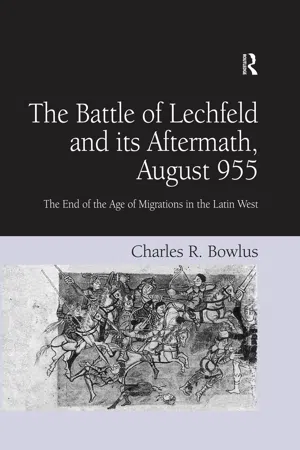
eBook - ePub
The Battle of Lechfeld and its Aftermath, August 955
The End of the Age of Migrations in the Latin West
- 247 pages
- English
- ePUB (mobile friendly)
- Available on iOS & Android
eBook - ePub
The Battle of Lechfeld and its Aftermath, August 955
The End of the Age of Migrations in the Latin West
About this book
In August 955 a battle took place that effectively ended the incursions of steppe nomads into Western Europe. The forces of Otto the Great annihilated a huge army of Hungarian mounted archers in an encounter that is generally known as the battle of Lechfeld, a broad plain near Augsburg in southern Germany. Since even after a defeat these elusive warriors surely could have fled back to the Carpathian Basin to rebuild their strength and resume their raids, the total annihilation of the Hungarian army is mysterious. This book provides the first satisfactory explanation for the decisive nature of Otto's victory. Based on a detailed analysis of all contemporary, and often contradictory, sources, Bowlus provides a step-by-step reconstruction of the battle. This is preceded by chapters analysing the administrative and military reforms in tenth-century Germany, and the strengths and weaknesses of nomadic styles of warfare, in particular their archery, and setting out the historical context in which the battle occurred. A pioneering aspect of his research is the introduction of environmental factors, not only the limits they imposed on the expansion of the nomadic way of life into Europe, but also the impact the local environment had on the outcome of the battle.
Chapter 1
Introduction
The Tears of st Lawrence
On 10 August 955 planet Earth passed through the tail of the Swift—Tuttle comet and a shower of cosmic debris streamed through the atmosphere for several days thereafter. Since this celestial event had been occurring every year inmid-August for millennia, ecclesiastics, well versed in such matters, surely expected it. Because meteor showers from the Swift-Tuttle comet seem to come from the constellation Perseus, the ancients called the meteorites ‘perseids.’ Christians renamed these cosmic droplets the ‘tears of St Lawrence,’ for on 10 August AD 258 Lawrence, an archdeacon in the Roman Church, was roasted alive on the orders of the imperial prefect Valerian. Subsequently the legend developed that the saint’s tears fell from the sky every year in mid- August to remind believers of Lawrence’s passion.1
In the latter half of the tenth century 10 August became the focus for the veneration of this saint because on the anniversary of his martyrdom in 955 a series of violent skirmishes began which continued over several days. Historians generally treat these martial events as a single battle, in which an army of heavy cavalry under Otto I (the Great), the ruler of the East Frankish kingdom (now Germany), completely annihilated a putatively huge invasion force of Hungarians (also called Magyars).2 The interlopers were fierce steppe warriors (mounted archers) who, a half-century earlier, had settled on the steppes of the Carpathian Basin whence, it is asserted, they terrorized much of Europe: Germany, France, the Low Countries, Italy, and even Islamic Spain.
In German-speaking countries the encounters associated with St Lawrence’s Day 955 are still regarded as a single event that took place on a broad plain (the Lechfeld) in the vicinity of the fortified episcopal city of Augsburg, then on the border of the duchies of Swabia and Bavaria. However, a careful reading of the sources makes it clear that thevirtual destruction ofthe Hungarian army occurred not on 10 August 955, but rather onthe days that followed, as the tears of St Lawrence were still coursing through the atmosphere. When King Otto entered Augsburg at dusk on St Lawrence’s Day and was greeted by Bishop Ulrich, the prelate of the city, the struggle with the Hungarians was still far from over. If King Otto looked up that night to see meteorites streaking across the firmament, no extant source reports it. Perhaps he could not have seen the perseids because storm clouds, which eventually produced heavy rains and severe flooding, were probably already gathering over Augsburg. Yet Otto was certainly aware thatit was St Lawrence’s Day, for he had ordered his soldiers to perform vigils in memory of the saint on the eve of the encounter; immediately following the battle, Lawrence came to occupy a special place in the Ottonian pantheon of Christian martyrs.3 Not incidentally, Bishop Ulrich, who led the defense of his see when it was under siege, was canonized before the turn of the millennium and his putative sanctity figured prominently in the iconography of Henry II, the last ruler of the Saxon line.4
When Otto passed through the gates of Augsburg to meet the bishop, he could not yet have comprehended fully the magnitude of the events that were still unfolding. On that evening he knew only that his men had just fought and won two bloody skirmishes against the Hungarians, allowing him to raise the siege of this wealthy episcopal center that straddled some of the most important communication routes in Europe. Otto, however, had restrained his forces from pursuing the vanquished foe too vigorously on to a broad steppe-like plain — the Lechfeld — sprawling along the Lech River on three sides of Augsburg. A battle on this plain or the wide-open spaces of the Bavarian plateau (beyond it to the east) would have favored the enemy since the Hungarians, like other steppe warriors, knew how to use their maneuverability to lure their adversaries into traps and ambushes.
Such a disaster had in fact befallen East Frankish forces forty-five years earlier — also in the vicinity of Augsburg. An army under King Louis (the Child) fell for a notorious feigned retreat and paid a terrible price for the mistake. Late on a summer day in the year 910 an army of Franconians and Swabians, believing that they had won the day, chased Magyars on to the Lechfeld only to be ambushed when their horses tired.5 ‘The apparent victors,’ wrote Bishop Liudprand of Cremona, ‘were turned into the vanquished.’ In contrast, Otto exercised caution on St Lawrence’s Day 955. His army crossed the Lech, captured the Hungarian camp on the right bank of the river and released captives. Yet his pursuit of the fleeing enemy was restrained, and, as the tears of St Lawrence entered the atmosphere that evening, a multitude of Magyar mounted archers remained at large in the Bavarian countryside east of the Lech.

Figure 1 St Ulrich with the Holy Lance supporting Henry II
Reproduced with permission by Bayerische Staatsbibliothek, Munich, Germany
Reproduced with permission by Bayerische Staatsbibliothek, Munich, Germany
Despite his apparent success, Otto’s mind must have been troubled when the bishop received him. The carnage had been great. Duke Conrad (the Red), the king’s son-in-law, who had played a crucial role in the fighting, was among the fallen, and Bishop Ulrich mourned his brother, Count Dietpald, as well as other relatives and members of his military following. Both men realized that a decisive victory over the Hungarians was still uncertain. On the other hand, the ruler was aware that forces friendly to his cause lurked along Magyar lines of retreat, for he dispatched swift couriers warning that the Hungarian warriors were retiring eastward and urging his supporters to block their flight, especially at river crossings.6 As king and bishop surveyed the events at dusk on that St Lawrence’s Day, they must have considered the possibility of trapping Magyar forces in eastern Bavaria, which could transform an ordinary victory into a resounding triumph.
The Battle and Its Significance
The final victory, which took place on the days that followed, was regarded by contemporaries as the greatest achievement of Otto’s long reign (936—73), and it eventually led to his imperial coronation in 962. But his triumph in 955 had not been easy. It came after two very trying years. Beginning in 953, Otto faced a major revolt led by none other than his own son Liudolf, Duke of Swabia, and his son-in-law, Duke Conrad of Lotharingia. A powerful Bavarian clan, the Liutpoldings, also joined the rebellion under the leadership of Arnulf, the count palatine of Regensburg, and Archbishop Herold of Salzburg. Restlessness even spread into Saxony, Otto’s power base, and spilled across the Elbe River, where Slavic tributaries, allied with dissident margraves, rose in revolt against Ottonian overlordship. At the height of the insurrections in 954, the Magyars seized their opportunity and invaded the East Frankish kingdom. Their expedition of 954 appears on maps as an impressive sweeping incursion through Bavaria and Swabia into the Rhine-Main region and, thence, clear to Lower Lotharingia, before veering south, entering the West Frankish kingdom and Burgundy, and finally crossing the Alps, to return via northern Italy to their camps in the Carpathian Basin.7
Otto eventually prevailed against the rebels, humiliating Liudolf and Conrad and removing them from their ducal offices. In the spring of 955 the king besieged and took Regensburg, an encounter in which the count palatine perished, and, in a spearate action, the archbishop was captured, blinded and banished to the alpine bishopric of Brixen, where he languished until his death seven years later. Then, moving north to pacify Saxony, Otto was in the process of dealing with Transelban Slavs when he got word that the Hungarians had launched yet another invasion of southern Germany. Only after defeating the Magyars did the king turn his attention once again to the Slavs across the Elbe, bringing them to heel. Restoring order throughout his realm, he staked his claim to the title of Roman emperor.
Otto’s victory in 955 came to be seen as a decisive event in his lifetime. Widukind, a monk at the Saxon monastery of Corvey, wrote that the army immediately recognized the significance of the king’s triumph, proclaiming Otto father of the fatherland and imperator as soon as the destruction of the Hungarian forces became apparent.8 Although Otto was not actually crowned in Rome until 962, for Widukind the defining moment came in August 955. ‘For no king before him had experienced such a victory in two hundred years,’ he added, referring to Charles Martel’s victory over the Spanish Muslims at the battle of Tours in 732, a victory that ended Islamic expansion into Europe. Presumably Bishop Ulrich benefited posthumously from his participation in the encounter with the Hungarians because his role in the struggle figured prominently in his canonization, which occurred within forty years of the battle.9
Throughout the Middle Ages the ‘battle of Lechfeld,’ as it came to be called later, was recognized as epoch-making by Central Europeans, and its reputation as a decisive encounter has never waned in that part of the world.10 To the English-speaking public, on the other hand, these events are largely unknown, and the battle of Lechfeld rarely appears on conventional lists of the most decisive battles in history.11 This fact is unfortunate, for thegeopolitical implications of the encounters in the summer of 955 are enormous. From the fourth century AD until about 1500, mounted archers from the steppes and deserts of Afro-Eurasia posed recurring threats to most of the settled societies of the eastern hemisphere. For more than a millennium highly mobile armies of horse archers dominated the battlefields of the world’s largest landmass. Latin Christendom, however, was an exception. After 955 Western Europe was largely spared the depredations of these warriors. Indeed, A. R. Lewis has argued that the later global dominance of the West was in no small measure due to the fact that this civilization was immune from invasions from the Afro-Eurasian steppes and deserts during the High Middle Ages (c. 1000-1350).12
The image of nomads storming out of the East to threaten Latin Christendom is of course a powerful one in popular histories and even in some scholarly works. Surveys of the impact of steppe peoples on western civilization, however, do not support myths of that magnitude.13 Huns and Avars had troubled Europe in Late Antiquity, but not for very long. The Hungarians, who pillaged Europe for roughly a half-century, represent the last sustained threat to the West by steppe peoples. Following their defeat in 955, the Magyars settled down, converted to Christianity and became fully integrated into western Christendom. In fact, their kingdom in the Carpathian Basin became a buffer against the westward movements of latter- day predators further to the east. Although the Mongols launched an invasion of Central Europe in the early 1240s, their armies quickly retired to Inner Asia, never to trouble that part of Europe again. By the time the Ottoman Turks entered the Carpathian Basin around 1500, they had long ceased to be a steppe power. Thus when the Hungarian raids came to an abrupt halt in August 955, a turning point in world history had been reached. While other societies struggled to keep steppe peoples at bay during the High Middle Ages, Western Europeans took advantage of chaotic conditions that predatory warriors were creating in the rest of Afro-Eurasia to embark on expansionist movements in the name of crusades against infidels, pagans and heretical Christians. Free from the necessity of maintaining elaborate defensive infrastructures against ‘steppe barbarians’ after 955, Latin Christendom experienced three centuries of uninterrupted economic growth andgeographic expansion. A close look at the ultimate reasons for the Magyar’s catastrophic defeat in August 955 provides an explanation for Europe’s immunity from the incursions of steppe peoples that proved so disruptive elsewhere.
Contemporary Accounts
Attempts to reconstruct the battle of Lechfeld have focused primarily (but not exclusively) on two sources. The first is authored by Gerhard, a native of Augsburg, who had become provost of the cathedral when he composed his account in about 985. He wrote a biography of Bishop Ulrich, which contains a long chapter on the battle. If Gerhard did not personally witness the events of August 955, he certainly knew many who had. We shall assume that his highly visual account was indeed written by a witness. A Saxon monk named Widukind wrote the other major narrative. He resided in the wealthy monastery of Corvey on the Weser River, in a house that had been well endowed by Otto’s ancestors. Although some modern historians have questioned the reliability of these authors, their testimonies (composed independently of one another) must be seriously considered.14 Despite the fact that these authors had ulterior motives, historians must recognize that Gerhard and Widukind were contemporaries who knew many people directly involved in the action. Gerhard’s Vita Uodalrici (The Life of St Ulrich) celebrates the achievements and the sanctity of Bishop Ulrich. Among his other deeds the bishop’s tenacious resistance to the Hungarian siege of Augsburg bought time, allowing Otto’s army to come to the relief of the city. Since Gerhard was writing a biography of a prelate who was under consideration for sainthood, he play...
Table of contents
- Cover Page
- Title Page
- Copyright Page
- Contents
- List of Figures
- Preface
- Acknowledgments
- Map
- 1 Introduction
- 2 Hungarian Warfare
- 3 The Reforms of Henry I in Saxony
- 4 Hungarians and the Latin West
- 5 The Way to the Lechfeld
- The Way from the Lechfeld
- Conclusion: Hungarian Defeat — Ottonian Victory
- Sources Concerning The Battle Annals
- Two Battles According To Liudprand Of Cremona
- The Military Reforms Of Henry I
- Bibliography
- Index
Trusted by 375,005 students
Access to over 1.5 million titles for a fair monthly price.
Study more efficiently using our study tools.
Frequently asked questions
Yes, you can cancel anytime from the Subscription tab in your account settings on the Perlego website. Your subscription will stay active until the end of your current billing period. Learn how to cancel your subscription
No, books cannot be downloaded as external files, such as PDFs, for use outside of Perlego. However, you can download books within the Perlego app for offline reading on mobile or tablet. Learn how to download books offline
Perlego offers two plans: Essential and Complete
- Essential is ideal for learners and professionals who enjoy exploring a wide range of subjects. Access the Essential Library with 800,000+ trusted titles and best-sellers across business, personal growth, and the humanities. Includes unlimited reading time and Standard Read Aloud voice.
- Complete: Perfect for advanced learners and researchers needing full, unrestricted access. Unlock 1.5M+ books across hundreds of subjects, including academic and specialized titles. The Complete Plan also includes advanced features like Premium Read Aloud and Research Assistant.
We are an online textbook subscription service, where you can get access to an entire online library for less than the price of a single book per month. With over 1.5 million books across 990+ topics, we’ve got you covered! Learn about our mission
Look out for the read-aloud symbol on your next book to see if you can listen to it. The read-aloud tool reads text aloud for you, highlighting the text as it is being read. You can pause it, speed it up and slow it down. Learn more about Read Aloud
Yes! You can use the Perlego app on both iOS and Android devices to read anytime, anywhere — even offline. Perfect for commutes or when you’re on the go.
Please note we cannot support devices running on iOS 13 and Android 7 or earlier. Learn more about using the app
Please note we cannot support devices running on iOS 13 and Android 7 or earlier. Learn more about using the app
Yes, you can access The Battle of Lechfeld and its Aftermath, August 955 by Charles R. Bowlus in PDF and/or ePUB format, as well as other popular books in History & World History. We have over 1.5 million books available in our catalogue for you to explore.