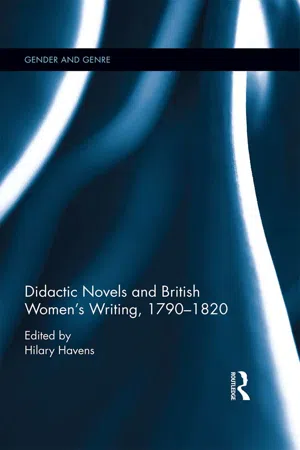
Tracing the rise of conduct literature and the didactic novel over the course of the eighteenth century, this book explores how British women used the didactic novel genre to engage in political debate during and immediately after the French Revolution and the Napoleonic Wars. Although didactic novels were frequently conventional in structure, they provided a venue for women to uphold, to undermine, to interrogate, but most importantly, to write about acceptable social codes and values. The essays discuss the multifaceted ways in which didacticism and women's writing were connected and demonstrate the reforming potential of this feminine and ostensibly constricting genre. Focusing on works by novelists from Jane West to Susan Ferrier, the collection argues that didactic novels within these decades were particularly feminine; that they were among the few acceptable ways by which women could participate in public political debate; and that they often blurred political and ideological boundaries. The first part addresses both conservative and radical texts of the 1790s to show their shared focus on institutional reform and indebtedness to Mary Wollstonecraft, despite their large ideological range. In the second part, the ideas of Hannah More influence the ways authors after the French revolution often linked the didactic with domestic improvement and national unity. The essays demonstrate the means by which the didactic genre works as a corrective not just on a personal and individual level, but at the political level through its focus on issues such as inheritance, slavery, the roles of women and children, the limits of the novel, and English and Scottish nationalism. This book offers a comprehensive and wide-ranging picture of how women with various ideological and educational foundations were involved in British political discourse during a time of radical partisanship and social change.
- 214 pages
- English
- ePUB (mobile friendly)
- Available on iOS & Android
eBook - ePub
Didactic Novels and British Women's Writing, 1790-1820
About this book
Information
1 Charlotte Smith and the Persistence of the Past
If seeing the term ‘didactic’ in the title of a collection of essays on the Romantic period strikes us as in any way incongruous, it is perhaps a testimony to the enduring legacy of what Jerome McGann labelled ‘the Romantic ideology’.1 Certainly, many of the ‘big six’ Romantic poets denounce didacticism in poetry and imaginative literature more broadly. Percy Shelley proclaims in A Defense of Poetry (1821) that ‘poetry cannot be made subservient’ to instruction, while John Keats argues in an 1818 letter that ‘We hate poetry that has a palpable design upon us – and if we do not agree, seems to put its hand in its breeches pocket’.2 Much of the writing of the Romantic era, however, especially in roughly the first half of the period we associate with ‘Romanticism’ (1790–1805), is infused with didactic intent and provides the backdrop against which Shelley’s and Keats’s objections are voiced.
This statement is particularly applicable to the novel, and perhaps more so than any other genre in the period. In the wake of the French Revolution, British novelists imaginatively responded to the socio-political arguments first articulated in the speeches, treatises, and pamphlets of statesmen and philosophers. They noisily proclaimed their didactic intent, announcing their designs on readers and positioning their works as interventions in a larger public debate about the nation’s future. Not excepting Mary Wollstonecraft or William Godwin, there is arguably no novelist who was more influential and widely read in the 1790s than Charlotte Smith, and who ‘is now widely recognized’, as Barbara Tarling observes, ‘as a central figure in the Romantic canon’.3 While critics have rightly identified Edmund Burke as the central figure she engages most consistently,4 they have not traced her considerable literary exchanges with the statesman across her novel corpus.
A prominent recurring target in Smith’s fiction is, this essay argues, a Burkean adherence to history-as-inheritance. In Reflections on the Revolution in France (1790), Burke argues that attempts to amend British order must be informed by an appreciation of its historically determined nature and a sustained awareness that it is a product of its past.5 By treating that construct as a corporate inheritance, he contends, Britons ensure that each generation enjoys the socio-political benefits that have accrued over time while leaving open the possibility of improvement by way of alteration or addition. As this essay argues, however, for Smith, this understanding of the nation as an inheritance amounts to a deadly commitment to the past that limits the possibility for meaningful change, enables corruption, and stultifies life in the present.
We can trace the evolving nature of Smith’s resistance to Burke’s understanding of the nation as an inheritance through her three most radical novels, Desmond (1792), The Old Manor House (1793), and The Young Philosopher (1798). While her opposition to Burke remains consistent throughout, the nature of her engagement with his ideas shifts. Her sense of her culture’s enmeshment in the past-oriented philosophy she associates with Burke becomes increasingly pronounced, revealing her fading hopes for a Britain free from its grip. In Desmond, a young man pursues his ‘ideal’ (Geraldine), contrary to the caution of his experienced guardian, Bethel, and his country’s customs. Disputing Bethel’s limited sense of the possible and the patriarchal assumptions of the institutions that render Geraldine the property of a worthless man, Desmond becomes a cipher for a reformed England by forging a future in which his imagined ideal becomes his everyday reality. In The Old Manor House, history’s hold is re-imagined through an intergenerational lens that gestures toward the complexity of the present’s entanglements with the past, but ultimately such forces are surmountable. In The Young Philosopher, a Burkean commitment to the past is omnipresent. No longer able to imagine a future Britain free from history’s inheritances, Smith’s heroes choose exile in America, a land capable of being re-formed, the novel suggests, because of its break from British history. Collectively, these novels chart Smith’s evolving conflict with Burkean discourse, in which the past’s influence increasingly determines the future while the prospects for change become ever more dire.
‘The absurd system you had built’: Desmond
Modern scholarship, with good reason, situates Desmond against the backdrop of the French Revolution debate in Britain. Continuing that critical trend, I focus on the Desmond–Geraldine–Verney relationship as the vehicle through which Smith tracks her hoped-for transformation of Britain from a past-oriented regime to one that accords with the early promise of the French Revolution. Much like James Monteith in Jane West’s A Tale of the Times (1799), a character who marries a Geraldine of his own,6 Richard Verney is a representative of the worst features he inherits from the aristocracy. A gambler and profligate, his actions betray his indifference to the family to which he is supposed to be committed and which is in Burke’s discourse the nation-building unit that allows for the transmission of value (titles and riches, values and mores). Effectively sold to this man by ‘the mercenary hands of her family’,7 whose prejudices mistake wealth for worth, Geraldine demonstrates a capacity for virtue that enthrals Desmond before the narrative begins, but which is oppressed by her husband’s influence. The novel depicts the process by which the old-world alliance that systematically enables misery and which stands in for Britain ‘as it really is’ (Verney/Geraldine) gives way to a prospective marriage that promises to correct the abuses of the old union and which represents Smith’s hope for a reformed Britain (Desmond/Geraldine).
Smith sets this fantasy of domestic/national transformation in motion through the narrative’s two main male correspondents, Desmond and Bethel. Throughout the novel, Desmond associates Geraldine with ‘perfectio[n]’ and describes her as ‘the very woman [his] imagination had formed’.8 As Alison Conway observes, his love for Geraldine is aligned with the idealism that conservatives consistently associated with the reform cause.9 As the experienced Bethel remarks of Desmond’s love for Geraldine, ‘you expect what you will never find, the cultivated mind and polished manners of refined society, with the simplicity and unpretending modesty of retired life’.10 But, he cautions, those qualities ‘are incompatible – they cannot be united; and this model of perfection, which you have imagined, and can never obtain, will be a source of unhappiness to you through life’.11 Connected to a longing for perfection and cast as an idealistic vision Bethel insists is unattainable, Desmond’s love occupies the same suspect place in the imagination of Bethel as reform discourse does in the writings of the critics of reform.
Long recognized as the novel’s fictional counterpart to Edmund Burke,12 Erasmus Bethel makes authoritative claims about the world ‘as it really is’ by virtue of his ‘dearly-bought experience’.13 Like Bethlem Gabor in Godwin’s St Leon (1799)14 and a host of other characters in 1790s reformist fiction, Bethel’s past experience determines his sense of the present. He dismisses Desmond’s idealized ‘model of perfection’ because his experience confirms for him its impossibility. Hoping to counter Desmond’s idealization, Bethel narrates the history of his life. As a young man, he married a woman of ‘unaffected innocence and timidity of … manners’, who, being corrupted by the ‘giddy’, ‘intoxicating draughts of flattery’ of London’s polished urban dwellers, eloped with ‘a man who disgraces the name he bears’.15 That early experience colours Bethel’s worldview and his sense of the possible. When Desmond proposes that Bethel pursue Geraldine’s sister, Fanny, Bethel cites a few reasons for not doing so – the disparity of their ages, her suspected infatuation with Desmond – but, most notably, the thought of taking Fanny as a partner triggers a now deeply engrained prejudice about women’s liability to seduction: ‘I could never hope to become acceptable to a young woman surrounded as she is, with flattery and admiration’.16 Tellingly, too, while the narrative ends with one marriage (Montfleuri/Fanny) and another impending (Desmond/Geraldine), Smith condemns Bethel to a single life: his voice, influence on Desmond, and prospects for a family legacy are simultaneously cut off.
The narrative of Desmond is thus structured around a clash between opposing ways of ‘knowing’, one past-oriented and informed by the logic of precedent (Burke) and the other forward-looking and committed to an ethos of innovation characteristic of many prominent reformers in the period. The hero journeys toward realizing an ideal, contrary to the testimonial evidence of his guardian figure, who himself comes to doubt if his experience applies in Geraldine’s case. The text thereby implicitly invites readers to undergo a similar conversion with respect to their opinions of revolutionary France and, by extension, a future reformed England. As the letters that end the novel turn toward the impending realization of the ideal (Desmond/Geraldine’s alliance), Bethel’s Burkean commitments to ‘experience’ and ‘precedent’ make way for the ethic of making new, a point registered formally through the absence of his further correspondence.17 In the world of the novel, the displacement of one worldview for another is achieved in little over twenty months, and the costs have been, relatively speaking, low. While Desmond experiences hardships, notably wounds from his duel, they remain consistent with the spirit of Comedy: he loses no one he cares about, sustains no lasting physical or mental injury, and retains the key markers of his identity, such as his home, friends, and nation.
While Smith uses Bethel to oppose a philosophy committed to making new, she uses Geraldine and the forces that contributed to her marriage to expose the oppressive potential of Burke’s past-oriented worldview. In particular, she targets two institutions at the heart of Burke’s metaphor-rich understanding of the nation: inheritance (primogeniture) and marriage (contract). For Burke, ‘the idea of inheritance’ is the ruling logic of the British family and the nation:
[it] furnishes a sure principle of conservation, and a sure principle ...
Table of contents
- Cover
- Half Title
- Title Page
- Copyright Page
- Table of Contents
- List of Figures
- Acknowledgements
- Introduction
- 1 Charlotte Smith and the Persistence of the Past
- 2 ‘Vehicles for Words of Sound Doctrine’: Jane West’s Didactic Fiction
- 3 Epistolary Exposés: The Marriage Market, the Slave Trade and the ‘Cruel Business’ of War in Mary Robinson’s Angelina
- 4 Moral and Generic Corruption in Eliza Fenwick’s Secresy
- 5 Mary Hays and the Didactic Novel in the 1790s
- 6 Lessons of Courtship: Hannah More’s Cœlebs in Search of a Wife
- 7 Maria Edgeworth’s Moral Tales and the Problem of Youth Rebellion in a Revolutionary Age
- 8 Maria Edgeworth’s Revisions to Nationalism and Didacticism in Patronage
- 9 Didacticism after Hannah More: Elizabeth Hamilton’s The Cottagers of Glenburnie
- 10 A National Bildungsroman: Didacticism and National Identity in Mary Brunton’s Discipline and Susan Edmonstone Ferrier’s Marriage
- Afterword: Lessons Learned
- List of Contributors
- Index
Trusted by 375,005 students
Access to over 1.5 million titles for a fair monthly price.
Study more efficiently using our study tools.
Frequently asked questions
Yes, you can cancel anytime from the Subscription tab in your account settings on the Perlego website. Your subscription will stay active until the end of your current billing period. Learn how to cancel your subscription
No, books cannot be downloaded as external files, such as PDFs, for use outside of Perlego. However, you can download books within the Perlego app for offline reading on mobile or tablet. Learn how to download books offline
Perlego offers two plans: Essential and Complete
- Essential is ideal for learners and professionals who enjoy exploring a wide range of subjects. Access the Essential Library with 800,000+ trusted titles and best-sellers across business, personal growth, and the humanities. Includes unlimited reading time and Standard Read Aloud voice.
- Complete: Perfect for advanced learners and researchers needing full, unrestricted access. Unlock 1.5M+ books across hundreds of subjects, including academic and specialized titles. The Complete Plan also includes advanced features like Premium Read Aloud and Research Assistant.
We are an online textbook subscription service, where you can get access to an entire online library for less than the price of a single book per month. With over 1.5 million books across 990+ topics, we’ve got you covered! Learn about our mission
Look out for the read-aloud symbol on your next book to see if you can listen to it. The read-aloud tool reads text aloud for you, highlighting the text as it is being read. You can pause it, speed it up and slow it down. Learn more about Read Aloud
Yes! You can use the Perlego app on both iOS and Android devices to read anytime, anywhere — even offline. Perfect for commutes or when you’re on the go.
Please note we cannot support devices running on iOS 13 and Android 7 or earlier. Learn more about using the app
Please note we cannot support devices running on iOS 13 and Android 7 or earlier. Learn more about using the app
Yes, you can access Didactic Novels and British Women's Writing, 1790-1820 by Hilary Havens in PDF and/or ePUB format, as well as other popular books in Literature & English Literary Criticism. We have over 1.5 million books available in our catalogue for you to explore.