- 238 pages
- English
- ePUB (mobile friendly)
- Available on iOS & Android
eBook - ePub
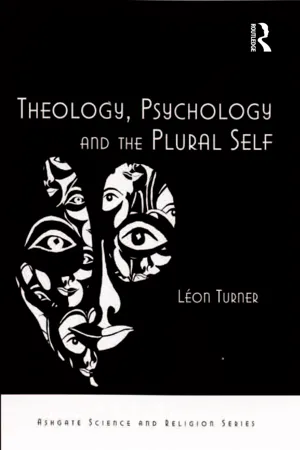
Theology, Psychology and the Plural Self
About this book
Is the human self singular and unified or essentially plural? This book explores the seemingly disparate ways that Christian theology and the secular human sciences have approached this complex question. The latter have largely embraced the idea of the plural self as an inescapable, even adaptive feature of psychological life. Contemporary Christian theology, by contrast, has largely neglected recent psychological accounts of the naturalness of self-plurality, and has sought to reaffirm the self's unity in opposition to those postmodern theorists who would dismantle it. Through an original analysis of recent theological and secular accounts of self and personhood, this book examines the extent of the intertheoretical disparity and its broader implications for theology's dialogue with the human sciences in general, and psychology in particular. It explains why theologians ought to take questions about the plurality of self very seriously, and how they overlap with many of the central concerns of contemporary theological anthropology, including the notions of relationality, particularity and human sinfulness. Introducing a novel psychological framework to distinguish various understandings of self-disunity, the author argues that contemporary theology's blanket condemnation of self-multiplicity is misconceived, and identifies a possible means of reconciling theological and human scientific accounts.
Information
CHAPTER 1
The Crisis of Identity: Diagnosing and Healing the Fragmented Self
Modern man is afflicted with a permanent identity crisis, a condition conducive to considerable nervousness.
(Peter Berger, Brigitte Berger, and Hansfried Kellner, The Homeless Mind, 1981)
People are not what they used to be. In the existentially challenging narratives of the postmodern novel, the mechanistic computational metaphors of cognitive psychology and the post-traditional discourses of social theory, the concept of individual personhood has been gradually dismantled. There is no shortage of literature to remind us how profoundly the social and intellectual climate has changed, and how, as modernity meanders towards its apogee, the notion of the unified inner self that preoccupied generations of distinguished thinkers, has receded in significance. But not everyone is prepared to consign it to history just yet. Christian theology seems determined to rehabilitate it, and remains reluctant to embrace the plural self of the contemporary human sciences. That is not to say that personhood’s modern transformation has gone unnoticed by Christian theologians, but most see it more as an aberration than an adaptation. As a result, a number of recent works have taken up the challenge of combating the rising tide of self-fragmentation and reinvigorating core Christian beliefs about the unity of individual personhood in relation to God.
Most of the recent theological anthropology to have addressed the perceived crisis of personhood in the modern world has tried to respond to three main sorts of threat. The first of these stems from modern essentialism’s challenge to personal identity, and the second stems from postmodern relativism. Generally speaking, neither position is acceptable to contemporary theology, since the former abstracts the individual from the relationality and community that is so central to the Christian tradition, and the latter destabilises personal identity and problematises personal particularity. The third sort of threat issues from contemporary social theory’s account of the progressive fragmentation of culture and society. According to this thesis, the fragmentation of the traditional systems of meaning and value, which were the bedrock of personal identity in days gone by, has compromised the individual’s capacity to develop the type of self that is characteristic of authentic unified personhood as Christian theology typically understands it. People have been instrumentalised, objectified, and consequently distorted both by social institutions and by each other. They are isolated and fragmented. The enduring hope is that Christian theology can heal society’s affliction and restabilise individual identity by grounding individual being in Christian community and re-establishing the unity of personhood that modernity eulogised but utterly failed to secure.1
In this first chapter I will situate the notion of self-fragmentation in recent theological discussions of individual personhood, and explain both the role that the secular human sciences have already played in raising theological concerns, and the role that they might yet play in its satisfactory resolution. Despite a flourishing dialogue between the human sciences and theology in other areas, there is a marked disparity between theological and secular thought, especially secular psychological thought, as regards the plural self. In the latter part of this chapter I hope to demonstrate why the absence of constructive dialogue here is so problematic. My initial aim, however, is to untie the concept of self-fragmentation from any single specific philosophical or sociological development. It is a complex multifaceted idea that impinges upon a variety of different philosophical, sociocultural and scientific discourses. The significance of this point is often overlooked by contemporary theology. Given the fundamental importance of the concept of self-unity both to the traditional Christian doctrines of human nature, sin and imago Dei and to contemporary theological accounts of the relationality of personhood, such an oversight is both surprising and potentially damaging. Indeed, it might be argued that questions surrounding the unity of self underlie each of the three sorts of threat mentioned above.
Self-Fragmentation in Modernity
The origins of the modern concept of self are elusive. Some have argued that a familiar concept of self can be discerned by the year 1200, although the Renaissance/Reformation period, both the early and late eighteenth century, and the late Enlightenment/early Romantic periods have also been candidates at one time or another.2 Others are prepared to credit a single author with its creation, naming Descartes’ Cogito argument of The Meditations as its definitive place of origin. Since self is a label that has been applied to so many things, it is likely that aspects of the concept of self arose in each of these eras:
[I]t is apparent from voluminous evidence that the ‘self’ described is different for each era and also fundamentally unlike the ‘self’ of people in the modern age of ‘existentialism’ and self-conscious concern with ‘identity’. A progression from something closer to a group identity (in very early times) to an emergence of ‘individualism’ (at some point ranging from the later Middle Ages through the Renaissance to Romanticism, depending on whom one reads) to a relatively intense concern with ‘self’ (in the contemporary era) can be discerned.3
Logan argues persuasively that the predominant usage of the word ‘self’ in the early Middle Ages is to refer to the non-self-conscious sense of simply being distinct from others, denoted by the personal pronoun ‘I’.4 In other words, to make a statement of personal distinctness, not to reflect upon the inner-self, which is denoted by the pronoun ‘me’. It is generally agreed that the self as an object of introspection, or as subject, had fully emerged by the close of the eighteenth century.5
Whatever its genealogy, we can be certain that its development within the shifting currents of modernity was never straightforward. The profound philosophical, scientific, social and cultural transformations that signified modernity’s ascendancy have been credited with the gradual destabilisation and fragmentation of the self for a long time, though it is still uncertain whether reports of its final demise have been exaggerated.6 Charles Taylor’s seminal work Sources of the Self (1992) remains amongst the most elaborate of all philosophical attempts to situate the decline of unified selfhood within the broader context of the modern identity’s conceptual history. According to Taylor’s thesis the decentring of the self that emerged from the Enlightenment began once philosophy adopted a ‘stance of radical reflexivity’ – what he refers to as the ‘inward turn’. This stance, he claims, is definitive of the modern period, and the changes in the moral landscape that this development engendered began the confusion that has plagued the concept of self ever since.7 The difficulties intensified in late modernity, when the process of moral evaluation that was traditionally the epicentre of identity became simply a matter of introspection, and the ‘inner’ sources of the self prevailed over the ‘outer’ naturalised or theistic sources. Taylor observes:
Unlike previous conceptions of moral sources in nature and God, these modern views give a crucial place to our own inner powers of constructing or transfiguring or interpreting the world, as essential to the efficacy of the eternal sources. Our powers must be deployed if these are to empower us. And in this sense the moral sources have been at least partly internalized.8
According to Taylor, neither the Cartesian rational self that controlled and unified experience, nor the expressive self of the Romantic period that sought to harmonise inner impulses with the external natural world, were able to withstand the exacerbation of the inward turn.9 Both these concepts of self depended upon a notion of unity that could not survive modernity’s rediscovery of the infinite variety of experience. The ebb and flow of sensation moment by moment seemed ready to replace the idea of the inner self that held subjectivity together. Both Romantic and expressive concepts were strongly challenged by the idea that individuals can, as Taylor puts it, ‘step outside the circle of the single, unitary identity, and … open ourselves to the flux which moves beyond the scope of control or integration’.10 Modernity, however, has been unable fully to abandon its focus upon interiority and the continuing tension has now all but eroded traditional notions of identity: ‘The modernist multileveled consciousness is thus frequently “decentred”: aware of living on a transpersonal rhythm, which is mutually irreducible in relation to the personal. But for all that it remains inward; and is the first only through being the second. The two features are inseparable.’11 Ultimately, Taylor argues, modernity must inevitably lead to the conclusion that people live ‘on a duality or plurality of levels, not totally compatible, but which can’t be reduced to unity’.12
Taylor has sometimes drawn sharp criticism for his restrictively narrow focus upon the contemporary self’s origins in modernity’s celebration of inwardness and the transformation of moral sources, but many of the themes he identifies with respect to the destabilisation of the unified self continue to resonate throughout contemporary thought.13 Recent commentators, including Jerrold Seigel in his comprehensive historical work The Idea of the Self, resist the temptation to articulate the intellectual history of the modern self in terms of a single metanarrative.14 He argues:
Those who speak about a ‘modern self’ in the singular have often claimed too much for it, or blamed too much on it. Instead we should recognize a range of different solutions to the modern problematic of the self, seeking to grasp them in light of the particular purposes they have been created to serve, and to put them into an intelligible relation with each other … [it] obscures the variety of modern thinking on the topic, the motivations that have powered it, and often the real interest that contrasting meditations still retain.15
This principle is tremendously significant for understanding the problem of self-fragmentation. No single metanarrative could adequately capture the enormous multiplicity of theories of self, unified or fragmented, some of which compete with one another and some of which are complementary, but each of which contributes to our modern self-understanding. The notion of the fragmented self clearly has a complex history in which a range of different disciplines have played important roles. The historical and contemporary multi-strandedness of this concept has recently become an issue in some sociological circles where the idea that modernity’s evolution can be characterised in terms of universal objectives or a unified outlook continues to recede.16 Here, at least, a conceptual re-evaluation of self-fragmentation has already begun. The sociologist of religion Linda Woodhead’s preference, for example, is to cast the fragmentation thesis in such a way that is sceptical of catch-all generalisations and to expose subtler ways of understanding the changes that confronted society as early-modernity gave way to late-modernity and to postmodernity.17
The term ‘fragmentation thesis’ is uniquely Woodhead’s, and is intended, it seems, to draw parallels with the much maligned ‘secularisation thesis’. Just as certain explanations of religion’s alleged failing significance in the modern world have been criticised for their simplicity and generality, she castigates the idea that a simple process, reflecting a single thread of cultural and philosophical development, underlies the break-up of the unified self. Her preference is for ‘a more nuanced understanding of modernity, an understanding which recognises that modernity is not one thing and attempts to make sense of its diversity through a schematisation of its main cultural trajectories, currents or strands.’18 Hence, Woodhead presents a historical model based upon the sociological work of Tipton, Bellah and Heelas that suggests we understand the fragmenting pressures of modernity in the context of four main philosophical strands of selfhood: the authoritative, the liberal humanistic, the expressive, and the utilitarian. She argues that when the route to modern selfhood is understood in these terms, ‘the cause of the fragmentation of the modern self is seen to lie in the large number of cultural possibilities which compete for the self in the contemporary context.’19
Differences between these strands of selfhood often manifest themselves as paradoxes. Kellner notes, for example, that identity is both self-reflexive and other-related, fluid and socially dependent, and yet also personal and seem...
Table of contents
- Cover Page
- Title Page
- Copyright Page
- Dedication
- Contents
- Acknowledgements
- Introduction
- 1 The Crisis of Identity: Diagnosing and Healing the Fragmented Self
- 2 The Destabilisation of Identity in Contemporary Social Thought
- 3 The Problem of the Self and its Representation
- 4 Experiential Multiplicity, Narrative Identity and Pathologies of Self
- 5 The Unity of the Person and the Doctrine of Imago Dei
- 6 Pannenberg and McFadyen in Dialogue with Psychology
- Conclusion: Reconfiguring Theology’s Dialogue with Psychology
- Bibliography
- Index
Trusted by 375,005 students
Access to over 1.5 million titles for a fair monthly price.
Study more efficiently using our study tools.
Frequently asked questions
Yes, you can cancel anytime from the Subscription tab in your account settings on the Perlego website. Your subscription will stay active until the end of your current billing period. Learn how to cancel your subscription
No, books cannot be downloaded as external files, such as PDFs, for use outside of Perlego. However, you can download books within the Perlego app for offline reading on mobile or tablet. Learn how to download books offline
We are an online textbook subscription service, where you can get access to an entire online library for less than the price of a single book per month. With over 1.5 million books across 990+ topics, we’ve got you covered! Learn about our mission
Look out for the read-aloud symbol on your next book to see if you can listen to it. The read-aloud tool reads text aloud for you, highlighting the text as it is being read. You can pause it, speed it up and slow it down. Learn more about Read Aloud
Yes! You can use the Perlego app on both iOS and Android devices to read anytime, anywhere — even offline. Perfect for commutes or when you’re on the go.
Please note we cannot support devices running on iOS 13 and Android 7 or earlier. Learn more about using the app
Please note we cannot support devices running on iOS 13 and Android 7 or earlier. Learn more about using the app
Yes, you can access Theology, Psychology and the Plural Self by Léon Turner in PDF and/or ePUB format, as well as other popular books in Theology & Religion & Religion. We have over 1.5 million books available in our catalogue for you to explore.