- 158 pages
- English
- ePUB (mobile friendly)
- Available on iOS & Android
eBook - ePub
About this book
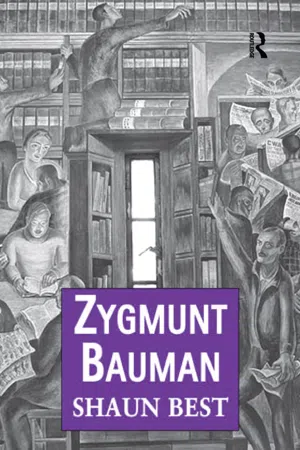
In this ground-breaking book, Shaun Best analyses the intellectual knowledge production of Zygmunt Bauman and his rise to academic stardom in the English speaking world by evaluating the relation between his biography, the contexts in which he found himself, and why his intellectual creativity is admired by so many people. Bauman has an interesting 'contested' biography and underwent a number of intellectual shifts from the early stages of his academic career as Marxist. Bauman moved on and for almost ten years he was associated with 'postmodernity' (from 1989-1997) but in 2000 he decided to distance himself from postmodernism and rebrand his approach to understanding the contemporary world as 'liquid modernity'. Best shows how Bauman developed his canonised status becoming an intellectual guru in the UK and in Australia despite being largely ignored by the academic community in the United States and Central Europe. Rather than investigating Bauman's academic output as a demonstration of his 'creative genius', Best argues that most academic output involves the interplay of multiple factors and this book evaluates the influences on both intellectual choices and the social factors or contexts that led Bauman to attach himself to different sets of ideas during his academic career.
Information
Chapter 1 How Zygmunt Bauman became Zygmunt Bauman: History and Biography
DOI: 10.4324/9781315545974-2
Zygmunt Bauman is one of the most talked about academic social commentators in the world today. His books and papers are widely read within the academic community and he contributes regularly to quality newspapers and other publications. In terms of his approach, when Bauman addressed the ceremony for the Prince of Asturias Foundation prize in 2010 he described his work as a ‘discipline of humanities, whose sole, noble and magnificent purpose is to enable and facilitate human understanding and interhuman ongoing dialogue’ (Bauman 2012a: 46).
Tony Blackshaw has described Zygmunt Bauman as an intellectual superstar, a global phenomenon who has produced a new theory of social change and modernity with the concept of ambivalence at its centre. Blackshaw insists that Bauman is one of those sociologist whose work operates at ‘an intuitive level that does not require them to explain why they have done something “this way” rather than another’ (Blackshaw 2005: 20). Unlike Blackshaw, I am one of those sociologists who do expect authors to give such an explanation. Bauman is not a postmodernist states Blackshaw, but rather his work should be regarded as a ‘sociology of postmodernity’ that has much in common with Lyotard, Baudrillard and, in particular, Deleuze and Guattari. Blackshaw describes life in liquid modernity as ‘rhizomatic; it is in a constant state of becoming’ (2005: 93).
Whatever one thinks of about the work of Zygmunt Bauman, he has led a life that cries out for biographical interpretation. Refugee, former communist, former member of the Polska Robotnicza (the Polish Workers’ Party) (PPR), Soviet ‘political instructor’, member of the Korpusu Bezpieczenstwa Wewnętrznego (KBW) an organisation that helped to establish Stalinism in Poland by ethnic cleansing, former secret police officer who fought against the Polish resistance army, academic driven out of Poland by an anti-Semitic campaign in 1968, who migrated to Israel despite his anti-Zionist leanings, and migrated to the capitalist West despite his communist leanings, and whilst in Leeds made the academic transition from Marxism and via a postmodern turn to liquid modernity and life as a respected and influential public intellectual and political commentator.
All of Bauman’s commentators and, indeed, many of his critics assume that Bauman’s intellectual output is a product of his individual genius, this stance is found in both the edited volumes (Kilminster and Varcoe 1995; Beilharz 2000; Elliott 2007; Jacobsen and Poder 2008) and in the sole-authored commentaries (Smith 1999; Beilharz 2000; Tester 2004 and Blackshaw 2005).
This book is an intellectual biography of Zygmunt Bauman and it is concerned with trying to explain how Zygmunt Bauman became Zygmunt Bauman. Biography is not simply a factual presentation of a life. Hermione Lee (2009) argues that the biographer ‘has a duty to the stream as well as to the fish’, by this she means that biography is a narrative that attempts to make sense of the complicated relationship between a specific human agent and the structures they inhabit and help to shape the life under discussion. I agree with Dennis Smith that ‘Bauman is part of the story he tells. He can be found on the map he draws’ (Smith 1999: 3) and that knowledge of the circumstances in which Bauman found himself in ‘provides a context in which to place Bauman’s explicit statements about his ideals and objectives in the books themselves’. For Smith, Bauman has a distinct voice and wisdom that is a product of his life experience: ‘So, in order to understand and appreciate Bauman properly, we need to know something about his background’ (Smith 1999: 35, 37).
All of our lives and our work are inter-cut with history, no more so than the life and work of Zygmunt Bauman whose ideas as represented in his writing were shaped by some of the darkest events in European history. Smith gives the reader an outline of the key points that we must grasp in order to understand Bauman accurately: ‘During World War II, he was a soldier fighting in a Polish division with the Red Army – a man of action committed to the communist cause. After the war, Bauman remained in the Polish army and became a senior officer – a dedicated bureaucrat working for a better society’ (Smith 1999: 36).
What Bauman must have witnessed at first hand with the advancement of the Red Army into Germany is not commented upon by Smith or by Bauman. The situated activities of the individual Red Army soldiers, carrying out what Jürgen Habermas has described as ‘Stalin’s barbaric conception of war’ did not appear to damage Bauman’s reflection of socialism as an ideology of humanity and equality. The Red Army actions, in Germany and elsewhere, notably Poland, Romania and Hungary, have been described by many researchers in damning terms, Jürgen Habermas, for example, has described the Red Army actions as ‘orgies of revenge, from mass rapes, arbitrary murder and indiscriminate deportations’ (Habermas 1989: 216–17). The brutalisation of the civilian population, including the systematic rape of German women, appears not to have dented Bauman’s vision of the Red Army as a liberating force. This was not the case for many of Bauman’s comrades, for example Alexander Solzhenitsyn who, like Bauman, was also fighting alongside the Red Army as they marched towards Berlin in 1945 but, unlike Bauman, was disgusted by the actions of the Red Army against the German civilian population. For making his views known Solzhenitsyn was arrested and imprisoned in the Gulag until 1956: a place which for Solzhenitsyn seemed a form of repression to equal Auschwitz.
For Smith, Bauman’s attraction to communism was a product of his childhood poverty, racial insults and the threat of Hitler. However, Smith makes it clear that Bauman is not ‘in the confessing business’ but, as Smith rightly suspects, ‘there are biographical reasons for Bauman’s silence on his own biography. Perhaps the biggest reason is that too much pain is hidden there’ (Smith 1999: 36–7), a view also reflected in Peter Beilharz’s intellectual biography of Bauman, which explains that Bauman ‘does not like to talks about his life’s path’ (Beilharz 2000: 1).
Hermione Lee (2009) points out biography can take the form of either a portrait or of an autopsy. Bauman has been reluctant to invite any close biographical interpretation of his life and most academic writing about his work takes the form of hagiography or hero-worship, an uncritical portrait rooted in flattery and idealisation that ignores the history that Bauman lives through, the choices he made, without an attempt to appraise Bauman’s preferred biographical representation of himself, challenge or question his ‘liquid memory’, the way he chose to reshape his identity, life and work in relation to social change and conflict. The narrative of his life presented here is closer to the autopsy than it is to the portrait; moral issues are addressed when the social and political implications of Bauman’s actions are discussed.
There will always be Bauman fans and this book is very much against the grain of writing about Bauman in that it is not idolatrous or affectionate. The starting point for this biography is a critical incident that took place in a Bauman seminar I attended as a postgraduate student at the University of Leeds. Bauman was talking about the work of Emile Durkheim and the idea of ‘social facts as things’. I have a fondness for the work of Durkheim. As an undergraduate I was made to read a chapter or two of Durkheim every week and report what the chapter was about and what I thought of it in a personal tutorial. I was surprised at the quality of Durkheim’s arguments and the sophisticated nature of his theorising. I challenged Bauman’s simplistic interpretation of ‘social facts as things’ and asked him to reflect on how social facts are constructed in Durkheim’s analysis and the role of the human agent in this process. To be challenged in this way annoyed Bauman and he responded to my Durkheim sympathies by banging on the table and repeating in an increasingly loud voice that: ‘social fact is thing like table’. My response was: ‘Okay professor, so what is the first chapter of The Rules of the Sociological Method about?’ Bauman fell silent.
This simple anecdote raises an important conceptual issue in Bauman’s postmodern writing and in the post-2000 liquid turn writing. One of the architects of solid modernity for Bauman is Emile Durkheim. However, Bauman is not familiar with Durkheim’s work. If I was asked by one of Bauman’s band of supporters to provide some justification or evidence of Bauman’s lack of engagement with the work of Durkheim there is a Bauman fact that can be pointed to. Every citation of Durkheim’s work in the many books and papers that Bauman has produced over the years with very few exceptions, such as Durkheim’s definition of socialism (Bauman 1976: 49) and passing reference to The Elementary Forms of Religious Life (Bauman 1993: 134, 135), is taken from one source: Anthony Giddens’ text Emile Durkheim: Selected Writings. I am not criticising Giddens book, but what I am suggesting is that it does no more than provide the reader with idea of what Durkheim’s work is about. If you want to know what Durkheim has to say, you really have to read Durkheim. Not only does Bauman claim to have knowledge that he does not possess, but his concept of liquid modernity is based upon a critique of an author he is not familiar with. People may see the gloss of the surface of Bauman’s writings and mistake it for depth, but they are wrong because there is very little depth in Bauman’s work. Bauman’s admirers appear to judge his work on the basis of his mythologised public life, not on the quality of the arguments he presents. If you are one of those readers who object to the assertion that Bauman has a mythologised public life then you should reflect on the fact that Bauman appears in his wife’s wartime autobiography as a fictional character named Conrad.
Social scientists are also social actors and we can assume that not only are their lives shaped by the same range of social forces as any other social actor but they also draw inspiration about the world in the same way as any other social actor. Bauman’s most influential book on modernity and the Holocaust was a product of specific life events, historical circumstances in which Bauman found himself in March 1968 and the decisions he made in relation to those circumstances. In addition, as we shall see in the next chapter, the book was central to his academic career.
It is often assumed that theory construction in particular and explanation building in general is a highly personal activity and very little is known about the intuitive creative process involved in theory construction. The decision about what to research and why are not made within a vacuum but are influenced by a range of factors. In contrast to investigating Bauman’s academic output on the basis of his creative genius, rather, in common with what has become known as the ‘new sociology of ideas’, an approach informed by the work of Pierre Bourdieu, Randall Collins, Hayden White and Neil Gross that investigates the ‘mundane social processes involved in knowledge making’ (Gross 2008: xiv), the argument developed here is that most academic output involves the interplay of multiple factors. However, unlike Bourdieu and others, I want to focus upon the ‘mechanisms’ or ‘strategic dimensions of choice’ in Bauman’s knowledge making practices, in order to evaluate the influences on his intellectual choices and the social factors or contexts that led Bauman to attach himself to one set of ideas at one time and then another at a given point in his academic career.
In order to fulfil my duty ‘to the stream’ as well as ‘to the fish’, I want to explore the connection between Bauman’s life and his intellectual output in the same way that an epidemiologist or doctor would explore the questions as to why people get sick at a particular point in time and under what given circumstances. In the same way that medical explanation is very complex, because most diseases involve the interplay of multiple factors, so too are theory construction and explanation building in social research. The intellectual production of outputs is best thought of as a causal network instantiation. In terms of social science explanation building, mechanisms are ‘social facts’ in the Durkheimian sense of the term and operate like motives in murder trials in that mechanisms allow us to focus on the process underlying the relationship between attachment to an idea and the life course. As Bauman himself has explained, ‘sociopolitical mechanisms … generate “enabling” and “disabling” pressures in tandem’ (Bauman 2012a: 80).
From this perspective, explanation building involves identifying the mechanisms that make things happen in the world and understanding the nature of objects that possess power, how such mechanisms work and under what conditions. As such, causal mechanisms are activated by measures that may not be recognised or acknowledged by Bauman himself, yet these mechanisms generate causal forces that shape Bauman’s academic outputs and publication patterns. Underlying mechanisms are the things which connect causal sequences. Children often grow up to have the same social class position as their parents. We could try to explain this by attempting to identify the underlying mechanisms:
by asking about the mechanisms of inheritance that advantaged or disadvantaged certain groups in acquiring class (occupational) positional positions. One would theorise about the credential barriers constructed to serve the interests of particular occupational groups. One could hypothesize how legislation on the inheritance of wealth and property favoured or disadvantaged particular groups. One could try to understand how the changing patterns of opportunities available with technological and economic change lessened or increased the mobility opportunities of different groups. (Pawson 1989: 74)
Bauman experienced many of the major events of the twentieth century, often at close quarters: the Second World War, the Holocaust, the formation of the Warsaw Pact, the fall of communism in Eastern Europe. To make sense of a life is to be concerned with finding links between history and biography, finding explanations for individual social actions and it is the actions of individuals that activate generative mechanisms. In turn, it is the activation of underlying generative mechanisms within a given context that brings about or generates change. This means that we can only make sense of change by understanding how and why individuals choose to act in the way they do. If all social action takes place in a context and the context is important for academic practice and intellectual output, and generative mechanisms are local to a given and specific social context, then the first stage of evaluation is to identify clearly the context in which the social action takes place and then identify the generative mechanisms that operate within that context.
This book attempts to identify the significant events that occurred in Bauman’s life and to come to an understanding as to what these events might mean. The argument presented here explores the intersections between personal history and collective memory and Bauman’s own involvement in the production of history. We have some clear ideas of key events in the life of Zygmunt Bauman, we know where he was during much of the period from 1939 to 1953, we also know the events that were taking place during this period and the positions that he held and what the organisations that employed him were attempting to achieve.
For Hayden White:
historical events differ from fictional events in the ways that it has been conventional to characterize their differences since Aristotle. Historians are concerned with events that can be assigned to specific time-space locations, events which are (or were) in principle observable or perceivable, whereas imaginative writers—poets, novelists, playwrights—are concerned with both these kinds of events and imagined, hypothetical, or invented ones. (White 1978: 121)
The actions of the organisations and their consequences are real historical events, real things that happened and are as such a matter of historical record; in White’s words these actions were observable or perceivable and can be assigned to specific time-space locations. The motives and intentions of the individuals who carried out the orders to bring about the organisation’s desired ends can only be speculated upon, unless the individuals involved choose to give an outline of what they did and why they did it. It is not the historical facts in themselves that determine the actions of human agents in any given circumstance; all social action involves reflexive interpretation by a human agent and how historical events unfold is the product of human minds and actions. As Alfred Louch explains:
If we are working on a murder and have a theory about the gun involved, and then find the gun, it counts as evidence because of the theory, but doesn’t exist because of the theory. ‘Pass the salt’ doesn’t bring a salt-cellar into existence, nor is passing the pepper just a linguistic error. (Louch 1979: 34)
As Bauman is unwilling to share his war and early post-war experiences and unwilling to outline his motives and intentions, we can only attempt to construct the in-order to and because motives that Bauman may have had by drawing upon the in-order to and because motives of other people ...
Table of contents
- Cover Page
- Half-Title Page
- Title Page
- Copyright Page
- Table of Contents
- Introduction
- 1 How Zygmunt Bauman became Zygmunt Bauman: History and Biography
- 2 The Unmaking of a Communist Identity
- 3 Modernity and the Holocaust
- 4 The Liquid Turn
- Conclusion Why Good People do Bad Things
- Bibliography
- Index
Trusted by 375,005 students
Access to over 1.5 million titles for a fair monthly price.
Study more efficiently using our study tools.
Frequently asked questions
Yes, you can cancel anytime from the Subscription tab in your account settings on the Perlego website. Your subscription will stay active until the end of your current billing period. Learn how to cancel your subscription
No, books cannot be downloaded as external files, such as PDFs, for use outside of Perlego. However, you can download books within the Perlego app for offline reading on mobile or tablet. Learn how to download books offline
Perlego offers two plans: Essential and Complete
- Essential is ideal for learners and professionals who enjoy exploring a wide range of subjects. Access the Essential Library with 800,000+ trusted titles and best-sellers across business, personal growth, and the humanities. Includes unlimited reading time and Standard Read Aloud voice.
- Complete: Perfect for advanced learners and researchers needing full, unrestricted access. Unlock 1.5M+ books across hundreds of subjects, including academic and specialized titles. The Complete Plan also includes advanced features like Premium Read Aloud and Research Assistant.
We are an online textbook subscription service, where you can get access to an entire online library for less than the price of a single book per month. With over 1.5 million books across 990+ topics, we’ve got you covered! Learn about our mission
Look out for the read-aloud symbol on your next book to see if you can listen to it. The read-aloud tool reads text aloud for you, highlighting the text as it is being read. You can pause it, speed it up and slow it down. Learn more about Read Aloud
Yes! You can use the Perlego app on both iOS and Android devices to read anytime, anywhere — even offline. Perfect for commutes or when you’re on the go.
Please note we cannot support devices running on iOS 13 and Android 7 or earlier. Learn more about using the app
Please note we cannot support devices running on iOS 13 and Android 7 or earlier. Learn more about using the app
Yes, you can access Zygmunt Bauman by Shaun Best in PDF and/or ePUB format, as well as other popular books in Social Sciences & Sociology. We have over 1.5 million books available in our catalogue for you to explore.