- 286 pages
- English
- ePUB (mobile friendly)
- Available on iOS & Android
eBook - ePub
About this book
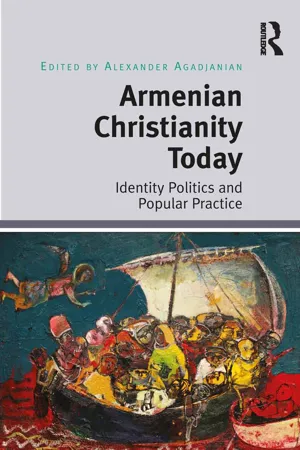
Armenian Christianity Today examines contemporary religious life and the social, political, and cultural functions of religion in the post-Soviet Republic of Armenia and in the Armenian Diaspora worldwide. Scholars from a range of countries and disciplines explore current trends and everyday religiosity, particularly within the Armenian Apostolic Church (AAC), and amongst Armenian Catholics, Protestants and vernacular religions. Themes examined include: Armenian grass-roots religiosity; the changing forms of regular worship and devotion; various types of congregational life; and the dynamics of social composition of both the clergy and lay believers. Exploring through the lens of Armenia, this book considers wider implications of 'postsecular' trends in the role of global religion.
Information
The Republic of Armenia: Religious Revival and Renewal
Chapter 1
“One Nation, One Faith, One Church”: The Armenian Apostolic Church and the Ethno-Religion in Post-Soviet Armenia
This chapter discusses the historical foundations and the modern manifestations and implications of the Armenian-Christian ethno-religion, as maintained and promoted by the Armenian Apostolic Church (AAC) in the post-Soviet Republic of Armenia. First, it examines a number of symbolic events and figures that constitute the Armenian-Christian “chain of memory” from the biblical Deluge to the Armenian genocide. Second, it presents and analyzes selected examples of the modern discourse of the AAC, taken from the Church’s publications or collected during the author’s interviews with members of the clergy. The chapter concludes by locating the ethno-religion of the Armenian Apostolic Church within the wider frame of the current socio-religious situation in Armenia.
The Armenian-Christian Chain of Memory: Origins and Reformulations
French sociologist Danièle Hervieu-Léger devoted a chapter of her seminal book Religion as a Chain of Memory to the phenomenon of “ethno-religion.” As she states, both religious and ethnic belonging create social ties on the basis of a postulated genealogy, which is, on the one hand, naturalized, since it appeals to blood and earth, and, on the other hand, symbolized, since it is established through invoking and praising the myth of origin. Hence religious and ethnic identities, in sharing a common essence, often strengthen each other, or even fuse together, and are perceived as inseparable.1
Although Hervieu-Léger writes about ethno-religion in a section entitled “The Chain Reinvented” and concentrates on examining modern cases of nationalisms that emerged as a fusion of ethnic and religious elements, she acknowledges two exceptional groups in which this paradigm of inseparability goes back deep into history and precedes the modern era, namely, the Jews and the Armenians. The view that the “Armenian case” is exceptional can be found not only in Hervieu-Léger’s work: it is supported by a number of historians and anthropologists, including Anthony Smith, Anne Elizabeth Redgate, Razmik Panossian, Abraham Terian and Levon Abrahamian. What leads all these authors to such a conclusion is their shared view that the Christianization of Armenia at the beginning of the fourth century and the subsequent creation of a separate literary tradition were watershed events that resulted in establishing and fixing a distinctive Armenian identity. More specifically, Smith, in his book devoted to the religious sources of national identity, states that by the act of adopting Christianity Armenians started to consider themselves as “Peoples of the Covenant.”2 According to Redgate, the “creation of the Armenian alphabet made possible a truly national sense of Armenian identity.”3 Panossian claims that “through … religious conversion church leaders were also producing a unique form of literary tradition … In this crucial respect they were ‘creating’ Armenians.”4 Finally, Terian speaks about the Armenian “blend of patriotism and piety”5 that occurred in the fourth and fifth centuries, while Abrahamian uses the term “early constructivism” to describe the unification project undertaken in that period by the state and the Church.6
However, the fusion of the ethnic and religious components of Armenian identity, as it exists today and is eagerly promoted by the Armenian Apostolic Church, should not be seen as a straightforward continuation of this “early constructivism” and “blend of patriotism and piety.” Even if the Armenian ethno-religious chain of memory was indeed “forged” centuries earlier than most other ethno-religious chains, it was undoubtedly reshaped by the grand narrative of modern nationalism, introduced to Armenians in the nineteenth century by the first Armenian political parties,7 and further developed in Soviet Armenia and in the post-genocide Armenian diaspora.
In the mid-nineteenth century the leaders of the emerging Armenian national movement blamed the AAC for the fall of the Armenian state and Armenians’ powerlessness in the face of perpetual invasions and persecutions. This anticlericalism was famously expressed by Raffi, one of the most influential Armenian writers of that time:
O fathers! O fore-fathers! … Had you built fortresses, instead of monasteries with which our country is full; had you guns and ammunition, instead of squandering fortunes on Holy urns, had you burned gunpowder instead of perfumery incense at the Holy altars, our country would have been more fortunate … From these very monasteries the doom of our country was sealed.8
In a few decades, however, this stance was eased and the authority of the Church became perceived as an important factor in cementing ethno-national identity. The AAC itself also employed the national discourse in order to strengthen its position among the people. As a result:
the priests were educated as national workers, as another party. The Church was subordinated to nationalistic feelings, and the churchmen themselves became the missionaries of nationality rather than religion.9
In post-World War II Soviet Armenia, with the emergence of a new secular “blend of patriotism and socialism,”10 the Armenian Apostolic Church was saved from the pre-war policies of annihilation. Its activities, however, took place predominantly in the context of the preservation of national identity and heritage. The Church was largely deprived of its spiritual functions, and reduced to a minimum in its structures. Meanwhile, selected elements of the Armenian-Christian heritage, such as the creation of the Armenian alphabet at the beginning of the fifth century, were recalled in a secular context and promoted thanks to official propaganda and compulsory education.11
Summarizing the impact of modern nationalism on the Armenian Apostolic Church over the last hundred years, Vigen Guroian offers the following assessment:
As it entered the twentieth century, the Armenian Church … embraced [the] role of safeguarding Armenian identity prescribed by secular Armenian nationalism … In the eighty years since the genocide, the Armenian Church hierarchy and clergy have constructed a religio-national myth … The myth traces the origins of the present secularized nationalistic church back to the founding acts of the Armenian Church in the fourth and fifth centuries. It is preached and argued in all sorts of public forums that the religionized nationalism that the church promotes is the self-same faith of the Church’s founders and its martyred defenders through the centuries.12
Six Elements of the Armenian Ethno-Religious Genealogy
The Armenian ethno-religious genealogy postulated by the Armenian Apostolic Church consists of a number of symbolic events and figures. Six of them, arguably the most important, widely known and continually recalled elements of this genealogy will be discussed here.
Chronologically the first element is the biblical story of the Deluge, Noah’s landing on Mount Ararat, and his settlement in the Ararat Valley from where life returned to earth.13 The city of Nakhchivan (the capital of the Nakhchivan Autonomous Republic, part of Azerbaijan), a name which in Armenian (Nakhijevan) means “the first place of resettlement,” is considered to be the eternal resting place of Noah, and his tomb used to be an important destination for Armenian pilgrims.14 Today, on the official website of the AAC one can find the following information: “When Noah emerged from the Ark, he prepared a sacrifice in the Araratian Valley and built an altar for the sacrifice in the place where Holy Etchmiadzin15 is now located.”16 Furthermore, ever since Movses Khorenatsi wrote his “Hayots Patmut‘yun” (The History of Armenia)17 the story of Noah has been supplemented in the Armenian tradition by the story of Hayk, the son of Noah’s great-grandson, who is claimed as the forefather of the Armenians.18
It is worth noting that, contrary to Armenian Apostolic Church discourse and popular knowledge, it was probably as late as the beginning of the second millennium AD when the localization of the biblical Mount Ararat was permanently moved from the highlands hemming upper Mesopotamia to Mount Masis in the heart of historical Armenian territory.19 Mount Masis was a sacred mountain even before its identification with Ararat, and afterwards its symbolic importance for the “Armenian Issue”20 has made Masis-Ararat crucial in the formation of modern Armenian identity. At the same time, just as in the case of the AAC, the modern “nationalization” of Masis-Ararat has also led to its partial secularization. Although less than 200 years ago high-ranking Armenian clergyman commented that to climb the sacred mountain was “to tire the womb of the mother of all mankind in a dragonish mode,”21 nowadays to ascend Ararat is the most highly valued goal of some of the patriotic pilgrimages that are organized in growing number from Armenia and the Armenian diaspora.
The second set of traditions included in the Armenian-Christian chain of memory traces back to apostolic times. First, two disciples of Christ—Saint Jude Thaddeus and Saint Bartholomew—are believed to have been martyred during their evangelical mission to Armenia in the middle of the first century. The Armenian Church considers itself to be the direct successor to their mission, and thus has the word “Apostolic” in its official name. Second, the apocryphal story of King Abgar of Edessa, “armenianized” by Movses Khorenatsi, establishes an Armenian history of conversion that precedes by almost three centuries the official adoption of Christianity by the Armenian kingdom.22 According to this apocryphon, Abgar, who suffered from an incurable sickness, “believed without seeing” in Christ’s divinity, asked him for healing, and offered him asylum in his palace. In reply, Christ sent to Abgar one of his Seventy Disciples, St. Thaddeus, equipped with the Mandylion—a cloth on which the image of Christ’s face had been miraculously imprinted. King Abgar, healed and baptized by St. Thaddeus, became the world’s first Christian ruler.
The third element of the mythological genealogy is the story of the Armenian conversion to Christianity at the beginning of the fourth century. This story, as handed down by the fifth-century historian Agat‘angeghos, includes an account of the 13 torments of St. Gregory the Illuminator, including his imprisonment in a Khor Virap pit; the martyrdom of St. Hrip‘simē, St. Gayanē, and their companions; and the divine punishment of King Trdat III, turned into a boar for his atrocities, his subsequent healing by St. Gregory followed by the baptism of the king and his subjects. Agat‘angeghos also describes a vision in which Christ appeared to St. Gregory pointing to the place where the spiritual center of the new religion should be built as well as King Trdat’s ascent of Ararat, from where he brought eight stones to be placed in the foundations of the cathedral.23 This cathedral, built on the site of a pagan temple (and of Noah’s first altar, according to the first element in the tradition), received the name Etchmiadzin, meaning the place where “The Only Begotten Descended.” Accordingly, in the AAC’s tradition Etchmiadzin is also referred to as the “Armenian Bethlehem.”
It is worth noting that the exact date of adopting Christianity—the year 301—was actually introduced only at the end of eighteenth century,24 and was glorified even more recently: the 1,700th anniversary of the conversion held in 2001 was the first to be celebrated with great pomp and the mobilization of people and resources.25 Nevertheless, the date 301, which establishes Armenian precedence among the peoples who accepted Christianity as a state religion, is absolutely central today for Armenian-Christian identity. Every academic attempt to challenge this “canonical” dating by suggesting that the conversion took place around 314–31526 is dismissed by the Church. Even when the year 305 was cited as a possible alternative to 301 in the footnotes of the “History of Armenia” school textbook a few years ago, the Church protested, and the whole edition was removed from print.27
The celebration of the 1,700th anniversary of Armenia’s conversion to Christianity in 2001 began in the Khor Virap monastery, built on the site of St. Gregory’s imprisonment. During the celebration, the head of the AAC, Catholicos Gareg...
Table of contents
- Cover Page
- Half-Title Page
- Title Page
- Copyright Page
- Table of Contents
- Introduction
- Part I The Republic of Armenia
- Part II Armenian Diasporas
- Index
Trusted by 375,005 students
Access to over 1.5 million titles for a fair monthly price.
Study more efficiently using our study tools.
Frequently asked questions
Yes, you can cancel anytime from the Subscription tab in your account settings on the Perlego website. Your subscription will stay active until the end of your current billing period. Learn how to cancel your subscription
No, books cannot be downloaded as external files, such as PDFs, for use outside of Perlego. However, you can download books within the Perlego app for offline reading on mobile or tablet. Learn how to download books offline
We are an online textbook subscription service, where you can get access to an entire online library for less than the price of a single book per month. With over 1.5 million books across 990+ topics, we’ve got you covered! Learn about our mission
Look out for the read-aloud symbol on your next book to see if you can listen to it. The read-aloud tool reads text aloud for you, highlighting the text as it is being read. You can pause it, speed it up and slow it down. Learn more about Read Aloud
Yes! You can use the Perlego app on both iOS and Android devices to read anytime, anywhere — even offline. Perfect for commutes or when you’re on the go.
Please note we cannot support devices running on iOS 13 and Android 7 or earlier. Learn more about using the app
Please note we cannot support devices running on iOS 13 and Android 7 or earlier. Learn more about using the app
Yes, you can access Armenian Christianity Today by Alexander Agadjanian in PDF and/or ePUB format, as well as other popular books in Theology & Religion & Middle Eastern History. We have over 1.5 million books available in our catalogue for you to explore.