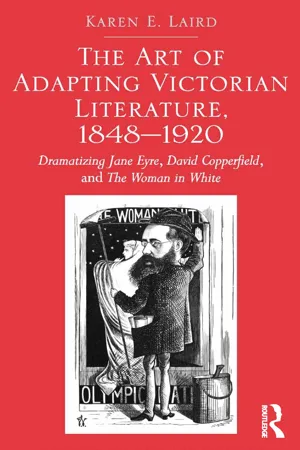
eBook - ePub
The Art of Adapting Victorian Literature, 1848-1920
Dramatizing Jane Eyre, David Copperfield, and The Woman in White
- 242 pages
- English
- ePUB (mobile friendly)
- Available on iOS & Android
eBook - ePub
The Art of Adapting Victorian Literature, 1848-1920
Dramatizing Jane Eyre, David Copperfield, and The Woman in White
About this book
In The Art of Adapting Victorian Literature, 1848-1920, Karen E. Laird alternates between readings of nineteenth-century stage and twentieth-century silent film adaptations to investigate the working practices of the first adapters of Victorian fiction. Laird's juxtaposition between stage and screen brings to life the dynamic culture of literary adaptation as it developed throughout the long nineteenth-century. Focusing on Charlotte Brontë's Jane Eyre, Charles Dickens's David Copperfield, and Wilkie Collins's The Woman in White, Laird demonstrates how adaptations performed the valuable cultural work of expanding the original novel's readership across class and gender divides, exporting the English novel to America, and commemorating the novelists through adaptations that functioned as virtual literary tourism. Bridging the divide between literary criticism, film studies, and theatre history, Laird's book reveals how the Victorian adapters set the stage for our contemporary film adaptation industry.
Information
Chapter 1
Upstairs, Downstairs: Jane Eyre’s Transatlantic Theatrical Debut
Perhaps no English novel’s opening chapters offer such a prescient warning of the trauma to come as do the first four chapters of Charlotte Brontë’s Jane Eyre. Jane’s abuse by her cruel cousin John, her attempt to fight back, and her subsequent imprisonment in the reputedly haunted “Red Room” establish the central themes of the “autobiography” that follows: freedom versus slavery, restraint versus passion, mind versus body. One less often discussed oppositional pairing foreshadowed by the novel’s establishing incident is status versus dignity. As a large-gartered Miss Abbot and a black-eyed Bessie restrain the unruly Jane, they reprimand her for striking “Master” John Reed. Jane replies with two questions: “How is he my master? Am I a servant?” Miss Abbot responds: “No, you are less than a servant, for you do nothing for your keep.”1 Jane’s story begins, then, at the very bottom of the hierarchy of power. Although she lives within the materially plush Gateshead estate, Jane is taught that she is essentially a trespasser and a beggar whose unemployment is a state deserving of shame rather than a social marker of gentility. As she matures and works to earn her keep as a governess at Edward Fairfax Rochester’s Thornfield Hall, and then as a teacher in St. John Rivers’s Moor End parish, Jane struggles to be recognized as more than a servant, asserting her right to be considered an equal to the two land-owning gentlemen who both ask for her hand in marriage. Her self-identity as a gentlewoman is only recognized when accompanied by tangible proof: an inheritance of 20,000 pounds, respectable relatives, and a husband who owns property. By the novel’s end, Jane is no longer “less than a servant”—rather, she enters into marriage as a financially independent woman and bestows upon her husband’s servant a generous “five-pound note.”2
The Victorian playwrights who first adapted Jane Eyre were fascinated by the economies of the novel, and especially with the working woman’s just inheritance. Their plays extracted the thematic binary opposition of status/dignity, shifted the dominant setting from the upstairs parlors to the below stairs workrooms, and reconstructed Brontë’s plot with a more radical emphasis on socio-economic disparities. To accomplish this revision, the playwrights spent just as much time dramatizing the lives of the servants as they did imagining the inner life of the heroine. John Courtney’s Jane Eyre, or The Secrets of Thornfield Manor (1848) and John Brougham’s Jane Eyre (1849) raise the novel’s submerged narrative of class discontent to the highly visible surface of melodrama. Written for predominantly working class theatres in London and New York (respectively), Courtney and Brougham’s scripts dared to make significant omissions, additions, and corrections to this remarkable new novel by the unknown “Currer Bell.”
Courtney and Brougham’s common adaptation strategy was to flesh out the novel’s original servant characters, as well as invent additional characters from the servant class. These characters provide more than Shakespearean comic relief: their highly vocal presence invites audience members to meditate on the daily drudgery involved in domestic service. In comparison, the travails of a governess must have seemed rather enviable. These invented characters are vivid storytellers and serve the important role of acting as mediators between Jane and the working-class audience. The servants actually supplant the heroine’s narrative agency, as it is their dialogue—and not Jane’s soliloquies—which most effectively convey Jane’s psychological, economic, and romantic struggles to the audience.
The subversive spirit of these initial Jane Eyre adaptations reflects the revolutionary year of 1848. These plays are creatures of their time, as good adaptations tend to be. It may seem surprising that a bildungsroman about a governess’s inner life would be a serviceable vehicle for social critique in the popular theatre. However, part of the perpetual appeal of Jane Eyre for dramatists is that it has built into its dramatic DNA (to use my own metaphor) what Patsy Stoneman sees as an “ambiguity of stance, so that an adaptor’s emphasis can present the story as either radical or conservative.”3 In the present context, this ambiguity allowed Courtney and Brougham to craft different stories for very different audiences. Courtney’s London adaptation is politically radical from start to finish, while Brougham’s New York play raises serious social critiques only to corral them within a conservative conclusion.
In addition to amplifying class issues, Courtney and Brougham also raise provoking anxieties about gender as they crosscut between Jane and the female domestic servants. This gendered focus is an important component of Victorian melodrama. Juxtaposing Jane’s romantic possibilities against those of the servants’ may also have made the plays appealing to a broader, middle-class audience. In her analysis of the novel, Cora Kaplan explains that the governess plot’s focus on the “sexual vulnerability” of Jane, a middle-class woman working “as semi-servant in a grand patriarchal household,” intrigued audiences of all classes: “A doubled scenario, in which the ideological and material differences between working-class and bourgeois women is blurred through condensation, was popular as a plot for melodrama with both ‘genteel’ and ‘vulgar’ audiences.”4 In Kaplan’s view, the novel maps “the crisis of middle-class femininity” onto the “structural sexual vulnerability of all working-class servants in bourgeois employment.”5 In this chapter, I pay special attention to the playwrights’ attempts to underscore the sexual vulnerability of the female servants for a primarily working-class audience. Often threats to the female characters’ virtue incite the male workers to political action. In their most progressive moments, these adaptations open up a window into the subjectivity of the Victorian servant and provide insight into the lived experience of both men and women in domestic service.
It has become second nature for contemporary audiences to interpret Victorian adaptations in light of their canonical antecedents. It seems likely, though, that the original spectators of Jane Eyre dramatized may not have read the novel before encountering it at the theatre. As Brian McFarlane argues, “the precursor literary work is only an aspect of the film’s [or play’s] intertextuality, of more or less the same importance according to the viewer’s acquaintance with the antecedent work.”6 For many who attended the Victoria Theatre on a winter’s night in 1848, the play was all that mattered, and the play could “not wait for the unknowing viewer to go away and read the book.”7 In my close readings of the adaptations, then, I aim to evaluate the plays as much as possible on their own merits within Victorian performance culture.
Charlotte Brontë and the Theatre
Although Charlotte Brontë did not witness the inaugural dramatization of her novel, she was well informed of the production by an experienced theatre critic who went in her place. William Smith Williams,8 publishing advisor at Smith, Elder and Company, attended Jane Eyre, or The Secrets of Thornfield Manor (1848) at London’s raucous Victoria Theatre and shared his reaction with Brontë (whose true identity was still unknown to him) in a series of letters. Although Williams’s side of the correspondence does not survive, Brontë’s two letters on this subject reveal her mingled skepticism and fascination at her novel’s debut on the stage of a “Minor Theatre.” Biographer Juliet Barker explains that, prior to Brontë’s visit to London in 1851, “she had seen only opera, which left her cold, and the mannered acting of Macready, which she despised.”9 Brontë’s correspondence at this early stage of her career reveals her suspicion not just of literary adaptation but of the theatre itself, which she had as yet experienced only in its most conservative form.
In the first of these letters to Williams, Brontë expresses her anxiety about seeing her imagined characters embodied on stage by flesh and blood actors:
I suppose all would be woefully exaggerated and painfully vulgarized by the actors and actresses on such a stage. What—I cannot help asking myself—would they make of Mr. Rochester? And the picture my fancy conjures up by way of reply is a somewhat humiliating one. What would they make of Jane Eyre? I see something very pert and very affected as an answer to that query.10
Brontë’s observation reveals a text/image rivalry that is perfectly consistent with her mistrust of book illustration. She had previously dismissed Williams’s suggestion that she herself serve as Jane Eyre’s illustrator and expressed “hope” that “no one will be at the trouble to make portraits” of her characters. Brontë’s rationale was based on the unconventional nature of her characters’ physical appearances: “Bulwer-and Byron-heroes and heroines are very well—they are all of them handsome—; but my personages are mostly unattractive in look and therefore ill-adapted to figure in ideal portraits—At best, I have always thought such representations futile.”11 Subsequent artists would contradict the novelist’s argument through fine illustrations of Jane Eyre. Fritz Eichenberg’s original wood engravings for Random House’s 1943 edition quietly attest that even a disfigured Rochester could prove a powerfully picturesque subject, as the “anguished” and maimed hero is rendered “still dominating the page, still with striding gait, aligned with one of his own knotty trees and with his hand hidden in his bosom in a gesture reminiscent of Napoleon.”12 Brontë’s apprehension about both adaptation and illustration betrays a prejudice dubbed by adaptation scholars as “anti-corporeality”—an antipathy against adaptation’s “inescapable materiality, its incarnated, fleshly, enacted characters, its real locales and palpable props, its carnality and visceral shocks to the nervous system.”13
Throughout both letters to Williams, Brontë equates dramatization with coarseness, thereby deflecting the critique most often leveled at her own novel by her first critics onto Courtney. Wavering over whether Williams should attend the play or not, Brontë meditates: “if you do not go, you will be spared a vulgarizing impression of the book; if you do go, I shall perhaps gain a little information: either alternative has its advantage.”14 The letters also reveal that Brontë was troubled over her implied relationship to the author of the stage adaptation, and was ultimately afraid that her identity as the author of the original text intimately bound her to the play’s success or failure. Moreover, she fears that Williams might become disenchanted with the novel that he selected for publication should its adaptation prove disappointing, writing: “One can endure being disgusted with one’s own work, but that a friend should share the repugnance is unpleasant.”15 By describing the dramatization as her “own work,” Brontë acknowledges a powerful connection between herself and Courtney, so much so that she would consider the blame for his failed play as her “own.” The anxiety of adaptation is not that the play will be an inferior copy of the original, but that it will retroactively damage public opinion of the original.
Brontë scholars have taken Charlotte’s apparent revulsion of the first stage adaptation at her word, thereby vio...
Table of contents
- Cover Page
- Title Page
- Copyright Page
- Contents
- List of Figures
- Acknowledgments
- List of Abbreviations
- Introduction
- 1 Upstairs, Downstairs: Jane Eyre’s Transatlantic Theatrical Debut
- 2 Adapting Melodramatically: Jane Eyre of the Silent Screen
- 3 Adapting the Seduction Plot: David Copperfield on the Victorian Stage
- 4 The Posthumous Dickens: David Copperfield on Screen
- 5 Adapting the Sensation Plot: The Woman in White on the Victorian Stage
- 6 Sensational Modernity: The Woman in White on the American Screen
- Works Cited
- Index
Trusted by 375,005 students
Access to over 1.5 million titles for a fair monthly price.
Study more efficiently using our study tools.
Frequently asked questions
Yes, you can cancel anytime from the Subscription tab in your account settings on the Perlego website. Your subscription will stay active until the end of your current billing period. Learn how to cancel your subscription
No, books cannot be downloaded as external files, such as PDFs, for use outside of Perlego. However, you can download books within the Perlego app for offline reading on mobile or tablet. Learn how to download books offline
Perlego offers two plans: Essential and Complete
- Essential is ideal for learners and professionals who enjoy exploring a wide range of subjects. Access the Essential Library with 800,000+ trusted titles and best-sellers across business, personal growth, and the humanities. Includes unlimited reading time and Standard Read Aloud voice.
- Complete: Perfect for advanced learners and researchers needing full, unrestricted access. Unlock 1.5M+ books across hundreds of subjects, including academic and specialized titles. The Complete Plan also includes advanced features like Premium Read Aloud and Research Assistant.
We are an online textbook subscription service, where you can get access to an entire online library for less than the price of a single book per month. With over 1.5 million books across 990+ topics, we’ve got you covered! Learn about our mission
Look out for the read-aloud symbol on your next book to see if you can listen to it. The read-aloud tool reads text aloud for you, highlighting the text as it is being read. You can pause it, speed it up and slow it down. Learn more about Read Aloud
Yes! You can use the Perlego app on both iOS and Android devices to read anytime, anywhere — even offline. Perfect for commutes or when you’re on the go.
Please note we cannot support devices running on iOS 13 and Android 7 or earlier. Learn more about using the app
Please note we cannot support devices running on iOS 13 and Android 7 or earlier. Learn more about using the app
Yes, you can access The Art of Adapting Victorian Literature, 1848-1920 by Karen E. Laird in PDF and/or ePUB format, as well as other popular books in Literature & Literary Criticism. We have over 1.5 million books available in our catalogue for you to explore.