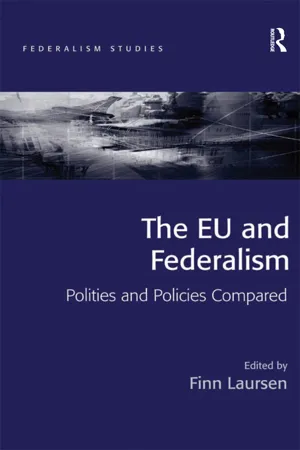
- 304 pages
- English
- ePUB (mobile friendly)
- Available on iOS & Android
eBook - ePub
About this book
Tracing the evolution of federalist theory and the European Union (EU), an international line up of distinguished experts debate the pros and cons of treating the EU in a comparative context and ask whether a constitutional equilibrium has been reached in the EU. They examine policymaking or modes of governance in the areas of employment, health, environment, security and migration, comparing the EU's policies with policies of both international organisations like NATO, OECD and federal states such as Canada, Japan and South Africa.
Information
Introduction
Chapter 1
Federalism: From Classical Theory to Modern Day Practice in the EU and Other Polities
Introduction
Federalism is an old concept, with positive connotations for some and negative connotations for others, especially in the context of the European Union (EU). Definitions differ. Countries that have federal governments include the United States, Canada, Germany, Switzerland and many others. If we think in terms of states, federations are states formed by states which retain a certain degree of autonomy but transfer some authority to the centre to carry out specific functions. One could also say that there is a vertical division of powers on at least two levels of government and that both levels of government have a certain degree of autonomy. Daniel Elazar has seen federalism as a combination of self-rule and shared rule (Elazar 1984).
William Riker suggested the following rule of identification:
A Constitution is federal if (1) two levels of government rule the same land and people, (2) each level has at least one area of action in which it is autonomous, and (3) there is some guarantee (even though merely a statement in the constitution) of the autonomy of each government in its own sphere (Riker 1964: 11).
How narrow a definition should be chosen for any political phenomenon can of course be up for discussion. Such a discussion is not absent in the literature on federalism. Kenneth Wheare, for instance, has been criticized for choosing a too narrow definition in his classic Federal Government, where the federal principle is defined as ‘the method of dividing powers so that the general and regional governments are each, within a sphere, co-ordinate and independent’ (Wheare 1963: 10). It is mainly the notion of ‘independent’ governmental levels that has been criticized. The delegation of federal administration to the Länder governments, which is an important characteristic of German federalism, for instance, is clearly not in accordance with Wheare’s definition (Brecht 1945, Neureither 1959), nor could it account for an important phenomenon in many federal systems, the so-called ‘cooperative federalism’, which puts emphasis on the actual cooperation between the regional and central governments (see, for example, Elazar 1962, Laursen 1976). It seems that autonomy is a better descriptor than independence.
There are big differences between the existing federal systems. Canada, for instance, is different from the United States. Canada is relatively decentralized and it has a parliamentary system, not a presidential system. Switzerland has a unique governmental system, where all the major political parties are represented in the federal government. Some federal states are monolingual; many accommodate more languages: two in Canada, four in Switzerland, and several more in India, for instance.
Sometimes there is a distinction between confederation and federation (or federal state) in the literature (see Durand 1955). This distinction grew out of the American experience, where the 13 British colonies first formed a confederation under the Articles of Confederation (1781–1789), but then went on to ‘invent’ a more centralized federal system at the Philadelphia Convention in 1787. The new constitution from Philadelphia formed a federal state.
Efforts to develop theories of pre-1787 federal systems had often run into problems because of the concept of sovereignty, which was associated with the modern state as it emerged in Europe after the Peace of Westphalia in 1648. Jean Bodin and Thomas Hobbes saw sovereignty as indivisible. Political philosophers such as Baron de Montesquieu and Jean-Jacques Rousseau, the latter especially, therefore had problems developing a clear and consistent theory of federalism (Nelson 1987). Both Montesquieu and Rousseau saw federalism as a way for small states to gain defensive strength against large states. Some other political philosophers, such as Immanuel Kant, saw federalism as a contributing factor to the creation of international law and peace (Kant 1969). Usually they had some non-centralized confederation in mind, where participating units would retain their sovereignty. A further current of thought is the one represented by Pierre-Joseph Proudhon, who started out as an anarchist but later discovered federalism, in which he saw the possibility of organizing an all-engulfing system of self-management growing from autonomous families and communes to the international level (Proudhon 1959 and 1979). Proudhon inspired some of the post-World War European federalists, including Henri Brugmans, Denis de Rougemont and Alexandre Marc (see, for example, Brugmans 1966a, de Rougemont 1970, Marc 1965). In Marc’s variant, this current was also called integral or global federalism (Roemheld 1977, Voyenne 1981).
The Federalist Bargain of the Philadelphia Convention
Federalism as a constitutional system of government was born in the United States. The American experiment with federalism started with a revolutionary Continental Congress after the Declaration of Independence on 4 July 1776 (Bennett 1964). A year later the Congress adopted the first written constitution, the Articles of Confederation, which, however, only received the last of the necessary ratifications from the 13 states in 1781. Until then the Congress functioned without a written definition of powers. From 1781 to 1789 it worked under the Articles of Confederation.
The Articles created a unicameral Congress where the member states had one vote each. The representatives were chosen by the states in the manner decided by the state legislatures.
Walter H. Bennett sums up the powers of the central authority of the confederation:
On relatively minor matters a simple majority of the votes was all that was required, while on other matters action could be taken if it were supported by the votes of nine states. Broad powers in the fields of foreign affairs and defense, as well as other important powers, were delegated to the Congress. Specifically, the Congress could conclude treaties with foreign countries, declare war, regulate Indian affairs, borrow money, coin money and regulate its value, establish a postal system, and provide for the punishment of persons guilty of piracy or other felonies committed on the high seas (Bennett 1964: 43).
The fact that majority decisions could be made in the spheres delegated to the Congress shows that the states were no longer sovereign in the meaning of being completely independent. However, the union was weak. It had no power of taxation and lacked means of coercion. The members of Congress were more like ambassadors than legislators, and they ‘legislated’ for states, not individuals.
American ‘nationalists’ wanted to form a stronger union. They asked the states to send delegates to a convention in Philadelphia in 1787, where the fifty-five delegates met in secret. To a great extent they came from the professional and propertied classes and included many lawyers. The average age was only forty-two (Potter 1961).
The ‘nationalists’ at Philadelphia introduced the so-called Virginia Plan, which foresaw a highly centralized system of government. The national legislature should even have the power to veto laws passed by state legislatures. Among the ‘nationalists’ we find General George Washington, Alexander Hamilton and James Madison (Holcombe 1950).
The Virginia Plan meant the negation of federalism as it was then understood. A contemporary understanding saw federalism as ‘relating to a league or contract’. Etymologically it comes from the Latin term foedus (faith). Federation thus was a contractual, voluntary relationship between states based on good faith (Diamond 1961a: 38).
The Articles of Confederation constituted such federalism. Article III declared that ‘the said states hereby enter into a firm league of friendship with each other’.1 Governor Morris explained ‘the distinction between a federal and national, supreme government, the former being a mere compact resting on the good faith of the parties; the latter having a complete and compulsive operation’ (quoted from Diamond 1961b: 29).
The delegates at Philadelphia who attached importance to this original conception of federalism were not willing to accept the Virginia Plan. They introduced the New Jersey Plan. The original federalists, or ‘Confederationists’ as Holcombe calls them, did want some strengthening of the central authority. The New Jersey Plan contained more precise definitions of the additional legislative powers to be granted to the general government. It provided for an independent judiciary but only a weak executive. It made no provision for the representation of the people of the United States in the general government (Holcombe 1950: 15–17).
Between the ‘nationalists’ and ‘confederationists’ was a third intermediate group, called ‘Unionists’ by Holcombe. This group actually had the majority, but it could not agree on a common platform (ibid.: 17–20).
Out of the prolonged discussions in Philadelphia grew a compromise, in many ways through gradually modifying the Virginia Plan to make it acceptable to the ruling factions in the states. Important in the compromise was the idea of a central legislature of two houses, which could give a role to both the national and state majorities. Oliver Ellsworth, who led the fight for what became known as the Connecticut Compromise, observed that it was ‘partly national, partly federal’. Lacking a name, he called it ‘a more perfect union’ (ibid.: 20).
In the proposed bicameral system, individuals were represented in the House of Representatives and the states in the Senate. The presidency created a strong and stable executive as an improved model of British monarchy. But the American President was to be subject to checks and balances. The president was elected for a fixed term and a president’s veto of legislation could be overridden by a two-thirds majority in both the Senate and the House of Representatives.
Allen M. Potter sums up:
… under the new Constitution the national government was granted wide powers over foreign affairs, fiscal policy, and commercial intercourse; it acted directly upon citizens, and it was, in part, directly derived from them.
State and local sentiment was too strong in America to allow the framers to strip the states of all their powers. The states were left to regulate most of their internal affairs. The structure of local government was left entirely to the states (Potter 1961: 21).
According to Carl Friedrich, the outcome was:
… a novel, hitherto unknown, concept of federalism as an integrated system of government, a fully institutionalized ‘unity in diversity’ of interrelated communities, a genuine political order of structured power, and a multicentred authority, democratically legitimized and pluralistically accepting the basic fact that each citizen belongs to two communities, that of his state and that of his nation at large (Friedrich 1963: 590).
The Federalism Theory of the Federalist
Although the Philadelphia compromise was not the ideal solution for Alexander Hamilton and James Madison, they certainly found it better than the Articles of Confederation. They set out to defend it together with John Jay in a series of articles known as The Federalist (or Federalist Papers) under the pseudonym ‘Publius’. These papers appeared over seven months from the autumn of 1787 to the spring of 1788 in New York newspapers.
It has been argued that The Federalist has a ‘split personality’ (Mason 1967). Hamilton in Philadelphia urged the necessity of ‘a general government completely sovereign’. He wanted to see state governments ‘reduced to corporations with very limited powers’. Important for Madison was ‘the necessity of providing more effectively for the securing of private rights, and the steady dispensation of justice’. Where Hamilton stressed the need to concentrate power, Madison believed in balancing and blending it (Fairfield 1961: xxvi).
What made it possible for the two men to cooperate successfully was a basic agreement on (1) human nature, (2) the inadequacy of the Articles of Confederation, and (3) the importance attached to a free society (Mason 1967).
Concerning the new constitution, it was argued that it could better fulfill the following three functions than the Article of Confederation:
1. Assure a free government that could guarantee life, liberty and property
2. Assure internal peace
3. Assure security against external dangers.
To assure freedom, a government was needed. The founding fathers feared despotism or mob rule. ‘Why has government been instituted at all?’ asked Hamilton in The Federalist No. 15. The answer given was: ‘Because the passions of men will not conform to the dictates of reason and justice, without constraint’ (Hamilton et al. 1999: 106). ‘[W]hat is government itself, but the greatest of all reflections on human nature,’ asked Madison in The Federalist No. 51. He added: ‘If men were angels, no government would be necessary’ (ibid.: 319). Although a central government was needed, it was also important to have ‘checks and balances’ built into the governmental system. The different constituent groups of society should keep each other ‘in their proper place’. ‘Ambition must be made to counteract ambition’ (ibid.).
Concerning internal peace, it was unrealistic to expect peace among a number of independent states. In The Federalist No. 15, Hamilton addressed the ‘material imperfections’ of the Confederation:
The great and radical vice in the construction of the existing Confederation is the principle of LEGISLATION for STATES, in their CORPORATE or COLLECTIVE CAPACITIES, and as contradistinguished from the INDIVIDUALS of which they consist (ibid.: 103).
One of the results of the legislation for states, not individuals, was that decisions, although ‘constitutionally binding on the members of the Union’ were ‘in practice mere recommendations which the states observe or disregard at their option’ (ibid.). Hamilton continued later in No. 15:
Government implies the power of making laws. It is essential to the idea of a law that it be attended with a sanction, or, in other words, a penalty or punishment for disobedience. If there be no penalty annexed to disobedience, the resolutions or commands which pretend to be laws will, in fact, amount to nothing more than advice or recommendation. This penalty, whatever it may be, can only be inflicted in two ways: by the agency of the courts and ministers of justice, or by military force … The first can evidently apply only to men, the last kind must of necessity be employed against bodies politic, or communities, or states (ibid.: 105).
Therefore, under the Articles of Confederation, ‘breach of the laws must involve a state of war’ (ibid.).
In line with this analysis, the prescription followed:
… we must resolve to incorporate into our plan those ingredients which may be considered as forming the characteristic difference between a league and a government, we must extend the authority of the Union to the persons of the citizens – the only proper objects of government (ibid.: 33).
Concerning the third function of government, security against external dangers, the Articles of Confederation also had a defect:
The power of raising armies by the most obvious construction of the articles of the Confederation is merely a power of making requisitions upon the States for quotas of men. This practice in the course of the late war was found replete with obstructions to a vigorous and to an economical system of defense (The Federalist No. 22, in ibid.: 141).
The defect would not exist under the new constitution. The federal government would be able to create a federal army.
The Philadelphia Convention had created a new system of government, although it did not quite fit in with established concepts at the time. Madison analyzed the new federalism in No. 39 and, applying the traditional meaning of ‘federal’, he concluded: ‘The proposed Constitution … is, in strictness, neither a national nor a federal constitution, but a composition of both’ (ibid.: 242).
The authors of The Federalist believed th...
Table of contents
- Cover Page
- Half Title page
- Series Page
- Title Page
- Copyright Page
- Contents
- List of Tables and Figures
- List of abbreviations
- Notes on Contributors
- Preface
- Acknowledgements
- Part I Introduction
- Part II The Federal Polity
- Part III Federalism and the Environment
- Part IV Federalism, Employment and Health Policy
- Part V Federalism, Governance and Economic Performance
- Part VI Federalism, Security and Migration
- Part VII Concluding Comments
- Index
Trusted by 375,005 students
Access to over 1.5 million titles for a fair monthly price.
Study more efficiently using our study tools.
Frequently asked questions
Yes, you can cancel anytime from the Subscription tab in your account settings on the Perlego website. Your subscription will stay active until the end of your current billing period. Learn how to cancel your subscription
No, books cannot be downloaded as external files, such as PDFs, for use outside of Perlego. However, you can download books within the Perlego app for offline reading on mobile or tablet. Learn how to download books offline
Perlego offers two plans: Essential and Complete
- Essential is ideal for learners and professionals who enjoy exploring a wide range of subjects. Access the Essential Library with 800,000+ trusted titles and best-sellers across business, personal growth, and the humanities. Includes unlimited reading time and Standard Read Aloud voice.
- Complete: Perfect for advanced learners and researchers needing full, unrestricted access. Unlock 1.5M+ books across hundreds of subjects, including academic and specialized titles. The Complete Plan also includes advanced features like Premium Read Aloud and Research Assistant.
We are an online textbook subscription service, where you can get access to an entire online library for less than the price of a single book per month. With over 1.5 million books across 990+ topics, we’ve got you covered! Learn about our mission
Look out for the read-aloud symbol on your next book to see if you can listen to it. The read-aloud tool reads text aloud for you, highlighting the text as it is being read. You can pause it, speed it up and slow it down. Learn more about Read Aloud
Yes! You can use the Perlego app on both iOS and Android devices to read anytime, anywhere — even offline. Perfect for commutes or when you’re on the go.
Please note we cannot support devices running on iOS 13 and Android 7 or earlier. Learn more about using the app
Please note we cannot support devices running on iOS 13 and Android 7 or earlier. Learn more about using the app
Yes, you can access The EU and Federalism by Finn Laursen in PDF and/or ePUB format, as well as other popular books in Politics & International Relations & European Politics. We have over 1.5 million books available in our catalogue for you to explore.