- 270 pages
- English
- ePUB (mobile friendly)
- Available on iOS & Android
eBook - ePub
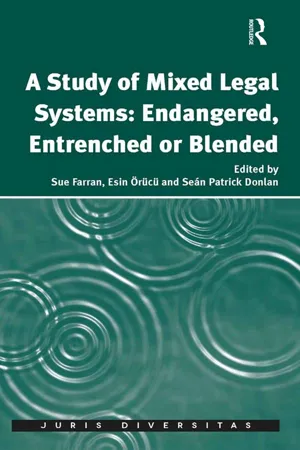
A Study of Mixed Legal Systems: Endangered, Entrenched or Blended
About this book
A Study of Mixed Legal Systems: Endangered, Entrenched, or Blended takes the reader on a fascinating voyage of discovery. It includes case studies of a number of systems from across the globe: Cyprus, Guyana, Jersey, Mauritius, Philippines, Quebec, St Lucia, Scotland, and Seychelles. Each combines its legal legacies in novel ways. Large and small, in Europe and beyond, some are sovereign, some part of larger political units. Some are monolingual, some bilingual, some multilingual. Along with an analytical introduction and conclusion, the chapters explore the manner in which the elements of these mixed systems may be seen to be 'entrenched', 'endangered', or 'blended'. It explores how this process of legal change happens, questions whether some systems are at greater risk than others, and details the strategies that have been adopted to accelerate or counteract change. The studies involve consideration of the colourful histories of the jurisdictions, of their complex relationships to parent legal systems and traditions, and of language, legal education and legal actors. The volume also considers whether the experiences of these systems can tell us something about legal mixtures and movements generally. Indeed, the volume will be helpful both for scholars and students with a special interest in mixed legal systems as well as anyone interested in comparative law and legal history, in the diversity and dynamism of law.
Chapter 1
Scotland
It is important first to look at the degree of endangerment, if any, through the sequence of events, since the history and the present may tell us different things about the status of a mixed legal system. This may very well be the case in Scotland, which was never a colony, but where the English common law is becoming more predominant compared to its historic roots in the civilian tradition. In fact, Sue Farran tells us that if anything is surprising about Scots law, it is perhaps that it has survived as a distinct system for so long. It has been under siege from England, with its common law, and more recently, European Union (EU) laws, it does not have a distinct language of its own (although it has a number of obscure legal terms, as she puts it), and it does not have a Civil Code. Yet, purists and comparatists continue to celebrate the unique features of Scots law as a distinct mixed legal system. Pragmatists and sceptics on the other hand, adopt a somewhat different view. Nonetheless, the fact that there is still a debate between the two must be evidence of a surviving species. Since law does not exist in a vacuum, one should consider other things going on, which may either endanger or strengthen the position of Scots law as a mixed legal system.
In this chapter, Farran draws attention to the external and internal forces that may, in the end, have much more bearing on the survival of Scots law as a mixed legal system than any laws. The reader could regard this legal system as one where its mixedness may be under threat, with strengthening common law content and a near suffocation of the civilian component, save in some specific and limited areas. When the different elements that gave birth to Scotland as a mixed legal system are weighed up, it is easy to come to the conclusion that now it is more common law oriented. There is both theoretical and empirical data in this chapter to support this view. However, there is also every likelihood that Scots law will remain mixed although the nature of that mixture may change.
Among the issues discussed the reader will find information as to the influence of history as a forming factor for the mix, the present possibilities following the referendum for independence to be held in September 2014, and the factors that maintain the legal system such as language, legal education, the personnel of the law – in academia, legal practice and courts of appeal – and legal literature. The chapter pays specific attention to events that have threatened the survival of Scots law as a distinct legal system.
Scotland: ‘Is the Tartan Fading?’
Introduction
The legal system of Scotland reflects much of the political history of Scots–English relationships, from outright and bloody warfare, to wary truce, and in more recent times, new assertions of sovereignty for Scotland following devolution in 1999 with a current movement towards independence from the United Kingdom (UK) by the Scottish National Party which will be the subject of a referendum in 2014. Despite or perhaps because of this uneasy relationship between Scotland and England, historically and today, the Scottish legal system has been regarded as distinct, if not always independent. Frequently regarded as a classical mixed legal system, the future of the Scottish system faces various possibilities. One is that the national referendum results in a political divorce between Scotland and the rest of the UK and therefore an opportunity to develop an increasingly distinct legal system – which may not necessarily be a classical mix but might, for example, be dominated by the demands of separate membership of the EU – as indeed is increasingly the case today within the UK. Alternatively, and possibly regardless of the outcome of the vote on Scottish independence under the referendum, the next decade might see an increasingly strong assertion of Scottish national identity and legal sovereignty as a stand against Westminster, globalization and its related general loss of autonomy, and a strengthening of the distinctiveness of the Scottish legal system to address its own domestic agenda.
A further possibility is that the referendum result is ‘no’, with a strengthening of ties between Scotland and the rest of the UK especially through the decisions of the Supreme Court, shared work by the English and Scottish Law Commissions and increasing trans-border law firms being established with branches in the ‘Central Belt’ (Glasgow and Edinburgh, and to a lesser extent, Stirling and Perth) and Aberdeen, providing a service largely to the commercial sector. In order to examine the strengths and weaknesses of these various possibilities this chapter considers the role of history, language, legal education, the courts and links with other members of the mixed legal family to determine the extent to which the Scottish legal system, as a mixed system, might be regarded as endangered if it was perceived that its civil law and mixed elements were in danger of being swamped by common law ones.
The Influence of History
Although there had been a number of attempts to bring the Scots under English rule, the major turning point for Scotland was when James V of Scotland became James I of England following the death of the childless English queen, Elizabeth I. King of Scotland before he was King of England and Wales, James’ ascension to the English throne ‘united’ the two countries, and the present Queen continues the tradition.1
The nature of Scots law prior to the 1707 Act of Union is the subject of debate among legal historians and not the subject matter of this chapter.2 What is significant, however, is that until the Act of Union, the Scottish courts, and to a lesser extent the Scottish Parliament, were free to borrow or reject English common law ideas and institutions, just as they could do with those from the civil law systems of the Continent.3 Scots law was also open to the reception of Roman and canon law from the Continent over a period of several centuries, although the influence of canon law seems to have waned from the Reformation in 1560 onwards – as indeed it did in England and Wales. Moreover Scots law developed its own common law through the cases,4 as well as retaining elements of Scots folk or customary law.5
Following Union the influence of English law accelerated in two ways. First as regards legislation which was made in Westminster, and secondly as regards appeals of civil cases.6 In respect of the former, rarely were the legislative needs of Scotland considered as being unique or distinct. Legislation was for the most part extended to Scotland, occasionally ‘kilted’ to make it appear more Scottish. As regards the latter, Article XVIII of the Treaty of Union 1707, expressly preserved Scots private law while Article XIX stated quite clearly that no causes in Scotland were to be heard in the English courts or any other court sitting at Westminster Hall. However, there was no reference in the Treaty to the Scots role of the Judicial Committee of the House of Lords or provision as to what was to happen to those appeals from the Inner House of the Court of Session which had previously been heard by the Scots Parliament – now abolished. Following test cases in 1707 and 1709, the appeal jurisdiction of the House of Lords, for Scots civil cases, emerged.7 This created considerably bad feeling as not only were Scots law cases being heard by non-Scots judges (in fact until 1844 frequently by peers who had no legal training at all let alone any knowledge of Scots law) but also, pending appeal to the Judicial Committee of the House of Lords, the execution of any judgment of the Court of Session was suspended (thereby undermining its authority). Appeal to the House of Lords, therefore, necessarily caused delays and was expensive.8 At its height over 20 cases a year were proceeding to the House of Lords from the Court of Session in Scotland.9 In almost all of them the House of Lords either overturned the Court of Session decision or remitted the case back to Scotland. Rarely were the decisions of the Scottish court upheld. Until the mid-nineteenth century there was little attempt to apply any Scots law and when it was raised the court often ignored it or assumed it must be the same as English law. For example, Lord Hope quotes Lord Chancellor Cranworth who stated in 1858:
But if such be the law of England, on what ground can it be argued not to be the law of Scotland? The law as established in England is founded on principles of universal application’.10
While this type of assumption must have been tiresome for litigants, perversely it may have been beneficial to the survival of Scots law. Walker, for example, has suggested that the ignorance of English judges and the English Parliament was a positive influence on the survival of Scots law, because both ‘contributed by their abstinence and non-interference to the maintenance of the distinctiveness of Scots law’.11 By the mid-nineteenth century a little more notice was being taken of Scots law but at the same time events on the Continent in the late eighteenth and early nineteenth century – particularly the French Revolution, together with industrial and commercial development in Britain and the wider British Empire, inclined Scotland more towards the common law and away from the civil law influence of Europe. Scotland, for example, never adopted the modern civilian codified tradition, the court structure or the public administration systems of the Napoleonic era or its aftermath.
The industrial revolution of the late eighteenth and nineteenth century gave rise to an increase in case law and legislation and it was perhaps inevitable that where there were gaps in the law in the face of rapid change, and fewer reported cases in Scotland than in England, that Scots lawyers would look to the jurisprudence of England and Wales. The momentum of the nineteenth century which prompted considerable legislative activity continued into the twentieth century, especially towards the latter half of the century, and there was, consequently, just much more law – in terms of statute law, criminal prosecutions, commercial and corporate law, the use of judicial review, and the emergence of new fields of law such as intellectual property law, family law and employment law. The law also became more complex demanding specialism in legal practice,12 so that generalists with a broad knowledge of the whole legal system found themselves increasingly marginalized, tending to have fewer commercial clients, fewer partners and were often located outside the major metropolitan areas.
While the wars of the twentieth century traversed intra-national boundaries, the use of regiments based on locality strengthened nationalism and between the wars there was a resurgence of emphasis on Scots law. In 1934 the Stair Society was established to assist in the ‘rebirth of Scots law’, and to engender a ‘Scottish legal renaissance’.13 Among the strongest protagonists of this movement were TB Smith and Lord Cooper, who between them advocated a Scottish legal nationalism which rejected any benefits of English law, stressing instead those of the civil law tradition.14 Even by those who support the classification of Scots law as a mixed legal system, there has been some criticism of the ‘neo-civilian and legal nationalist bias’ of TB Smith and Lord Cooper, which it has been suggested warped ‘their historical judgment’, and ‘idealized the period of the Institutional writers from 1681 till about 1800 as a golden age’.15 Pragmatists tend to accept that there have either been periods of strong convergence between English law and Scots, or areas of la...
Table of contents
- Cover Page
- Half Title page
- Title Page
- Copyright Page
- Contents
- List of Tables
- Notes on Contributors
- Preface
- An Introductory Overview
- 1 Scotland
- 2 Guyana
- 3 Philippines
- 4 Jersey
- 5 Mauritius
- 6 Seychelles
- 7 Quebec
- 8Saint Lucia
- 9 Cyprus
- Endnote to Mixed Legal Systems: Endangered, Entrenched, Blended or Muddled?
- Index
Trusted by 375,005 students
Access to over 1.5 million titles for a fair monthly price.
Study more efficiently using our study tools.
Frequently asked questions
Yes, you can cancel anytime from the Subscription tab in your account settings on the Perlego website. Your subscription will stay active until the end of your current billing period. Learn how to cancel your subscription
No, books cannot be downloaded as external files, such as PDFs, for use outside of Perlego. However, you can download books within the Perlego app for offline reading on mobile or tablet. Learn how to download books offline
Perlego offers two plans: Essential and Complete
- Essential is ideal for learners and professionals who enjoy exploring a wide range of subjects. Access the Essential Library with 800,000+ trusted titles and best-sellers across business, personal growth, and the humanities. Includes unlimited reading time and Standard Read Aloud voice.
- Complete: Perfect for advanced learners and researchers needing full, unrestricted access. Unlock 1.5M+ books across hundreds of subjects, including academic and specialized titles. The Complete Plan also includes advanced features like Premium Read Aloud and Research Assistant.
We are an online textbook subscription service, where you can get access to an entire online library for less than the price of a single book per month. With over 1.5 million books across 990+ topics, we’ve got you covered! Learn about our mission
Look out for the read-aloud symbol on your next book to see if you can listen to it. The read-aloud tool reads text aloud for you, highlighting the text as it is being read. You can pause it, speed it up and slow it down. Learn more about Read Aloud
Yes! You can use the Perlego app on both iOS and Android devices to read anytime, anywhere — even offline. Perfect for commutes or when you’re on the go.
Please note we cannot support devices running on iOS 13 and Android 7 or earlier. Learn more about using the app
Please note we cannot support devices running on iOS 13 and Android 7 or earlier. Learn more about using the app
Yes, you can access A Study of Mixed Legal Systems: Endangered, Entrenched or Blended by Sue Farran,Esin Örücü in PDF and/or ePUB format, as well as other popular books in Law & Comparative Law. We have over 1.5 million books available in our catalogue for you to explore.