eBook - ePub
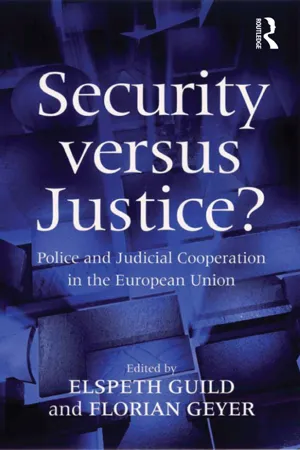
Security versus Justice?
Police and Judicial Cooperation in the European Union
- 352 pages
- English
- ePUB (mobile friendly)
- Available on iOS & Android
eBook - ePub
Security versus Justice?
Police and Judicial Cooperation in the European Union
About this book
One of the most dynamic areas of EU law since the great changes brought to the EU constitutional order by the Amsterdam Treaty in 1999 has been cooperation in the fields of policing and criminal justice. Both fields have already been the subject of substantial legislative effort in the EU and an increasing amount of judicial activity in the European Court of Justice. In 2007 - after the Constitutional Treaty of 2004 failed - the new Reform Treaty planned very substantive changes to these policies. Bringing together a wide-ranging set of topics and contributors, this book enables readers to understand these changes by examining three key questions: how did we get to the Reform Treaty; what have been - and still are - the key struggles in competence; and how do the changes fit into the transformation of police and judicial cooperation in criminal matters in the EU?
Information
Chapter 1
Introduction: The Search for EU Criminal Law—Where is it Headed?
One of the most dynamic fields of EU law since the great changes brought to the EU constitutional order by the Amsterdam Treaty in 1999 has been cooperation in the fields of policing and criminal justice. Irrespective of whether the Reform Treaty is ratified by the member states, these two areas will continue to be high on the political and legislative agenda. Both fields have already been the subject of substantial legislative effort in the EU and an increasing amount of judicial activity in the European Court of Justice (ECJ). The original three treaties—creating the economic community, atomic energy community and steel and coal community—did not expressly anticipate the inclusion of policing and criminal law. Similarly, the objective of economic integration while requiring a mechanism of enforcement did not foresee the use of criminal law and the concomitant police involvement as a central part of the structure. In 2007, the Reform Treaty planned wide ranging changes to both EU police cooperation and judicial cooperation in criminal matters. In the meantime, the ECJ has found the use of criminal law sanctions in pursuit of Community law objectives to be lawful.1 In order to understand these changes we must first review how we got to the Reform Treaty, what have been the key struggles in competence and how the Reform Treaty changes fit into the transformation of police and judicial cooperation in criminal matters in the EU.
To seek for answers to these questions is one of the main objectives not only of this introductory chapter, but also of this entire volume. This book is in large parts the outcome of a doctoral training school that was held in April 2007 at the Centre for European Policy Studies in Brussels, organized within the framework of CHALLENGE—an integrated project funded by the Sixth Framework Programme for Research of the European Commission. Its task was to explore the question: “Police and judicial cooperation in criminal matters in the EU: Which future for the EU’s third pillar?” And in fact at the time of the Training School this future was rather bleak. Hardly anyone would have dared to take a bet that a couple of months later European heads of state and government would actually be able to agree on a text that addresses some of the more notorious flaws in the institutional setting of the third pillar.
The circumstances accompanying the production of this volume allow us to take a look at major third-pillar issues from a unique perspective: assessing and analysing their present form (as influenced by their past) while being able to take the changes into account expected to be brought about by the Reform Treaty. As stated above, it is this perspective that makes us understand the envisaged new setting.
Furthermore the origin of this volume enabled us to bring together a unique combination of contributors from many different disciplines all across the EU: young researchers at doctoral level together with renowned experts, academics and practitioners alike.
Hence the first part of the volume is dedicated to some of the major actors of police and judicial cooperation in criminal matters, notably the agencies and bodies set up at EU level to facilitate cooperation and coordination of national authorities, as well as the European Court of Justice (ECJ) and member states themselves. Accountability, transparency, democratic and judicial control, emerge to be the underlying themes of this first part, themes, however, that constantly reverberate throughout the subsequent chapters. The first part sets off with Sonja Puntscher Riekmann providing (in Chapter 2) a comparative analysis of provisions relating to accountability and transparency in the legal acts setting up Europol (third pillar) and Frontex (first pillar). Jiří Vlastník then adds to this by assessing the current and future setting of Eurojust, the European Judicial Cooperation Unit, posing the question whether this unit can be perceived as precursor of a federal style of European criminal justice (Chapter 3). Control exercised by the European Court of Justice in the third pillar is the topic of Eulalia Sanfrutos Cano’s contribution in Chapter 4. A contentious issue as the ECJ was originally intended to play only a minor role in this field. However, “by way of its cautious yet at the same time audacious jurisprudence, the Court has questioned the intrinsic characteristics of intergovernmental cooperation in criminal matters” as she observes. In contrast, the absence of control and the lack of transparency are the major issues of Judit Tóth’s contribution (Chapter 5) concluding this first part on the actors. Drawing from recent reports of the Council of Europe and the European Parliament she addresses EU member states’ complicity in CIA activities on European territory and assesses member states’ reactions to these reports.
The second part of the book is dedicated to “Concepts and Instruments.” It commences with a critical assessment by Didier Bigo of the EU development in the area of freedom, security and justice and how this affects national sovereignty. Putting a question mark behind the axiom that we live in a world of unprecedented threats, he raises the question whether state sovereignty is merely an old-fashioned argument masking egoistic self interest or whether it is the ultimate argument against global security hegemony (Chapter 6). In the chapter that follows Bigo’s more conceptual assessment, Julia Sievers concentrates on the flagship instrument of EU-wide judicial cooperation: the framework decision on the European arrest warrant. Applying an empirical approach, she analyses first experiences with the application of this instrument, comparing Germany and the UK with regard to legislative implementation and everyday application by national courts. “Too different to trust?” is the provocative starting point of her contribution (Chapter 7). Returning to a more conceptual and theoretical approach Gloria González Fuster and Pieter Paepe scrutinize the contrasting cases of EU data protection and criminal law based on the reflexive governance theory. Their objective is to propose a reflexive assessment of these case studies that may benefit EU third pillar governance (Chapter 8).
Under the headline “Law and Policy” Valsamis Mitsilegas, Mar Jimeno Bulnes and Rocco Bellanova in three separate chapters address some of the most contentious third pillar issues in recent years: the Community’s (first pillar!) competence to define legally binding criminal sanctions and penalties (Mitsilegas—Chapter 9); the adoption of common procedural safeguards for suspects in criminal proceedings throughout the EU (Jimeno Bulnes—Chapter 10); and the “Prüm experience” hailed by some as the way forward, criticized by others as a sign of contempt towards EU structures and procedures, lacking parliamentary oversight and involvement (Bellanova—Chapter 11). None of these three issues had been entirely settled at the time of preparation of this volume. And as it appears, not even the Reform Treaty will be able to solve all the questions and struggles that are inherent in them.
The last part mainly concentrates on practical questions: “Practice—Achievements and Obstacles” starts off with a contribution by Toine Spapens providing a criminological assessment of trans-frontier criminality in the Meuse-Rhine Euroregion and how EU and bilateral police and judicial cooperation impacts on this “laboratory” (Chapter 12). In the subsequent chapter entitled “Uniforms without uniformity,” Peter Hobbing sticks to the practicalities of police work. He reports on his frustrating quest to find “common EU standards in policing,” a concept often referred to in EU political statements and legal texts but still far from being reality (Chapter 13). Turning away from policing and the professionals of security, Richard Lang hence shares insights and experience he has acquired as a solicitor in practical cases affected by EU law. In three concise case studies he illustrates different ways in which practitioners can encounter the third pillar (Chapter 14). In the final chapter of this part, Susie Alegre takes a wider perspective, leaving to a certain extent the third pillar behind and investigating the intended global impact of the language and position of human rights in the EU Counter-Terrorism Strategy 2005. She criticizes the absence of any clarity as to how the EU ensures respect for human rights while combating terrorism and states that this makes it difficult for the EU to act as a promoter of human rights in this context outside its borders (Chapter 15).
Finally, in the concluding chapter of this volume Sergio Carrera and Florian Geyer assess the impact of the Reform Treaty on the common area of freedom, security and justice (Chapter 16).
Having outlined the genesis and structure of this volume, let us return to our introductory chapter and the questions initially posed: how did we got to the Reform Treaty? What have been the key struggles in competence? How will the Reform Treaty fit into the transformation of police and judicial cooperation in criminal matters in the EU?
The EU’s Engagement with Police and Judicial Cooperation in Criminal Matters
An EU engagement with policing and criminal law began quite gradually—mainly as a response to the proposal to abolish intra member state border controls (Brouwer 2007). The Schengen Agreement of 1985, although outside the framework of the European Economic Community (EEC) as it then was, first brought to the legislative table the issue of policing. The inclusion in that treaty (which began with five of the then 12 member states) of provisions on police cooperation was the first visible manifestation of member states’ concerns regarding the abolition of intra member state border controls and the effects on policing. In the Single European Act, signed in 1986 to amend the EEC Treaty, the abolition of these border controls was agreed with a deadline of 31 December 1991 without any express reference to policing and criminal justice (Guild 2006). 1990 brought two key changes to the European legal landscape on policing and criminal justice—on the one hand the signing of the Schengen Implementing Agreement which specifically provided for police cooperation across borders complete with the principle of ne bis in idem (the legal principle that an individual cannot be the objective of a criminal trial twice for the same cause of action or double jeopardy); and secondly the signing of the first EUROPOL convention establishing an institution loosely connected with the EU which would provide the engine for EU wide police cooperation.
The Rhodes Council of December 1988 tied progress on the abolition of border controls for the free movement of persons with progress on police cooperation and criminal law: “The European Council is aware that in the latter area, [free movement of persons], the achievement of the Community’s objectives, especially the area without internal frontiers, is linked to progress in intergovernmental cooperation to combat terrorism, international crime, drug trafficking and trafficking of all kinds.” To make progress on these issues the Council set up a Coordinators’ Group charged with presenting a report on the field. The result, the Palma Document, was presented to and approved by the Council in 1989, set out, both clearly the framework for police and judicial cooperation in the EU. It is worth going back to that document to examine the agenda which it set out and where we are now. The Coordinators suggest that “The achievement of an area without internal frontiers could involve as necessary, the approximation of national laws and their rules of application and scope, collaboration between national administration and a prior strengthening of checks at external frontiers.” They recommend two mechanisms—one entitled “ad intra” which are the measures needed within the EU to achieve the abolition of border controls. The other they called “ad extra” which relates to external border controls.
Looking then, at the ad intra facet, the Coordinators call for three sets of measures which are central to the current area of freedom, security and justice:
• Combating terrorism, drug trafficking and other illicit trafficking: the creation of an area without internal frontiers, in accordance with the Treaty, will require checks at the external frontiers to be tightened up which will involve increased inter-governmental cooperation.
• Improved cooperation on law enforcement: this improvement will in particular involve closer cooperation between the member states’ law enforcement agencies, and an improved system for exchanging information.
• Judicial cooperation: judicial cooperation should be intensified, particularly in criminal matters, in order to combat terrorism, drug trafficking, crime and other illicit trafficking. In this context, the possibility of harmonizing certain provisions should be studied.
Just as the deadline for the abolition of intra member state border controls approached, the EU embarked on a new intergovernmental conference which finished in 1991 and resulted in the Maastricht Treaty which reframed very substantially the EU (indeed, the EU per se was only created as a result of the Maastricht Treaty). The famous pillar structure of the EU was created through a new treaty—the Treaty on European Union (TEU). The original three treaties were stuffed into the so called “first pillar,” the only one with legal personality; the common foreign and security policy inhabited the shadowy “second pillar” and the “third pillar” covered justice and home affairs, issues stretching from immigration and asylum to policing and drug trafficking.
It is worth noting at this point, that the Coordinators recommended to the Council that terrorism and drug trafficking remain inter-governmental. Cooperation on law enforcement they considered in effect as a practical matter which required law enforcement agencies to speak to one another. Judicial cooperation in criminal matters was tied to combating terrorism and here the Coordinators envisaged the possibility of harmonization. At least it was a subject to be studied. In the event, in the 1991 Treaty, everything went into the third pillar which was definitely intergovernmental in form—run by the member states (primarily the justice and interior ministries)—sheltered from the inquisitive eye of the European Parliament which was entitled only to an annual report; and protected from judicial control by the ECJ. The result may have been satisfactory for some of the actors in the Union but was a source of great friction between and among the EU institutions whose competences were chopped up and divided and the EU institutions and many non-governmental organizations which demanded greater transparency, democratic and judicial accountability.
The 1999 Compromises
The shape which the EU took once the Maastricht Treaty came into force in 1993 (the delay a result of a rejection by referendum in Denmark) did not actually last that long. By 1996 a new intergovernmental conference was opened the purpose of which was to achieve a greater degree of institutional and structural order in the EU. A number of fundamental flaws were appearing in the fabric of the EU—judicial challenges among the institutions regarding their competence for policy areas split between the first and third pillars (see for instance ECJ case C-170/96 Commission v. Council 12 May 1998 on the correct legal basis for airport transit visas) and between the Parliament and just about everyone else over the right to participate in the law making process in the split first and third pillars (see for instance C-392/95 Parliament v. Council 10 June 1997 on the legislative procedure regarding the visa list) were cropping up regularly. The result being that the ECJ was ultimately responsible for determining the political structure of the EU.
Another source of trouble was the developm...
Table of contents
- Cover Page
- Half Title Page
- Title Page
- Copyright Page
- Table of Contents
- List of Graphs and Tables
- Acknowledgements
- Notes on Contributors
- List of Abbreviations
- 1 Introduction: The Search for EU Criminal Law—Where is it Headed?
- Actors
- Concepts and Instruments
- Law and Policy
- Practice—Achievements and Obstacles
- A Possible Future
- Bibliography
- Index
Trusted by 375,005 students
Access to over 1.5 million titles for a fair monthly price.
Study more efficiently using our study tools.
Frequently asked questions
Yes, you can cancel anytime from the Subscription tab in your account settings on the Perlego website. Your subscription will stay active until the end of your current billing period. Learn how to cancel your subscription
No, books cannot be downloaded as external files, such as PDFs, for use outside of Perlego. However, you can download books within the Perlego app for offline reading on mobile or tablet. Learn how to download books offline
Perlego offers two plans: Essential and Complete
- Essential is ideal for learners and professionals who enjoy exploring a wide range of subjects. Access the Essential Library with 800,000+ trusted titles and best-sellers across business, personal growth, and the humanities. Includes unlimited reading time and Standard Read Aloud voice.
- Complete: Perfect for advanced learners and researchers needing full, unrestricted access. Unlock 1.5M+ books across hundreds of subjects, including academic and specialized titles. The Complete Plan also includes advanced features like Premium Read Aloud and Research Assistant.
We are an online textbook subscription service, where you can get access to an entire online library for less than the price of a single book per month. With over 1.5 million books across 990+ topics, we’ve got you covered! Learn about our mission
Look out for the read-aloud symbol on your next book to see if you can listen to it. The read-aloud tool reads text aloud for you, highlighting the text as it is being read. You can pause it, speed it up and slow it down. Learn more about Read Aloud
Yes! You can use the Perlego app on both iOS and Android devices to read anytime, anywhere — even offline. Perfect for commutes or when you’re on the go.
Please note we cannot support devices running on iOS 13 and Android 7 or earlier. Learn more about using the app
Please note we cannot support devices running on iOS 13 and Android 7 or earlier. Learn more about using the app
Yes, you can access Security versus Justice? by Florian Geyer, Elspeth Guild in PDF and/or ePUB format, as well as other popular books in Politics & International Relations & Politics. We have over 1.5 million books available in our catalogue for you to explore.