eBook - ePub
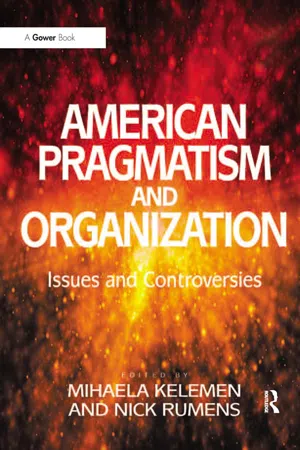
American Pragmatism and Organization
Issues and Controversies
- 258 pages
- English
- ePUB (mobile friendly)
- Available on iOS & Android
eBook - ePub
About this book
Emerging during the late nineteenth century in the diverse scholarship of US commentators such as Charles Sanders Peirce, William James and John Dewey, American pragmatism shaped many intellectual currents within a range of disciplines including politics, education, administrative science and religion. Despite attracting attention and interest due to its conceptualization of theory, in terms of its practical consequences for improving the human condition, American pragmatism struggled to maintain its influence and suffered a hiatus until it experienced a renaissance within scholarly circles during the 1970s. While renewed interest in American pragmatism continues to grow, with some scholars distinguishing between classical, neo and new forms of pragmatism, it is only relatively recently that organization studies scholars have drawn upon American pragmatist philosophies for shedding new light on aspects of contemporary organizational life. This edited collection builds on this emergent literature in an engaging and scholarly manner. American Pragmatism and Organization is a ground-breaking collection and distinctive in its book-length treatment of American pragmatism as a relevant resource for analysing organisations. It draws together an international body of research focused on the interconnections and interplay between American pragmatism and organizational phenomena, explores the theoretical possibilities afforded by pragmatist thinking for understanding organization, and illuminates the practical advantages of doing so.
Part 1 Theory and Context
1 American Pragmatism and Organization Studies: Concepts, Themes and Possibilities
DOI: 10.4324/9781315566696-1
Introducing American Pragmatism
On 26 August 1898, in a speech to the Philosophical Union of the University of California, in Berkeley, US, an individual by the name of William James used the word ‘pragmatism’ to designate a philosophical position. This moment has come to be acknowledged as a significant milestone in the commitment toward the development of American pragmatism as a philosophical movement in the US, which emerged in the 1870s and flourished until the end of World War II. Summarizing the main thrust and merits of American pragmatist philosophies is difficult, not least because they are not a unified body of ideas, perspectives and theories. Still, put simply, American pragmatism may be described as a practical and anti-foundationalist philosophy that focuses on the future, concerned with improving the conditions that enable individuals to thrive in their everyday lives. It collapses not only the artificial division between theory and practice, emphasizing the link between theory and praxis, but also other restrictive dualisms (e.g. body-mind, subject-object), by a process of inquiry that understands knowledge as social phenomena and the value of theory by the consequences and actions it produces. That being said, we do not wish to provide essentialist definitions, acknowledging that other commentators may place emphasis on different qualities and characteristics associated with American pragmatism.
During its heyday, roughly from the 1890s to 1930s, American pragmatism established itself on the philosophical landscape in the US, influencing theory and practice within and across the realms of politics, psychology, education and religion, to name just a few. Yet in the years after World War II, the credibility American pragmatism had previously enjoyed began to wane. As analytical philosophies such as logical positivism gained the ascendancy, American pragmatist struggled to respond to the criticism leveled at it by its adversaries. Following the death of John Dewey in 1952, someone who is often credited with advancing the pragmatic approach within academic circles well into the early decades of the twentieth century, American pragmatism receded into the background. It is important to note that American pragmatism had been in trouble for some years prior to Dewey’s death. Explanations for its alleged demise are varied and disputed, although we might point to the frequent charges levied by its critics of naiveté, idealism and romanticism. For example, while Dewey and his fellow pragmatists believed in the ability of the American ‘civilization … (to) … establish and nourish institutions that will promote the liberation of the talents and potentialilites of all citizens’ (Dewey 1928: 134), his opponents viewed this as an unattainable dream and criticised the simplicity of the proposed pragmatist methods by which such goal could be reached. This gave ammunition to critics who attacked American pragmatism for being vague, lacking clarity and robust philosophical foundations, for being deficient of grand themes and ideals as present in metaphysical philosophies. But the story does not end here.
American pragmatism did not disappear altogether, but it did suffer from marginalization for a number of years. It is in 1979 that we witness a marked reversal of pragmatism’s fortune instigated, in part, by the publication of Richard Rorty’s Philosophy and the Mirror of Nature. This was the beginning of a resurrection in pragmatist philosophies and, arguably, heralded the emergence of neo-pragmatism_ informed by but distinct from classical American pragmatism. Philosophers such as Richard Rorty and Hilary Putnam helped to reinvent American pragmatism, restoring something of its former intellectual reputation and furnishing it with a new sense of direction. Since then American pragmatism has entered what we might dub a ‘third phase’, with new scholars reworking its concepts and ideals to maintain its contemporary vitality and relevance, of which the contributors to this edited volume are striking examples.
While it is relatively easy to chart the vicissitudes of American pragmatism, it is much harder to pinpoint exactly what it is. As with many philosophies, American pragmatism encompasses diverse positions, often competing and contradictory, and a range of founding figures who steered pragmatism in different directions. A key observation here is that American pragmatism does not cohere around a neat and tidy set of principles or distinctive doctrine. This is explained, in part, by the lack of general consensus among early pragmatists about what, exactly, pragmatism is – more on this later. As Peter Jackson rightly points out in this volume (Chapter 3), it is a ‘tall order’ to define American pragmatism, but it is a challenge that we confront over the pages of this introductory chapter.
One important reason for getting to grips with American pragmatism is the overarching argument, presented and developed across the chapters of this edited collection, that American pragmatism has much to offer organization studies. More specifically, we argue that, from one perspective, American pragmatism has already enriched organization studies but its influence and popularity is not widespread, seldom acknowledged and sometimes misunderstood. Put differently, the potential American pragmatism holds for informing how scholars and practitioners understand, analyze and ‘improve’ forms of organization and management to the benefit of human experience is, with some notable exceptions (Elkjaer and Simpson 2011; Watson 2010; Fontrodona 2002), largely unrealised. Indeed, from the perspectives of those who have contributed to this book, even those individuals who express scepticism, American pragmatism offers attractive modes of thought, positions and concepts that are not easily dismissed. This appeal is strong in a context of ongoing concerns about the role and ‘value’ of theory in ‘improving’ management, how some modes of organizing have detrimental effects for those who are ‘managed’ and the apparent lack of imagination to envision new, alternative ways of organizing and improving the human experience in organization (Delbridge and Keenoy 2010; Hambrick 2007; Markoczy and Deeds 2009; Parker 2002).
Over the course of this chapter, we provide background information about some of American pragmatism’s key figures, major concepts and themes that, together, have shaped the content of the chapters in this edited collection. Collectively, these chapters aim to bring to the fore the relevance of American pragmatism for understanding organizational issues that relate to public administration, economics, finance, organizational learning, spirituality and emotion in the workplace. All contributions exhibit a passion for American pragmatism and evaluate whether American pragmatism can provide a different and constructive lens through which we may examine and alter contemporary organizational life.
Key Figures
In this section we provide background information about some of the key figures associated with American pragmatism. This is necessarily brief, not due just to the limits of space, but also because of the sheer number of people who, over the years, have shaped the course of American pragmatist philosophies. These include the early pragmatists such as Charles Sanders Peirce, William James, John Dewey, Jane Addams and George Herbert Mead, and those later associated with its resurrection such as W.V. Quine, Hilary Putnam and Richard Rorty. It is crucial to note this is by no means an exhaustive list, with much scholarly discussion having taken place about who is and who is not a ‘pragmatist’. Not all this debate about who/does not qualify as a ‘pragmatist’ has been productive, revealing more about the fractured nature of pragmatism as a movement and the diverse array of people associated with it. For the purpose of this introductory chapter and the book more broadly, we focus on three major figures connected with what some call ‘classical American pragmatism’: Charles Sanders Peirce, William James and John Dewey; all of whom figure centrally in many writings on American pragmatism. However, we may also add Josiah Royce and George Herbert Mead to the canon of ‘classical American pragmatists’, although restrictions of space do not allow us to discuss the contributions of these figures further.
Charles Sanders Peirce (1839–1914)
Charles Sanders Peirce is often regarded as the founding figure in pragmatism, coining its name as well as some of its ideals. Born in Cambridge, Massachusetts, US, in 1839, Peirce’s fascination with logic and reasoning started at an early age. He graduated from Harvard University in 1859 and in 1863 he was awarded Harvard’s first-ever summa cum laude chemistry degree. It was at Harvard where he met and began his lifelong friendship with William James. Peirce worked intermittently between 1859 and 1891 for the US Coast Survey. From 1879 to 1884 he was employed by Johns Hopkins University as a lecturer in logic (among his students was John Dewey). This was the only academic appointment that Peirce ever held. In 1887, Peirce received a modest inheritance from his parents and purchased a plot of land in Milford, Pennsylvania. It was here that he wrote prolifically, although much of this work was published posthumously. Peirce lived meagrely but he continued to write. Throughout this period the ever-faithful William James arranged occasional lectures for him in Cambridge. Peirce also relied on reviewing articles and writing encyclopaedia entries to supplement his income. Be that as it may, Peirce never attained the scholarly reputation enjoyed by William James and John Dewey, and he died destitute 20 years before his widow in 1914.
Peirce only ever had one book published in his lifetime, which was on astronomy: Photometric Researches (1878). His intellectual reputation rests on his prolific article writing in American scholarly journals and on the thousands of unsorted papers/documents sold to Harvard University by his wife after he had died. It is striking then that it did not become clear until 1967 that Peirce had left 1,650 unpublished manuscripts, equating to over 100,000 pages. Much but by no means all of Peirce’s writing has been published in anthologies. From these volumes, it is clear that Peirce’s work is diffuse in its coverage of topics and issues, not all of which directly relate to pragmatism, and his writing style obscure and dense, earning Peirce the reputation of not being the most accessible of the early pragmatists. Yet, these limitations notwithstanding, Peirce had an acute influence on what we currently understand as classical American pragmatism.
In order to provide some flavour of his thoughts and ideas on pragmatism, it is useful to refer to his often-cited articles (‘The Fixation of Belief’ and ‘How to Make Our Ideas Clear’) which appeared in a collection titled ‘Illustrations of the Logic of Science’, published in Popular Science Monthly (1877–78). These articles are considered by many to be pivotal in inaugurating the pragmatist movement (Bernstein 2010). Notably, in ‘How to Make Our Ideas Clear’, Peirce proposed a ‘pragmatic’ notion of clear concepts. Both papers, however, reveal that, for Peirce, pragmatism was a theory of standing in opposition to or questioning various strands of idealism. Significantly, Peirce did not use the term ‘pragmatism’ to identify his overall philosophical position and orientation. He proffered that theorising alone was unsatisfactory and that the effects of beliefs should be tested in the real world. Yet, as the term ‘pragmatism’ attracted more and more attention, Peirce became unhappy with the ways it was interpreted. It is notable then that, in 1905, Peirce coined the term ‘pragmaticism’ in an attempt to distance himself, and to distinguish his original conceptualization of the word ‘pragmatism’ from others’ perceptions and from what it had become to be recognised as in the literary journals. He famously stated that pragmaticism was ‘to serve the precise purpose of expressing the original definition’, saying that it was ‘ugly enough to be safe from kidnappers’.
William James (1842–1910)
William James was born in New York City on 11 January 1842, the son of Henry James Sr. who was a wealthy, eccentric, theologian and philosopher in his own right. In fact, the James family was marked by intellectual brilliance. His brother and sister were notable writers: Alice James was a diarist and Henry James is commonly regarded as one of the most acclaimed American novelists. William James could speak fluent French and German, and visited Europe many times as a child and throughout his life. From an early age, James was interested in becoming a painter and although his father initially resisted, James was permitted to study art under William Morris Hunt before enrolling at Lawrence Scientific School at Harvard to study chemistry in 1861. In 1864 he enrolled at Harvard’s School of Medicine. He then studied physiology at Berlin University until 1868, before returning to Harvard to complete his MD degree in 1869. James never practised medicine and, in 1872, he accepted a role at Harvard to teach an undergraduate course in comparative physiology. James secured himself as an academic, spending almost his entire career at Harvard where he was eventually made a full professor in philosophy in 1885.
James wrote prolifically throughout his life, encompassing the disciplines of physiology, psychology and philosophy. His works are numerous and varied but he gained widespread recognition for Principles of Psychology (1890) which took him 12 years to write. Two years later, he wrote a condensed version, Psychology: The Briefer Course (1882). There were many influential concepts which came out of these books including his analysis of the ‘stream of thought’, his characterization of the ‘self’ and his theory of emotion. His ideas sometimes courted controversy. In 1896 he published ‘The Will to Believe’, a lecture in which he defended the concept of a belief without prior evidence of its truth, such as religious faith without sufficient evidence of religious truth. As one of the early pioneers of pragmatism, James is often noted for being the first to use the word in print in 1898, although he rightly credited its conception to Charles S. Peirce. Among his many intellectual endeavours, James criticised empiricism for being too dependent upon the elements and the origins of experience, and how it did not satisfactorily deal with the...
Table of contents
- Cover Page
- Half Title Page
- Dedication
- Title Page
- Copyright Page
- Table of Contents
- List of Figures and Tables
- About the Editors
- About the Contributors
- Acknowledgments
- PART 1 THEORY AND CONTEXT
- PART 2 AMERICAN PRAGMATISM APPLIED
- Index
Trusted by 375,005 students
Access to over 1.5 million titles for a fair monthly price.
Study more efficiently using our study tools.
Frequently asked questions
Yes, you can cancel anytime from the Subscription tab in your account settings on the Perlego website. Your subscription will stay active until the end of your current billing period. Learn how to cancel your subscription
No, books cannot be downloaded as external files, such as PDFs, for use outside of Perlego. However, you can download books within the Perlego app for offline reading on mobile or tablet. Learn how to download books offline
Perlego offers two plans: Essential and Complete
- Essential is ideal for learners and professionals who enjoy exploring a wide range of subjects. Access the Essential Library with 800,000+ trusted titles and best-sellers across business, personal growth, and the humanities. Includes unlimited reading time and Standard Read Aloud voice.
- Complete: Perfect for advanced learners and researchers needing full, unrestricted access. Unlock 1.5M+ books across hundreds of subjects, including academic and specialized titles. The Complete Plan also includes advanced features like Premium Read Aloud and Research Assistant.
We are an online textbook subscription service, where you can get access to an entire online library for less than the price of a single book per month. With over 1.5 million books across 990+ topics, we’ve got you covered! Learn about our mission
Look out for the read-aloud symbol on your next book to see if you can listen to it. The read-aloud tool reads text aloud for you, highlighting the text as it is being read. You can pause it, speed it up and slow it down. Learn more about Read Aloud
Yes! You can use the Perlego app on both iOS and Android devices to read anytime, anywhere — even offline. Perfect for commutes or when you’re on the go.
Please note we cannot support devices running on iOS 13 and Android 7 or earlier. Learn more about using the app
Please note we cannot support devices running on iOS 13 and Android 7 or earlier. Learn more about using the app
Yes, you can access American Pragmatism and Organization by Nick Rumens, Mihaela Kelemen in PDF and/or ePUB format, as well as other popular books in Business & Business General. We have over 1.5 million books available in our catalogue for you to explore.