eBook - ePub
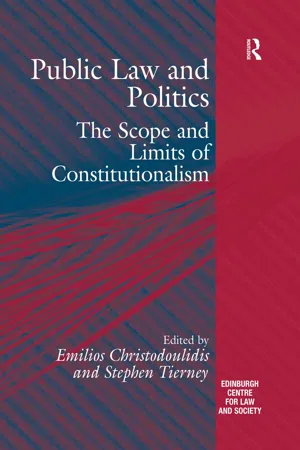
Public Law and Politics
The Scope and Limits of Constitutionalism
- 232 pages
- English
- ePUB (mobile friendly)
- Available on iOS & Android
eBook - ePub
Public Law and Politics
The Scope and Limits of Constitutionalism
About this book
In a critical engagement with the function of public law and with constitutionalism in its political dimensions, this volume brings together the reflections of three leading constitutionalists: Martin Loughlin, James Tully and Frank Michelman. Comprising three critical commentaries on each, it addresses the multiple ways in which public law is implicated in the logic of rule. This operates on the one hand in maintaining and underwriting relative patterns of power and weakness through political structures and processes. On the other hand, public law is considered to contain the potential to redress these patterns through the use of constitutional authority, social and economic as well as civil and political rights, redistribution of political power, the expansion of territorial governance, and moves to supra-state levels of authority. The book reproduces, in a succinct and organized way, the insights into both the limitations and the potentialities of public law within its political setting.
Chapter 1
Public Law and Politics: Rethinking the Debate
I Framing the Debate
This volume seeks to arrive at a better understanding of how the relationship between public law and politics is conceptualised by constitutional theorists today. And to this end we asked the contributors in this volume to take issue with the following question: Should constitutionalism be envisaged as a discrete sphere, hermeneutically closed off or self-standing, subject to its own proper logic which can be described without the deployment of categories of political theory? The book brings together three leading constitutionalists: Frank Michelman from the American constitutionalist tradition which has its emphasis on internal constitutional debates surrounding the substance and processes of a long-settled and popularly endorsed written constitutional settlement. Martin Loughlin who, in The Idea of Public Law,1 articulates a relational account of public law as a phenomenon that has developed in close synergy with its political environment; an account steeped in classical European thinking from the age of modernity to the present. And James Tully, whose radical philosophy presents one of the most startling challenges to orthodox constitutional thinking today, asking questions of liberal constitutionalism in an age where people and peoples call for constitutional recognition of the pluralism which, for Tully, both defines our time and is obscured in the hegemonic structures of established constitutional theory and practice. This project was organised by the Centre for Law and Society within the University of Edinburgh through three day-long workshops in 2006, each involving one of the main contributors and a number of papers offered in commentary by members of the Edinburgh Law School and colleagues working in the area of constitutional and political theory either in Scotland or abroad. This collection comprises a selection of these commentaries.
The relationship between politics and public law is a vexing one. In essence, the issue our principal contributors were asked to engage with was the interplay between the legal and the political, exposing the possibility for critical engagement with the function of public law and with constitutionalism in its political dimensions, and searching for the multiple ways in which public law is implicated (per Loughlin) in the logic of rule. This logic of rule seems to operate, on the one hand, in maintaining and underwriting relative patterns of power and weakness through political structures and processes. On the other hand, public law may be considered to contain the potential to redress these patterns through the use of constitutional authority, for example in the application of social and economic as well as civil and political rights, in the redistribution of political power through the development of new sites of territorial governance that reflect sub-state identity patterns, and in moves to supra-state levels of authority. The book tries to reproduce in a succinct way the insights we arrived at which help both expose the limitations and suggest the potentialities of public law within its political setting.
The book begins with four chapters focused upon The Idea of Public Law which, both in the UK and elsewhere, has triggered extensive debate in recent years concerning the nature of our discipline. In his chapter, Loughlin takes the opportunity to re-explain the purpose of the book and to answer critics who, in reviewing the book have, in his view, misunderstood its foundational purpose and intellectual contribution. He also responds directly to the commentaries by Stephen Tierney, Scott Veitch and Emilios Christodoulidis. The other two parts of the book have a slightly different format. The chapters by James Tully and Frank Michelman constitute new work, and therefore these chapters are themselves the subject of responses by three commentators. In reference to Tully’s chapter, Hans Lindahl, Neil Walker and Gavin Anderson offer a diverse range of comment and critique, while Frank Michelman’s chapter is scrutinised by Johan van der Walt, Ioannis Tassopoulos and Victor Tadros.
What is especially fascinating about the contributions from each of the central participants is that they are so varied. Loughlin, Tully and Michelman come from different intellectual and disciplinary backgrounds and, as such, present distinctive understandings of the very nature of public law as a discipline, its empirical foundations, the scope of its application in respect of the state and beyond, and whether or not it has any essential normative content. But although each engages with the relationship between law and politics in particular ways, a central theme that emerges is that central to this relationship is the nature of power relations within (Loughlin and Michleman), and extending beyond (Tully), the polity. Politics is of course about relations of power, and in this context, per Loughlin, we might usefully define public law as the set of rules that provides public authority with legitimacy for the exercise of political power through the practice of governing.2 In many established formulations (for example, Michelman’s) this legitimacy is to be found in the way public law both divides power among a number of public authorities, and constrains the mode of its exercise.
Finally, by way of introduction, a note on terminology. All three of the main contributors seem to treat public law as synonymous with constitutional law: indeed Tully notes explicitly that he and Loughlin do so, while it is common in American legal scholarship to do so, and such an approach seems to be implicit in Michelman’s chapter. In the context of this volume not much hangs on this distinction. Since the book is concerned with broad, conceptual issues concerning the very nature of higher order legal authority within the polity, the concepts with which it engages cover principally this constitutional sense of public law rather than the details of administrative regulation.
II Public law, power and governance
With the concept of ‘power’ as a key to understanding the nature of the relationship with which we are concerned, it is possible to draw out linkages in terms of how the contributors address the issue of power throughout the book in relation to two of its important vehicles: governance and the state. The latter will be considered in the next section. For now let us concentrate on the relationship between public law and governance.
It is the mapping work of Loughlin that first focuses our attention on this issue as central to an understanding of the function of public law. In The Idea of Public Law he sets out to articulate the conceptual foundations of public law, an empirical exercise which, in his chapter in this volume, he argues has been badly misconstrued by several reviewers. His book has been charged either with constituting a normative (in the moral sense) exercise, which he argues it does not, or alternatively for failing to be a normative exercise, which again he contends it never purported to be. In short, it is Loughlin’s contention that his critics have created a straw man to burn. Loughlin takes these reactions to his book as in themselves an important example of how the discipline of public law has become conceptually weakened by a general assumption that public law scholarship must combine empirical analysis and normative aspiration. This impoverished mindset has made it all the more necessary to excavate the discipline’s conceptual underpinnings. However, at the same time it also makes it all the more difficult for readers to appreciate this empirical exercise for what it is. ‘The most basic objective of the book ... was to retrieve a subject that seems to have fallen off contemporary maps of knowledge. For want of a better term, I call this subject public law. But by public law I do not mean a categorical division within positive law, as is often intended when drawing a distinction between public law and private law. I mean something much more basic: the “law” by which public authority is established and maintained’. For Loughlin then, public law is the normative (in a rule-based sense) structure concerned with the creation and ongoing dynamics of public authority. It is about power, but power with a public face, granted legitimacy by a constitutional system: ‘Public law is concerned with those precepts of “political right” that establish and maintain public authority’.
This raises various issues concerning the connection between public law and governance, in particular whether this relationship is sufficient to provide public law with a conceptual autonomy separable from politics and other mechanisms of power, such as economics. Is public law really a discrete idea, or is it so implicated in other relations of power that it cannot be understood as a free-standing concept? In this context Veitch and Christodoulidis ask, respectively, whether in addressing governmental authority, Loughlin neglects economic power and other modes of governance, and whether, in short, his claim that public law is an autonomous discipline lacks coherence. It seems that the purported autonomy of public law is also questioned by Tully in his assessment of public law as deeply implicated in the structures of imperialism. In a way similar to Veitch, Tully raises questions about the pervasive nature of economic power and hence of a continuum of modes of governance across the public and private spheres (on the issue of a continuum within Loughlin’s account see also Christodoulidis’s contribution and Loughlin’s reply to this chapter). In short, Tully poses the difficult question whether public law, and with it international public law, are unavoidably co-opted to serve dominant interests through imperial relations of power.
Loughlin’s reply in the context of Veitch’s critique is interesting in that it initiates a broader (albeit indirect) conversation between Loughlin and Tully. He begins by defending his approach as scientific: in empirical terms it describes what public law does. In practice Loughlin concedes that it is of course the case that public law can act oppressively; governing as we know from history and from contemporary experience can represent the triumph of the powerful over the weak. Indeed, this dynamic ‘is not confined to imperialism; it is inherent in the logic of rule’. But this is not the whole story. Public law in a conceptual sense, if not necessarily in practice, does not permit exploitation; and in this sense, for Loughlin, it seems to have some democratic or normative content: ‘Public law (the precepts of political right) emerged in modern European practice as the explanatory and justificatory language of a particular mode of ruling. This was founded on basic ideas of sovereignty and citizenship and, later, on notions of democracy and rights. It is a mode of rule that claims to be law (droit)-governed ... The achievement of a system of public law does not mean that exploitation is eliminated from the world. But it does mean that exploitation is eliminated conceptually from the world of public law’.
At this point it seems that on one level we can explain the potential contradiction between Loughlin and Tully by the fact that each is addressing public law in functional terms according to different models of analysis. Loughlin, as has been observed, addresses public law in terms of its role in constituting governance/public authority within a polity/state. Tully, however, applies a wider and deeper frame of enquiry. His sociological lens has wider scope in seeking out those other power structures beyond municipal public law that serve the functional role of ‘governance’ (a question also raised by Christodoulidis); and it goes deeper in searching for what governance does in practice and the power relations it both reflects and helps shape. Loughlin addresses public authority as a discrete concept, while recognising that it is an idea that is conditioned by the reality of that authority in practice (‘the task for public law is ... to understand the ways in which existing constitutional arrangements can be said to work’). Nonetheless, Loughlin does not see his analytical role as one that necessarily extends to addressing in detail the practical ramifications that result from how public law is in fact exercised. But for Tully this is a major concern, and for him public law does, and it seems can only, work oppressively in practice: ‘The old and new features [of public law] ..., whether we like it or not, play imperial roles in what Martin Loughlin calls the “governance” of contemporary legal and political associations. We are not “entrapped” in these fields of imperial relationships, but, to use Wittgenstein’s alternative phrase, we are “entangled” in them, and not so sure of our way out as the critics of imperialism lead us to believe’.
It still seems, however, that even in light of these possible tensions between them, in another sense there need be no necessary contradiction between Loughlin and Tully if we address their approaches as constituting different modes of enquiry. Loughlin’s is a strictly limited (in an entirely unpejorative sense) enquiry into the regulatory function of law, describing its component parts and how these come together to form the body of the constitution and its legal structure. Tully’s is a sociological enquiry into the uses to which this regulatory framework – and its equivalent international law framework – are put. As Tully states: ‘I follow Martin Loughlin ... in taking public law to be the basic laws that juridicalize or legalize the distribution, institutionalization and exercise of the political powers of governing, including governing the economy, in any form of legal and political association. Like Loughlin, who follows Foucault on this, I call the basic legal and political institutions “practices of governance”’.3 And conversely, Loughlin’s account does not preclude space for a radical political critique of public law: ‘Just as Kelsen claimed that even an anarchist could accept his pure theory of law, so too does the pure theory of public law work irrespective of one’s personal political convictions’.
By Tully’s account, public law and international public law provide the regulatory mechanisms and purported legitimacy for imperialism, a point brought out in an even more radical form of critique in Anderson’s commentary. Is it the case, for Tully, that this is not simply a consequence of malpractice, but rather, in its conceptual essence, the idea of public law is inherently implicated in sustaining oppression? Tully does seem to see structures of oppression as intrinsic to the public law model and as such his account can be termed deeply critical – that is, one that does not disaggregate a functional account of public law from the oppressive practices which, by its nature, it necessarily portends. Tully sets out his work in the context of other anti-imperialist theorists, thereby locating himself within an overtly normative terrain. In doing so he identifies ‘five sets of presumptively or allegedly anti-imperial theorists’ who examine and criticise ‘a range of political and legal phenomena they take to be imperial’. Although they each present an alternative model that they take to be non-imperial, in every case Tully argues that ‘features of both the languages and practices they presume to be external to imperialism (non-imperial) turn out on closer examination to be internal to, or play a role in, contemporary imperialism’.
This is a strong critique indeed, and in his commentary Walker observes that Tully’s analysis might be seen as nominalist and fatalistic. In terms of the former charge ‘the price of a redefinition as radical as that offered by Tully is the loss of precisely that common sense of the zone of plausible contestation around the concept of empire which would make any such redefinition potentially persuasive and so worth making in the first place. On this view, the criticism is that Tully, armed with a stipulative definition that few share, may end up talking only to these converted few. In the second place, there is the charge of structural fatalism. According to this argument, the new definition of empire and of empire’s law offered by Tully may be so encompassing that it becomes difficult if not impossible to imagine how law is ever to escape the clutches of empire and operate in the service of an alternative geopolitical vision’. Walker concludes that the former charge is in fact ill-founded given the depth of Tully’s analysis in highlighting a ‘causal relationship between old and new – between colonial and post-colonial imperialism’ and also in the way it identifies and describes ‘a close analogy between classical and contemporary imperialism’. And even if we think his diagnosis unduly pessimistic about an alternative anti-imperial role for law, Walker reads Tully’s account as, in part, a normative challenge. Although Tully sees (as Walker puts it) ‘the deep rules of the game ... skewed in favour of empire’ and is sceptical of ‘the capacity of the subalterns to challenge imperial relations from within in a manner which attacks their very imperial logic and form’, what he has done, according to Walker, is formulate new theoretical and practical challenges for those committed to an idea of global justice. We will return to this in the final section.
III Public law: The state and identity
To search further for an answer as to whether Tully’s account denies even the possibility of a conceptualisation of public law as non-oppressive, let us turn to the issue of the nation-state and its identity. In Loughlin’s sense public law is both a universal and a particular phenomenon. It is universal in that everywhere ‘public’ power, as it is understood in the modernist sense, is exercised within an authority structure we can call public law. It is particular in that these structures of authority are spatially contained. And it is in this latter fact that the state is so central to Loughlin’s account, as he confirms in his responses to both Tierney and Christodoulidis. This reminds us that his is an empirical attempt to understand how public law has served the function of sustaining the link between state and nation – those key constructs of modernity – by giving the former authority – legitimate authority – in the management of the latter.
Tully’s focus, although looking beyond the state, also has important things to say about the state in terms of relations of power. One of Tully’s critiques of the state system is that powerful states acting both alone, and also in concert through the international order of states which they have built to suit their interests, have acted to control weak states. Here Tully seems to challenge the scope of Loughlin’s account: ‘While Martin Loughlin presents what is in many respects a classic Westphalian theory of public law and political theory, he does explicitly respond to the imperial hypothesis, but only in the specific form presented by Hardt and Negri in Empire, and only with respect to their challenge to the traditional state-centred account of sovereignty, which is very different from the histories of imperialism I am drawing on here’. Tully appears to suggest more explicitly than before that, even conceptually, the modernist construct of public law is oppressive, given the role this idea (as well as its practice) plays in sustaining and legitimising state power. The state, and its homogenising social glue ‘the nation’, are homogenising theoretical constructs and, therefore, by definition they deny pluralism and act to enhance the role of powerful interests. What is more, the international order of states has acted from the outside to reinforce the idea of the state and the nation within territories where each has been so ill-fitting.
And so we seem to see in Tully’s chapter a sense that public law, by its nature, supports structures of order and oppression, and in doing so tends to foreclose political action rather than empower it. Or as Anderson puts it: ‘The historic mission of modern constitutionalism, as Tully’s work has helped establish, has been to prevent key aspects of constitutional knowledge being opened to debate’. But this in turn causes us to return to Loughlin with the question, if public law is oppressive, is this simply an unavoidable consequence of its role in providing identity and normative authority for a polity, which by definition will contain imbalanced relations between the weak and the powerful? Loughlin’s claim that ‘exploitation’ is eliminated conceptually from the world of public law does not mean that a polity can avoid the inherent power relations that come with the reality of governance and a concept of constitutional unity. In fact, Loughlin seems to view these features as inherent in the logic of rule. They are essential components of a polity with a public law structure and should not by that mere fact alone be cast as inherently exploitative. Let us turn to Lindahl’s analysis that the demos is a necessary condition of the polis in exploring this tension between the Loughlin and Tully accounts further.
Lindahl explores the implications of Tully’s call for the full constitutional accommodation of deep societal pluralism both as it appears in his chapter in this book and elsewhere, most notably his seminal monograph Strange Multipli...
Table of contents
- Cover Page
- Title Page
- Copyright Page
- Contents
- List of Contributors
- 1 Public Law and Politics: Rethinking the Debate
- PART 1 ON ‘THE IDEA OF PUBLIC LAW’
- PART 2 PUBLIC LAW AND IMPERIALISM
- PART 3 PUBLIC LAW AND PROCEDURALISM
- Index
Trusted by 375,005 students
Access to over 1.5 million titles for a fair monthly price.
Study more efficiently using our study tools.
Frequently asked questions
Yes, you can cancel anytime from the Subscription tab in your account settings on the Perlego website. Your subscription will stay active until the end of your current billing period. Learn how to cancel your subscription
No, books cannot be downloaded as external files, such as PDFs, for use outside of Perlego. However, you can download books within the Perlego app for offline reading on mobile or tablet. Learn how to download books offline
Perlego offers two plans: Essential and Complete
- Essential is ideal for learners and professionals who enjoy exploring a wide range of subjects. Access the Essential Library with 800,000+ trusted titles and best-sellers across business, personal growth, and the humanities. Includes unlimited reading time and Standard Read Aloud voice.
- Complete: Perfect for advanced learners and researchers needing full, unrestricted access. Unlock 1.5M+ books across hundreds of subjects, including academic and specialized titles. The Complete Plan also includes advanced features like Premium Read Aloud and Research Assistant.
We are an online textbook subscription service, where you can get access to an entire online library for less than the price of a single book per month. With over 1.5 million books across 990+ topics, we’ve got you covered! Learn about our mission
Look out for the read-aloud symbol on your next book to see if you can listen to it. The read-aloud tool reads text aloud for you, highlighting the text as it is being read. You can pause it, speed it up and slow it down. Learn more about Read Aloud
Yes! You can use the Perlego app on both iOS and Android devices to read anytime, anywhere — even offline. Perfect for commutes or when you’re on the go.
Please note we cannot support devices running on iOS 13 and Android 7 or earlier. Learn more about using the app
Please note we cannot support devices running on iOS 13 and Android 7 or earlier. Learn more about using the app
Yes, you can access Public Law and Politics by Stephen Tierney, Emilios Christodoulidis in PDF and/or ePUB format, as well as other popular books in Law & International Law. We have over 1.5 million books available in our catalogue for you to explore.