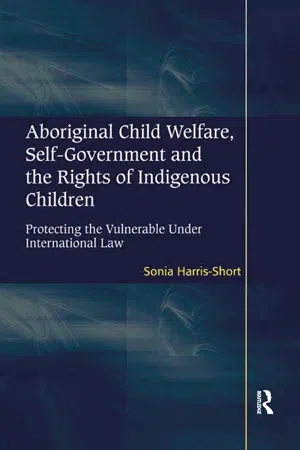
This volume addresses the contentious and topical issue of aboriginal self-government over child welfare. Using case studies from Australia and Canada, it discusses aboriginal child welfare in historical and comparative perspectives and critically examines recent legal reforms and changes in the design, management and delivery of child welfare services aimed at securing the 'decolonization' of aboriginal children and families. Within this context, the author identifies the limitations of reconciling the conflicting demands of self-determination and sovereignty and suggests that international law can provide more nuanced and culturally sensitive solutions. Referring to the UN Declaration on the Rights of Indigenous Peoples, and the UN Convention on the Rights of the Child, it is argued that the effective decolonization of aboriginal child welfare requires a journey well beyond the single issue of child welfare to the heart of the debate over self-government, self-determination and sovereignty in both national and international law.
eBook - ePub
Aboriginal Child Welfare, Self-Government and the Rights of Indigenous Children
Protecting the Vulnerable Under International Law
- 342 pages
- English
- ePUB (mobile friendly)
- Available on iOS & Android
eBook - ePub
Aboriginal Child Welfare, Self-Government and the Rights of Indigenous Children
Protecting the Vulnerable Under International Law
About this book
Introduction
Chapter 1
Introduction
Australia
James’ Story1
James’ grandmother, Helen, was four years old when she was removed from her family and placed in a white institution. Throughout her time at the institution she was denied all contact with her parents. At the age of 17 she left to work as a cook in the city. Without family support she was totally lost in the city. She had no idea who she was or where she had come from. She became pregnant at a very young age. Her partner was alcoholic and violent. They had severe financial problems. Helen became very depressed and began to drink. Her traumatic removal from her parents as a child had rendered her incapable of forming and maintaining any long-term loving familial relationships. She did not know how to love and to trust. She did not know how to parent her own children. Her marriage broke down and the children were neglected. Eventually, her children were all removed and placed into care by ‘the welfare’.
James’ mother, Jenny, had a chaotic childhood. Her life with Helen was characterized by alcohol and violence and she was sexually abused by her father. She was three-and-a-half when she was first removed from her parents and placed into foster care. Over the next few years she moved in and out of care, being returned on occasion to Helen before being removed again. Like her mother, Jenny was thus deprived of the stability and security of a loving family home and found herself similarly scarred. As an adult she struggled to come to terms with her childhood experiences of alcoholism, violence and sexual abuse. Daily life became a battle. She was depressed, unable to hold down a job and turned to alcohol for comfort. Her relationships with men were typically marked by alcoholism, violence and abuse. Desperate for a sense of family and to feel needed and loved she had one child after another despite struggling to cope. Although the children’s basic needs were met, their lives were chaotic. Unable to manage alone, Jenny clearly needed help and support but, terrified that her children would be removed from her as she had been from her own mother, she avoided all contact with ‘the welfare’. Deeply affected by the myriad of problems facing his mother, James developed his own severe emotional and behavioural problems.
James now has his own son, Stephen. Stephen is a very intelligent, healthy boy albeit somewhat overweight. He is, however, failing at school and is socially isolated, having no friends of his own. His behaviour is erratic including sexually acting out. He frequently places himself in physical danger. It is feared that he is being sexually abused but this cannot be substantiated. Due to his aggressive, erratic behaviour he has been suspended from a number of schools. His mother cannot cope with his behaviour and he has thus been sent to live with his grandmother. His future looks bleak. Separated from his mother and siblings and excluded from school, his chances of securing stable employment as an adult and forming and sustaining healthy adult relationships are diminishing. He is at serious risk of ending up as a ‘street kid’. Stephen has talked of feeling severely depressed and that his life is not worth living. He has in fact attempted to kill himself by cutting his wrists. Stephen is seven years old.
The tragic cycle of abuse and despair that has devastated James’ family began four generations ago with the forced removal of his grandmother from her family and her community by the British colonial powers in Australia. It continues today in the complex problems of her seven-year-old great grandson, Stephen. The story of James’ family is a living testament to the devastating consequences of Australia’s colonial past. It is a shameful legacy. On 2 August 1995, Michael Lavarch, Attorney-General of Australia, requested that Australia’s Human Rights and Equal Opportunity Commission (HREOC) inquire into and report on issues relating to past policies concerning the forced removal of Aboriginal children from their families and communities.2 The resulting report (Bringing Them Home) concludes that between one in three and one in ten Aboriginal children were forcibly removed from their families and communities between 1910 and 1970.3 It was a brutal policy:
I was at the post office with my Mum and Auntie [and cousin]. They put us in the police Ute and said they were taking us to Broome. They put the mums in there as well. But when we’d gone [about 10 miles] they stopped, and threw the mothers out of the car. We jumped on our mothers’ backs, crying, trying not to be left behind. But the policemen pulled us off and threw us back in the car. They pushed the mothers away and drove off, while our mothers were chasing the car, running and crying after us. We were screaming in the back of that car. When we got to Broome they put me and my cousin in the Broome lock-up. We were only ten years old. We were in the lock-up for two days waiting for the boat to Perth.4
The forced removal of Aboriginal children whether by ‘compulsion, duress or undue influence’5 formed just one part of a much larger pattern of dispossession, economic marginalization, systemic discrimination and genocidal practices suffered by Aboriginal people at the hands of Australia’s colonial governments. However, the widespread removal of Aboriginal children was particularly devastating, causing a multitude of complex personal and inter-societal problems within Aboriginal communities, the crippling effects of which continue to overwhelm many Aboriginal communities today. As the Bringing Them Home report notes,
It is difficult to capture the complexity of the effects for each individual … For the majority of witnesses to the Inquiry, the effects have been multiple and profoundly disabling. An evaluation of the following material should take into account the ongoing impacts and their compounding effects causing a cycle of damage from which it is difficult to escape unaided. Psychological and emotional damage renders many people less able to learn social skills and survival skills. Their ability to operate successfully in the world is impaired causing low educational achievement, unemployment and consequent poverty. These in turn cause their own emotional distress leading some to perpetrate violence, self-harm, substance abuse or anti-social behavior.6
The devastating impact of this level of individual trauma on the health of whole communities already struggling against the ravages of colonial governments hungry for land and power is now widely acknowledged.7
The forced removal of Aboriginal children from their families and communities is not, however, an historical relic to be acknowledged by Australian society but essentially consigned to Australia’s past. Not only does the Bringing Them Home report highlight how the ‘actions of the past’ continue to affect the general health of Aboriginal communities today,8 it raises strong concerns about the continuing removal of Aboriginal children by the Australian authorities, as evidenced by the disproportionate number of Aboriginal children in public state care. Although figures vary between the different states and territories, Bringing Them Home reports that on average indigenous children are seven times more likely to be in substitute care than non-native children, with indigenous children across Australia, who constitute just 2.7 per cent of the total population, making up 20 per cent of the number of children in care.9 An important aspect of the Inquiry’s work was thus to: ‘examine current laws, practices and policies with respect to the placement and care of Aboriginal and Torres Strait Islander children and advise on any changes required taking into account the principle of self-determination by Aboriginal and Torres Strait Islander peoples’.10 Although past practices of removal give rise to important legal questions such as the right of Aboriginal individuals and communities to recover some form of compensation for the damage they have suffered,11 it is with this latter aspect of the Inquiry’s work – the future of Aboriginal child welfare in Australia – that this book is principally concerned.
With respect to the crucial question of how best to address the continuing disproportionate removal of Aboriginal children from their families, the Inquiry reaches a deceptively simple conclusion: the answer lies in self-determination. As expressed in the report, the ‘principal finding is that self-determination for Indigenous peoples provides the key to reversing the over-representation of Indigenous children in the child welfare and juvenile justice systems of the States and Territories and to eliminating unjustified removals of Indigenous children from their families and communities’.12 Self-determination, which is defined in the report as the right to exercise control over matters directly affecting Aboriginal children, is thus regarded as the essential starting point for moving forward.13 The report goes on to outline a number of more specific recommendations concerning how this right to self-determination is to be realized within the context of Aboriginal child welfare. Central to the Inquiry’s conclusions is the recommendation that national framework legislation is introduced to facilitate the negotiation of Aboriginal autonomy and, if desired, the transfer of legal responsibility for Aboriginal children from the state and territories to local communities; legislation that will, in other words, set the framework for Aboriginal self-government over child welfare including child protection, adoption and juvenile justice.14 The national framework legislation would also establish a number of core principles and minimum national standards to be implemented across Australia whether or not a community decides to assume self-government over its own child welfare or agrees to continued service delivery by state authorities. Those standards would include the protection of indigenous children’s fundamental human rights and guarantees that in any judicial or administrative decision affecting the care and protection, adoption, or residence of an indigenous child, the child’s welfare would be the paramount consideration. In determining the child’s best interests, the decision-maker would be required to take into account: (i) the need of the child to maintain contact with his or her indigenous family, community and culture; (ii) the significance of the child’s indigenous heritage for his or her future well-being; (iii) the views of the child and his or her family; and (iv) the advice of the appropriate accredited indigenous organization.15 Further recommendations deal with the need to establish an accreditation framework for indigenous organizations,16 the requirement to consult with indigenous organizations in all care and protection matters,17 the right of the child to be separately represented in court proceedings,18 statutory recognition of the Indigenous Child Placement Principle,19 and for the strengthening of the Family Law Act 1975 (Cth) to include explicit recognition of the importance of an Aboriginal child maintaining a meaningful connection with his/her Aboriginal culture and heritage.20
The recommendations in Bringing Them Home clearly address not only the right of Aboriginal communities to self-government over child welfare but the continuing need for the existing legal framework and those currently delivering child welfare and protection services to be more sensitive and responsive to the cultural needs of Aboriginal families and communities. In the wake of the report, many states have moved to address this objective, initiating legislative reforms aimed at affording greater recognition to the importance of an Aboriginal child’s cultural identity and place within an Aboriginal community. However, it is self-government which sits at the heart of the report with a clear and unequivocal commitment to the long-term objective of achieving the transfer of control over Aboriginal child welfare to local Aboriginal communities. Disappointingly, with respect to this core objective, the response of the Australian authorities has been poor with all states and territories remaining a long way from implementing any kind of meaningful self-government over Aboriginal child welfare. An Implementation Progress Report prepared by HREOC in September 1998 records that none of the Inquiry’s recommendations regarding national framework legislation for facilitating self-government and setting minimum national standards have been implemented, with the commonwealth government and the governments of Queensland and Victoria actively rejecting the need for any such legislation.21 This picture of co...
Table of contents
- Cover
- Half Title
- Dedication
- Title Page
- Copyright Page
- Table of Contents
- Table of Cases
- Table of Statutes
- Table of International Documents
- Preface
- Acknowledgements
- List of Abbreviations
- PART I INTRODUCTION
- PART II ABORIGINAL CHILD WELFARE IN AUSTRALIA AND CANADA
- PART III SELF-GOVERNMENT OVER ABORIGINAL CHILD WELFARE: LESSONS FROM CANADA
- PART IV BROADENING HORIZONS: INDIGENOUS PEOPLES, SELF-DETERMINATION AND PROTECTING CHILDREN’S RIGHTS UNDER INTERNATIONAL LAW
- PART V CONCLUSIONS
- Bibliography
- Index
Trusted by 375,005 students
Access to over 1.5 million titles for a fair monthly price.
Study more efficiently using our study tools.
Information
Publisher
RoutledgeEdition
1Year
2016Print ISBN
9781138261082
9781409419549
Subtopic
International LaweBook ISBN
9781317186120
Frequently asked questions
Yes, you can cancel anytime from the Subscription tab in your account settings on the Perlego website. Your subscription will stay active until the end of your current billing period. Learn how to cancel your subscription
No, books cannot be downloaded as external files, such as PDFs, for use outside of Perlego. However, you can download books within the Perlego app for offline reading on mobile or tablet. Learn how to download books offline
Perlego offers two plans: Essential and Complete
- Essential is ideal for learners and professionals who enjoy exploring a wide range of subjects. Access the Essential Library with 800,000+ trusted titles and best-sellers across business, personal growth, and the humanities. Includes unlimited reading time and Standard Read Aloud voice.
- Complete: Perfect for advanced learners and researchers needing full, unrestricted access. Unlock 1.5M+ books across hundreds of subjects, including academic and specialized titles. The Complete Plan also includes advanced features like Premium Read Aloud and Research Assistant.
We are an online textbook subscription service, where you can get access to an entire online library for less than the price of a single book per month. With over 1.5 million books across 990+ topics, we’ve got you covered! Learn about our mission
Look out for the read-aloud symbol on your next book to see if you can listen to it. The read-aloud tool reads text aloud for you, highlighting the text as it is being read. You can pause it, speed it up and slow it down. Learn more about Read Aloud
Yes! You can use the Perlego app on both iOS and Android devices to read anytime, anywhere — even offline. Perfect for commutes or when you’re on the go.
Please note we cannot support devices running on iOS 13 and Android 7 or earlier. Learn more about using the app
Please note we cannot support devices running on iOS 13 and Android 7 or earlier. Learn more about using the app
Yes, you can access Aboriginal Child Welfare, Self-Government and the Rights of Indigenous Children by Sonia Harris-Short in PDF and/or ePUB format, as well as other popular books in Politics & International Relations & International Law. We have over 1.5 million books available in our catalogue for you to explore.