eBook - ePub
Informal Norms in Global Governance
Human Rights, Intellectual Property Rules and Access to Medicines
- 264 pages
- English
- ePUB (mobile friendly)
- Available on iOS & Android
eBook - ePub
Informal Norms in Global Governance
Human Rights, Intellectual Property Rules and Access to Medicines
About this book
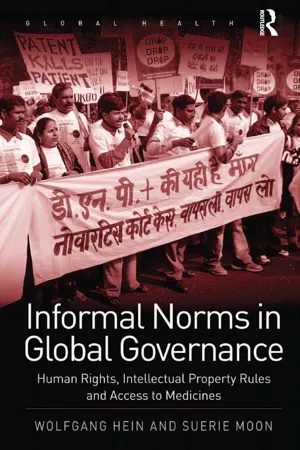
Hein and Moon take up a serious problem of contemporary global governance: what can be done when international trade rules prevent the realization of basic human rights? Starting in the 1990s, intellectual property obligations in trade agreements required many developing countries to begin granting medicines patents, which often rendered lifesaving drugs unaffordable. At stake was the question of what priority would be given to health-particularly of some of the world's poorest people-and what priority to economic interests, particularly those of the most powerful states and firms. This book recounts the remarkable story of the access to medicines movement. The authors offer an explanation for how the informal, but powerful norm that every person should have access to essential medicines emerged after a decade of heated political contestation and against long odds. They also explore the stability and scope of the norm. Finally, the book examines the limitations of informal norms for protecting human rights, and when renewed focus on changing formal norms is warranted.
Information
Chapter 1
Introduction
(a) Formal and informal norms in the governance of a global society
Globalization entails a growing density of social relations that has made possible the emergence of a global society, albeit nascent and inchoate. Political actors in this global society include not only those widely-recognized to wield power on the global stage, such as major states and transnational firms, but also developing country governments, civil society networks, journalists, experts and the public at large. This society is governed not only by norms codified in formal international law, but also by informal norms that emerge through complex political processes.
Recent key developments in the field of global health give us reason to hope that the emergence of a global society may lead to a more inclusive vision of equity and interdependence beyond national borders, and that this may be conducive to the protection and promotion of human rights in general, and the progressive realization of the right to health1 in particular. Informal norms may have an important role to play in this societal evolution. Such key developments include the following:
First, awareness of the dramatic disparities in health status between richer and poorer populations has increased, and created the normative groundwork for acts of solidarity such as resource transfers to improve health. Development assistance for global health increased dramatically, nearly quintupling from 1990 to 2010 from about $5.7 billion to $26.9 billion (Murray et al., 2011). The growing density of social relations suggests that systems analogous to national social safety nets may one day be constructed at the global level, and make more concrete the realization of economic, social and cultural rights.
Second, tighter relations of interdependence between populations, economies and states have increased the degree to which societies face common health threats, such as the spread of pandemic influenza or harmful effects of tobacco marketing. This increased interdependence has, arguably, strengthened the willingness to transfer resources but also exacerbated governance challenges at the global level.
Third, information on significant scientific advances, such as the development of new life-saving drugs or vaccines, travels more quickly and can create higher expectations and new political demands for access to healthcare. However, even with increased levels of aid, development spending for health amounts to an annual per capita “subsidy” of only about $4 for people living outside the developed world,2 an amount that is far from sufficient for ensuring a minimum standard of healthcare to all people in need. Thus, increased political demands for health rapidly bump up against resource constraints.
Finally, the development of transnational networks has strengthened the political power of health advocates, who share information, devise joint strategies, and mobilize to put pressure on other powerful actors such as governments and multinational firms to be responsive to health concerns.
A remarkable illustration of the combined impact of these four developments is the case of the access to medicines movement and the emergence of a robust, albeit informal, “access norm.” Starting in the 1990s, global trade rules required many developing countries to begin granting patents on medicines in their domestic laws for the first time. Patent monopolies enabled high drug prices that put them out of reach for the majority of the population. Most high-income countries have social protection systems such as public or private insurance to ensure the provision of even highly-priced medicines to their citizens, whether rich or poor. In many developing countries, however, low incomes and weak social safety nets mean that few will be able to access high-cost medicines.
Nevertheless, global trade rules allowed governments to apply certain flexibilities in patent rules to access lower-cost medicines for their populations. However, whether or not they would do so depended heavily on prevailing global norms on the proper balance between intellectual property protection and public health. At the heart of these debates lay the question of what priority would be given to health—particularly the health of some of the world’s poorest people—and what priority to economic interests, particularly those of the most powerful nations and firms.
Against long odds, after a decade of heated political contestation and negotiation, a stable, widely-accepted and reliably-enforced informal norm had emerged that all people should have access to essential medicines—what we call the “access norm” for brevity. It is this informal norm that is the core focus and analytical puzzle of this book.
A “norm” is a basic concept in the social sciences. Finnemore and Sikkink (1998) define it as “a standard of appropriate behavior for actors with a given identity.” The behavior could be appropriate within a small group of friends, an ethnic group, a nation or even a global society. There is a whole family of phenomena that can be categorized as “norms” (principles, standards, guidelines, and rules (Braithwaite and Drahos, 2000; see also Wiener, 2008) and that help to create stable expectations with regard to behavior within the respective group, thereby simplifying human interactions.
Formal norms are generally such norms that have been accepted by a formally legitimized body (from a general meeting of an association to the General Assembly of the United Nations). If this body is a legislative body of a political unit, these norms are normally called “laws” and they are reinforced by the threat of sanctions.
Informal norms also play a role at all levels of social organization (from routines in everyday life to diplomatic conventions), but they are based on shared norms and beliefs3 and not on formal institutional decisions. There is no formal (legal) obligation to comply with these norms, but social sanctions against non-compliance can be rather severe (e.g. exclusion from an important social group, loss of public support).
When it comes to international law, however, there is no global political authority or world government that can implement or enforce formal norms against the will of sovereign nation states.4 For example, despite the dense web of international rules produced since the 1940s through the United Nations system and other international institutions, including a comprehensive human rights system, the right to health remains poorly implemented. Great disparities in the burden of disease persist between populations, as well as the resources to address them. Health spending per capita is about $7300 per year in the US, Norway, and Luxemburg, but just $9 in Eritrea, Ethiopia, and the Democratic Republic of the Congo (World Health Organization, 2010). Ensuring the protection and promotion of human rights basically remains the responsibility of sovereign nation states. Nevertheless, international human rights instruments obligate richer countries to assist poorer states, which face challenges in fulfilling economic, social and cultural human rights, including the right to health. However, there is no institution with the authority to implement the necessary measures to realize this right, such as mandating a level of resource transfers from high-income to lower-income countries. The persistence of extremely high levels of inequality in global health seems to reflect the overall failure of global governance processes to implement the right to health.5
Nevertheless, in the access to medicines case, global governance processes have resulted in surprisingly widespread respect for and adherence to the access norm. Implementation of the access norm involved both greater flexibility in the application of patent rules and considerable resource transfers to improve access to medicines for HIV and other high-burden diseases.
This case, then, raises some provocative questions: Could informal norms also “work” in other sectors of global governance to produce a transnational web of implementable norms to strengthen the realization of economic and social human rights? Can we think of informal norms as a step towards the development of formal norms with a solid institutional foundation for their implementation? Or does the emergence of a global society against a backdrop of rigid state-based governance structures imply an increasing dependence on informal norms? If so, how stable, inclusive and effective are informal norms?
(b) The emergence of the “access to medicines” norm
Access to essential6 medicines is now recognized as an integral part of fulfilling the human right to health. However, the lack of resources in some countries makes the fulfillment of this right a major challenge. At the same time, the development of new medicines requires significant investments into research and development (R&D). The knowledge component of a medicine can be considered a global public good (Moon, 2009). That is, the knowledge that 200mg of compound X can safely and effectively treat disease Y is the end result of a long process of drug development, and is potentially non-excludable and non-rival—all people can benefit from this new knowledge, and sharing this knowledge with others does not diminish the amount that is left for others. However, somebody must bear the high costs and risks of developing this knowledge. How can universal access to medicines be ensured in a world of vastly unequal resources, growing political demands for health, and an ongoing need for investment into the development of new drugs? Who should pay for the development of new medicines, how much, and who decides?
The patent system, with its roots going back for centuries, pre-dates the emergence of the modern pharmaceutical industry in the mid twentieth century. The industry came to rely on patent-based monopolies as the primary legal tool that enabled them to recover investments into research and development. Patents are state-granted time-limited monopolies that allow patent-holders to sell the patented product at the highest price the market will bear without being exposed to competition. However, high prices can make medicines unaffordable to many of those who may need them.
The problem of ensuring universal access to medicines can be seen as essentially a problem of global public goods provision—how can the global community ensure that medicines are affordable to all while maintaining continued investment into R&D? This is not merely an economic problem, but a political one that goes to the heart of global governance challenges. Complicating these challenges is the 1994 World Trade Organization (WTO) Agreement on Trade-Related Aspects of Intellectual Property Rights (TRIPS), which required all WTO Members to adopt minimum standards of intellectual property protection. In many countries, TRIPS required the introduction of patents on medicines into domestic law for the first time. The TRIPS Agreement came into force just as the HIV pandemic was decimating populations, particularly in the developing world. For HIV/AIDS, the challenge of how to allocate payment for medicines R&D at the global level was resolved with an implicit political compromise:
High-income countries accepted to pay the R&D costs for the antiretroviral (ARV) drugs used to treat HIV/AIDS by paying the high monopoly prices enabled by the patent system, while many developing countries paid roughly the costs of production by procuring competitively-produced generic ARVs.7 This solution did not come easily, but rather, was reached after a decade of intense political struggles and hard-fought concessions over the degree of flexibility developing countries would be allowed to apply in the way they implemented TRIPS in their domestic legal systems. A normative landmark was the 2001 WTO Doha Declaration on TRIPS and Public Health, in which all WTO Members agreed that TRIPS should not block the protection of public health, and should be implemented in a manner that would ensure access to medicines for all.
In the case of HIV drugs, the norm of universal access to medicines has been at least partially implemented through a limited and informal (from a legal point of view), but strong consensus among concerned state and non-state actors, supported by civil society organizations (CSOs) and important sections of the global public. The consensus is most explicit and visible in the UN General Assembly commitment in 2005 to achieve universal access to treatment and care for HIV/AIDS by 2010 (United Nations General Assembly, 2005). With only one-third of people in need getting access to HIV/AIDS treatment by 2010, the universal access goal was not achieved by the deadline (WHO, UNICEF, UNAIDS 2010). Nevertheless, the progress in increasing access to HIV medicines in developing countries was extraordinary: access to treatment increased over 16-fold from about 400,000 people in 2003 to 6.6 million in 2011 (UNAIDS, 2011; WHO, UNICEF, UNAIDS 2010). Over 60 countries made use of flexibilities in TRIPS rules, including but not limited to those enumerated in the Doha Declaration, to get access to lower-cost generic versions of widely-patented medicines (‘t Hoen, 2009). This widespread government authorization of the use of generic HIV medicines resulted in over 95% of donor-funded ARVs used in developing countries coming from generic sources by 2008 (Waning, Diedrichsen and Moon, 2010).
This process of norm-implementation was accompanied by a continuing push to broaden and clarify understandings of the “access norm” beyond the implicit meaning of the early days of the global access to medicines movement, which focused almost exclusively on ARVs—that is, there was an effort to expand the norm to include not only HIV drugs but medicines for all diseases. With respect to the so-called “neglected diseases,” which almost exclusively affect poor populations and therefore do not constitute a sufficient incentive for private sector R&D investment, a consensual arrangement was reached in which public and philanthropic money was invested into R&D through public-private product development partnerships, which decreased costs and investment risks for pharmaceutical companies participating in neglected disease research collaborations. On the other hand, transnational pharmaceutical companies (TNPCs) and the industrialized countries in which they were based continued to contest the expansion of the access norm beyond the narrow confines of HIV/AIDS or neglected diseases.
However, populations in developing countries need access to a range of newer, widely-patented medicines, particularly as they are facing a growing burden of disease from both communicable and non-communicable diseases. In particular, TNPCs and their home countries continued to use their political and economic power to discourage IP-related measures to reduce drug prices, such as compulsory licensing and other patent law flexibilities, as was demonstrated clearly in the negotiations leading up to the UN High-Level Meeting on Non-Communicable Diseases held in September 2011 at the UN General Assembly. Industrialized countries strongly—and successfully—opposed any mention of the Doha Declaration in the meeting’s final declaration, arguing that Doha only applied to infectious diseases such as HIV/AIDS; in contrast, many developing countries had pushed to include the Doha Declaration in the text, arguing that patents on cancer drugs, among others, were increasing prices to unaffordable levels (Fink and Rabinowitz, 2011). CSOs and some developing country governments had consistently advocated for the right to make use of TRIPS flexibilities across a broad range of medicines, with some success. We discuss further the expansion of the access norm in chapters 5 and 6.
Overall, by 2011, there was widespread acceptance, both formally and informally, of the norm that access to essential medicines should be universal, and should not be blocked arbitrarily by patent protection—what we call the “access norm,” for brevity. This norm was driven forward and implemented most legibly in the area of HIV/AIDS. However, it rests largely on informal political understandings between the actors involved (governments, CSOs, TNPCs) that developing countries will enjoy some degree of flexibility in how they implement international intellectual property obligations—that is, no major changes were made to the TRIPS Agreement itself.
These major steps towards implementing at least one aspect of the human right “to the highest attainable standard of physical and mental health” (International Covenant on Economic, Social and Cultural Rights, ICESCR, Art. 12) are encouraging, but they raise at least three key questions:
(1) How stable is the access norm? In a global system with few enforceable rules and no binding system for resource transfers, how stable is the access norm likely to be? For example, there is no institution that can guarantee through the authoritative control of financial means and the potential use of coercive means that HIV medicines will be delivered continuously to people in need of them. Can the current levels of access to antiretroviral therapy (ART) and the commitments to expand access be upheld? In particular, can TNPCs be continuously put under sufficient pressure to adhere to the range of “access policies” that have been put in place to facilitate access to HIV drugs, including for newly developed medicines? Can the policy space for developing country governments to use flexibilities in the TRIPS Agreement to access generic medicines be preserved? And how can the necessary level of financial transfers to pay for access to treatment in poor countries be guaranteed?
(2) How inclusive is the access norm? The scope of the access norm remains contested along two dimensions—which diseases it will cover, and which countries will be allowed greater flexibility in managing patents. Universal access to essential medicines concerning all diseases has been accepted in principle, but not in practice. Beyond HIV and clearly-defined emergencies such as pandemic flu, the degree to which drugs for other diseases are included in the access norm remains highly contested. The issue has become particularly heated over drugs for cancer, for which mortality rates are far higher in poorer regions...
Table of contents
- Cover Page
- Title Page
- Copyright Page
- Contents
- List of Figures and Tables
- Foreword
- Preface
- List of Abbreviations
- 1 Introduction
- 2 Towards a Global Society
- 3 Access to Medicines: A Matter of Human Rights
- 4 Access to Medicines and Intellectual Property
- 5 The HIV/AIDS Crisis: The Rise of the Access Norm
- 6 Beyond HIV in Africa: Solidification and Expansion of the Access Norm
- 7 Challenges to the Stability of Informal Norms
- 8 Re-framing the Access Norm: Incorporating Innovation
- 9 The Impact of Non-state Actors on Informal Norms: Nodal Governance and Global Democracy
- 10 Conclusions
- Annex 1 The 2001 WTO Doha Declaration on TRIPS and Public Health
- Annex 2 Timeline of Key Events
- References
- Index
Trusted by 375,005 students
Access to over 1.5 million titles for a fair monthly price.
Study more efficiently using our study tools.
Frequently asked questions
Yes, you can cancel anytime from the Subscription tab in your account settings on the Perlego website. Your subscription will stay active until the end of your current billing period. Learn how to cancel your subscription
No, books cannot be downloaded as external files, such as PDFs, for use outside of Perlego. However, you can download books within the Perlego app for offline reading on mobile or tablet. Learn how to download books offline
Perlego offers two plans: Essential and Complete
- Essential is ideal for learners and professionals who enjoy exploring a wide range of subjects. Access the Essential Library with 800,000+ trusted titles and best-sellers across business, personal growth, and the humanities. Includes unlimited reading time and Standard Read Aloud voice.
- Complete: Perfect for advanced learners and researchers needing full, unrestricted access. Unlock 1.5M+ books across hundreds of subjects, including academic and specialized titles. The Complete Plan also includes advanced features like Premium Read Aloud and Research Assistant.
We are an online textbook subscription service, where you can get access to an entire online library for less than the price of a single book per month. With over 1.5 million books across 990+ topics, we’ve got you covered! Learn about our mission
Look out for the read-aloud symbol on your next book to see if you can listen to it. The read-aloud tool reads text aloud for you, highlighting the text as it is being read. You can pause it, speed it up and slow it down. Learn more about Read Aloud
Yes! You can use the Perlego app on both iOS and Android devices to read anytime, anywhere — even offline. Perfect for commutes or when you’re on the go.
Please note we cannot support devices running on iOS 13 and Android 7 or earlier. Learn more about using the app
Please note we cannot support devices running on iOS 13 and Android 7 or earlier. Learn more about using the app
Yes, you can access Informal Norms in Global Governance by Wolfgang Hein,Suerie Moon in PDF and/or ePUB format, as well as other popular books in Politics & International Relations & Politics. We have over 1.5 million books available in our catalogue for you to explore.