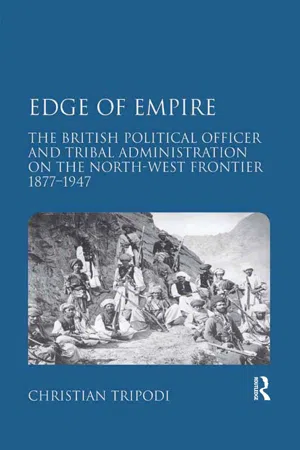
eBook - ePub
Edge of Empire
The British Political Officer and Tribal Administration on the North-West Frontier 1877–1947
- 268 pages
- English
- ePUB (mobile friendly)
- Available on iOS & Android
eBook - ePub
Edge of Empire
The British Political Officer and Tribal Administration on the North-West Frontier 1877–1947
About this book
Britain's often rather ad hoc approach to colonial expansion in the nineteenth century resulted in a variety of imaginative solutions designed to exert control over an increasingly diverse number of territories. One such instrument of government was the political officer. Created initially by the East India Company to manage relations with the princely rulers of the Indian States, political offers developed into a mechanism by which the government could manage its remoter territories through relations with local power brokers; the policy of 'indirect rule'. By the beginning of the twentieth century, political officers were providing a low-key, affordable method of exercising British control over 'native' populations throughout the empire, from India to Africa, Asia to Middle East. In this study, the role of the political officer on the Western Frontier of India between 1877-1947 is examined in detail, providing an account of the personalities and mechanisms of colonial influence/tribal control in what remains one of the most unstable regions in the world today. It charts the successes, failures, dangers and attractions of a system of power by proxy and examines how, working alone in one of the most dangerous and lawless corners of the Empire, political officers strove to implement the Crown's policies across the North-West Frontier and Baluchistan through a mixture of conflict and collaboration with indigenous tribal society. In charting their progress, the book provides a degree of historical context for those engaging in ambitious military operations in the same region, seeking to increasingly rely on the support of tribal chiefs, warlords and former enemies in order for new administrations to function. As such this book provides not only a fascinating account of key historical events in Anglo-Indian colonial history, but also provides a telling insight and background into an increasingly seductive aspect of contemporary political and military strategy.
Trusted by 375,005 students
Access to over 1.5 million titles for a fair monthly price.
Study more efficiently using our study tools.
Information
1 Who were the Politicals?
DOI: 10.4324/9781315578774-1
It is not about rifle and cannon but of character and all that character can do among a community of free men. 1
The Foreign and Political Department of the Government of India, as one observer noted, was ‘an empire within an empire’. 2 By 1947, its responsibilities stretched the length and breadth of that vast country and eventually beyond its borders yet its numbers never exceeded more than 180 individuals. 3 This small cadre of men, who had emerged over the course of the eighteenth century to manage the Government of India’s relations with the princely rulers of the Indian state, gradually saw their charge extend to territories beyond the borders of India. Consequently, in addition to its task of providing diplomatic representation to the indigenous rulers of India’s independent territories, the department soon found itself responsible for undertaking diplomatic missions to a variety of constituents. From the sheikdoms of Mesopotamia and the Gulf, the Government of Afghanistan, the independent kings and rulers of the northern territories and Tibet’s Dalai Lama and tribal groupings in the Arabian peninsular to Baluchistan, the North-West Frontier and Burma, the department’s members worked to protect India’s interests. 4
The roots of the department lay in the ‘Residency’ system developed by the East India Company (EIC) during the late seventeenth century in order to manage relations with India’s native rulers. 5 Company officers were theoretically civil servants but the peculiar position of the EIC during this period – advancing its commercial interests into a turbulent network of independent ‘country powers’–meant that officials were often required to act as diplomats. Thus, as the former political officer Terence Coen points out, ‘Politicals’ preceded ‘civil servants’ and the activities of the earliest EIC officers were consequently recognizable as ‘Political’ in the sense of this particular study long before the actual Political Department was formed. 6 As it was, the roots of such a department were quickly planted and in terms of the formation of a recognizable office charged with the responsibility of managing tribal, diplomatic and foreign affairs, we must look to British India’s first Governor-General, Warren Hastings. Responsible for rationalizing much of the administrative structure of British rule in India during the period of his tenure 1773–84, he was instrumental in creating the Secret and Political Department, responsible for handling military plans and conducting diplomatic relations both within India itself and also with other European nations and their colonies, notably the French and Portuguese. 7 Comprising three distinct branches – Secret, Political and Foreign – the department went through a number of iterations and guises over the following half century or so until, subsequent to the First Anglo-Afghan War, in May 1843 the Government of India reorganized it into the Foreign Department. It remained unchanged until 1 January 1914, when it was renamed the Foreign and Political Department of the Government of India – ‘Foreign’ referring to the task of representing the government to ‘foreign’ powers and rulers, ‘Political’ referring to the management of diplomatic relations with the Indian states. Although the Foreign Secretary was the titular head of the department, the Viceroy of India was in charge of both Foreign and Political portfolios. The Foreign and Political Department retained its title until 1937 when it was finally renamed the Indian Political Service or IPS. 8
Although this study focuses on the department’s activities on the Frontier, this was in fact a relatively specialized area of involvement. In reality, most ‘Political’ work was directed toward the states: independent territories within India that numbered some 600 by the time of Independence in 1947, ruled over by a variety of rajahs (kings) and, according to the state’s size and power, maharajas (great kings). The Viceroy maintained close control of the Foreign Department due to its integral importance to diplomatic relations within India; indeed post-1861 the Viceroy was essentially in charge of Political relations although his subordinate Foreign Secretary was, of course, of significant importance as a conduit for policy. The importance of the Foreign Secretary, however, was magnified with reference to the tribal areas and the adjoining districts. The proximity of Afghanistan, the fear of Russian intrusion and the activities of the independent trans- and cis-border tribes with relation to foreign intrigues were of immediate concern to those tasked with managing the external relations (and thus internal security) of British India. But what the dual responsibilities of the Foreign and Political Department illustrate were the demands placed upon this small cadre of men. When we seek to judge the effectiveness of the Politicals in managing the government’s relations with its fractious tribal constituents, it must be borne in mind that only around 30 per cent of the department’s average strength of 160 was ever devoted to this challenging task.
The Political Agent
Those men that staffed the department over the duration of this study thus drew upon a rich tradition of diplomatic enterprise that dated back to the earliest days of the EIC’s advance into India. However, it was the activities of certain key figures in Afghanistan, Central Asia and the Punjab during the mid-nineteenth century that lent the department, and specifically the Politicals themselves, a certain mystique. The Soldier Sahibs had carved their heroic reputations in the Punjab, while Arthur Conolly and Charles Stoddart earned themselves a certain degree of immortality through their actions in Central Asia. But their actions only partially compensated for events in Afghanistan during the First Anglo-Afghan War, when men such as William Hay MacNaghten and Oliver St John were held largely responsible, through their local politicking and deal-making, for the collapse of the British position in that country. 9 As the years progressed however, and as British India entered a steadier state of physical domain, so the ‘Political’ waters were becalmed and our subject becomes far more of a functionary: a tool of policy rather than a spearhead of Empire. Certainly, as the nineteenth century drew to a close, the Foreign and Political Department slowly but surely aligned itself alongside other government departments in terms of structure, recruitment and promotion. Gone were the days of independent adventurers single-handedly pushing British influence into new territories. In their place came a far more restrained and recognizable figure. Indeed, the extent to which the political agent, as an institution, developed over time is illustrated by the respective careers of Sir Robert Sandeman (1835–92) and Sir James Acheson (1899–1973), both of whom, some five decades apart, were to rise to prominence within the British frontier administration.
Sandeman’s career began in 1856 with a period of service in the Indian Army followed by his informal transition into ‘Political’ work shortly afterwards on the personal invitation of Sir John Lawrence, then head of the Punjab’s civil administration. 10 This was then followed by administrative duties in Dera Ismail Khan, the southernmost settled district of the Punjab until, through his own initiative, he manufactured a convivial relationship between the Government of India and the ruler of Khelat in neighbouring Baluchistan, hitherto racked by a damaging civil war that persisted in spilling over the border with British India. Rewarded with stewardship of the newly established British administration there from 1877 until his death in 1892, he was responsible for nearly every element of British civil and military engagement in the region. In essence, the hugely powerful Sandeman was Baluchistan, and was forever remembered as such in the official mind, as will be seen. In contrast, Acheson followed what would be recognized by any modern civil servant as a far more familiar career path. Educated at Trinity College Dublin, he transferred into the Political Department from the Indian Civil Service (ICS), serving initially as an assistant magistrate in Shahjahanpur in 1913 before becoming an assistant commissioner in Lucknow the following year. A posting in Agra was followed by his appointment as a temporary political officer in Quetta, Baluchistan in 1917. More ‘Political’ work in Baluchistan and the British legation in Afghanistan was followed by a transfer to Dera Ismail Khan in 1923. In 1925 he was appointed Political Agent North Waziristan and after a year in post he was appointed department secretary to the Government of India in the Foreign and Political Department until he was sent to London to attend the Imperial College of Defence (ICD) in late 1929. Upon his return, he was appointed Foreign Secretary of the Government of India before being given the post of Resident (Senior political officer) in Waziristan in November 1935. He would ultimately return to Baluchistan and, after a period as revenue and judicial commissioner there, finally retire as Resident Kashmir in June 1945. What is immediately apparent is the hugely varied nature of Acheson’s career in comparison to Sandeman’s. His period of study at the ICD and his subsequent position as Foreign Secretary would have exposed him to a far wider and more elevated appreciation of Indian and international affairs than Sandeman. It would also have introduced him to a number of senior military officers and government officials in a setting far removed from the more parochial concerns of the Frontier. 11 Within the Frontier itself, his experience was notable and multifaceted, his brief tenure in Afghanistan no doubt providing him with yet another perspective on matters. But it should be noted that even this model bureaucrat’s career featured some quite remarkable experiences ‘at ground level’. Such was the nature of Political work; even a ‘paper ...
Table of contents
- Cover
- Half Title Page
- Title Page
- Copyright Page
- Contents
- List of Maps and Figures
- Acknowledgements
- Introduction
- 1 Who were the Politicals?
- 2 Forward with Hearts and Minds, 1877–92
- 3 The North-West Frontier, 1892–1900
- 4 Reform and Consolidation, 1900–1914
- 5 War, Rebellion and the ‘Modified Forward’ Policy, 1914–24
- 6 Interregnum, 1924–30
- 7 Frontier Strategy, 1930–39
- 8 Toward the End, 1939–47
- Conclusion
- Bibliography
- Index
Frequently asked questions
Yes, you can cancel anytime from the Subscription tab in your account settings on the Perlego website. Your subscription will stay active until the end of your current billing period. Learn how to cancel your subscription
No, books cannot be downloaded as external files, such as PDFs, for use outside of Perlego. However, you can download books within the Perlego app for offline reading on mobile or tablet. Learn how to download books offline
Perlego offers two plans: Essential and Complete
- Essential is ideal for learners and professionals who enjoy exploring a wide range of subjects. Access the Essential Library with 800,000+ trusted titles and best-sellers across business, personal growth, and the humanities. Includes unlimited reading time and Standard Read Aloud voice.
- Complete: Perfect for advanced learners and researchers needing full, unrestricted access. Unlock 1.5M+ books across hundreds of subjects, including academic and specialized titles. The Complete Plan also includes advanced features like Premium Read Aloud and Research Assistant.
We are an online textbook subscription service, where you can get access to an entire online library for less than the price of a single book per month. With over 1.5 million books across 990+ topics, we’ve got you covered! Learn about our mission
Look out for the read-aloud symbol on your next book to see if you can listen to it. The read-aloud tool reads text aloud for you, highlighting the text as it is being read. You can pause it, speed it up and slow it down. Learn more about Read Aloud
Yes! You can use the Perlego app on both iOS and Android devices to read anytime, anywhere — even offline. Perfect for commutes or when you’re on the go.
Please note we cannot support devices running on iOS 13 and Android 7 or earlier. Learn more about using the app
Please note we cannot support devices running on iOS 13 and Android 7 or earlier. Learn more about using the app
Yes, you can access Edge of Empire by Christian Tripodi in PDF and/or ePUB format, as well as other popular books in History & World History. We have over 1.5 million books available in our catalogue for you to explore.