eBook - ePub
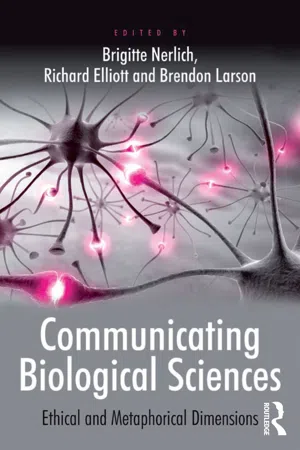
Communicating Biological Sciences
Ethical and Metaphorical Dimensions
- 266 pages
- English
- ePUB (mobile friendly)
- Available on iOS & Android
eBook - ePub
Communicating Biological Sciences
Ethical and Metaphorical Dimensions
About this book
Recent scandals in the biosciences have highlighted the perils of communicating science leading many observers to ask questions about the pressures on scientists and the media to hype-up claims of scientific breakthroughs. Journalists, science writers and scientists themselves have to report complex and rapidly-developing scientific issues to society, yet work within conceptual and temporal constraints that shape their communication. To date, there has been little reflection on the ethical implications of science writing and science communication in an era of rapid change. Communicating Biological Sciences discusses the 'ethics' of science communication in light of recent developments in biotechnology and biomedicine. It focuses on the role of metaphors in the creation of visions and the framing of scientific advances, as well as their impact on patterns of public acceptance and rejection, trust and scepticism. Its rigorous investigation will appeal not only to science writers and scientists, but also to scholars of sociology, science and technology studies, media and journalism.
Information
1 Communicating Biological Sciences: An Introduction
DOI: 10.4324/9781315572888-1
Science communication, ethics and metaphors
This book deals with science communication, especially the communication of biological sciences. But it approaches science communication from two perspectives that have never before been used together to discuss the aims, process and effects of science communication, namely: ethics and metaphor. There are, of course, many books and articles on science communication and ethics, and even more on journalism and ethics and the ethical dimensions of public communication of science and technology, some of which will be mentioned in due course. Many books and articles have also been devoted to science, science communication and metaphor; and again references to some of these will be made throughout. In this book we attempt to knit these efforts together and to shed some new light on the ethical and metaphorical dimensions of science communication.
By science communication we mean the reporting of technoscientific, especially biotechnological, knowledge and developments to non-scientists through popular science books and journals, newspapers and magazines, the broadcast media and ‘public engagement’ activities such as science fairs, museums and café scientifiques (see Stocklmayer et al. 2001). Some of these engagement activities have a long history (Gregory and Miller 1998), while others have emerged after older models of ‘communicating science’ had become problematised by theoretical developments in the social sciences but also by developments in science itself.
In the 1980s, a then new model of science communication, the so-called ‘public understanding of science model’ (Bodmer 1985; Miller 2001), had become the subject of growing critique. Social scientists increasingly challenged as ethically dubious its key underlying assumption: that giving laypeople more information about science will necessarily promote the acceptance of scientific and technological advances and lead to greater uptake of science subjects in school and as a career. They pointed out that this assumption is based on a ‘conduit’ metaphor of communication (Reddy 1979) on the one hand, and a ‘deficit’ model of knowledge and understanding on the other (for a good overview from the perspective of a science writer, see Dickson 2005). Messages, or ‘facts’ about science, are portrayed as being transmitted in a linear fashion from experts, those who know, to laypersons, those who have a deficit in knowledge. This model overlooks the fact that communication is grounded in dialogue, contextual understanding and the co-construction of meaning. While laypeople may perhaps know fewer ‘facts’ about science per se, they still have a good understanding of the social and political function of science in society. That is, they have what one might call good ethical antennae. In this context, trying to improve our understanding of science communication becomes an important task for both social scientists and scientists themselves. This book contributes to these continued efforts.
Developments in science itself, including shifts in the politics of science and science funding, have also served to complicate existing conceptions of science communication. A recent issue of research eu: the magazine of the European research area (2008) included a special report on science journalism entitled ‘The science storytellers’:
Science is progressively acquiring a new role as the progress it makes is seen as vital for the future. The media are also assuming growing importance with ever more codified means of communication. At the interface between the two, science journalism is undergoing a fundamental change that is affecting scientists as much as journalists, as their specific constraints often cause expectations to diverge. (d’Hoop 2008: 6)
Storytelling by science journalists is constrained by a variety of evolving issues, especially the diversification and acceleration of scientific research and the diversification and acceleration of science journalism. Two other developments in science and science communication herald increased tensions in the future. Demands are increasingly placed on science to generate innovative and commercial products with applications that benefit society and boost national markets. The second is the progressive and accelerating diversification of the media, aided by new outlets, new technologies (satellite television, the internet) and new genres (such as blogs, see Holliman et al. 2008); all this is accompanied by increasing demands for ‘fast news’ (see Gross 2008; Rosenberg and Feldman 2009). We do not directly address the increasing commercialisation of both science and science journalism here. Instead, we focus on an issue intimately connected with these developments and one of the major material and ethical challenges facing scientists and science communicators today: hype. As Bubela, Nisbet et al. (2009) have pointed out: ‘The orientation towards hype is viewed internationally by many scientists, ethicists, policymakers, and government officials as the primary shortcoming of the media.’ (p. 516)
Here, we briefly summarise some of the potential ethical difficulties related to the use of hype in science communication and explore some conceptual issues inherent in science communication itself, including framing, storytelling and the use of metaphor. We conclude by considering some major practical and ethical components of modern science writing.
Some (ethical) perils of science communication
Recent scandals in the biosciences, especially the South Korean stem cell scandal, have highlighted some ethically problematic aspects of science publishing and science communication in an age of increasing competition for research funding, academic status and public recognition (Bogner and Menz 2006; Weingart 2006; Gottweis and Triendl 2006; Franzen et al. 2007; Chekar and Kitzinger 2007; Hong 2008; Kruvand and Hwang 2008; Kim 2008; Kitzinger 2008; Jonyoung in press; Park et al. in press; Augoustinos et al. in press; and Nerlich, this volume). In particular, as we discuss in subsequent chapters, such scandals reveal fundamental weaknesses in the traditional use of framing and metaphor in science storytelling.
In 2004, the discoveries of Woo-Suk Hwang seemed to herald the dawn of regenerative medicine and a future in which the tissues and organs of every individual could be repaired and revitalised using their own genetically-matched stem cells. His work was published in a reputable science journal and greeted with enthusiasm by the media as a breakthrough achievement. But after Hwang’s ‘fall from grace’ questions arose, not only about the scientific peer review system and the pressures placed on scientists to succeed, but about the nature of science writing and the media’s seeming complicity in hyping up scientific breakthrough claims. Some analysts have called for greater humility in science writing (see Wolvaardt on Borchelt, this volume) and a greater awareness of the power of framing in general and metaphors in particular in science communication (Nisbet, this volume). Some, such as the Science Media Centre in the UK, have begun to take practical steps to address such problems (Fox, this volume).
While it should be stressed that the Hwang scandal does not stand alone (there have been other science/communication scandals in the past and there will surely be others in the future), it does appear to have had a particularly strong impact in bringing to light ongoing changes, in both science and the politics of science, which increase the likelihood of hype and fraud in these fields. These changes have been increasingly discussed not only by social scientists and media analysts but also by science communicators themselves (see Wolvaardt, this volume).
In 2007, delegates to the 5th World Conference of Science Journalists heard that science journalists need a new, or at least better, code of ethics if they are to communicate increasingly complicated science accurately. Bob Williamson, a professor of medical genetics at the University of Melbourne and an active science communicator, told a conference session that such a code would help both scientists and science journalists define what constitutes legitimate science reporting. As reported by Jia (2007), Williamson implied that both scientists and science journalists are implicated in the hyping of research findings. Another delegate, Rob Morrison, vice-president of Australian Science Communicators, presented research showing that almost half of the 2006 news releases posted on the science press website EurekAlert were labelled as ‘breakthroughs’. He pointed out that overuse of the term fuelled the hype surrounding science, but noted that such sensational language was all too often necessary to grab the attention of editors (Wormer 2008, see also Radford and Nerlich, both this volume). In his report on the conference, Jia goes on to point out:
Wolfgang C. Goede, senior editor of German science magazine P.M., highlighted the increasing influence of public relations in science communication, with institutions using science reporters to paint a positive image of their work. Goede said a code of ethics could include rules and descriptions to help journalists distinguish science news from public relations material. Pallab Ghosh, a senior science reporter at the BBC and the incoming president of the World Federation of Science Journalists, said it was more important for science reporters to improve their general journalistic skills than have a code of ethics. ‘It is easy to understand the research and peer review process, but what’s needed more is the sense of finding the new and exploring the truth,’ said Ghosh. He said the World Federation has no plans for a code of ethics, but will continue to help train science journalists in better practice. (Jia 2007)
Whether the World Federation of Science Journalists adopts a code of ethics or not, increasing attempts in other forums to put the ethics of science communication on a more academic footing, including the Science Research Communication Ethics Project at Kansas State University in the United States 1 and the Three-E model in the Netherlands (see Osseweijer 2006), testify to the fact that these issues are unlikely to go away. Other efforts, such as the development of a special section on the ethics of science journalism in the journal Ethics in Science and Environmental Politics, 2 demonstrate that the ethics of science communication is attracting increasing attention from academics and science writers alike (see Murcott, this volume).
Over and above the broadly defined ethical aspects of science communication, one of this book’s central concerns is the ethics of metaphor use in science communication. As John Dupré has pointed out, ‘it has long been argued that all science depends on metaphors. Understanding grows by the projection of a framework through which we understand one kind of thing onto some less familiar realm of phenomena’ (Dupré 2007).
Metaphors in science can have theory-constitutive (Boyd 1979), explanatory and communicative functions, and ethical complications can result from all of these. Some of these issues will be discussed in more detail in the following chapters. Jon Turney, for example, focuses on the explanatory function of metaphor while others, like Brendon Larson, Iina Hellsten and Brigitte Nerlich focus more on the communicative function.
The focus of this introduction and many of the chapters (e.g. those by Hellsten, Larson, Nerlich, Balmer and Herreman) will be on the communicative function of metaphor and the ethical issues that surround it. But metaphor is also important in the process of science itself (see for example Radman, ed. 1995; T. S. Brown 2003; Baake 2003). We must stress that even the use of metaphors as constitutive scientific devices is not devoid of ethical issues. The field of genetics was partly built on metaphors that stemmed from historically salient discourses about information sciences, early computing and encryption (Kay 2000). While this may have helped to advance scientific discovery, it has clear implications for how we ‘see’ people, in a genetic context, as mere carriers of genetic information, and thus how we deal with health and disease. Early cognitive science framed the brain as a computer which, again, has advanced our understanding of cognitive processes, but also has ethical implications...
Table of contents
- Cover
- Halftitle Page
- Title Page
- Copyright Page
- Contents
- List of Figures and Tables
- Notes on the Contributors
- Preface
- Acknowledgements
- 1 Communicating Biological Sciences: An Introduction
- PART I SETTING THE SCENE: ISSUES OF HYPE, HUBRIS AND HUMILITY IN SCIENCE COMMUNICATION AND CITIZEN PARTICIPATION
- 2 How Journalism Can Hide the Truth about Science
- 3 Technologies of Humility: Citizen Participation in Governing Science
- PART II SCIENCE COMMUNICATION, ETHICS AND FRAMING: MODELS AND CULTURAL REALITY
- 4 The Ethics of Framing Science
- 5 Bioethical Decisions and the Public Sphere: A Cross-Cultural Perspective
- 6 Journalism and Society
- 7 Science Communication and Ethics – Trying to Get it Right: The Science Media Centre – A Case Study
- PART III SCIENCE COMMUNICATION, METAPHORS AND PRACTICAL REALITIES
- 8 Genes, Genomes and What to Make of Them
- 9 A Workbench View of Science Communication and Metaphor
- 10 Metaphor Contests and Contested Metaphors: From Webs Spinning Spiders to Barcodes on DNA
- PART IV SCIENCE, SCIENCE COMMUNICATION AND METAPHOR ANALYSIS
- 11 Should Scientists Advocate? The Case of Promotional Metaphors in Environmental Science
- 12 Metaphors as Time Capsules: Their Uses in the Biosciences and the Media
- 13 Breakthroughs and Disasters: The (Ethical) Use of Future-Oriented Metaphors in Science Communication
- 14 Craig Venter and the Re-programming of Life: How Metaphors Shape and Perform Ethical Discourses in the Media Presentation of Synthetic Biology
- EPILOGUE
- 15 Blame Francis Bacon: The Metaphor of Progress and the Progress of Metaphor in Science
- Index
Trusted by 375,005 students
Access to over 1.5 million titles for a fair monthly price.
Study more efficiently using our study tools.
Frequently asked questions
Yes, you can cancel anytime from the Subscription tab in your account settings on the Perlego website. Your subscription will stay active until the end of your current billing period. Learn how to cancel your subscription
No, books cannot be downloaded as external files, such as PDFs, for use outside of Perlego. However, you can download books within the Perlego app for offline reading on mobile or tablet. Learn how to download books offline
Perlego offers two plans: Essential and Complete
- Essential is ideal for learners and professionals who enjoy exploring a wide range of subjects. Access the Essential Library with 800,000+ trusted titles and best-sellers across business, personal growth, and the humanities. Includes unlimited reading time and Standard Read Aloud voice.
- Complete: Perfect for advanced learners and researchers needing full, unrestricted access. Unlock 1.5M+ books across hundreds of subjects, including academic and specialized titles. The Complete Plan also includes advanced features like Premium Read Aloud and Research Assistant.
We are an online textbook subscription service, where you can get access to an entire online library for less than the price of a single book per month. With over 1.5 million books across 990+ topics, we’ve got you covered! Learn about our mission
Look out for the read-aloud symbol on your next book to see if you can listen to it. The read-aloud tool reads text aloud for you, highlighting the text as it is being read. You can pause it, speed it up and slow it down. Learn more about Read Aloud
Yes! You can use the Perlego app on both iOS and Android devices to read anytime, anywhere — even offline. Perfect for commutes or when you’re on the go.
Please note we cannot support devices running on iOS 13 and Android 7 or earlier. Learn more about using the app
Please note we cannot support devices running on iOS 13 and Android 7 or earlier. Learn more about using the app
Yes, you can access Communicating Biological Sciences by Richard Elliott, Brigitte Nerlich in PDF and/or ePUB format, as well as other popular books in Social Sciences & Anthropology. We have over 1.5 million books available in our catalogue for you to explore.