eBook - ePub
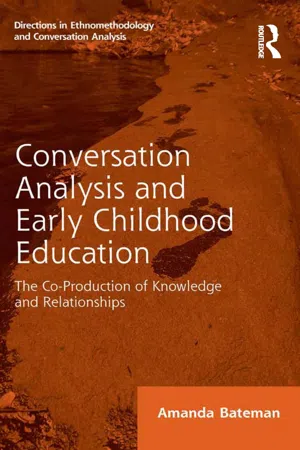
Conversation Analysis and Early Childhood Education
The Co-Production of Knowledge and Relationships
- 194 pages
- English
- ePUB (mobile friendly)
- Available on iOS & Android
eBook - ePub
Conversation Analysis and Early Childhood Education
The Co-Production of Knowledge and Relationships
About this book
This book provides insight into the everyday activities co-produced by teachers and young children, demonstrating the fine details of teaching and learning as knowledge is shared through the everyday activities of talk-in-interaction. Adopting an ethnomethodological perspective, together with conversation analysis and membership categorisation analysis, it reveals how teaching and learning are jointly accomplished during activities such as pretend play episodes, during disputes, managing illness and talking about the environment. Through in-depth studies of child-teacher interactions, the book explores the means by which knowledge is transferred and episodes of teaching and learning are co-constructed by participants, shedding light on the co-production of social order, the communication of knowledge and manner in which professional and relational identities are made relevant in interaction. As such, Conversation Analysis and Early Childhood Education will be of interest not only to scholars of ethnomethodology and conversation analysis, but also to those working in the areas of early childhood studies and pedagogy.
Information
1 Investigating Teacher and Child Interactions
DOI: 10.4324/9781315574158-1
This book presents and discusses findings from a study that investigated the everyday teaching and learning interactions between young children and their teachers in an early childhood education setting in New Zealand. The central aim of the project was to further understand how knowledge exchange occurred during the process of everyday communications between teachers and young children within the framework of the New Zealand early childhood curriculum, Te Whāriki (Ministry of Education [MoE], 1996). As Te Whāriki is a world-renowned document (Waller, 2005) that has recently prompted several countries to revise or develop their early childhood curricula, it was regarded as important to investigate how it guides pedagogy in situ. The presentation and analysis of these findings in this book offer an ethnomethodological insight into the mundane activities engaged in by teachers and young children during their daily routine, offering a unique and detailed insight into everyday interactions that the participants themselves orient to as important. This line of inquiry revealed how both knowledge and relationships were being co-produced between children aged two and half years up to five years and their early childhood teachers. This book highlights the importance of understanding further how the youngest members of society contribute to the co-production of an early education institution with their teachers from a very young age, demonstrating their social competencies as they work to co-create their social worlds.
It is important to note at the very beginning of this book that the observations included here are intended to contribute to the growing body of work regarding how teaching and learning is locally managed between teachers and young children, they are not chosen to provide examples of ‘best teaching practice’. Through discussing examples of everyday teaching and learning interactions, this book aims to demonstrate the usefulness and relevance of using an ethnomethodological approach to such investigations and the significant findings it can reveal. In particular, the findings presented in this book demonstrate how an ethnomethodological investigation into teacher-child interactions can reveal how the participants made relevant the co-production of knowledge and relationships within their everyday interactions with one another in situ.
This book aims to extend research in ethnomethodology, conversation analysis, membership categorisation analysis, early childhood studies and pedagogy. With regard to ethnomethodology (EM), conversation analysis (CA) and membership categorisation analysis (MCA), this book provides new knowledge about the interactional features of the mundane activities engaged in between early childhood teachers and young children. Likewise, through investigating child-teacher interactions using both CA and MCA, the research presented here also offers a unique insight into early childhood education for teachers and early childhood researchers. The empirical chapters of this book (Chapters 4, 5, 6 and 7) examine episodes of teacher-child interaction during pretend play (Chapter 4), in dispute episodes (Chapter 5), when talking about environmental surroundings in the early childhood centre and New Zealand bush land (Chapter 6), and during a single-case analysis of managing illness (Chapter 7).
These findings demonstrate the complexity of interactions between young children and their teachers through their systematic turns at talk where they display saliency in managing category membership. The analysis of mundane activities engaged in by early childhood teachers and young children provide new understandings by revealing how the participants attend to sharing knowledge whilst also orienting to emotional and relational exchanges during their interactions.
A Rationale for the Project: An Early Childhood Education Perspective
The work involved in this book has grown from the shift in thinking from a psychological, deficit view of the child to an increasing awareness that children are capable and competent members of society. In New Zealand the early childhood curriculum acknowledges that children bring wisdom with them to their early childhood centres where the ‘starting point is the learner and the knowledge, skills, and attitudes that the child brings to their experiences’ (MoE, 1996, p. 9). Of interest then is how children actively contribute in the process of a teaching and learning episode with their teachers, and how teachers manage opportunities for collaborative knowledge exchange with young children.
The New Zealand curriculum, Te Whāriki, promotes teaching and learning as a collaborative activity that is guided by its framework. Te Whāriki is recognised as a metaphorical ‘mat’ that is woven by the members of each early childhood setting, ‘The early childhood curriculum has been envisaged as a whāriki, or mat, woven from the principles, strands, and goals defined in this document’ (MoE, 1996, p. 11). This emphasis of a framework to guide teachers, rather than a checklist of outcomes that could be perceived as restrictive, recognises the different types of learning possibilities that occur within centres in New Zealand; an intentional approach to ensure that the diversity of the members within each setting is valued.
The perspective that teaching and learning is context specific and dependant on the individual members present in each location sits well with CA methods where it is recognised that the turn-taking actions of each person works to co-produce the context. Likewise, the systematic and reciprocal co-production of interaction that is acknowledged in CA is also evident in Te Whāriki where it states, ‘This curriculum emphasises the critical role of socially and culturally mediated learning and of reciprocal and responsive relationships for children with people, places, and things’ (MoE, 1996, p. 9).
In New Zealand qualified early childhood teachers are educated to degree level where they are guided in the proficiency of noticing a child’s interests during everyday activity, recognising opportunities for teaching and learning within that interest, and responding in a way which extends and builds knowledge (MoE, 1996). The skills involved in such teaching approaches are a requirement for effective pedagogy where a shared understanding between child and teacher are co-produced. This shared understanding is affirmed in literature exploring effective pedagogy in New Zealand where the research findings revealed:
Effective pedagogy is linked to teachers/educators who are involved, responsive and cognitively demanding, and who encourage ‘sustained shared thinking’ where adults and children co-construct an idea or skill. (Mitchell and Cubey, 2003, p. pviii)
What can be unclear to teachers though is how everyday interactions and conversations can effectively develop children’s learning in practical and non-intrusive ways (Carr, 2007; Davis and Peters, 2008). Prior New Zealand projects, including a project by Davis and Peters (2008), ‘Moments of wonder, everyday events: How are young children theorising and making sense of their world?’ revealed some issues with regard to the dimensions of implementing effective pedagogy under the Te Whāriki framework. Within this project it was found that teachers were interested in learning more about what types of children’s actions they should respond to and how they should respond to them (Peters and Davis, 2011). Of particular interest was how to respond to children’s questions without unintentionally ‘hijacking’ children’s progressive working theories rather than actively listen to their development (Peters and Davis, 2011). The project was essential in revealing these interests with regard to the practical implementation of the New Zealand early childhood curriculum on an everyday basis. The findings suggested that, although the importance of Te Whāriki is acknowledged both nationally and internationally, the implementation of effective pedagogy through its framework could remain somewhat elusive for some early childhood teachers.
The research presented in this book also builds on a New Zealand based early years project by Carr (2007) titled ‘Learning Wisdom’, which focused on ‘knowing why, when and how to engage with learning opportunities’. One of the project findings revealed that the participating teachers used a range of conversational strategies in their practice to maximise learning and teaching opportunities (Carr, 2011). As a way of demonstrating the discussed strategies, the author used transcriptions of conversations between the teachers and children. Although not as detailed as CA transcriptions, this way of presenting the data showed the rich information that can be gained from a close investigation into the verbal interactions between teachers and children in everyday teaching practice. Also of interest to the current project was the finding that ‘teachers deliberately used “identity”’ (Carr, 2011, p. 268) to refer to children’s competencies. The use of membership categories in the turn-taking of everyday conversations is also relevant in CA, where the identities of the people present can be made observable by all members through the talk that is used. The use of membership categorisation analysis lends itself well to exploring further the use of such identity categories in the co-production of teaching and learning episodes.
These valuable New Zealand projects demonstrate that further investigation into the variety of conversations that occur every day in early childhood centres would be beneficial in order to build on the already established information. The study discussed in this book therefore aimed to do just that, where it hoped to provide further insight into teaching and learning in early childhood education in New Zealand under the framework of Te Whāriki. The findings in this book offer early childhood teachers the opportunity to take a closer look at the teaching and learning moments that occur in a systematic and orderly way through various everyday activities between teachers and young children. In turn, the findings will help to answer questions posed by teachers in prior New Zealand research projects (Carr et al. 2008; Davis and Peters, 2008).
From an international perspective, the findings from the current research project contribute to a growing body of research investigating teaching and learning in early childhood education where a greater focus on reciprocal conversations between children and teachers has been initiated in order to gain a clearer insight into the co-construction of pedagogical moments (see Durden and Dangel, 2008 for an overview). Within this arena there have been discussions concerning how teachers can practically extend children’s learning through conversations that are ‘cognitively challenging talk’ (Durden and Dangel, 2008, p. 253). The study and its findings discussed here also hold implications for international research, such as the Effective Provision of Preschool Education (EPPE) study where guidance has been offered regarding quality interactions between early childhood teachers and young children, including the promotion of interactions that consist of sustained and shared thinking episodes (Sylva, Melhuish, Sammons, Siraj-Blatchford and Taggart, 2010)
The EPPE study, developed in the UK, suggests that ‘sustained shared thinking’ is an effective way of implementing early childhood pedagogy where the concept of ‘sustained shared thinking’ is explained as:
‘Sustained shared thinking’ occurs when two or more individuals ‘work together’ in an intellectual way to solve a problem, clarify a concept, evaluate an activity, extend a narrative etc. Both parties must contribute to the thinking and it must develop and extend the understanding. (Sylva et al., 2004, p. 6)
This definition acknowledges the collaborative achievement of teaching and learning moments through reciprocal interaction when engaging in and around a task problem or activity, and therefore aligning well to a CA approach to investigating the social processes of collaborative achievement of shared understandings in everyday interactions.
The work of the EPPE study was further continued through the Researching Effective Pedagogy in the Early Years (REPEY) study (Siraj-Blatchford et al. 2002; 2003) which discussed the use of adults’ questioning for effective pedagogy. The use of conversational strategies for promoting teaching and learning were explored in this research whereby the teachers’ specific use of questions were employed in order to stimulate ‘possibility thinking’ (Siraj-Blatchford and Manni, 2008, p. 267). The importance of specific types of questions in children’s learning were identified; open-ended questions were found to stimulate possibility thinking and exploration whereas closed type questions did not. This international research indicates that, although open-ended questions were promoted in early childhood education to encourage cognitive stimulation, these types of questions were not used very often in everyday practice, and there was ambiguity as to what an open-ended question might look like by the teachers involved (Siraj-Blatchford and Manni, 2008).
These findings suggest that, as with the national research in the area of teacher-child pedagogy, early childhood teachers are interested in learning more about how to implement teachable moments in their everyday conversational practice. Through the synthesis of national and international research, the project findings discussed in this book offer further understanding into moments of teaching and learning through everyday conversations, as the need for such an investigation is clearly apparent.
The Usefulness of Ethnomethodology, Conversation Analysis and Membership Categorisation Analysis for Studying Teacher-Child Interactions
The project used an ethnomethodological approach using a data-driven line of inquiry where findings emanate from the observations of the participants during their everyday interactions with one another; using an ethnomethodological approach to teaching and learning interactions identifies how pedagogy happens in everyday situations. The turn-by-turn verbal and non-verbal interactions between teachers and children were observable during transcription using CA where they revealed the systematic process that was made relevant by the participants. MCA added further depth to the analysis by revealing the membership categories that the teachers and children co-produced during their talk-in-interaction. Approaching early childhood pedagogy using EM, CA and MCA provides answers to the questions raised by the teachers involved in the valuable prior national and international studies.
The initial line of inquiry was to investigate, very broadly, how knowledge was exchanged during teaching and learning episodes in the co-production of everyday interactions between teachers and young children in an early childhood education environment. A CA approach to such a study requires unmotivated looking (discussed further in Chapter 2), allowing insight into the ways in which a shared understanding is achieved that might otherwise be overlooked. Through providing a broad and data-driven investigation into teacher–child interactions, the identification of moments of shared understanding could be revealed as a members matter.
This interest in how shared understandings are co-produced aligns with prior ethno...
Table of contents
- Cover Page
- Half Title Page
- Series Page
- Title Page
- Copyright Page
- Table of Contents
- Acknowledgements
- 1 Investigating Teacher and Child Interactions
- 2 Teaching and Learning as a Social Process
- 3 The Research Project
- 4 Doing Pretend Play
- 5 Relationships and Knowledge in Disputes
- 6 Learning Outside
- 7 Managing Illness: A Single Case Analysis
- 8 Knowledge and Relationships in Early Childhood Education
- Appendix: CA Transcription Conventions
- References
- Index
Trusted by 375,005 students
Access to over 1.5 million titles for a fair monthly price.
Study more efficiently using our study tools.
Frequently asked questions
Yes, you can cancel anytime from the Subscription tab in your account settings on the Perlego website. Your subscription will stay active until the end of your current billing period. Learn how to cancel your subscription
No, books cannot be downloaded as external files, such as PDFs, for use outside of Perlego. However, you can download books within the Perlego app for offline reading on mobile or tablet. Learn how to download books offline
Perlego offers two plans: Essential and Complete
- Essential is ideal for learners and professionals who enjoy exploring a wide range of subjects. Access the Essential Library with 800,000+ trusted titles and best-sellers across business, personal growth, and the humanities. Includes unlimited reading time and Standard Read Aloud voice.
- Complete: Perfect for advanced learners and researchers needing full, unrestricted access. Unlock 1.5M+ books across hundreds of subjects, including academic and specialized titles. The Complete Plan also includes advanced features like Premium Read Aloud and Research Assistant.
We are an online textbook subscription service, where you can get access to an entire online library for less than the price of a single book per month. With over 1.5 million books across 990+ topics, we’ve got you covered! Learn about our mission
Look out for the read-aloud symbol on your next book to see if you can listen to it. The read-aloud tool reads text aloud for you, highlighting the text as it is being read. You can pause it, speed it up and slow it down. Learn more about Read Aloud
Yes! You can use the Perlego app on both iOS and Android devices to read anytime, anywhere — even offline. Perfect for commutes or when you’re on the go.
Please note we cannot support devices running on iOS 13 and Android 7 or earlier. Learn more about using the app
Please note we cannot support devices running on iOS 13 and Android 7 or earlier. Learn more about using the app
Yes, you can access Conversation Analysis and Early Childhood Education by Amanda Bateman in PDF and/or ePUB format, as well as other popular books in Sozialwissenschaften & Bildungstheorie & -praxis. We have over 1.5 million books available in our catalogue for you to explore.