- 384 pages
- English
- ePUB (mobile friendly)
- Available on iOS & Android
eBook - ePub
About this book
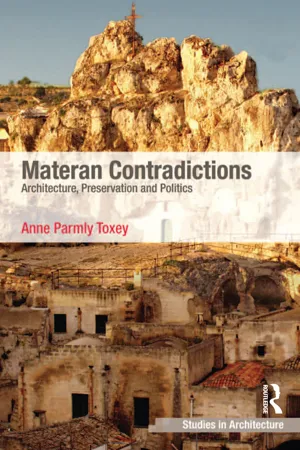
Shaped by encrusted layers of development spanning millennia, the southern Italian city of Matera is the ultimate palimpsest. Known as the Sassi, the majority of the ancient city is composed of thousands of structures carved into a limestone cliff and clinging to its walls. The resultant menagerie of forms possesses a surprising visual uniformity and an ineffable allure. Conversely, in the 1950s Matera also served as a crucible for Italian postwar urban and architectural theory, witnessed by the Neorealist, modernist expansion of the city that developed in aversion to the Sassi. In another about-face, the previously disparaged cave city has now been recast as a major tourist destination, UNESCO World Heritage Monument, and test subject for ideas and methods of preservation. Set within a sociopolitical and architectural history of Matera from 1950 to the present, this book analyses the contemporary effects of preservation on the city and surrounding province. More broadly, it examines the relationship between and interdependence of preservation and modernism within architectural thought. To understand inconsistencies inherent to preservation, in particular its effect of catalyzing change, the study lays bare planners' and developers' use of preservation, especially for economic goals and political will. The work asserts that preservation is not a passive, curatorial pursuit: it is a cloaked manifestation of modernism and a powerful tool often used to control economies. The study demonstrates that preservation also serves to influence societies through the shaping of memory and circulation of narratives.
Information
1
Geographic Situation
Matera’s particular geographic situation plays a significant role in the city’s history and development. This is partly due to its location on a cavernous limestone cliff that lent itself to rupestral habitation. It is also partly due to the city’s inland location on the western edge of the Apulian Murgia (high plains), not far from the port city of Bari. Occurring at the boundary between the calcareous Apulian plains and the clay Lucanian hills—and woven into the walls of the deep canyon called the Gravina di Matera that emphasizes this dramatic, geologic change—Matera has strategically functioned as the threshold between Adriatic trading cities and the peninsula’s southern interior. These geographic attributes have afforded the city not only commercial importance but also religious and political importance. For example, Matera boasts over 150 rock churches. Many of them Byzantine, they are located in the Sassi and stretch north and south of the city along the canyon. Matera has also reigned as the seat of a Latin archbishop for 800 years, has off-and-on served as provincial and regional capital, and has been the prize of invading armies.
With few written records prior to the 16th century, the city’s early history is only tentatively known through deciphered physical traces, archaeological investigation, concurrent regional histories, and later accounts based on oral histories and legend. These resources coalesce to portray a site occupied continuously as an urban cave complex for at least 1,300 years and occupied either continuously or sporadically as smaller tribal settlements for some 100–700 millennia prior to this.1 Divergent groups and conquerors have translated their differing ideologies into Matera’s urban fabric through the synthesizing local medium of tufo. They also comprise the area’s genetic makeup and have impressed its cultural fabric, for example, names, language, music, religion, and cuisine. These groups include: 1) peoples of the early, middle, and late Paleolithic, Neolithic, Eneolithic, early, middle, and late Bronze Ages, and Iron Age (ca. 700,000–400 BCE); 2) indigenous tribes, for example, the Ausoni, Enotri, Morgesi, Peuceti, Italioti, and Pelasgi (ca. 1650–500 BCE);2 3) such colonizing and invading groups as Greeks, Romans, Goths, Longobards, Saracens, Normans, Swabians, Angevins, Aragonese, Napoleonic forces, Austrians, Bourbons, and Lombards (ca. 600 BCE–1860 CE); 4) factions of the Byzantine and Latin churches (700–1200 CE); and 5) such immigrant groups as Armenians, Arabs, Jews, and Slavs (particularly prevalent during the Norman rule, 1000–1200 CE). Although the uninformed visitor does not perceive all these different influences, the intricacy and layering of stonework, accumulated over millennia, clue him to the complexity of the site’s history.

I.1 Civita and Sassi structures rippling down the cliff toward the Gravina di Matera
Walking through the Sassi, one experiences an Escher drawing come to life through the imagination and tiered artistry of masons. Mystery and magic pervade the stones that seem to defy gravity. Churches, shrines, sanctuaries, and symbols of the occult abound, forming the weft of the site’s physical and spiritual fabrics. Mysticism is palpable. Without collapsing, vaults rise effortlessly, conforming to irregular spaces, intersecting with other vaults, and accommodating seemingly impossible openings; arches spring and collide; staircases by the thousands weave millions of steps up, down, and around the canyon walls. Even unpeopled, this cacophony of forms writhes with unearthly energy.

I.2 The Altamura Man (ca. 150,000 BCE): a very early Neanderthal skeleton showing signs of the precedent Homo erectus and found in a Murgia cave north of Matera

I.3 Layers of vaults and endless steps create a labyrinth of stone.
Compass bearings do not exist in this place, whose organizational order comes from somewhere either deep within the earth or beyond this world. Augmenting confusion of direction, the blaring brightness of the stone reflects the oppressive summer sunshine from every surface. The sense of vertigo increases upon exiting a cool, humid, dark cave into blinding heat. The contrast reverses in winter: the caves feel warm and dank compared to the crisp cold outside, where the color of stone—sometimes covered with snow—blends with the bright, overcast sky. Corman captures the effect of the summer sun on the people in his poem, “NO WAY, Via di Sette Dolori.”
to get
out of the sun
these rocks
blatant rocks
kids hopping
hot cobbles
flip coins
under carts
of sun
whose leadpoles unharnessed
hail the sun
women
ages of old
cramped black
mend shadows
men and
mules and sun creep
down to
the bottom
a sun
on sun on sun
stone on
stone on stone
bottom
building for them
a dry
common well3
Meaning “stones” in modern Italian, the term Sassi in the context of Matera does not reference this building material. It is the plural proper noun referring to the place-names of the two zones of caves, Sasso Barisano and Sasso Caveoso. However, the overwhelming presence of stone here—in situ, rough hewn, machined, sculpted, carved into doorways, excavated to make rooms, shaped into mangers and wine casks, channeling water, confronting the eye in every direction—transforms the term Sassi into a superlative iconograph for the place.
In turn, the sense of mysticism and otherworldliness has marked the Sassi as an iconograph for Jerusalem. Often likened to a living crèche and to the Levantine landscape, the Sassi and surrounding region offer film directors a safe substitute for the Holy Land. Many of the dozens of films set here have been Biblical in theme, bringing to Matera the related industry of cinematic tourism.
Located half-underground and carved into a cliff below the modern city of Matera, the ancient cave-city is largely invisible from the upper ground—a defensive strategy of early cave settlers used throughout the territory and one reason that the city survived. Instead of caves, therefore, what meets the visitor’s eye upon arrival to Matera is a city dating largely from the second half of the twentieth century. It is composed of residential towers ranging in height from three to eight stories and arranged in neighborhood groupings. This is the modular modern Italian building block, and the units within serve both residential and occupational uses. Composing 80 percent of Matera’s surface area, these neighborhoods extend from a similarly scaled municipal complex of city hall, courthouse, police station, and transportation hub.

I.4 The Sassi resembling Jerusalem

I.5 (above) Map of contemporary Matera; (below) Section cut of Gravina separating Apulian and Lucanian geologies and explaining relative ease of cave development in this location
This twentieth century city radiates north, south, and west from the centro storico [historic city center], dating to the seventeenth to nineteenth centuries. The corso [main street] forms the spine of this sector, whose nucleus is the central Piazza Vittorio Veneto. (Fig. I.5) From its construction through the present time, this area has housed the city’s elite (as witnessed by the concentration of palazzi [elite houses], churches, and monastic buildings) as well as its commerce (evidenced by banks and shops). Not coincidentally, Piazza Vittorio Veneto and the corso also define the edge of the city’s prominent geologic feature to the east, the Gravina di Matera, which gives the city its linear form (compounded by a gradual drop-off to the west). Absorbed into this Baroque fabric are outlying buildings dating from previous eras of urban development: Romanesque churches (San Giovanni Battista and San Domenico, dating from the 13th century), the unfinished “new” castle (Castello Tramontano, from the beginning of the 16th century), and the former municipal seat (the late 16th-century Piazza Sedile). Beyond the palazzi lining the corso and unseen from the Baroque centro storico as well as from the twentieth century city, the ancient Sassi caves and constructions ripple down the steep, rocky ravine that delimits the eastern side of the city. Staircases leading under and between buildings in the centro storico provide frequent but subtle access to the Sassi.
Composed of the Sassi and the Piano, the bipartite city that we know today took shape in the 1930s when the Fascist government constructed a road that connected the two areas of Sassi. Previous to this event, Matera had been known as a tripartite city, as witnessed in travelers’ journals from at least as far back as the 16th century.4 Deriving from its physical situation, this ancient urban configuration is located east of the more recent centro storico. The three segregated areas had little communication among them. They were comprised of the two zones of cave structures (Sasso Barisano, facing east, and Sasso Caveoso, facing southeast) nestled into valleys flanking a spit of high ground between them, called the Civita (the third zone, whose name indicates its central role in the community). A ground spring issuing from the highest point of the Piano (at the site of Castello Tramontano) develops two streams that discharge into the Gravina. Over eons of time, these two streams cut valleys (called the Grabaglioni) into the ridge, leaving between them a raised peninsular acropolis (the Civita). Gentler in slope than the main walls of the Gravina and graced with year-round groundwater, the valleys of the two streams provided optimal conditions for development of the cave communities.5 (Fig. I.6)
A wall of buildings (called the Quinta Settecentesca, or just Quinta)6 along the corso physically and visually separates the Sassi from the centro storico. (Fig. I.7) (That said, windows and balconies of the elite palazzi comprising this Quinta provide stunning private views of the Sassi.) Until the 1930s, when the Fascist government wound a paved road through the Sassi and around the Civita to connect the parts, access to the Sassi was limited to obscure, narrow stairways used by mules and their owners.
The Civita, however, has historically been less isolated. Located on the same level as the Piano, it is accessed through Piazza Sedile, the first...
Table of contents
- Cover Page
- Title Page
- Copyright Page
- Contents
- List of Figures
- Acknowledgments
- About the Author
- Prologue: Introduction to the Problem
- 1 Geographic Situation
- 2 Social Geography and Political Context of Modern Matera
- 3 1945–1952: Transformation of Public Discourse into Political Action
- 4 1953–1970: Modernization of the Vernacular City
- 5 1971–2001: Completion of the Job: Recupero dei Sassi
- 6 2002–2006: Consequences of Preservation
- Epilogue: Preservation, Modernization, and the Political Economy
- Appendix
- Bibliography
- Index
Trusted by 375,005 students
Access to over 1.5 million titles for a fair monthly price.
Study more efficiently using our study tools.
Frequently asked questions
Yes, you can cancel anytime from the Subscription tab in your account settings on the Perlego website. Your subscription will stay active until the end of your current billing period. Learn how to cancel your subscription
No, books cannot be downloaded as external files, such as PDFs, for use outside of Perlego. However, you can download books within the Perlego app for offline reading on mobile or tablet. Learn how to download books offline
Perlego offers two plans: Essential and Complete
- Essential is ideal for learners and professionals who enjoy exploring a wide range of subjects. Access the Essential Library with 800,000+ trusted titles and best-sellers across business, personal growth, and the humanities. Includes unlimited reading time and Standard Read Aloud voice.
- Complete: Perfect for advanced learners and researchers needing full, unrestricted access. Unlock 1.5M+ books across hundreds of subjects, including academic and specialized titles. The Complete Plan also includes advanced features like Premium Read Aloud and Research Assistant.
We are an online textbook subscription service, where you can get access to an entire online library for less than the price of a single book per month. With over 1.5 million books across 990+ topics, we’ve got you covered! Learn about our mission
Look out for the read-aloud symbol on your next book to see if you can listen to it. The read-aloud tool reads text aloud for you, highlighting the text as it is being read. You can pause it, speed it up and slow it down. Learn more about Read Aloud
Yes! You can use the Perlego app on both iOS and Android devices to read anytime, anywhere — even offline. Perfect for commutes or when you’re on the go.
Please note we cannot support devices running on iOS 13 and Android 7 or earlier. Learn more about using the app
Please note we cannot support devices running on iOS 13 and Android 7 or earlier. Learn more about using the app
Yes, you can access Materan Contradictions by Anne Parmly Toxey in PDF and/or ePUB format, as well as other popular books in Biological Sciences & Architecture General. We have over 1.5 million books available in our catalogue for you to explore.