eBook - ePub
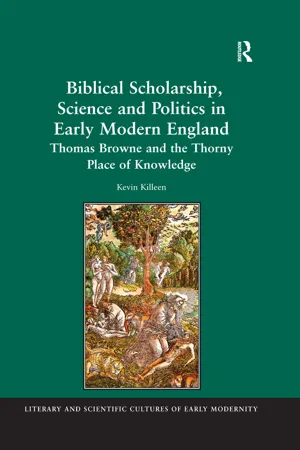
Biblical Scholarship, Science and Politics in Early Modern England
Thomas Browne and the Thorny Place of Knowledge
- 268 pages
- English
- ePUB (mobile friendly)
- Available on iOS & Android
eBook - ePub
Biblical Scholarship, Science and Politics in Early Modern England
Thomas Browne and the Thorny Place of Knowledge
About this book
Kevin Killeen addresses one of the most enigmatic of seventeenth century writers, Thomas Browne (1605-1682), whose voracious intellectual pursuits provide an unparalleled insight into how early modern scholarly culture understood the relations between its disciplines. Browne's work encompasses biblical commentary, historiography, natural history, classical philology, artistic propriety and an encyclopaedic coverage of natural philosophy. This book traces the intellectual climate in which such disparate interests could cohere, locating Browne within the cultural and political matrices of his time. While Browne is most frequently remembered for the magnificence of his prose and his temperamental poise, qualities that knit well with the picture of a detached, apolitical figure, this work argues that Browne's significance emerges most fully in the context of contemporary battles over interpretative authority, within the intricately linked fields of biblical exegesis, scientific thought, and politics. Killeen's work centres on a reassessment of the scope and importance of Browne's most elaborate text, Pseudodoxia Epidemica, his vast encyclopaedia of error with its mazy series of investigations and through this explores the multivalent nature of early-modern enquiry.
Information
Chapter 1
Introduction: The Thorny Place of Knowledge
Culture, Scholarship and Politics in Pseudodoxia Epidemica
At the death of Thomas Browne in 1682, Horatio, Lord Townshend of Raynam Hall in Norfolk received the news together with a eulogistic lament from Browne's 'cosen', Thomas Townshend:
The worse news (comes now) to this towne & my perticular, Sr. Tho: Browne is dead & as hee lived in an eaven temper without deep concerne with how the world went & was therein very happy so hee died like a wise old philosopher ... All scholars allow him to have the most curious Learning of all sorts & that his fellow is not left.1
Such a reputation has proved both enduring and alluring; a tranquil and largely imperturbable scholar, who registers the various revolutions around him –political, religious and scientific – only through the wide vistas of his humanist learning and humour, only by retreat to a gentlemanly interest in science or the patient practice of medicine. His scholarship has been accounted as impressively idiosyncratic, viewing the world askew, with high-minded indifference to and defiance of its contemporary tumult. If there is some truth in such a picture, it also neglects the extent to which his voluminous ragbag of learning – his wide-ranging natural philosophy and natural history, his extensive attention to the Bible and its commentators, his antiquarianism and his picture theory – emerges from the cultural parameters and the political circumstances of his day. Though neither rebarbative nor overly partisan, Thomas Browne's encyclopaedic scholarship is wholly engaged with the intellectual frameworks and arguments of mid-seventeenth-century England, embroiled as it was in both civil and scientific upheavals. While he is most frequently remembered for the magnificence of his prose and his temperamental poise, qualities that knit well with the picture of a detached, apolitical figure, The Thorny Place of Knowledge argues that Browne's significance emerges most fully in the context of contemporary controversy over biblical interpretation and the loss of interpretative authority that so preoccupied his contemporaries. Browne's rhetorical subtlety, this work argues, consists in his interlacing of apparently disinterested scholarship and exegetical controversy.
At the core of these claims is a reassessment of the scope and importance of Browne's most elaborate work, Pseudodoxia Epidemica, his vast encyclopaedia of error with its mazy series of investigations. For all its vast seventeenth-century popularity, Pseudodoxia is a work that makes only fitful appearances in modern accounts of the intellectual and scientific history of the period.2 It is sometimes considered an anomaly in Browne's output, though it dwarfs his other works in its breadth and ambition. Pseudodoxia, or as it is sometimes known. Vulgar Errors, has generally been accounted a hotchpotch of essays, held together in a rather skimpy structural order, whose primary aim is the clearing away of the assorted and accumulated misconceptions of the gullible 'vulgar', or, in his more classically and scientifically orientated chapters, their slightly more learned compatriots. A recurring note of this work is that Browne is engaging with beliefs that arrive already corrected, that he is, by and large, addressing 'errors' which are widely known to be wrong, merely part of the inherited intellectual curiosa of the era. The errors themselves, considered as discrete pieces of ignorance, are not what is really at stake. There are more glorious patterns of ignorance which Browne is addressing – in particular, the exegetical habits of the 'vulgar', who constitute not the unlearned and superstitious masses, but rather what Browne considers to be a more dangerous class of the politically and religiously vulgar, whose interpretative habits when they address scripture are endlessly replicated across the cultural landscape of the 1640s. At stake in Pseudodoxia are habits of poor interpretation which permeate natural philosophy as thoroughly as they occupy the pages and pulpits where Browne detects the scurrilous excesses of biblical exegesis.
Pseudodoxia is also a work that deals extensively with natural philosophy, but one which barely registers in the historiography of early-modem science.3 The second main claim made in this book is that Browne's work is an important text of natural philosophy, not because of any scientific or philosophical originality, but precisely because it is a text so thoroughly immersed in exploring a culture of contested hermeneutics. Much recent historiography of science has dealt with the intrusions of religion into early-modern conceptions of nature, with an increasing awareness of how nature was conceived of in reciprocity with the religious investments of scientific writers.4 Nevertheless, this is an admission that is seldom sustained far into the pages of early-modern historiography of science, to which the practices of biblical or humanist exegesis of nature remain thoroughly alien. The idea that nature was deemed amenable to the same interpretative tools that were applied to the scriptures is one that is occasionally noted, though rarely with any substantial elaboration.5 Browne has an important role in our ascertaining the parameters of early-modern natural philosophy as a set of disciplines which deal with a permeable conception of nature, the object of textual as much as empirical study – categories that used to be deemed antithetical in tracing the routes by which modern science emerged. This work argues that Browne's significance lies neither within the post-Baconian frame where his scientific accomplishments have generally been located, nor within a nascent history of scepticism with new, improved standards of proof and persuasion. It first makes the case that Browne's major philosophical interests involve early-modern matter theory, in a murky area of corpuscular action on the cusp of the visible, whose activity is seen as important evidence in debates on the nature of God. Second, it reads Browne's extensive treatment of animals as similarly imbricated within his sometimes awkward exegetical amalgams, with their presumption of the place of the Bible in understanding nature. Browne's engagement in natural philosophy and natural history is valuable not in spite of its occasionally incongruous blurring of what are often (and wrongly) characterised as 'old' and 'new' science, but precisely because it troubles any chronology of ideas by which science is said to emerge as an unhinging of nature from its textual and religious past.
The argument that runs through these pages makes repeated reference to the political nature of Pseudodoxia. 'Polities' here is used is a loose sense, to describe particular cultural investment and habits of thought allied to political positions, rather than an explicit involvement with the polity. There are also a number of more specific engagements, however. It has long been treated as almost axiomatic in studies of Browne that he eschews politics, that, in the words of one critic: 'He so completely ignores the political situation that one might suppose the Puritan and turbulent Norwich to have been a happy island, completely cut off from the rest of England'.6 Though Religio Medici has been the subject of revised readings, assessing its involvement in a number of doctrinal wrangles and on the fringes of civil war rhetoric. Pseudodoxia has retained its reputation for dogged scholarly isolation, even while Browne's Norwich descended into war around him.7 The third axis of the book makes the case that Browne's major work of the civil war era involves overt and extended attention to the political arena. Pseudodoxia contains a lengthy consideration of the nature of religious images and of pictorial error. There were, in an era in which iconoclasm and church ornament aroused such fierce enmities, few more obviously political topics, or few which contained such incendiary potential. It is, then, quite remarkable that the work has not been seen as an intervention in the literature of iconoclasm and the last part of this work will trace Browne's responses to local and national politics which were, in the opinion of Anglicans at least, destroying the religious fabric of the nation.
Pseudodoxia was completed in Browne's house in St George Tombland, in the shadow of the disused and defaced hulk of Norwich Cathedral, and in an urban townscape of some 30 churches, few of which had escaped the careful attention of an iconoclastic mayoralty involved in an intricate set of the corporate wrangles with which, I show, Browne was undoubtedly acquainted. Browne's focus on pictorial exegesis, the gestures of saints, the stance of a scriptural patriarch or the depiction of the trinity is not. in these circumstances, disinterested scholarship, but is rather a pointed, and often sophisticated, analysis of the hermeneutics of idolatry. At stake in this exploration of the scientific, scholarly and political debates that constitute Pseudodoxia is, on the one hand, a re-assessment of Browne as a substantial figure on the intellectual stage of mid-seventeenth century. In addition, however, the book addresses the disciplinary boundaries and conditions in which such a work as Pseudodoxia could make sense, the permeability of intellectual activities in which biblical scholarship, natural philosophy and politics could so readily cohere.
In the space of three years, Browne moved from provincial obscurity to being an enigmatic international figure, his status as an eminently learned and ingenious figure forged by the successive publications of Religio Medici (1642/1643) and Pseudodoxia Epidemica (1646). Translations of his work were commissioned across Europe over the following decades and his views were appropriated to a range of philosophical and religious causes.8 Religio Medici had established Browne as a speculative and, in the view of some, a scandalous thinker, but also a distinctly slippery writer. Despite its prominent doctrinal assertions of Anglicanism, he was courted by both radicals and Catholics, who suspected an intellectual ally. The Norwich Quaker Samuel Duncon, 'judgeing thee juditious', offers to converse with Browne on 'the principals of our religion', while John Merryweather, the Latin translator of Religio Medici, writes in a letter to Browne how a Paris edition 'by some Papist ... endeavour'd to shew, that nothing but Custom and Education kept you from their Church'.9 The response of Sir Kenelm Digby, the freewheeling fly-by-night cavalier and natural philosopher, who had converted to Catholicism, only added to the sense that this was a work of intellectual gravity.10 Notwithstanding the Catholic approval, the book was placed on the Papal Index of prohibited books, ensuring Browne's place in the English Protestant heart.11
This careful poise by which Religio Medici managed to mean so many different things was a feat that was replicated with Pseudodoxia, if for different reasons. Published in 1646, the work was a curious best-seller, erudite and scholarly, at times breezy and good-humoured in its disposing of errors, and at other moments minutely pedantic and stern. It is the source of his enduring reputation across a number of fields, receiving rich contemporary plaudits and quickly establishing its formidable standing. Samuel Johnson speaks of how 'the favour with which it was first received filled the kingdom with copies'.12 Testimony to Browne's philosophical standing is ample. Robert Boyle talks of 'the learned Dr Browne', Walter Charleton refers to 'the now flourishing Dr Browne', praise echoed by Joseph Glanvill, Nehemiah Grew, John Ray and others.13 It is not, however, so immediately apparent what the basis of the praise is. Many of die responses are not unambiguously celebrating his scientific acumen, but rather some more impalpable quality and it is the enigmatic nature of this esteem that will be explored in this book. ...
Table of contents
- Cover
- Half Title
- Title
- Copyright
- Dedication
- Contents
- Acknowledgements
- List of Illustrations
- 1 Introduction: The Thorny Place of Knowledge
- 2 'The inconsiderable Salarie of Judas': Biblical Historiography and Law
- 3 The Community of this Fruit: Commentary, Curiosa and Chronology
- 4 Subtle Seeds and Agile Emanations: Natural Philosophy, Religion and Witchcraft
- 5 'The doctor quarrels with some pictures': Browne's Fabulous Animals
- 6 The Politics of Painting
- 7 Conclusion
- Bibliography
- Index
Trusted by 375,005 students
Access to over 1.5 million titles for a fair monthly price.
Study more efficiently using our study tools.
Frequently asked questions
Yes, you can cancel anytime from the Subscription tab in your account settings on the Perlego website. Your subscription will stay active until the end of your current billing period. Learn how to cancel your subscription
No, books cannot be downloaded as external files, such as PDFs, for use outside of Perlego. However, you can download books within the Perlego app for offline reading on mobile or tablet. Learn how to download books offline
Perlego offers two plans: Essential and Complete
- Essential is ideal for learners and professionals who enjoy exploring a wide range of subjects. Access the Essential Library with 800,000+ trusted titles and best-sellers across business, personal growth, and the humanities. Includes unlimited reading time and Standard Read Aloud voice.
- Complete: Perfect for advanced learners and researchers needing full, unrestricted access. Unlock 1.5M+ books across hundreds of subjects, including academic and specialized titles. The Complete Plan also includes advanced features like Premium Read Aloud and Research Assistant.
We are an online textbook subscription service, where you can get access to an entire online library for less than the price of a single book per month. With over 1.5 million books across 990+ topics, we’ve got you covered! Learn about our mission
Look out for the read-aloud symbol on your next book to see if you can listen to it. The read-aloud tool reads text aloud for you, highlighting the text as it is being read. You can pause it, speed it up and slow it down. Learn more about Read Aloud
Yes! You can use the Perlego app on both iOS and Android devices to read anytime, anywhere — even offline. Perfect for commutes or when you’re on the go.
Please note we cannot support devices running on iOS 13 and Android 7 or earlier. Learn more about using the app
Please note we cannot support devices running on iOS 13 and Android 7 or earlier. Learn more about using the app
Yes, you can access Biblical Scholarship, Science and Politics in Early Modern England by Kevin Killeen in PDF and/or ePUB format, as well as other popular books in Literature & Literary Criticism. We have over 1.5 million books available in our catalogue for you to explore.