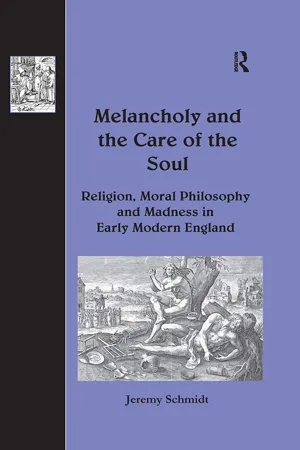
eBook - ePub
Melancholy and the Care of the Soul
Religion, Moral Philosophy and Madness in Early Modern England
- 232 pages
- English
- ePUB (mobile friendly)
- Available on iOS & Android
eBook - ePub
Melancholy and the Care of the Soul
Religion, Moral Philosophy and Madness in Early Modern England
About this book
Melancholy is rightly taken to be a central topic of concern in early modern culture, and it continues to generate scholarly interest among historians of medicine, literature, psychiatry and religion. This book considerably furthers our understanding of the issue by examining the extensive discussions of melancholy in seventeenth- and eighteenth- century religious and moral philosophical publications, many of which have received only scant attention from modern scholars. Arguing that melancholy was considered by many to be as much a 'disease of the soul' as a condition originating in bodily disorder, Dr. Schmidt reveals how insights and techniques developed in the context of ancient philosophical and early Christian discussions of the good of the soul were applied by a variety of early modern authorities to the treatment of melancholy. The book also explores ways in which various diagnostic and therapeutic languages shaped the experience and expression of melancholy and situates the melancholic experience in a series of broader discourses, including the language of religious despair dominating English Calvinism, the late Renaissance concern with the government of the passions, and eighteenth-century debates surrounding politeness and material consumption. In addition, it explores how the shifting languages of early modern melancholy altered and enabled certain perceptions of gender. As a study in intellectual history, Melancholy and the Care of the Soul offers new insights into a wide variety of early modern texts, including literary representations and medical works, and critically engages with a broad range of current scholarship in addressing some of the central interpretive issues in the history of early modern medicine, psychiatry, religion and culture.
Information
Chapter One
Therapeutic Languages: Ancient Moral Philosophy and Patristic Christianity
It was something of a commonplace in Greek philosophical thought that both body and soul could be diseased and that both had their proper forms of healing: the medical art for ailments of the body and philosophy for the diseases of the mind.1 In The Republic, Plato explained his conception of the just soul with an analogy to Greek medical ideas about health and disease: just as “health is produced by establishing a natural relation of control and subordination among the constituents of the body, disease by establishing an unnatural relation … [s]o justice is produced by establishing in the mind a similar natural relation of control and subordination among its constituents, and injustice by establishing an unnatural one.” Thus Plato called the subordination of the appetitive and spirited elements of the soul to the rational element “a kind of mental health.”2 And where Plato outlined the course of education needed to enable the soul to achieve justice through an apprehension of the Good, he stressed in particular the need to shape carefully the student’s emotional life.3 Aristotle likewise argued in his Nicomachean Ethics that “anyone who is going to be a competent student in the spheres of what is noble and what is just – in a word, politics – must be brought up well in his habits.”4 Indeed, Aristotle went on to define human good precisely in terms of these moral habits, which he argued to involve a tempering of character according to a mean between opposite emotional dispositions as well as an understanding of what feelings and actions are appropriate in a given situation and in what measure.5 Clearly, as in Plato, rational thought was to supervene on natural human impulse in the formation of virtuous character.6 And that this achieved the good of the soul Aristotle clarified by analogy to bodily health and disease, noting that “we must use clear examples to illustrate the unclear.” Just as “too much food and drink and too little ruin one’s health, while the right amount produces, increases and preserves it”, in the same way, “temperance, courage and the other virtues … are ruined by excess and deficiency, and preserved by the mean.”7
The post-Aristotelian, Hellenistic philosophical schools in particular concentrated on the importance of controlling the emotions in the endeavor to attain the health of the soul.8 The Stoics advocated the position that the emotions are the soul’s diseases because they consist of judgments of good and evil not in accordance with reason.9 Since the Stoics defined the good strictly in terms of the moral goods of virtue and vice, many of the common human emotional responses to events of the social and natural world – grief at the death of others, pity for human suffering, for example – were considered as diseased states of mind, incompatible with virtue and wisdom. These emotions took for real goods and evils objects which were not moral goods and moral evils.10 The Stoics thus encouraged their students to cultivate a posture of indifference to political and natural events, but this posture was clearly only conceivable within the context of the Stoic belief that reason governed the cosmos through divine providence. Rather than becoming distressed with apparent evil, the sage accepted calmly that all which occurred in the universe was governed by divine reason.11
Ancient discussions of the emotions thus generally advanced the idea that they could be modified and shaped according to reason, and that doing so would contribute significantly to human happiness. But whereas the Platonists explained the conflict between reason and passion by locating the passions in the appetitive and spirited parts of the soul, “below” reason, most of the Stoics insisted that soul consisted only of a rational part which issued both rational judgments and “irrational” judgments, or passions, and that the passions could therefore, at least notionally, be eliminated entirely by rectifying the judgments of the soul. Against this, the Epicureans argued that feelings of pleasure and pain were to some degree natural, and could not be eliminated. But the Epicureans were as insistent as others that they, too, could provide insight into the grounds of human happiness, which they argued to consist in peace of mind and a body free from pain. Considerable human suffering could be alleviated by rationally trimming human desire to what was naturally necessary. Thus Epicurus recommended a rather spare diet, to control both the suffering of ardent appetitive longing and to keep the body in good health, and advocated withdrawal from the political sphere to avoid the over-elation and deep disappointments of public life.12 Recognizing that grief, disappointment, and suffering were to some degree natural and inevitable, however, the Epicureans suggested turning thought to more pleasant objects and memories to alleviate emotional distress.13
Many of the views of these Greek philosophical schools on the emotions and the health of the soul were later taken up by Roman writers such as Seneca and Cicero, who dealt extensively with the problem that the passions posed to the cultivation of the health of the soul, and who discussed and developed the remedies that various Hellenistic philosophies had suggested.14 Both Seneca and Cicero had certain moral philosophical commitments, mainly Stoic in nature. But because most philosophical perspectives converged on the idea that an emotional life ungoverned by reason was in conflict with happiness, which was taken by all to be conterminal with the good and with the fulfilment of human nature, moral philosophy could be viewed from a pragmatic or therapeutic point of view as a means of relieving wretchedness and suffering. In the Tusculan Disputations, after rehearsing the various arguments of the philosophic schools on the cure of distress (aegritudo), Cicero says that “in my Consolation I threw them all into one; … for my soul was in a feverish state and I attempted every means of curing its condition.”15
Such therapeutic eclecticism was in an important way not as available within the context of Christianity, which was defined by its espousal of Christ as the only true source of comfort. Many of the Patristic authorities were deeply influenced by Greco-Roman philosophy, incorporating its concepts, ideals, and techniques into their writing and practice, but they insisted that the soul’s well-being could only be achieved through the aid of divine grace.16 In his Confessions (397–400), Augustine recounted his wretched state of restless and unsatisfied desire before his conversion. importantly, it is through Neoplatonic philosophical reasoning and spiritual exercise that Augustine was at last able to envision human fulfilment and happiness through an apprehension of God, man’s greatest good, in whom alone can restless human desire be satisfied. But, as Augustine later confessed to his God, “to enjoy you I was too weak.” His analysis of his weakness is in fact an indictment of heathen philosophy:
I prattled on as if I were expert, but unless I had sought your way in Christ our Saviour (Titus 1:4), I would have been not expert but expunged. I began to want to give myself airs as a wise person. I was full of my punishment, but I shed no tears of penitence … Where was the charity which builds on the foundation of humility which is Christ Jesus? When would the Platonist books have taught me that?17
Later, Augustine states, when “my wounds were healed by your gentle fingers, I would learn to discern and distinguish the difference between presumption and confession, between those who see what the goal is but not how to get there and those who see the way which leads to the home of bliss, not merely as an end to be perceived but as a realm to live in.”18
This statement encapsulates the distinction between heathen philosophy and Christianity which would become commonplace in the Western tradition. The philosopher is able to define the good, but is not able to achieve it. This was more or less admitted by ancient philosophers. Pierre Hadot writes that “with the possible exception of the Epicurean school, wisdom was conceived as an ideal after which one strives without the hope of attaining it.”19 Yet the philosopher insistently strove after wisdom, and Christian thinkers took this as a manifestation of pride: the philosopher vainly attempts to heal his soul through his own effort, whereas the Christian humbly admits that he needs God to heal him. And the Christian thus does not view the practice of philosophical dialectic as important, but rather prays, repents, and confesses. The pages of the Platonist books, Augustine writes, “do not contain the face of this devotion, tears of confession, your sacrifice, a troubled spirit, a contrite and humble spirit (Psalms 50:19).”20
This kind of devotion created a further disjunction between Christian and philosophical models of the soul’s health. As Augustine’s quotation from the Psalms indicates, a state of spiritual sorrow was a well-developed topoi in Christianity’s Old Testament, and in the second letter to the Corinthians, Paul contrasts a form of sadness which “worketh death” with a “sorrow to repentance,” or “godly sorrow.”21 But the cultivation of sorrow was entirely perverse from an Epicurean perspective, and seemed equally contrary to the Stoic goal of indifference, or apatheia. In The City of God against the Pagans (426), Augustine agreed with the Stoics that the ideal of “a life without those emotions which arise contrary to reason and which disturb the mind … is clearly a good and desirable condition.” But although Augustine achieved a substantial measure of peace of mind through his conversion, in The City of God he argued that the Stoic state of apatheia “does not … belong to this present life.” Humans remain in a condition of sin, and rightly feel “pain for their sins,” as well as pain and anxiety in their temptations to sin.22
Paul’s “godly sorrow” is a good rather than an evil, Augustine argued against the Stoic position on emotion, because it is derived from the love of God. Augustine concluded that Christians were thus in the position of Alcibiades, whose story was recounted by Cicero in the Tusculan Disputations:
He seemed to himself to be happy; but when Socrates demonstrated to him by argument how miserable he was because he was foolish, he wept. For him, then, foolishness was the cause of a useful and desirable grief: the grief of one who deplores that he is not what he ought to be.23
The point which Cicero had argued with t...
Table of contents
- Cover
- Half Title
- Title
- Copyright
- Contents
- Acknowledgments
- Introduction: Melancholy, Language, and Madness
- 1 Therapeutic Languages: Ancient Moral Philosophy and Patristic Christianity
- 2 Melancholy among the Passions in Seventeenth-century Thought
- 3 The Pastoral Care of Melancholy in Calvinist England
- 4 Anglicanism, Melancholy, and the Restoration Critique of "Enthusiasm"
- 5 The "Puritan Tradition"? Nonconformist Practical Divinity and the Critique of "Enthusiasm"
- 6 From Religious Despair to Hypochondria: The Languages of Melancholy Transformed
- 7 Curing Augustan Hysterics: Morality, Politics, and Religion
- Conclusion
- Bibliography
- Index
Trusted by 375,005 students
Access to over 1.5 million titles for a fair monthly price.
Study more efficiently using our study tools.
Frequently asked questions
Yes, you can cancel anytime from the Subscription tab in your account settings on the Perlego website. Your subscription will stay active until the end of your current billing period. Learn how to cancel your subscription
No, books cannot be downloaded as external files, such as PDFs, for use outside of Perlego. However, you can download books within the Perlego app for offline reading on mobile or tablet. Learn how to download books offline
Perlego offers two plans: Essential and Complete
- Essential is ideal for learners and professionals who enjoy exploring a wide range of subjects. Access the Essential Library with 800,000+ trusted titles and best-sellers across business, personal growth, and the humanities. Includes unlimited reading time and Standard Read Aloud voice.
- Complete: Perfect for advanced learners and researchers needing full, unrestricted access. Unlock 1.5M+ books across hundreds of subjects, including academic and specialized titles. The Complete Plan also includes advanced features like Premium Read Aloud and Research Assistant.
We are an online textbook subscription service, where you can get access to an entire online library for less than the price of a single book per month. With over 1.5 million books across 990+ topics, we’ve got you covered! Learn about our mission
Look out for the read-aloud symbol on your next book to see if you can listen to it. The read-aloud tool reads text aloud for you, highlighting the text as it is being read. You can pause it, speed it up and slow it down. Learn more about Read Aloud
Yes! You can use the Perlego app on both iOS and Android devices to read anytime, anywhere — even offline. Perfect for commutes or when you’re on the go.
Please note we cannot support devices running on iOS 13 and Android 7 or earlier. Learn more about using the app
Please note we cannot support devices running on iOS 13 and Android 7 or earlier. Learn more about using the app
Yes, you can access Melancholy and the Care of the Soul by Jeremy Schmidt in PDF and/or ePUB format, as well as other popular books in Medicine & Early Modern History. We have over 1.5 million books available in our catalogue for you to explore.