eBook - ePub
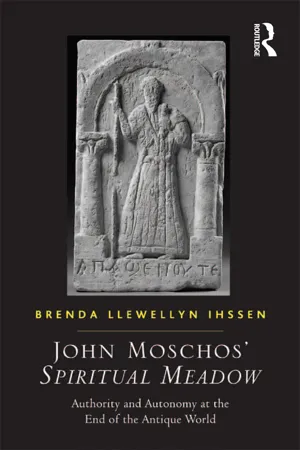
John Moschos' Spiritual Meadow
Authority and Autonomy at the End of the Antique World
- 198 pages
- English
- ePUB (mobile friendly)
- Available on iOS & Android
eBook - ePub
John Moschos' Spiritual Meadow
Authority and Autonomy at the End of the Antique World
About this book
John Moschos' Spiritual Meadow is one of the most important sources for late sixth-early seventh century Palestinian, Syrian and Egyptian monasticism. This undisputedly invaluable collection of beneficial tales provides contemporary society with a fuller picture of an imperfect social history of this period: it is a rich source for understanding not only the piety of the monk but also the poor farmer. Brenda Llewellyn Ihssen fills a lacuna in classical monastic secondary literature by highlighting Moschos' unique contribution to the way in which a fertile Christian theology informed the ethics of not only those serving at the altar but also those being served. Introducing appropriate historical and theological background to the tales, Llewellyn Ihssen demonstrates how Moschos' tales addresses issues of the autonomy of individual ascetics and lay persons in relationship with authority figures. Economic practices, health care, death and burials of lay persons and ascetics are examined for the theology and history that they obscure and reveal. Whilst teaching us about the complicated relationships between personal agency and divine intercession, Moschos' tales can also be seen to reveal liminal boundaries we know existed between the secular and the religious.
Information
Chapter 1
Monks in The Meadow: Proving and Improving the Ascetic Program
Introduction
In 1992, Christopher Johnson McCandless died of starvation in an abandoned bus north of Mt McKinley, Alaska. Two years earlier he had graduated from Emory University and quickly divested himself of his possessions, his money and his relationship with his family. Adventure and travel writer Jon Krakauer reported McCandless’ story for Outside magazine,1 which he later expanded into a national bestseller and feature film, both titled Into the Wild.2 McCandless’ story was riveting and polarizing, and produced strong commentary that either lauded his romanticism or harshly criticized what people unsympathetically considered a foolish lack of basic survival skills.3 His story would have been as captivating to monks of Moschos’ era, some of whom would claim that one does not seek the angelic life on one’s own, while others would claim that survival is not necessarily the point of walking into the wild.
Whether each point were to be argued by a monastic in the sixth century or a lay person in the twenty-first, both positions betray a fundamental misunderstanding about lines drawn between a life dedicated to ascetic ideals and a life that is not, and, further, what physical movement contributes to conversation between the two positions. Scholarship on the movement of monastic figures has successfully uncovered their vibrant lives and has rightly linked them—no matter how transient or isolated—with economic and social structures of the Mediterranean world.4 John Wortley notes that “it is clear from that material itself that the separation between the wilderness and the world was not by any means absolute,”5 and religious and ethnic dislocation into which Christian monasticism emerged and developed contributed in its own way to the general culture of movement.6 This, in turn, shaped social relations, self-sufficiency and the development of the landscape, as evident in Moschos’ text as in any other of the genre.7 Several centuries of migrations and invasions into western provinces by various Germanic tribes and into eastern provinces by Slavic, Bulgar and Persian tribes created an atmosphere in which movement of all types of individuals carried with it the potential to be permeated with religious import.8 In her careful and extensive treatment of religious travel, Maribel Dietz distinguishes between those exiled as a result of conciliar decision, restless individuals, spiritual/monastic wanderings, pilgrimage travel and missionary activity before considering the “worst” or “inferior” types of traveling monks, identified by Jerome and Cassian as “remnouth” and “sarabaites” respectively, and a category of traveling monastics more carefully refined in the Regula Magistri as “gyrovagues.”9 Regarding remnouth, Jerome writes that “These men live together in twos and threes, seldom in larger numbers, and live according to their own will and ruling.”10 Curiously, this description fits many figures in The Meadow, including the author and his companion. Regarding sarabaites, Cassian writes that they are despised because of their separation and concern for their own needs.11 Although Palladius mentions the gyrovagues also in his Lausiac History—confirming that this was not a problem limited to western monastic communities12—these flaws do not appear to pertain to Moschos and Sophronios; there are no passages in The Meadow to suggest that they are neither welcomed nor treated with proper hospitality, or suspected of being imposters. That said, I would not argue that Moschos makes a claim for the spiritual significance of his itinerancy or that of any of the wandering monks in his tales, or at least not an overt one such as that of Fabiola, whose feelings of confinement led her to seek an itinerant life in which she was “in every sphere, foreign.”13 Rather, Moschos’ argument is that the virtuous life be focused not only on “studying [what is] divine”14 but on the composition of the praiseworthy lives of others. Wandering itself is not Moschos’ goal, even as he does an awful lot of it; wandering occurs because writing about the tales that he gathers is a significant component of his particular ascetic program, an element of his monastic vocation and discipline, and he cannot write tales that have not been gleaned from the meadow. In Moschos’ case—like the Scottish-American writer and environmental champion John Muir many centuries later and, dare I add, Chris McCandless—wilderness and movement within it contribute to Moschos’ ability to produce thoughtful reflections on his environment, which results in their preservation.
Evidence of positions for and against wandering exist, which present challenges if one hopes for continuity; for example, note the distinction between a brother’s complaint to Abba Sisoes that the brothers are mocking him for “making a practice of racing from place to place”15 with the tale of John the elder, whose injured feet were healed by an angel who ordered him to return to his life of grazing and “wandering from place to place.”16 Likewise, Antony did not always appear to obey the counsel that he is credited with giving, that one should not be too eager to move on.17 Although the link between asceticism and travel is neither explicitly identified nor denied in eastern monasticism, the link between writing and ascesis has been quite persuasively acknowledged. Recent studies on how the holy life is—and might have been—understood reveal how hagiographers were more than cultural or spiritual voyeurs; in the process of collecting and writing beneficial tales, Moschos himself engaged in more than preservation. Writing allowed him to participa...
Table of contents
- Cover Page
- Title Page
- Copyright Page
- Contents
- Foreword
- Preface
- Acknowledgements
- List of Abbreviations
- Introduction
- 1 Monks in The Meadow: Proving and Improving the Ascetic Program
- 2 Money in The Meadow: Coin, Cost and Conversion
- 3 Medical Management in The Meadow: Curing, Enduring and Identity Formation
- 4 Mortality in The Meadow: Dying, Death and Predetermination
- Conclusion
- Bibliography
- Index
Trusted by 375,005 students
Access to over 1.5 million titles for a fair monthly price.
Study more efficiently using our study tools.
Frequently asked questions
Yes, you can cancel anytime from the Subscription tab in your account settings on the Perlego website. Your subscription will stay active until the end of your current billing period. Learn how to cancel your subscription
No, books cannot be downloaded as external files, such as PDFs, for use outside of Perlego. However, you can download books within the Perlego app for offline reading on mobile or tablet. Learn how to download books offline
Perlego offers two plans: Essential and Complete
- Essential is ideal for learners and professionals who enjoy exploring a wide range of subjects. Access the Essential Library with 800,000+ trusted titles and best-sellers across business, personal growth, and the humanities. Includes unlimited reading time and Standard Read Aloud voice.
- Complete: Perfect for advanced learners and researchers needing full, unrestricted access. Unlock 1.5M+ books across hundreds of subjects, including academic and specialized titles. The Complete Plan also includes advanced features like Premium Read Aloud and Research Assistant.
We are an online textbook subscription service, where you can get access to an entire online library for less than the price of a single book per month. With over 1.5 million books across 990+ topics, we’ve got you covered! Learn about our mission
Look out for the read-aloud symbol on your next book to see if you can listen to it. The read-aloud tool reads text aloud for you, highlighting the text as it is being read. You can pause it, speed it up and slow it down. Learn more about Read Aloud
Yes! You can use the Perlego app on both iOS and Android devices to read anytime, anywhere — even offline. Perfect for commutes or when you’re on the go.
Please note we cannot support devices running on iOS 13 and Android 7 or earlier. Learn more about using the app
Please note we cannot support devices running on iOS 13 and Android 7 or earlier. Learn more about using the app
Yes, you can access John Moschos' Spiritual Meadow by Brenda Llewellyn Ihssen in PDF and/or ePUB format, as well as other popular books in Theology & Religion & Christian Denominations. We have over 1.5 million books available in our catalogue for you to explore.