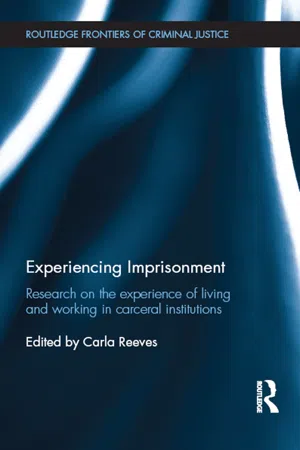
Experiencing Imprisonment
eBook - ePub

Experiencing Imprisonment

Research on the experience of living and working in carceral institutions

  1. 338 pages
  2. English
  3. ePUB (mobile friendly)
  4. Available on iOS & Android
eBook - ePub

Experiencing Imprisonment

Research on the experience of living and working in carceral institutions

About this book

The growing body of work on imprisonment, desistance and rehabilitation has mainly focused on policies and treatment programmes and how they are delivered. Experiencing Imprisonment reflects recent developments in research that focus on the active role of the offender in the process of justice. Bringing together experts from around the world and presenting a range of comparative critical research relating to key themes of the pains of imprisonment, stigma, power and vulnerability, this book explores the various ways in which offenders relate to the justice systems and how these relationships impact the nature and effectiveness of their efforts to reduce offending.

Experiencing Imprisonment showcases cutting-edge international and comparative critical research on how imprisonment is experienced by those people living and working within imprisonment institutions in North America and Northern, Central and Eastern Europe, as well as Scandinavia. The research explores the subjective experience of imprisonment from the perspective of a variety of staff and prisoner groups, including juveniles, adult female and male prisoners, older prisoners, sex offenders, wrongfully convicted offenders and newly released prisoners.

Offering a unique view of what it is like to be a prisoner or a prison officer, the chapters in this book argue for a prioritisation of understanding the subjective experiences of imprisonment as essential to developing effective and humane systems of punishment. This is essential reading for academics and students involved in the study of criminology, penology and the sociology of imprisonment. It will also be of interest to Criminal Justice practitioners and policymakers around the globe.

Trusted by 375,005 students

Access to over 1.5 million titles for a fair monthly price.

Study more efficiently using our study tools.

Information

Publisher
Routledge
Year
2016
Print ISBN
9781138304765
eBook ISBN
9781317653486

Part I Cultures of imprisonment

Stigma, identity and interaction

Introduction

Carla Reeves
DOI: 10.4324/9781315764177-1
In this first section research from Europe, North America and Australia will be presented that explores the impact of incarceration on prison staff and prisoners’ sense of self-identity and the nature of their interactions with one another within the context of prison culture. Each of these chapters considers a specific offender group or element of prison culture, such as sex offenders or concepts of fairness; however, they all draw upon some common theoretical positions. In particular, this section is underpinned by the seminal works of Erving Goffman on stigma (1963) and his study of interactions and adaptations within a closed institution (namely, an asylum) (1961), Donald Clemmer’s work on prison community and culture (1940) as well as John Irwin and Donald Cressey’s (1962) ideas on the formation of prison culture.

Stigma

Goffman’s 1963 work Stigma has been influential in developing the study of how stigma is constructed and experienced. Stigma, in this context, refers to undesirable social or moral characteristics attributed to individuals or groups of people. Linked to the concept of stigma is that of social identity or identities. The term social identity encompasses the social status and position of the individual as well as personal characteristics such as honesty, reliability or friendliness. Goffman explores how stigma discredits or spoils social identities through the reaction of society or particular social groups when they attribute negative characteristics to people. This can lead to the othering and stereotyping of those stigmatised people, resulting in a ‘them and us’ position in which the stigmatised is regarded as different (and ‘other’) to the ‘normal’ stigmatisers. The prompt for this negative reaction can be due to any socially unaccepted behaviour or condition and researchers have explored the construction and impact of stigma in a wide range of contexts from public health (such as: health inequalities; see, for example, Hatzenbuehler et al. 2012; Puhl and Heuer 2010; Wahl 2012) to race and ethnicity (see Wilton et al. 2013) and the workplace (see Stone and Hernandez 2013). Criminologically, stigma has most often been applied to the study of labelling and its role in the criminalisation process, including its significance in shaping the experience of pre-release, release and post-release from incarceration, particularly for sex offenders or prisoners with mental health or substance misuse problems (see Chui and Cheng 2012; Seidler 2010; Williams et al. 2011).

Prison culture

Over the last half of the twentieth century, and with increasing academic interest more recently, researchers have turned their attention to understanding prison culture with a view to exploring what is happening within these institutions that inhibits and facilitates positive change. Clemmer’s 1940 study described the character of prison society and cultural norms, including how people became socialised to prison culture through a prisonisation process. More recent work has developed on this to further consider the value systems and social hierarchies prevalent in prisons generally, and within prison subcultures (see Edgar et al. 2012; Kjær Minke 2014; Skarbek 2014). The main criticism of the early work in this field was that it failed to account for how prison culture formed in the first place. This led to two opposing theories: the deprivations model and the importation model.

Deprivations model

This model follows from the work of Goffman in Asylums and Sykes in The Society of Captives, and primarily explains prison culture as being formed through the experience of being a prisoner and how they adjust and cope with the challenges that prison life brings. Thus, prison culture is shaped internally as a response to imprisonment. Criticisms of this model focus on the failure to consider why prisoners respond to the deprivations of imprisonment in the way that they do and so why a prison culture forms which tends to be antithetical to the aims of imprisonment. (The challenges, or deprivations, faced by prisoners are the focus of Part II of this book and the introduction to that section includes a brief overview of these concepts.)

Importation model

Proponents of this model argue that rather than being shaped through internal forces prison culture is formed through a range of subcultures which result from prisoners’ prior experiences, values and culture which are imported into prison with them. Irwin and Cressey (1962) were the first to argue this perspective, and they set out the main subcultures as revolving around ‘thief’, ‘convict’ and ‘straights’: thief referring to career criminals who see prison as a temporary break in work, convicts being career prisoners, and straights being those who do not see themselves as an offender and rather identify with prison staff.

Integrated model

Latterly, theorists have sought to reconcile these two models and, rather than seeing them as extremes on a continuum, instead conceptualise prison culture as resulting from a synthesis of these internal and external influences. Therefore, prison culture and subcultures form as a consequence of the challenges of imprisonment, but how prisoners respond is shaped by their previous cultural associations, values and experiences.
The concepts of stigma and shame are foremost in the first two chapters in Part I. First, Ricciardelli and Clow’s study of how stigma is experienced and attributed by male prisoners and prison staff in Canada and the consequences this may have in creating ‘discredited identities’ for these groups of people. This is followed by Blagden and Perrin’s study of sex offenders in a therapeutically orientated UK prison in which they situate sex offender treatment within the broader context of incarceration. In so doing, Blagden and Perrin integrate research on the effectiveness of sex offender treatment programmes with that on stigma and social exclusion experienced by sex offenders within the prison community; considering the nature of the prison environment, culture and the impact this can have on supporting treatment objectives.
The rest of Part I considers the social environments of incarceration and significant aspects of prison life which shape the experience of people working and incarcerated in penal institutions. First, Gooch and McNamara’s chapter compares different ways of working in youth justice facilities in the UK and Australia to explore the working cultures and impacts on staff and incarcerated youth. In Chapter 4 Schmidt explores how inmates in juvenile prisons in Germany perceive the fairness of imprisonment, with particular reference to concepts of justice, legitimacy, dignity and respect. Sloan’s chapter focuses on UK adult male prisons and considers the interaction between masculinity, imprisonment and work, and how identity is constructed through performance. Finally, Smoyer explores the role of food, its acquisition, consumption and distribution (‘foodways’) as a significant mechanism of negotiating social relationships, status and identities within US female prison communities.

References

  • Chui, W. H. and Cheng, K. K-Y. (2012) ‘The mark of an ex-prisoner: Perceived discrimination and self-stigma of young men after prison in Hong Kong’, Deviant Behaviour, 34(8): 671–684.
  • Clemmer, D. (1940) The Prison Community, Boston: Christopher.
  • Edgar, K., O’Donnell, I. and Martin, C. (2012) Prison Violence: The dynamics of conflict, fear and power, London: Routledge.
  • Goffman, E. (1961) Asylums: Essays on the social situation of mental patients and other inmates, London: Penguin.
  • Goffman, E. (1963) Stigma: Noted on the management of spoiled identity. Harmondsworth: Penguin, Prentice-Hall.
  • Hatzenbuehler, M. L., Pehlan, J. C. and Link, B. G. (2012) ‘Stigma as a fundamental cause of population health inequalities’, American Journal of Public Health, 103(5): 813–821.
  • Irwin, J. and Cressey, D. (1962) ‘Thieves, convicts, and the inmate subculture’, Social Problems, 54: 590–663.
  • KjĂŚr Minke, L. (2014) ‘A study of prisonization among Danish prisoners’, Prison Service Journal, 211: 37–42.
  • Puhl, R. M. and Heuer, C. A. (2010) ‘Obesity stigma: Important considerations for public health’, American Journal of Public Health, 100(6): 1019–1028.
  • Seidler, K. (2010) ‘Community management of sex offenders: Stigma versus support’, Sexual Abuse in Australia and New Zealand, 2(2): 66–76.
  • Skarbek, D. (2014) The Social Order of the Underworld: How prison gangs govern the American penal system, Oxford: Oxford University Press.
  • Stone, P. and Hernandez, L. A. (2013). ‘The all-or-nothing workplace: Flexibility stigma and “opting out” among professional-managerial women’, Journal of Social Issues, 69(2): 235–256.
  • Wahl, O. F. (2012) ‘Stigma as a barrier to recovery from mental illness’, Trends in Cognitive Sciences, 16(1): 9–10.
  • Williams, A., Moore, E., Adshead, G., McDowell, A. and Tapp, J. (2011) ‘Including the excluded: High security hospital user perspectives on stigma, discrimination, and recovery’, British Journal of Forensic Practice, 13(3): 197–204.
  • Wilton, L. S., Sanchez, D. T. and Garcia, J. A. (2013) ‘The stigma of privilege: Racial identity and stigma consciousness among biracial individuals’, Race and Social Problems, 5(1): 41–56.

1 Extrapolating the realities of stigma Correctional officers ‘seeing' prisoners versus prisoners ‘seeing’ correctional officers

Rose Ricciardelli and Kimberley A. Clow
DOI: 10.4324/9781315764177-2
In Canada, imprisonment is supposed to serve the function of deterrence, retribution and rehabilitation – however prisons remain largely punitive and prisoners bear one of the most stigmatising statuses in society (Akerstrom 1986; Albrecht et al. 1982; Bontrager et al. 2005; Clear et al. 2001; Edwards 2000; Goffman 1963; Ricciardelli 2014b). The combined influence of politicians, media personalities, victims and perpetrators of crime have shaped Canadian correctional policy, most recently through detrimental legislative changes. These changes came about in light of penal populism, where public and political pressures promote a ‘get tough on’ crime agenda (Garland 2001; Pratt 2007). The passing of the Safe Streets and Communities Act (formerly Bill C-10) in 2012 resulted in amendments to the Corrections and Conditional Release Act, the Criminal Records Act, the Controlled Drugs and Substances Act, the International Transfer of Offenders Act, the Youth Criminal Justice Act, the Immigration and Refugee Protection Act and the Criminal Code, resulting in longer sentences, mandatory minimums, increasing ineligibility for conditional sentences, harsher punishments for sex offenders and youth, and the creation of new offences, among other changes (Canadian Civil Liberties Association 2014; Correctional Service Canada 2012; Parliamentary Information and Research Service 2011; Parole Board of Canada 2012). In response to the implementation of this Act, on 3 June 2013, the former Public Safety Minister, Vic Toews, spoke in parliament about Bill C-10, noting that the Barreau du Quebec had filed an application to declare the mandatory minimums imposed by this Bill as ‘unconstitutional and of no force or effect’ (Cohen 2013). The Safe Str...

Table of contents

  1. Cover Page
  2. Frontmatter Page
  3. Half Title Page
  4. Series Page
  5. Title Page
  6. Copyright Page
  7. Table of Contents
  8. List of figures
  9. List of tables
  10. Notes on contributors
  11. Acknowledgements
  12. General introduction—CARLA REEVES
  13. PART I Cultures of imprisonment: stigma, identity and interaction
  14. PART II Coping with the pains of imprisonment
  15. PART III The boundaries between the inside and outside worlds
  16. Conclusions—CARLA REEVES
  17. Index

Frequently asked questions

Yes, you can cancel anytime from the Subscription tab in your account settings on the Perlego website. Your subscription will stay active until the end of your current billing period. Learn how to cancel your subscription
No, books cannot be downloaded as external files, such as PDFs, for use outside of Perlego. However, you can download books within the Perlego app for offline reading on mobile or tablet. Learn how to download books offline
Perlego offers two plans: Essential and Complete
  • Essential is ideal for learners and professionals who enjoy exploring a wide range of subjects. Access the Essential Library with 800,000+ trusted titles and best-sellers across business, personal growth, and the humanities. Includes unlimited reading time and Standard Read Aloud voice.
  • Complete: Perfect for advanced learners and researchers needing full, unrestricted access. Unlock 1.5M+ books across hundreds of subjects, including academic and specialized titles. The Complete Plan also includes advanced features like Premium Read Aloud and Research Assistant.
Both plans are available with monthly, semester, or annual billing cycles.
We are an online textbook subscription service, where you can get access to an entire online library for less than the price of a single book per month. With over 1.5 million books across 990+ topics, we’ve got you covered! Learn about our mission
Look out for the read-aloud symbol on your next book to see if you can listen to it. The read-aloud tool reads text aloud for you, highlighting the text as it is being read. You can pause it, speed it up and slow it down. Learn more about Read Aloud
Yes! You can use the Perlego app on both iOS and Android devices to read anytime, anywhere — even offline. Perfect for commutes or when you’re on the go.
Please note we cannot support devices running on iOS 13 and Android 7 or earlier. Learn more about using the app
Yes, you can access Experiencing Imprisonment by Carla Reeves in PDF and/or ePUB format, as well as other popular books in Social Sciences & Criminology. We have over 1.5 million books available in our catalogue for you to explore.