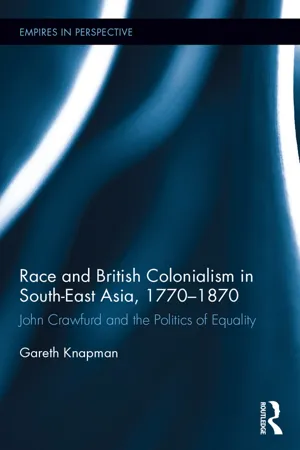
The idea of "race" played an increasing role in nineteenth-century British colonial thought. For most of the nineteenth century, John Crawfurd towered over British colonial policy in South-East Asia, being not only a colonial administrator, journalist and professional lobbyist, but also one of the key racial theorists in the British Empire. He approached colonialism as a radical liberal, proposing universal voting for all races in British colonies and believing all races should have equal legal rights. Yet at the same time, he also believed that races represented distinct species of people, who were unrelated. This book charts the development of Crawfurd's ideas, from the brief but dramatic period of British rule in Java, to his political campaigns against James Brooke and British rule in Borneo. Central to Crawfurd's political battles were the debates he had with his contemporaries, such as Stamford Raffles and William Marsden, over the importance of race and his broader challenge to universal ideas of history, which questioned the racial unity of humanity. The book taps into little explored manuscripts, newspapers and writings to uncover the complexity of a leading nineteenth-century political and racial thinker whose actions and ideas provide a new view of British liberal, colonial and racial thought.
eBook - ePub
Race and British Colonialism in Southeast Asia, 1770-1870
John Crawfurd and the Politics of Equality
- 278 pages
- English
- ePUB (mobile friendly)
- Available on iOS & Android
eBook - ePub
Race and British Colonialism in Southeast Asia, 1770-1870
John Crawfurd and the Politics of Equality
1 The East India Company’s Scottish Critic of Empire in Asia
Perhaps paradoxically, colonial history in the late eighteenth and early nineteenth centuries was highly critical about the practices of European colonial expansion. Much of this criticism was written either by Scottish philosophers and historians observing the European colonial experience from Britain or Scottish orientalists who worked within the British East India Company. These Scottish writers included Adam Smith, William Robertson, Adam Ferguson, Walter Scott and James Mill, to name a few, but also East India Company officials such as Colin Mackenzie, John Malcolm, John Leyden, Mountstuart Elphinstone, Joseph Hume and John Crawfurd as well as many others.1 Yet, despite the centrality of critical philosophers and historians, the criticism of colonial practice also presented a moral contradiction between the control necessary for empire and the ideal of advancing freedom.
Early nineteenth century historians romanticised the barbarian and advocated advancing the cause of freedom in Asia. Theodore Koditschek has recently argued that the romanticism of the barbarian was particularly strong with Scottish orientalists, who compared tribal groups in Asia to freedom-loving Scottish Highlanders, whose freedom was also suppressed by the British Empire.2 For Koditschek, the East India Company officials Elphinstone, Leyden and Malcolm all shared a personal friendship with Walter Scott. Each of these Company writers extended Scott’s romanticised view of Scottish Highlanders to various war-like tribal groups in India, Afghanistan and South-East Asia. In romanticising the warlike groups in Asia, these writers looked on these warlike peoples as analogous to the early stages of human society, in which individual freedom was a guiding principle of social interaction.
As colonial administrators, the historian-administrators of the late eighteenth and early nineteenth centuries also believed that aspects of individual freedom were important for colonial settlements to flourish. Their focus on freedom made their tomes appear highly critical of European colonialism for suppressing freedom in Asia, whilst at the same time, these same writers advocated the continuation of colonial regimes. Their idea of freedom demonstrated a tension within their writings between colonial suppression and individual freedom.
The tension within colonial histories can be viewed as a distinction between individual and collective freedoms, with empire providing individual freedom of property, whilst the promise of collective freedom was held as a distant possibility. For Scottish historians, distinction between individual and collective also corresponded to their personal narratives, where their Scottish nation has been subsumed within the broader British Empire. Such statements of freedom were not legitimisations of colonial rule in Asia, but rather, they were an attempt to connect their colonising actions to broader historical themes as they saw them.
The development of freedom was a fixation of British historiography in the Enlightenment. Historians wrote about the development of freedom and liberty within the historical narrative of the evolution of the British state. Central to this narrative of freedom was the belief that barbarians introduced freedom into decadent societies. The barbarian invaded the decadent and corrupt society of the civilised. Through barbarian invasions and then settlement (on the remnants of the old, decayed civilisation), the barbarian introduced a new government built on tribal freedom, thereby reinvigorating civilisation. The historian-administrators saw colonialism as a new form of barbarian invasion reinvigorating a decadent Asian society.
Crawfurd and the historian-administrators wanted to introduce liberal ideals of free trade, rule of law and private property to South-East Asia. These policy themes interconnected with the preoccupation of Enlightenment historiography to describe the evolution of individual liberty. Therefore, when writing their histories, the historian-administrators focused on the development of freedom in South-East Asia and the role of colonialism—as a new form of barbarian invasion—in achieving this end.
This chapter demonstrates how Crawfurd and the historian-administrators used the barbarian past of Europe to present colonialism as a new form of barbarism which would bring individual liberty to a decadent Asia. Although they acknowledged colonialism was at times immoral and filled with self-serving vice, the historian-administrators maintained that colonialism was also a force for good. Despite the contradiction between their language of freedom and their practice of administration, some of these Scottish colonial critics produced radical ideas of individual freedom through democratisation and developed the first ideas of national independence for colonised peoples.
Freedom and Empire
In 1811, the Governor-General of India, Lord Minto, led a British East India Company expeditionary force from India to conquer the Dutch colony of Java. This expedition was part of the strategic posturing of the Napoleonic wars, which had seen the British take possession of many Dutch colonies.
Minto was a product of the Scottish Enlightenment. As a child, he was tutored by the philosopher-historian David Hume before going on to study law at the University of Edinburgh. Minto’s family were immersed in the East India Company. He was a shareholder and his younger brother had moved up through the ranks of the East India Company. Minto quickly went into parliament and became a member of the Commons select committee on the Bengal judiciary and managed the House of Commons’ impeachment of the Governor-General Warren Hastings in 1788. With his experience in overseeing the Company, Minto was made Governor-General of India in 1806.3
The orders that Minto received from the Court of Directors in London for the invasion of Java stipulated that he was to ‘expel the Dutch Power, to destroy the fortifications, and to distribute the arms and stores among the natives’ and restore power back to the traditional Javanese elites.4
Minto chose to disregard his orders and instead took possession of Java for the East India Company and gave Lieutenant Governor Thomas Stamford Raffles the job of establishing a permanent British authority in the island. Five years later, Charles Assey, Raffles’s secretary in Java, wrote the first history of the occupation and justified Minto’s decision to disregard his orders in the following terms:
It appeared to the enlightened mind of Lord Minto, that the opportunity should not be lost of bestowing on a whole nation [of Java] the freedom which is everywhere the boast of British subjects: perhaps he also contemplated the prospect, thus offered, of establishing a new empire to Great Britain.5
In reasoning why Minto chose to disregard his orders, Assey is actually explaining why Minto did not give the Javanese their independence and instead extended to the Javanese the liberal freedoms of British law. In writing the history of the British occupation of Java, Assey made Minto the agent of the European Enlightenment extending freedom to the people of Java.
In Assey’s narrative, Minto becomes a liberal reformer who was introducing morality into an empire that in the eighteenth century was, at best, amoral. Assey presented the idea that it was commercially beneficial to take possession of Java almost as an afterthought. Implicit in his statement was a belief that the Javanese were better off and should be grateful for Minto for not giving them independence. Herein lies the contradiction and problem that existed throughout British historical writing in Asia in the early nineteenth century: historians wanted to bestow a moral cause to British expansion but, at the same time, these historians were describing the enslavement of Asians under the imperial yoke.
Assey’s account of Minto presents a contradiction in the moral logic of freedom. Assey’s contradiction extends to most early nineteenth century British historical writing on South-East Asia. Many of the historians were equally aware of the contradictions. In 1830, Basil Hall also reflected on Minto’s decision as part of a reflection on the life of Stamford Raffles. Hall concluded that if independence were immediately given, it would cause ‘the most calamitous consequences to all parties concerned’.6 In protecting the ‘parties concerned’, Hall supported individual freedoms guaranteed by law rather than national freedoms. For Basil—and for many others—the contradiction was overcome by the idea that colonial government prepared the natives for independence. Therefore, how to teach individual freedom became a focus of colonial administration.
By the early nineteenth century Britain was a liberal society, with a growing consensus around freedoms encompassing trade, labour, association, the press and some formal equality before the law. These freedoms were not egalitarian rights of freedom to achieve, but they were negative rights of freedom from oppression.7
Individual and national freedom are two related yet different concepts in liberal thought. National freedom is the right for a nation to exist independently from others, and there was broad support for this idea within British liberal thinking in the early nineteenth century. Minto chose to reject this collective national freedom when he disregarded the objective of Javanese self-determination in 1811. The idea of national freedoms for people outside of Europe was a fraught area. As we will see in this chapter, many historian-administrators grappled with this issue. Accepting the right to national independence meant rejecting their own actions as administrators in removing the independence of colonised peoples.
The alternative idea of freedom was individual freedom, that is, the freedom to be protected by law and the freedom from invasive government. The idea of individual freedom did not pose so many contradictions. The British Empire could easily guarantee individual freedoms under the law. Therefore, when faced with the issue of national freedom or individual freedom, the historian-administrators supported extending the British Empire to support individual freedom, with the vague idea of national freedom being delivered at a later date.
In favouring individual rights over collective rights, the historian-administrators were disregarding South-East Asian collective rights in favour of their own system and culture of individual rights. When talking about freedom, the historian-administrators assumed the universality of their British system of rights. In his study of liberalism and empire, Uday Singh Mehta concluded that the contradiction between liberal rhetoric and colonial reality occurred because of the British universalist ideas of history.8 He argued that the British liberal tradition made claims about rights and responsibilities as bein...
Table of contents
- Cover
- Title
- Copyright
- Contents
- List of Figures
- Preface
- Introduction
- 1 The East India Company’s Scottish Critic of Empire in Asia
- 2 Land, History and the Source of Civilisation
- 3 Searching for the Aboriginal Pre-History of the Savage
- 4 Race and the Natural History of the Savage
- 5 Singapore and Competing Visions of Colonialism
- 6 Protecting and Civilising Savages in Sarawak
- 7 Resisting Colonialism in Sarawak
- 8 Civilisation, the Savage and Equality
- Conclusion
- Appendix: Identifying John Crawfurd’s Writings in The Examiner
- Bibliography
- Index
Trusted by 375,005 students
Access to over 1.5 million titles for a fair monthly price.
Study more efficiently using our study tools.
Frequently asked questions
Yes, you can cancel anytime from the Subscription tab in your account settings on the Perlego website. Your subscription will stay active until the end of your current billing period. Learn how to cancel your subscription
No, books cannot be downloaded as external files, such as PDFs, for use outside of Perlego. However, you can download books within the Perlego app for offline reading on mobile or tablet. Learn how to download books offline
Perlego offers two plans: Essential and Complete
- Essential is ideal for learners and professionals who enjoy exploring a wide range of subjects. Access the Essential Library with 800,000+ trusted titles and best-sellers across business, personal growth, and the humanities. Includes unlimited reading time and Standard Read Aloud voice.
- Complete: Perfect for advanced learners and researchers needing full, unrestricted access. Unlock 1.5M+ books across hundreds of subjects, including academic and specialized titles. The Complete Plan also includes advanced features like Premium Read Aloud and Research Assistant.
We are an online textbook subscription service, where you can get access to an entire online library for less than the price of a single book per month. With over 1.5 million books across 990+ topics, we’ve got you covered! Learn about our mission
Look out for the read-aloud symbol on your next book to see if you can listen to it. The read-aloud tool reads text aloud for you, highlighting the text as it is being read. You can pause it, speed it up and slow it down. Learn more about Read Aloud
Yes! You can use the Perlego app on both iOS and Android devices to read anytime, anywhere — even offline. Perfect for commutes or when you’re on the go.
Please note we cannot support devices running on iOS 13 and Android 7 or earlier. Learn more about using the app
Please note we cannot support devices running on iOS 13 and Android 7 or earlier. Learn more about using the app
Yes, you can access Race and British Colonialism in Southeast Asia, 1770-1870 by Gareth Knapman in PDF and/or ePUB format, as well as other popular books in History & 19th Century History. We have over 1.5 million books available in our catalogue for you to explore.