- 572 pages
- English
- ePUB (mobile friendly)
- Available on iOS & Android
eBook - ePub
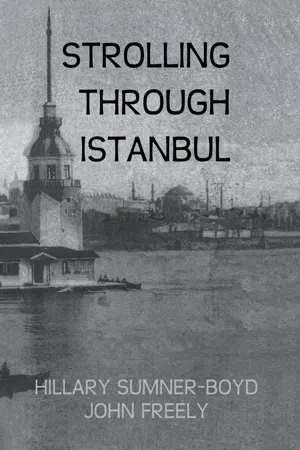
Strolling Through Istanbul
About this book
First published in 2005. Long acknowledged to be the 'best travel guide to Istanbul' (Times of London) this classic of travel literature is now available in a larger format in hardback binding. The work is both a useful and informative guide to the city with major useful monuments described in detail in terms of the history and architecture. Although the main emphasis of the book is on the Byzantine and Ottoman Antiquities, the city is not treated as a museum in the context of a living city. Itineraries are arranged so that each one takes the visitor to a different part of Istanbul.
Information
1
The View from the Bridge
A poet writing fourteen centuries ago described this city as being surrounded by a garland of waters. Much has changed since then, but modern Istanbul still owes much of its spirit and beauty to the waters which bound and divide it. There is perhaps nowhere else in town where one can appreciate this more than from the Galata Bridge, where all tours of the city should begin. There are other places in Istanbul with more panoramic views, but none where one can better sense the intimacy which this city has with the sea, nor better understand how its maritime situation has influenced its character and its history. So the visitor is advised to stroll to the Galata Bridge for his first view of the city. But you should do your sight-seeing there as do the Stamboullus, seated at a teahouse or cafe on the lower level of the Bridge, enjoying your keyif over a cup of tea or a glass of raki, looking out along the Golden Horn to where it meets the Bosphorus and the Sea of Marmara.
Istanbul is the only city in the world which stands upon two continents. The main part of the city, which is located at the southeastern tip of Europe, is separated from its suburbs in Asia by the incomparable Bosphorus. The Golden Horn then divides the European city into two parts, the old imperial town of Stamboul on the right bank and the port quarter of Galata on the left, with the more modern residential districts on the hills above Galata and along the European shore of the lower Bosphorus. Stamboul itself forms a more or less triangular promontory bounded on the north by the Golden Horn and on the south by the Sea of Marmara, the ancient Propontus. At Saray Point, the apex of this promontory, the Bosphorus and the Golden Horn flow together into the Marmara, forming a site of great beauty. So it must have appeared to Jason and the Argonauts when they sailed across the Propontus three thousand years ago in search of the Golden Fleece, and so it still appears today to the tourist approaching the city on a modern oceanliner.
According to tradition, the original settlement from which the city grew was established on the acropolis above Saray Point in the seventh century B.C., although there are evidences that the site was inhabited much earlier than that. The legendary founder of the town of Byzantium was Byzas the Megarian, who established a colony on the acropolis in the year 667 B.C. We are told that Byzas had consulted the Delphic oracle, who advised him to settle "opposite the land of the blind." The oracle was referring to the residents of Chalcedon, a Greek colony which had been established some years before across the strait. The implication is that the Chalcedonians must have been blind not to have appreciated the much greater advantages of the site chosen by Byzas. Situated at the mouth of the Bosphorus, it was in a position to control all shipping from the Black Sea, the ancient Pontus, through to the Propontus and the Aegean, while its position on the boundary of Europe and Asia eventually attracted to it the great land routes of both continents. Moreover, surrounded as it is on three sides by water, its short landward exposure defended by strong walls, it could be made impregnable to attack. As the French writer Gyllius concluded four centuries ago: "It seems to me that while other cities may be mortal, this one will remain as long as there are men on earth."
From the very beginning of its history Byzantium was an important center for trade and commerce, and was noted for its wine and fisheries. Not all of the wine was exported, apparently, for in antiquity the citizens of Byzantium had the reputation of being confirmed tipplers. Menander, in his comedy. The Flule Girl, tells us that Byzantium makes all of her merchants sots. Says one of the Byzantine characters in his play: "I booze it all the night, and upon my waking after my dose I feel that 1 have no less than three heads upon my shoulders." The character of a city is formed quite early in its career.
During its first millennium Byzantium had much the same history as the other Greek cities in and on the edge of Asia Minor. The city was taken by Darius in the year 512 B.C., and remained under Persian control until 479 B.C., when it was recaptured by the Spartan general Pausanias. Byzantium later became part of the Athenian Empire; although it revolted in 440 and again in 41 I it was reconquered on each occasion by the Athenians, the last time by Alcibiades. After the defeat of Athens in 403 Byzantium was captured by Lysander and was still under a Spartan governor when Xenophon's Ten Thousand arrived shortly afterwards. Xenophon and his men were so inhospitably treated that in retaliation they occupied the town, leaving only after they exacted a large bribe from its citizens. During the first half of the fourth century B.C. Byzantium was held in enforced alliance with Athens, but in the year 356 B.C. the city rebelled and won its independence. Despite this the Athenians, through the urgings of Demosthenes, sent aid to Byzantium when it was besieged by Philip of Macedon in 340 B.C. A contemporary Athenian writer informs us that the Byzantine commanders were forced to build taverns within the very defense walls in order to keep their tipsy soldiers at their posts. But the Byzantines fought well, for they successfully held off the Macedonians in a memorable siege.
Despite their spirited fight against King Philip, the Byzantines had enough good sense not to resist his son, Alexander the Great. Scon after Alexander's victory at the battle of the Granicus in 334 B.C. Byzantium capitulated and opened its gates to the Macedonians. Later, after Alexander's death in 323 B.C., Byzantium was involved in the events following on the collapse and dismemberment of his empire and the subsequent eastward expansion of Rome. In the year 179 B.C. the city was captured by the combined forces of Rhodes, Pergamum and Bithynia. A century later Byzantium was a pawn in the struggle between Rome and Mithridates, King of Pontus. After the final victory of Rome Byzantium became its client state, and thereafter enjoyed nearly three centuries of quiet prosperity under the mantle of the Pax Romana. But eventually, in the closing years of the second century. A.D., Byzantium was swept up once again in the tides of history. At that time Byzantium found itself on the losing side in a civil war and was besieged by the Emperor Septimius Severus. After finally taking Byzantium in the year 196 A.D., the Emperor tore down the city wails, massacred the soldiers and officials who had opposed him, and left the town a smouldering ruin. A few years afterwards, however, Septimius realized the imprudence of leaving so strategic a site undefended and then rebuilt the city and its walls. The walls of Septimius Severus are thought to have begun at the Golden Horn a short distance downstream from the present site of the Galata Bridge, and to have ended at the Marmara somewhere near where the lighthouse now stands. The area thus enclosed was more than double that of the ancient town of Byzantium, which had comprised little more than the acropolis itself.
At the beginning of the fourth century A.D. Byzantium was profoundly affected by the climactic events then taking place in the Roman Empire. After the retirement of the Emperor Diocletian in the year 305, his successors in the Tetrarchy, the two co-emperors and their caesars, fought bitterly with one another for the control of the Empire. This struggle was eventually won by Constantine, Emperor of the West, who in the year 324 finally defeated Licinius, Emperor of the East. The last battle took place in the hills above Chrysopolis, just across the Bosphorus from Byzantium. On the following day, 18 September in the year A.D. 324, Byzantium surrendered and opened its gates to Constantine, now sole ruler of the Roman Empire.
During the first two years after his victory Constantine conceived the grand scheme which would affect world history for the next millennium — the re-establishment of the Roman Empire with Byzantium as its capital. After he made his decision Constantine set out to rebuild and enlarge and adorn the old town to suit its imperial role. Work began on 4 November in the year 326, when the Emperor personally traced out the limits of the new city. The defense walls with which Constantine enclosed the city on the landward side began at a point on the Golden Horn somewhat upstream from the present AtatLirk Bridge, and extended to the Sea of Marmara in a great circular arc, ending in the bay of Samatya. Constantine's city was thus more than five times as large as the town of Septimius Severus, and it was to be infinitely more grand.
The imperial building program proceeded rapidly, and in less than four years the new capital was completed. On 11 May in the year A.D. 330, in a ceremony in the Hippodrome, Constantine dedicated the city of New Rome, soon after to be called Constantinople. Three years thence the old town of Byzantium would have been a thousand years old.
During the century following the reign of Constantine the city grew rapidly and soon expanded beyond the limits set by its founder. In the first half of the fifth century, during the reign of Theodosius 11, a new and much stronger line of defense-walls was built nearly a mile farther out into Thrace, replacing the older walls of Constantine. These walls have delimited the size of the old city up to the present day, so that subsequent expansion was restricted to the suburban districts along the Marmara, the Golden Horn and the Bosphorus. The area thus enclosed included seven hills, the same number as in Old Rome, a matter of some mystical significance in Byzantium. Although the contours of these hills have been obscured by modern roads and buildings, they can still be discerned and form convenient reference-points for studying the old city. Six of the seven hills can be seen from the Galata Bridge, marching in stately line down the Golden Horn, each of them crowned with a Byzantine church or an Ottoman mosque, giving an imperial quality to the skyline of Stamboul.
Great changes took place in the Roman Empire in the two centuries following the reign of Constantine the Great. After the death of Theodosius 1 in 395, the Empire was divided between his two sons, with Honorius ruling the West from Rome, and Arcadius the East, with his capital at Constantinople. The western part of the Empire was overrun by barbarians during the following century, and in the year 476 the last Emperor of the West was deposed, leaving the Emperor in Constantinople sole ruler of what was left of the Empire. This soon brought about a profound change in the character of the Empire, for it was now centered in lands populated largely by Greek-speaking Christians. And so, although Latin remained the official language of the court up until the beginning of the sixth century, the Empire was becoming more and more Greek and Christian in character, and began to sever its connections with the classical traditions of Athens and Rome. As the great churchman Gennadius was to write in later times: "Though I am a Hellene by speech yet I would never say that I was a Hellene, for I do not believe as Hellenes believed. I should like to take my name from my faith, and if anyone asks me what I am, I answer, 'A Christian'. Though my father dwelt in Thessaly I do not call myself a Thessalian, but a Byzantine, for I am of Byzantium."
A new epoch in the city's history began during the reign of Justinian the Great, who succeeded to the throne in the year 527. Five years after his accession Justinian was very nearly overthrown by an insurrection of the factions in the Hippodrome, the famous Nika Revolt, which was finally crushed only after widespread destruction and terrible loss of life. Immediately after the suppression of the revolt Justinian set out to rebuild the city on an even grander scale than before. When he had finished his reconstruction, only a scant few years later, the city of Constantinople was the greatest and most magnificent metropolis on earth, an imperial capital beginning the first of its golden ages. The crowning glory of Justinian's new city was the resurrected church of Haghia Sophia, whose venerable form can still be seen on the acropolis, a symbol of the ancient city of which it was so long the heart.
During the course of Justinian's reign his generals succeeded in reconquering many of the lost dominions of the Roman Empire, and by the time he died in 565 the borders of Byzantium stretched from the Euphrates to the Pillars of Hercules. But the golden age did not last long, for within a half-century after the death of Justinian his empire had fallen apart, assaulted from without by the Lombards, Slavs, Avars and Persians, ravaged from within by anarchy, plague and social unrest. The Empire was saved from total destruction by the Emperor Heraclius, who ruled from 610 till 641. In a series of brilliant campaigns, Heraclius defeated the Persians, the Avars and the Slavs, and succeeded in regaining much of the territory which had been lost in the previous half-century. Shortly after the death of Heraclius, however, much of the eastern part of the Byzantine Empire was overrun by the Arabs, who on several occasions in the seventh and eighth centuries besieged Constantinople itself. But Byzantium held off the Arab advance and prevented them from gaining a foothold in eastern Europe, just as they were finally stopped at about the same time in the West by Charles Martel. In the ninth and tenth centuries the Byzantine Empire was invaded by the Bulgars, who gained control of large areas of the Balkans and twice laid siege to Constantinople. But on both occasions they were defeated by the great Theodosian land-walls, which continued to shelter Byzantium from its enemies across the centuries.
Despite these numerous wars Byzantium was still strong and basically sound as late as the middle of the eleventh century, controlling an empire which stretched from western Persia through Asia Minor and the Balkans to southern Italy. But then in the year 1071 the Byzantine army, led by Romanus IV, suffered a catastrophic defeat by the Selcuk Turks at the battle of Manzikert and much of eastern Asia Minor was permanently lost to the Empire. In the same year the Normans captured Bari, thus bringing to an end Byzantine rule in Italy. The forces were now gathering which would eventually destroy the Empire.
A decade after these defeats Alexius Comnenus ascended the throne of Byzantium. For the next century he and his successors, the illustrious dynasty of the Comneni, successfully defended the Empire against the attacks of its numerous enemies. During that period the Empire was being subjected to increasing pressure by the Latins of western Europe, whose armies first passed through Asia Minor in the year 1097 during the First Crusade. As time went on it became increasingly apparent that the Latins were less interested in freeing the Holy Land from the Saracens than they were in seizing land and wealth for themselves. And the prize which attracted them most was the rich and magnificent city of Constantinople. By the time the Comneni dynasty came to an end in the year 1185, the Normans had already captured Thessalonica and were advancing towards the capital. Two decades later, in the year 1203, the Latin armies of the Fourth Crusade made their first assault upon Constantinople. Although they were not able to take the city at that time they did so in a second attack the following year. On 13 April 1204 the Crusaders breached the sea-walls along the Golden Horn and took the city by storm. They then proceeded to ruin and sack Constantinople, stripping it of its wealth, its art treasures and its sacred relics, most of which were shipped off to western Europe. As wrote the French knight Villehardouin, describing the sack of Constantinople by the Crusaders: "Of holy relics I need only say that it contained more than all Christendom combined; there is no estimating the quantity of gold, silver, rich stuffs and other valuable things — the production of all the climates of the world. It is the belief of me, Geoffrey de Villehardouin, marechal of Champagne, that the plunder of this city exceeded all that had been witnessed since the creation of the world." And as the Byzantine historian Nicetas Choniates wrote in his lament: "Oh city, city, eye of all cities, subject of narratives all over the world, supporter of churches, leader of faith and guider of orthodoxy, protector of education, abode of all good. Thou hast drunk to the dregs the cup of the anger of the Lord, and hast been visited with fire fiercer than that which in days of yore descended upon the Pentapolis."
The Latin Kings ruled in Constantinople from 1204 till 1261, at which time Michael Palaeologus succeeded in recapturing the city and restoring the Byzantine Empire. But the Empire was now only a fragment of what it had been in former days, comprising parts of Thrace, Macedonia and the Peloponnesus, with most of its former possessions in Asia Minor occupied by the Ottoman Turks, and much of its land in Europe lost to the rapacious Latins. Within the next century even these dominions were lost, as the Turks crossed over into Europe and advanced far into the Balkans. By the beginning of the fifteenth century the Byzantine Empire consisted of little more than Constantinople and its immediate suburbs, with the old city decaying within the great walls which had protected it for so long. Nevertheless, the indomitable Byzantines hung on for another half-century, fighting off several attempts by the Turks to take the capital. But by the middle of the fifteenth century it became increasingly obvious that the city could not hold out much longer, for it was by then completely surrounded by the Ottoman Empire.
On 13 February 1451 the young Sultan Mehmet II ascended to the Ottoman throne and almost immediately began preparations for what would be the final siege of the city. During the summer of the following year, 1452, he constructed the fortress of Rumeli Hisari on the Bosphorus, just across the narrow straits from the Turkish fortress of Anadolu Hisari, which had been built in the previous century by Sultan Beyazit I. The two fortresses thus completely cut off Constantinople from the Black Sea, the first step in the blockade of the capital. In March of 1453 the Ottoman navy sailed into the Sea of Marmara, cutting off Byzantium from the West and completing the blockade. Then, in the first week of April in that year, Sultan Mehmet massed his armies in Thrace and marched them into position before the land walls of the city, thus beginning a siege which was to last for seven weeks. The Byzantines and their Italian allies, who were outnumbered more than ten to one, defended the city valiantly, until their strength and resources were nearly gone. Finally, on 29 May 1453, the Turks forced their way through a breach in the shattered land walls and poured into the city. Constantine XI Dragases, the last Byzantine Emperor, fought on bravely with his men until he was killed on the walls of his fallen city, thus bringing to an heroic end the long and illustrious history of Byzantium.
According to the custom of the age, Sultan Mehmet, now called Fatih, or the Conqueror, gave over the city to his soldiers to pillage for three days after it was captured. Immediately afterwards the Sultan began to restore the city, repairing the damage it had sustained during the siege and in the decades of decay before the Conquest. A year or so later Sultan Mehmet constructed a palace on the Third Hill, on the site of which the Beyazit Fire Tower now stands. Some years afterwards he built a second and more extensive palace, Topkapi Sarayi, whose domes and spires still adorn the First Hill, the ancient acropolis of the city. By 1470 he had completed the great mosque which bears his name; Fatih Camii, the Mosque of the Conqueror. This mosque, which was comparable in size to Haghia Sophia, was the center of a whole complex of pious foundations, religious and philanthropic institutions of one sort or another. Many of Fatih's vezirs followed his example, building mosques and pious foundations of their own, each of which soon became the center of its local neighborhood, together developing into the new Moslem town of Istanbul. Fatih also repeopled the city, which had lost much of its population in the decades preceding the Conquest, bringing in Turks, Greeks and Armenians from Asia Minor and Thrace and settling them in Stamboul and Galata. Later in that century large numbers of Jewish refugees from Spain were welcomed to the Empire by Fatih's son and successor, Beyazit 11, and many of them settled in Istanbul. By the beginning of the sixteenth century, then, Istanbul was a thriving and populous city, once again the capital of a vast empire.
During the century after the Conquest the Turkish armies swept victorously through the Balkans and the Near East and its buccaneering navies dominated the Mediterranean. By the middle of the sixteenth century the Ottoman Empire stretched from Baghdad in the east to Algiers in the west, and from lower Egypt to the southern borders of Russia, rivaling in extent the Byzantine Empire in the days of Justinian. The Empire reached the peak of its power during the reign of SLileyman the Magnificent, who ruled from 1520 till 1566. Süleyman personally led his armies in a dozen victorious campaigns, failing only in his attempts to take Vienna and Corfu, which thereafter set the limit to Turkish expansion to the north and west in Europe. The loot from these campaigns and the tribute and taxes from the conquered territories enormously enriched the Empire, and much of this wealth was used by SLileyman and his vezirs to adorn Istanbul with mosques, palaces and pious foundations. The grandest and most beautiful of these structures was the Süleymaniye, the mosque which was completed for Süleyman in the year 1557 by his Chief Architect, the great Sinan. This magnificent edifice stands on the crest of the ridge above the Golden Horn to the west of the Stamboul end of the Galata Bridge, dominating the whole skyline of the city. The Süleymaniye is the symbol of the golden age of the Ottoman Empire, just as H...
Table of contents
- Cover
- Title
- Copyright
- Contents
- Preface
- 1 The View from the Bridge
- 2 From the Galata Bridge to Haghia Sophia
- 3 Haghia Sophia (Aya Sofya)
- 4 Topkapi Sarayi
- 5 The Outer Gardens of the Saray
- 6 Around the Blue Mosque
- 7 From Haghia Sophia to Beyazit Square
- 8 Through the Markets and Bazaars
- 9 Around Beyazit and Şehzade Başi
- 10 The Süleymaniye
- 11 From the Galata Bridge to Şehzade Başi
- 12 Around the Mosque of the Conqueror
- 13 The Fifth and Sixth Hills
- 14 Kariye Camii
- 15 Along the Golden Horn
- 16 The Seventh Hill
- 17 Along the Land Walls
- 18 Up the Golden Horn to Eyüp
- 19 Üsküdar and the Princes' Isles
- 20 Pera and Galata
- 21 The Lower Bosphorus' European Shore
- 22 The Bosphorus
- 23 A Last Stroll
- Appendices
- Index
Trusted by 375,005 students
Access to over 1.5 million titles for a fair monthly price.
Study more efficiently using our study tools.
Frequently asked questions
Yes, you can cancel anytime from the Subscription tab in your account settings on the Perlego website. Your subscription will stay active until the end of your current billing period. Learn how to cancel your subscription
No, books cannot be downloaded as external files, such as PDFs, for use outside of Perlego. However, you can download books within the Perlego app for offline reading on mobile or tablet. Learn how to download books offline
Perlego offers two plans: Essential and Complete
- Essential is ideal for learners and professionals who enjoy exploring a wide range of subjects. Access the Essential Library with 800,000+ trusted titles and best-sellers across business, personal growth, and the humanities. Includes unlimited reading time and Standard Read Aloud voice.
- Complete: Perfect for advanced learners and researchers needing full, unrestricted access. Unlock 1.5M+ books across hundreds of subjects, including academic and specialized titles. The Complete Plan also includes advanced features like Premium Read Aloud and Research Assistant.
We are an online textbook subscription service, where you can get access to an entire online library for less than the price of a single book per month. With over 1.5 million books across 990+ topics, we’ve got you covered! Learn about our mission
Look out for the read-aloud symbol on your next book to see if you can listen to it. The read-aloud tool reads text aloud for you, highlighting the text as it is being read. You can pause it, speed it up and slow it down. Learn more about Read Aloud
Yes! You can use the Perlego app on both iOS and Android devices to read anytime, anywhere — even offline. Perfect for commutes or when you’re on the go.
Please note we cannot support devices running on iOS 13 and Android 7 or earlier. Learn more about using the app
Please note we cannot support devices running on iOS 13 and Android 7 or earlier. Learn more about using the app
Yes, you can access Strolling Through Istanbul by Hillary Sumner-Boyd,John Freely,Sumner-Boyd in PDF and/or ePUB format, as well as other popular books in Social Sciences & Anthropology. We have over 1.5 million books available in our catalogue for you to explore.